First played on January 1, 1935, the Orange Bowl is tied with the Sugar Bowl and Sun Bowl as the second-oldest bowl games in the country. The game has been held at Hard Rock Stadium in Miami Gardens, Florida, since 1996, with a one-game return to its former namesake stadium in 1999. Historically tied to the Big Eight and later the ACC, the Orange Bowl has been a part of the Bowl Coalition, Bowl Alliance, Bowl Championship Series, and now the College Football Playoff. The game has been sponsored by Capital One since December 2014 and is officially known as the Capital One Orange Bowl.
Founding and Early History
The Orange Bowl originated from Miami's economic need to attract tourists during the Great Depression. In 1932, city greeter George E. Hussey organized the Festival of Palms Bowl, a predecessor event where the University of Miami played invited opponents. These 1933 and 1934 games are not recognized as official bowl games by the NCAA because Miami was guaranteed a berth regardless of record. The first officially recognized Orange Bowl was played on New Year's Day 1935, featuring Bucknell and Miami. Bucknell won that inaugural game 26-0 before a crowd of 5,134 at Miami Field. The game was conceived as "Football in the Tropics," borrowing the concept of a New Year's football festival from Pasadena's Rose Bowl to promote South Florida . Civic leaders formed the Greater Miami Athletic Association and drew on New Deal funds to rebuild the event under a new name for New Year's Day 1935.
Venue History and Moves
The Orange Bowl has been played at three primary venues throughout its history. The first three games from 1935 to 1937 were held at Miami Field. In 1938, the game moved to the newly constructed Miami Orange Bowl stadium , where it would become a New Year's Day fixture for nearly six decades. The Orange Bowl was played at the Miami Orange Bowl from 1938 through the January 1996 game. In December 1996, the game moved to its current home, Hard Rock Stadium in Miami Gardens, Florida. A scheduling conflict in 1999, when the NFL's Miami Dolphins hosted a playoff game at Hard Rock Stadium on the same day, forced the Orange Bowl to return to the Miami Orange Bowl for a final time. That 1999 game was the last bowl game ever played in the Miami Orange Bowl stadium before its demolition in 2008.
Conference Tie-ins and Playoff Evolution
The Orange Bowl's conference affiliations have evolved significantly over its history. From 1954 through the 1996 season, the game maintained a strong relationship with the Big Eight Conference, typically inviting its champion. Following the formation of the Bowl Coalition in 1992, the Orange Bowl became part of a system designed to crown a national champion. It served as the national championship game for the Bowl Coalition in 1994 and 1995, for the Bowl Alliance in 1998, and for the Bowl Championship Series in 2001 and 2005. From 1999 through the 2026 edition, the game had a tie-in with the Atlantic Coast Conference, and starting with the 2006 season it was tied exclusively to the ACC under the brand Home of the ACC Champion. With the creation of the College Football Playoff in 2014, the Orange Bowl became one of the "New Year's Six" bowls. It served as a CFP semifinal in 2015, 2018, and 2021 during the four-team playoff era. Following the playoff's expansion to 12 teams, the Orange Bowl serves as a quarterfinal or semifinal each year, with its official ACC tie-in ending after the 2026 game.
During the four-team CFP era when not a semifinal, the Orange Bowl paired the best available ACC team with the second best team from the Big Ten, SEC, or Notre Dame . The selection was governed by specific rules to avoid rematches and respect other bowl contracts. From 2014 to 2023, the SEC made five appearances in these non-semifinal Orange Bowls, the Big Ten made two, and Notre Dame made zero. The ACC champion appeared in the non-semifinal Orange Bowl in 2022 and 2023, while other high-ranked ACC teams filled the spot in other years.
Sponsors and Game Names
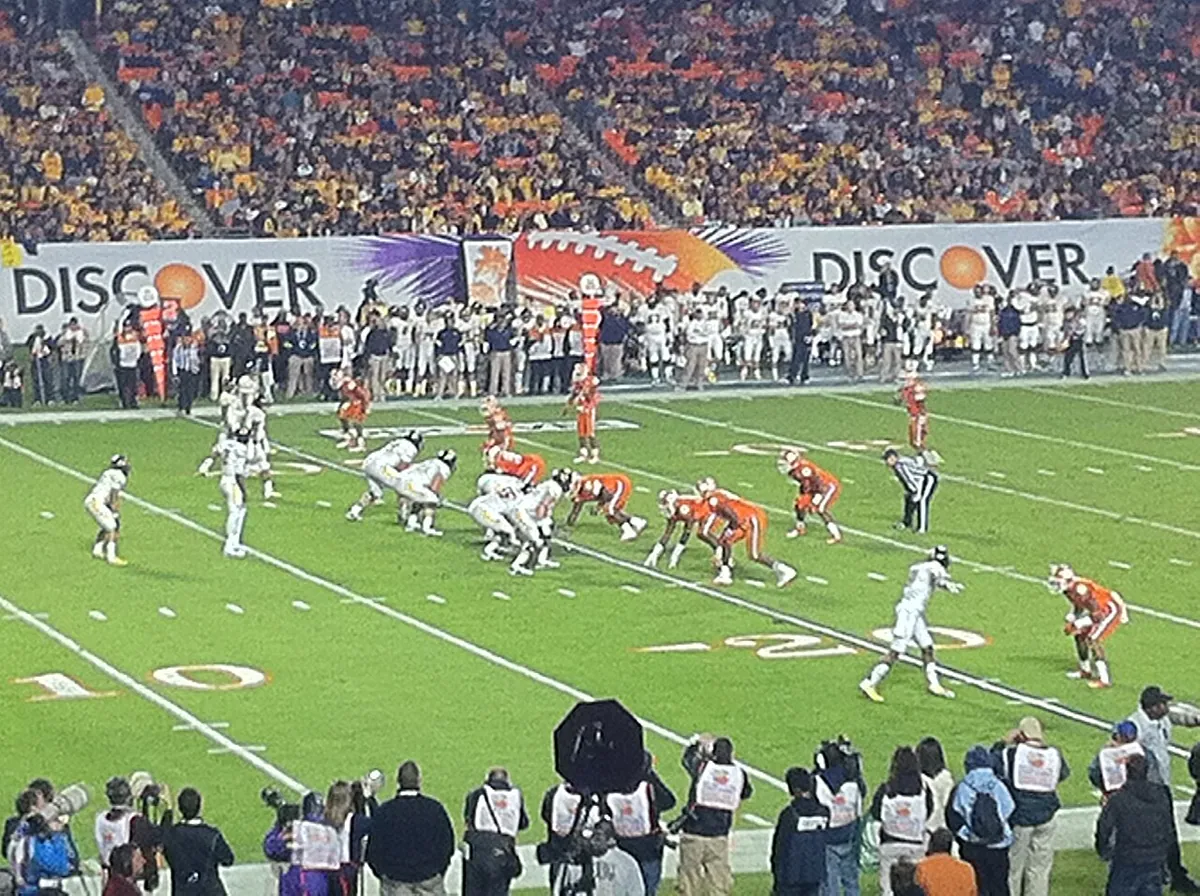
The Orange Bowl has had several corporate sponsors whose names have been incorporated into the game's official title. Federal Express, later FedEx, sponsored the game from 1989 through the 2010 edition. Discover Financial Services took over as title sponsor from 2011 through January 2014. The game's payout was reported as $35 million per conference as of 2009. Capital One became the title sponsor in December 2014, and the game is officially called the Capital One Orange Bowl.
Team Appearances and Records
Through the January 2026 edition, 92 Orange Bowl games have been played, resulting in 184 total team appearances. As a Big Eight member, Oklahoma made 16 Orange Bowl appearances with a record of 11 wins and 5 losses. Oklahoma also beat Florida State 13-2 in the 2001 Orange Bowl, after the Big Eight had merged into the Big 12. Among conferences, the former Big Eight Conference leads in total appearances with 42, though it holds a losing record of 20 wins and 22 losses. The Southeastern Conference ranks second with 40 appearances and holds a record of 23 wins and 17 losses. From the 1998 to 2023 seasons, the Orange Bowl hosted the ACC champion 11 times when it was not serving as the BCS National Championship Game.
| Conference | Appearances | Record (W-L) |
|---|---|---|
| Big Eight | 42 | 20-22 |
| SEC | 40 | 23-17 |
Notable Games in History
On January 1, 1965, the Texas vs. Alabama Orange Bowl became the first college bowl game televised live in prime time. In the 1984 Orange Bowl, the Miami Hurricanes won their first national title by defeating the Nebraska Cornhuskers 31-30 after a deflected pass stopped a Nebraska two-point conversion attempt. The 1991 Orange Bowl saw a controversial finish where Notre Dame's Raghib Ismail had a 92-yard punt return touchdown called back due to a clipping penalty, preserving Colorado's 10-9 victory and a share of the national championship. The 1994 Orange Bowl served as the Bowl Coalition national championship game, where Florida State held off Nebraska 18-16 after Cornhusker kicker Byron Bennett missed a 45-yard field goal as time expired.
The 2006 Orange Bowl was a triple-overtime classic between Penn State and Florida State, notable as the final coaching matchup between Joe Paterno and Bobby Bowden. Penn State won 26-23. The 2012 Orange Bowl set numerous offensive records as West Virginia defeated Clemson 70-33. In the College Football Playoff era, the Orange Bowl served as a semifinal in the 2015 season, the 2018 season, and the 2021 season. The Orange Bowl Committee also staged the BCS National Championship Game in Miami Gardens in 2009 and 2013.
- 1984: Miami 31, Nebraska 30 - Miami's first national title.
- 1991: Colorado 10, Notre Dame 9 - Controversial punt return penalty.
- 1994: Florida State 18, Nebraska 16 - National championship decided by missed field goal.
- 2000: Michigan 35, Alabama 34 (OT) - First BCS overtime game.
- 2006: Penn State 26, Florida State 23 (3OT) - Final Paterno vs. Bowden matchup.
- 2012: West Virginia 70, Clemson 33 - Record-setting offensive performance.
Recent Results and Playoff Role
When serving as a semifinal, the winners advanced to the CFP National Championship Game. In seasons where the Orange Bowl was not a semifinal, it featured high-profile matchups between the ACC and other power conferences as part of the New Year's Six. With the expansion to a 12-team playoff starting in the 2024 season, the Orange Bowl's function has become more regularized as a playoff round. It served as a College Football Playoff semifinal in January 2025, when Notre Dame faced Penn State. It served as a quarterfinal on January 1, 2026, when Oregon defeated Texas Tech 23-0 at Hard Rock Stadium. Through the 2026 game, the Orange Bowl hosted the ACC champion as a quarterfinal if that team was seeded in the top four, and a semifinal edition is played one week after New Year's Day. The game's historic parade, the King Orange Jamboree, was a New Year's Eve tradition from 1936 to 2001 but was discontinued due to declining attendance and loss of television coverage.
Video
FAQ
What is the Orange Bowl?
The Orange Bowl is an annual college football bowl game first played on January 1, 1935. It is the second-oldest bowl game in the country, tied with the Sugar Bowl and Sun Bowl. The game is currently played at Hard Rock Stadium in Miami Gardens, Florida, and is part of the College Football Playoff system. It has historically been associated with the Big Eight and ACC conferences and has served as a national championship game multiple times under different postseason systems.
When is the Orange Bowl game played?
The Orange Bowl is traditionally played on or around New Year's Day. Since becoming part of the College Football Playoff, its exact date can vary. When it serves as a playoff semifinal or quarterfinal, the game may be scheduled in late December or early January. For example, as a semifinal in the expanded playoff, it is played one week after New Year's Day.
What is the history of the Orange Bowl?
The Orange Bowl was founded in 1935 to boost tourism in Miami during the Great Depression. It evolved from earlier Palm Festival games played in 1933 and 1934. The game was played at Miami Field until 1937, then moved to the Miami Orange Bowl stadium from 1938 to 1996. It moved to its current venue, Hard Rock Stadium, in 1996. The bowl has been part of every major postseason system, including the Bowl Coalition, Bowl Alliance, Bowl Championship Series, and now the College Football Playoff. It has hosted national championship games in 1994, 1995, 1998, 2001, and 2005, plus the BCS National Championship Game in 2009 and 2013.
Who has won the most Orange Bowls?
The Oklahoma Sooners have won the most Orange Bowls, with 11 victories as a Big Eight member and another in the 2001 game against Florida State. Oklahoma's wins came largely during the era when the game had a strong tie-in with the Big Eight Conference. Other schools with multiple Orange Bowl victories include Nebraska, which won 6 as a Big Eight member, and Alabama with 5 wins. The Southeastern Conference has a record of 23 wins and 17 losses in 40 Orange Bowl appearances, more wins than the 20 recorded by the Big Eight.
Where was the Orange Bowl played before Hard Rock Stadium?
Before Hard Rock Stadium, the Orange Bowl was primarily played at the Miami Orange Bowl stadium from 1938 through January 1996. The first three games (1935 to 1937) were played at Miami Field, which was located on the site where the Miami Orange Bowl was later built. The game returned to the Miami Orange Bowl for a final time in 1999 due to an NFL scheduling conflict at Hard Rock Stadium. The Miami Orange Bowl was demolished in 2008.
What is the Orange Bowl's role in the College Football Playoff?
The Orange Bowl is one of the six major bowls in the College Football Playoff system. During the four-team playoff era (2014 to 2023), it served as a semifinal game every three years (2015, 2018, 2021). When not a semifinal, it hosted the best available ACC team against the second best team from the Big Ten, SEC, or Notre Dame. With the playoff's expansion to 12 teams in 2024, the Orange Bowl serves as either a quarterfinal or semifinal each year. Its official conference tie-in with the ACC ended after the 2026 game as all New Year's Six bowls became permanent playoff fixtures.
Sources
- Orange Bowl (Wikipedia) Wikipedia
- Orange Bowl abc7.com
- Winners of the Orange Bowl onthisday.com
- History: Orange Bowl NCAA
- Orange Bowl History orangebowl.org
- Orange Bowl History: From the Palm Festival to the CFP, Bowl Game Central bowlgamecentral.com