The Canadian Football League (CFL) is the premier professional Canadian football league in Canada. Founded in its modern form on January 19, 1958, the league consists of nine teams divided into East and West Divisions. The CFL season features an 18-game regular schedule from June to November, culminating in the Grey Cup championship, a trophy first awarded in 1909. The league plays a distinct version of gridiron football characterized by three downs, 12 players per side, and a larger field.
Origins and Early History
Canadian football evolved from rugby in the 1860s, with the first documented game played at the University of Toronto in 1861. The sport diverged from its rugby origins with the introduction of the Burnside rules. The Canadian Rugby Union (CRU) was formed in 1891 as an umbrella organization for amateur play. The Grey Cup was donated by Governor General Earl Grey in 1909 for the Senior Amateur Football Championship of Canada. The professional foundations of the modern CFL began with the formation of the Interprovincial Rugby Football Union, known as the Big Four, in 1907 by clubs in Ontario and Quebec. A western counterpart, the Western Interprovincial Football Union (WIFU), was formed in 1936 by clubs in Manitoba, Alberta, and Saskatchewan. Throughout the 1930s to 1950s, these unions gradually transitioned from amateur to fully professional competitions. The 1954 season marked the start of the modern era, as amateur teams were excluded from Grey Cup contention, making the championship a contest between the Big Four and WIFU champions.
League Formation and Merger
In 1956, the threat of the Montreal Alouettes leaving the Big Four for the WIFU prompted the formation of the Canadian Football Council (CFC) to modernize the professional game. On January 19, 1958, the CFC formally reorganized as the Canadian Football League, taking possession of the Grey Cup from the CRU. The Big Four was renamed the Eastern Football Conference in 1960, and the WIFU became the Western Football Conference in 1961. Limited interconference play began in 1961, but the conferences operated with different schedule lengths until the East expanded to 16 games in 1974. The two conferences fully merged into East and West Divisions of a single league in 1981, instituting a balanced, interlocking schedule. The league remained stable with nine franchises from 1958 to 1981. Key events in team history include the folding of the original Montreal Alouettes after 1981, their brief replacement by the Montreal Concordes, and the folding of the Ottawa Rough Riders after the 1996 season.
- January 19, 1958: CFL is officially founded.
- 1960: Eastern Football Conference name adopted.
- 1961: Western Football Conference name adopted. Limited interconference play begins.
- 1974: Eastern Conference expands to a 16-game schedule.
- 1981: Conferences merge into unified league divisions.
- 1986: Regular season expands to 18 games.
- 1996: Ottawa Rough Riders franchise folds.
United States Expansion and Retrenchment
The CFL launched an expansion into the United States in the 1990s to increase revenue. The Sacramento Gold Miners became the first U.S. franchise in 1993. In 1994, the league added the Las Vegas Posse, Baltimore Stallions, and Shreveport Pirates. For the 1995 season, a South Division was created for the American teams, and the Birmingham Barracudas and Memphis Mad Dogs joined, while the Posse folded and the Gold Miners moved to become the San Antonio Texans. The Baltimore Stallions won the Grey Cup in 1995, the only non-Canadian team to do so. However, most U.S. teams struggled financially and with fan support. The establishment of the NFL's Baltimore Ravens in 1996 and financial troubles among core Canadian teams led the CFL to end the experiment after the 1995 season. The Stallions organization was relocated to Montreal, reviving the Alouettes franchise for the 1996 season. The league returned to an all-Canadian format, holding dispersal drafts for players from the folded American teams and the Ottawa Rough Riders.
Modern Era and Commissioner Leadership
The CFL entered a period of stabilization and growth in the 2000s. In 1997, the NFL provided a $3 million interest-free loan to the struggling league, which was later repaid. Commissioner Mark Cohon's tenure from 2007 to 2015 was marked by new television deals, stadium renovations, and the celebration of the 100th Grey Cup in 2012, which set English Canadian television ratings records. League attendance consistently surpassed 2 million fans per season in the 2000s, with a per-game average of 29,167 in 2007. A major stadium construction and renovation wave occurred, including new venues for BC, Winnipeg, Hamilton, and Ottawa. The Ottawa Redblacks joined as an expansion team in 2014, returning the league to nine teams. Commissioner Randy Ambrosie, who took office in 2017, launched the CFL 2.0 initiative to form global partnerships, including with leagues in Mexico and Europe, to develop international talent. Prior to the 2019 season, the league assumed control of the Montreal Alouettes franchise to secure its future operations.
CFL Game Rules and Format
The CFL plays a distinct form of gridiron football with several key differences from the American game. Teams have three downs to gain 10 yards for a first down, compared to four in the NFL. Each side fields 12 players instead of 11. The traditional field is 110 yards long between goal lines, 65 yards wide, with 20-yard deep end zones. A unique scoring rule is the single point, or rouge, awarded when a kicked ball lands in the end zone and is not returned out by the receiving team. The play clock is 35 seconds between plays. There is no fair catch rule on punts. Returners are given a 5-yard halo to field the ball. Following a touchdown, teams can attempt a convert for 1 point via a kick or 2 points via a scrimmage play. The regular season consists of 18 games per team. Six teams qualify for the playoffs, with the first-place teams in each division receiving a bye to the Division Final.
- Three downs to gain 10 yards.
- 12 players per side on the field.
- Single point (rouge) awarded on certain kicks into the end zone.
- 35-second play clock.
- No fair catch. 5-yard halo for punt returners.
- 18-game regular season.
Upcoming Rule and Field Changes
The CFL has approved a phased package of rule changes designed to modernize the game and increase entertainment value. For the 2026 season, new rules include a standardized 35-second automatic play clock, the placement of team benches on opposite sidelines, and a restriction on the rouge. Starting in 2026, a single point will not be given for a missed field goal, punt, or kickoff that goes through the end zone without being touched. The rouge will still be scored if a returner fails to advance the ball out of the end zone after fielding it there. More significant changes are scheduled for the 2027 season. The field length will be reduced from 110 yards to 100 yards, with the midfield line moving to the 50-yard line. End zone depth will shrink from 20 yards to 15 yards. Goalposts will be moved from the goal line to the back of the new end zones. These changes aim to encourage more touchdown attempts, adjust late-game strategy, and create a faster style of play while maintaining the CFL's unique identity.
Teams and Structure
As of 2026, the CFL consists of nine teams split into two divisions. The West Division has five teams, and the East Division has four. The West Division includes the BC Lions, Calgary Stampeders, Edmonton Elks, Saskatchewan Roughriders, and Winnipeg Blue Bombers. The East Division comprises the Hamilton Tiger-Cats, Montreal Alouettes, Ottawa Redblacks, and Toronto Argonauts. The Edmonton Elks hold the record for the most Grey Cup championships with 12 titles. The league headquarters is located in Toronto, Ontario. The commissioner as of 2026 is Stewart Johnston. The league's broadcast rights in Canada are held by TSN and CTV, with French-language coverage on RDS. Beginning in 2027, live streaming in Canada will be available on DAZN and in the United States on YouTube.
| Division | Team | City |
|---|---|---|
| West | BC Lions | Vancouver |
| West | Calgary Stampeders | Calgary |
| West | Edmonton Elks | Edmonton |
| West | Saskatchewan Roughriders | Regina |
| West | Winnipeg Blue Bombers | Winnipeg |
| East | Hamilton Tiger-Cats | Hamilton |
| East | Montreal Alouettes | Montreal |
| East | Ottawa Redblacks | Ottawa |
| East | Toronto Argonauts | Toronto |
Stadium Development and Renovations
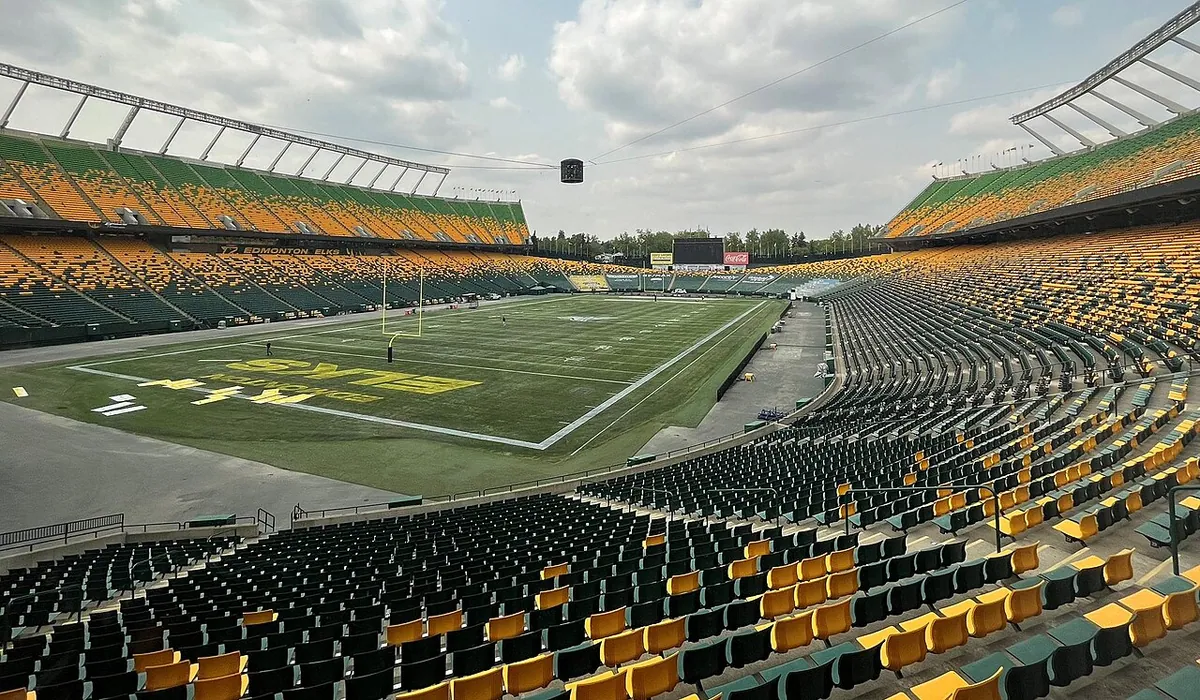
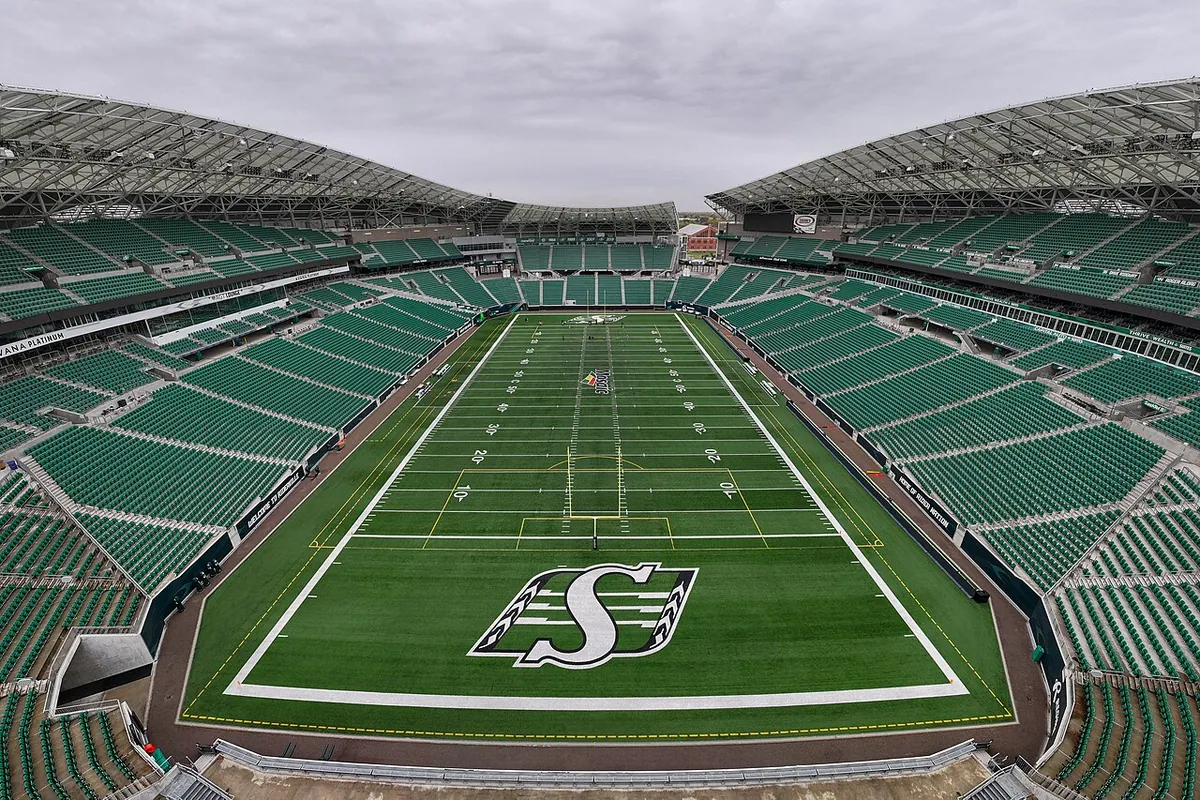
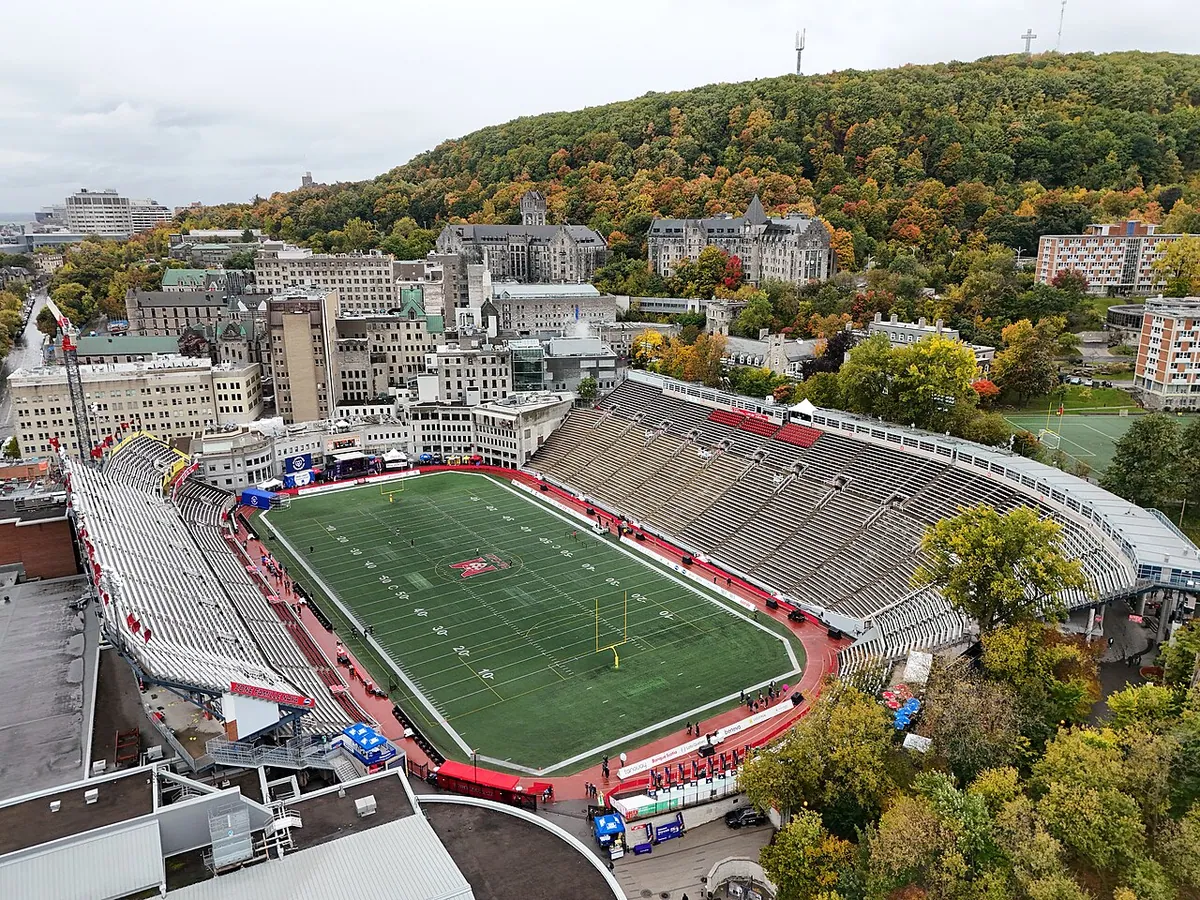
A significant wave of stadium construction and renovation occurred from the late 2000s through the 2010s, improving facilities across the league. The Montreal Alouettes expanded Percival Molson Memorial Stadium with 5,000 additional seats for the 2010 CFL season. The Edmonton Eskimos and Calgary Stampeders also renovated their stadiums for 2010. In 2011, the BC Lions began playing under the new retractable roof at BC Place. The Winnipeg Blue Bombers moved to the new Princess Auto Stadium in 2013. The Hamilton Tiger-Cats started using Tim Hortons Field in 2014 after the demolition of Ivor Wynne Stadium. The Ottawa Redblacks began play in 2014 at the renovated TD Place Stadium. The Toronto Argonauts moved to BMO Field in 2016 after decades at the Rogers Centre. The Saskatchewan Roughriders opened New Mosaic Stadium in 2017. These projects modernized the fan experience and provided teams with improved revenue streams.
Financial and Cultural Status
CFL player salaries in 2026 range from a league minimum of $70,000 to a top tier around $600,000 for starting quarterbacks, with an average salary between $110,000 and $140,000. According to a 2006 survey conducted at the University of Lethbridge, the CFL ranked as the second most popular sports league in Canada. The survey found that 19% of the adult Canadian population followed the CFL, compared to 30% for the NHL and 11% for the NFL. The league has maintained a strong cultural presence, with the Grey Cup game remaining one of Canada's largest annual television sports events. The CFL has faced competition from the NFL but has cultivated a distinct identity through its rules, history, and focus on Canadian markets. The global CFL 2.0 initiative under Commissioner Randy Ambrosie sought to build international partnerships for player development, signing agreements with leagues in over a dozen countries including Mexico, Germany, and Japan by 2020.
Notable Events and Milestones
The CFL has experienced several notable events beyond its on-field play. In 2015, Michael Sam signed a contract with the Montreal Alouettes, becoming the first openly gay player in league history, though he left the team before playing a regular season game. The league set an all-time attendance record in 2005 with over 2.3 million total fans. In 2006, the league launched CFL Broadband, an early internet streaming service for games. After the 2015 season, commissioner Jeffrey Orridge oversaw a league-wide rebranding including new logos and uniforms. The CFL's relationship with the NFL included a 1997 loan and an agreement on player option windows that expired in 2006. Negotiations for a new agreement ended in 2007 after Rogers Communications paid $78 million to host Buffalo Bills games in Toronto. The CFL 2.0 global combines began in 2019, with the first Mexican player draft seeing wide receiver Diego Viamontes selected first overall by the Edmonton Eskimos.
Video
FAQ
What is the difference between CFL and NFL football?
The CFL has several key differences from the NFL. CFL teams play with three downs to gain 10 yards instead of four, and field 12 players per side instead of 11. The CFL also features unique rules like the single point (rouge) on kicks into the end zone, no fair catch on punts, and unlimited pre-snap motion by offensive players. These differences create a faster, more pass-oriented style of play.
How many teams are in the CFL?
The CFL has nine teams as of 2026. They are divided into two divisions: the West Division with five teams and the East Division with four teams. The West Division consists of the BC Lions, Calgary Stampeders, Edmonton Elks, Saskatchewan Roughriders, and Winnipeg Blue Bombers. The East Division includes the Hamilton Tiger-Cats, Montreal Alouettes, Ottawa Redblacks, and Toronto Argonauts. Each team plays an 18-game regular season, and six teams qualify for the playoffs which conclude with the Grey Cup championship.
What is a rouge in the CFL?
A rouge, also called a single, is a one-point score unique to Canadian football. It is awarded when a team kicks the ball into the opponent's end zone and the receiving team does not return it out. Traditionally, this included punts, missed field goals, and kickoffs. Under a new rule for the 2026 season, the rouge is restricted. A single point is no longer awarded if the ball sails through the end zone untouched on a missed field goal, punt, or kickoff. The rouge still applies if a returner fields the ball in the end zone and is tackled there or takes a knee, or if the ball is kicked out of bounds in the end zone.
How much do CFL players get paid?
CFL player salaries vary widely. For the 2026 season, the league minimum salary is $70,000. The average salary for players falls between $110,000 and $140,000 per year. Top-tier players, particularly starting quarterbacks, can earn up to approximately $600,000 annually. These figures represent a significant range, with many players earning closer to the minimum while star players and veterans command higher salaries. The league operates under a salary cap system to maintain competitive balance among its nine teams.
Why doesn't the CFL merge with the NFL?
A merger between the CFL and NFL is highly unlikely due to fundamental differences in the games, market sizes, and business models. The sports have different rules, field dimensions, and roster sizes. The NFL is a vastly larger enterprise in terms of revenue, television contracts, and player salaries. Furthermore, the CFL holds significant cultural value in Canada as its top domestic football league. Past interactions include a 1997 loan from the NFL to help stabilize the CFL and an expired agreement regarding player option windows, but no serious merger discussions have occurred. Each league operates successfully within its own national context.
When was the Canadian Football League officially founded?
The Canadian Football League was officially established on January 19, 1958. This founding date came from the merger of two existing unions: the Interprovincial Rugby Football Union, also known as the 'Big Four' and founded in 1907, and the Western Interprovincial Football Union, which started in March 1936. The merger created a new umbrella organization for professional Canadian football. The league's first season was played in 1958, marking the beginning of its modern era.
Sources
- Canadian Football League (Wikipedia) Wikipedia
- New to CFL? Your Complete Guide to the Canadian Football League cflnewshub.com
- CFL Rules amtgridiron.neocities.org
- Beginner's Guide To Football gridironnewbrunswick.org
- Canadian Football League (CFL) | Sports and Leisure | Research Starters | EBSCOhost ebsco.com