Walter Chauncey Camp was an American college football player, coach, and sports writer widely known as the Father of American Football. As a halfback at Yale University and later as a coach, Camp served on the rules committees that reshaped the game from its rugby origins. He created foundational elements including the line of scrimmage, the system of downs, the reduction of players per side from 15 to 11, and the standard offensive arrangement of a seven-man line and four-man backfield. Beyond his rule-making, Camp founded the annual All-America team selection in 1889 and wrote prolifically about the sport, leaving a legacy that includes the Walter Camp Football Foundation and its national awards.
Early Life and Athletic Career
Walter Camp was born on April 7, 1859, in New Britain, Connecticut, to Leverett and Ellen Sophia Camp. His ancestry was English, tracing back to colonist Nicholas Camp who arrived in New England in 1630. Camp attended Hopkins Grammar School in New Haven before entering Yale College in 1875, graduating in 1880 and later attending Yale Medical School from 1880 to 1883. His medical studies were interrupted by typhoid fever and work for the Manhattan Watch Company, after which he began a career with the New Haven Clock Company in 1883, eventually rising to chairman of the board. Camp was a multi-sport athlete from a young age, excelling in track, swimming, baseball, and early forms of football at Hopkins. At Yale, he continued this athletic versatility, participating in baseball, track, tennis, and rowing in addition to football.
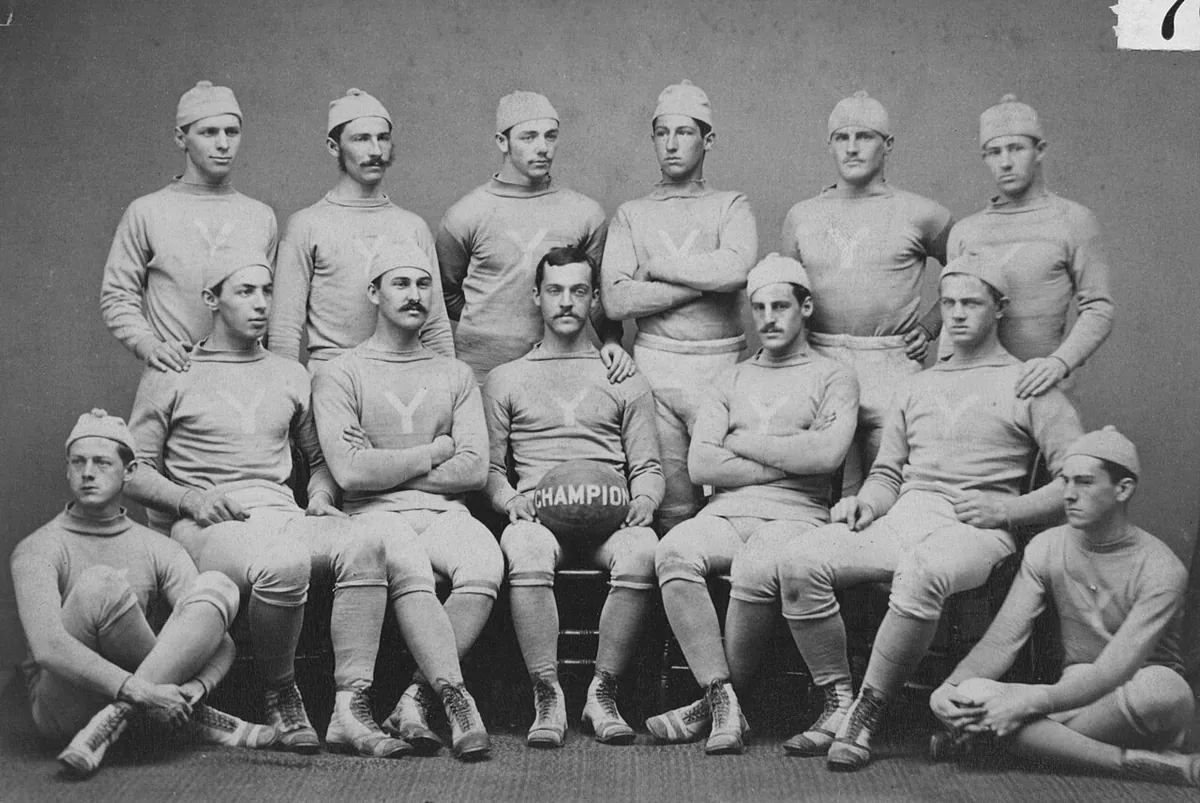
Camp's football career began during a formative period for the sport. In 1873, a meeting was held where representatives from Columbia, Rutgers, Princeton, and Yale created the Intercollegiate Football Association. He played halfback for Yale from 1876 to 1882, a time when the game was transitioning from soccer and rugby rules. Despite his build of 156 pounds, which drew skepticism from opponents like Harvard's Nathaniel Curtis, Camp became a team leader. His experiences as a player informed his later critiques of rugby rules, particularly the inefficiency of the scrum and the lack of reward for a touchdown if the conversion kick failed.
Rule Innovations and the Creation of American Football
Walter Camp's decades of service on collegiate football rules committees engineered the transformation of rugby into a distinct American sport. His first major success came in 1880 when he successfully lobbied the Intercollegiate Football Association to reduce the number of players on a team from 15 to 11. This change, which Yale had advocated for since playing an 11-a-side match against an English Eton College team in 1873, altered the game's dynamics. With fewer forwards, the traditional rugby scrum became impractical, leading teams to line up in an open formation to heel the ball backward more quickly. Camp proposed replacing the contested scrum with a fixed line of scrimmage, giving the team with the ball uncontested possession. This rule, adopted in the early 1880s, was a key step in the evolution from rugby.
Camp introduced a series of interconnected rules that created the strategic framework of modern American football. He devised the system of downs, initially requiring a team to advance the ball five yards in three attempts or surrender possession. He also created the snap from center to quarterback to start each play. In 1883, he helped reform the scoring system, assigning point values to touchdowns, field goals, and conversions. He created the safety, awarding two points to the defense for tackling a ball carrier in his own end zone, followed by a free kick from the 20-yard line. Other contributions included adding measured lines to the field and defining the dimensions of the modern gridiron.
- Reduced players per side from 15 to 11 (1880).
- Created the line of scrimmage, replacing the rugby scrum.
- Invented the system of downs to gain yardage.
- Introduced the snap from center to quarterback.
- Standardized the 7-4 offensive lineup (seven-man line, four-man backfield).
- Established the safety rule worth 2 points.
- Helped assign modern point values for touchdowns and field goals (1883).
- Added measured lines, creating the gridiron field.
Coaching Career and Record
Walter Camp served as the head football coach at Yale University from 1888 to 1892 while maintaining his full-time executive role at the New Haven Clock Company. His Yale teams were exceptionally dominant, compiling a record of 68 wins and only 2 losses. Under his leadership, Yale was recognized as national champion in 1888, 1891, and 1892. His 1888 team finished with a perfect 13-0 record, a feat matched by his 1891 and 1892 squads which also went 13-0. His 1889 team went 16-1, and his 1890 team finished 13-1. Following his tenure at Yale, Camp coached at Stanford University in December 1892 and again for the full 1894 and 1895 seasons. His Stanford teams posted a combined record of 12 wins, 3 losses, and 3 ties. One notable intersectional contest occurred on Christmas Day 1894, when Amos Alonzo Stagg's University of Chicago team defeated Camp's Stanford squad 24-4 in San Francisco. Camp's overall collegiate head coaching record stands at 79 wins, 5 losses, and 3 ties.
- Yale head coach from 1888 to 1892.
- Yale record: 68-2.
- National championships at Yale: 1888, 1891, 1892.
- Stanford head coach in 1892, 1894, and 1895.
- Stanford record: 12-3-3.
- Overall coaching record: 79-5-3.
Writing, the All-America Team, and Public Influence
Despite his business and coaching commitments, Walter Camp was a prolific writer, authoring nearly 30 books and more than 250 magazine articles on football and sports by the time of his death. His work appeared in national periodicals like Harper's Weekly, Collier's, Outing, and The Independent, as well as in juvenile magazines. In 1889, he initiated the selection of an annual All-America team, the oldest and most prestigious honor of its kind in college football. The team was published annually and was associated with Caspar Whitney's column in Harper's Weekly. Camp's selections were frequently criticized for an Eastern bias, as they heavily featured players from Ivy League schools like Yale, Harvard, and Princeton while often overlooking standout athletes from leading Western universities such as Michigan, Chicago, Minnesota, and Notre Dame. This bias reflected the limited exposure of Eastern sportswriters who primarily covered games in their own region.
Camp's influence extended beyond football into public fitness. During World War I, he served as an adviser to the United States military and devised the Daily Dozen exercise regimen to improve servicemen's physical conditioning. The program consisted of 12 simple calisthenic exercises that could be completed in about eight minutes. Both the Army and Navy adopted Camp's methods, and he published a book promoting the system. During the 1920s, the term Daily Dozen became synonymous with exercise in general, and Camp promoted the program through record sets and early radio broadcasts starting in 1922.
- Wrote nearly 30 books and over 250 magazine articles.
- Founded the annual All-America team selection in 1889.
- Published work in Harper's Weekly, Collier's, Outing, and The Independent.
- All-America selections criticized for Eastern bias against Western schools.
- Created the Daily Dozen exercise regimen for the U.S. military in WWI.
- The Daily Dozen consisted of 12 exercises like hands, grind, crawl, and wave.
- Promoted the Daily Dozen via books, records, and radio in the 1920s.
The Walter Camp Football Foundation and Legacy
The Walter Camp Football Foundation, based in New Haven, Connecticut, continues to honor Camp's work by managing several of college football's most prestigious awards. Its flagship honor is the Walter Camp Player of the Year award, the fourth-oldest individual college football award in the nation, which is voted on by NCAA head coaches. The foundation also presents awards for Coach of the Year, All-America teams, Man of the Year, Distinguished American, and an Alumni Award. It selects weekly National Offensive and Defensive Players of the Week during the Football Bowl Subdivision season, the nation's longest-running such award. In November 2026, the foundation announced a list of 20 semifinalists for its Player of the Year award. The foundation also hosts events like the National Awards Dinner and a Charity Golf Classic.
Walter Camp died of a heart attack in New York City on March 14, 1925, at the age of 65. He was survived by his wife, Alice Graham Sumner, whom he married in 1888, and their two children, Walter Camp Jr. and Janet Camp Troxell. The family is buried in Grove Street Cemetery in New Haven. Camp entered the College Football Hall of Fame as a coach in 1951. His personal papers and extensive archives are held at Yale University's Sterling Library. While modern scholarship acknowledges that the evolution of American football involved figures in Canada and other U.S. universities, Camp's role in codifying the rules and promoting the sport's identity remains central, securing his historical title as the Father of American Football.
Controversies and Historical Context
Walter Camp's role in football's development was not without controversy, particularly regarding the sport's violence and his personal influence. Games often featured serious injuries, gouging, and fistfights. This led to the legalization of the forward pass in 1906 and other rule changes that marked the beginning of the modern game. Historical analysis has also revisited the narrative of Camp as the sole inventor of American football. Scholars note that Canadian rugby enthusiasts in Toronto proposed abolishing the scrum in favor of a lined-up formation in 1875, five years before Camp's similar proposal. The move to 11 players, a change Camp championed, was itself influenced by Yale's experience playing an 11-a-side match under hybrid rules against an English Eton team in 1873. These facts illustrate that the sport's development was an incremental, international process rather than a series of isolated American inventions. Camp's advocacy, his strategic innovations like the down-and-distance system, and his role as the game's chief publicist through his writing and All-America teams established his prominent status in football history.
Video
FAQ
What is Walter Camp known for?
Walter Camp is known as the Father of American Football for his foundational rule innovations that transformed the game from rugby. He created the line of scrimmage, the system of downs, and reduced the number of players per side from 15 to 11. He also standardized the offensive lineup of a seven-man line and four-man backfield, introduced the safety, and helped establish the modern scoring system. Beyond rule-making, he founded the annual All-America team selection in 1889 and was a prolific sports writer and coach at Yale and Stanford.
What rules did Walter Camp invent?
Walter Camp invented or championed several core rules of American football. His most significant inventions include the line of scrimmage, which replaced the rugby scrum, and the system of downs, which required a team to gain yardage within a set number of plays. He successfully advocated for reducing players per team from 15 to 11. Camp also introduced the snap from center to quarterback, defined the safety rule worth two points, and helped assign point values to touchdowns, field goals, and conversions in 1883. He is credited with adding measured lines to the field, creating the gridiron.
What is the Walter Camp Football Foundation?
The Walter Camp Football Foundation is an organization based in New Haven, Connecticut, that honors the legacy of Walter Camp by presenting prestigious college football awards. It manages the Walter Camp Player of the Year award, the fourth-oldest individual award in college football, voted on by head coaches. The foundation also selects the annual All-America team, awards for Coach of the Year, and weekly National Offensive and Defensive Players of the Week during the FBS season. It hosts events like the National Awards Dinner and maintains historical archives of All-America selections and award winners.
How did Walter Camp contribute to football safety?
Walter Camp's rule innovations in the 1880s and 1890s, which created a distinct American game, also contributed to a period of extreme violence known as football's red-meat era. Mass momentum plays like the flying wedge led to severe injuries. The resulting reforms, including the legalization of the forward pass in 1906, were aimed at opening up the game and reducing injuries. The crisis that led to these safety rules was partly a consequence of the physical, line-based game his earlier rules had fostered.
What was Walter Camp's Daily Dozen?
The Daily Dozen was an exercise regimen created by Walter Camp during World War I while he served as a fitness adviser to the U.S. military. It consisted of 12 simple calisthenic exercises with names like hands, grind, crawl, wave, hips, grate, curl, weave, head, grasp, crouch, and wing. The entire set was designed to be completed in about eight minutes to improve general physical fitness. Both the Army and Navy adopted Camp's program. He wrote a book promoting the exercises, and during the 1920s, the term Daily Dozen became a popular catchphrase for exercise, promoted through record sets and early radio broadcasts.
When and where was Walter Camp born and when did he die?
Walter Camp was born on April 7, 1859, in New Britain, Connecticut. He died of a heart attack on March 14, 1925, in New York City at the age of 65. He is buried with his wife and children in Grove Street Cemetery in New Haven. His life spanned a crucial period in the development of American football.
Further reading
- The Early History of Football's Forward Pass Smithsonian Magazine. How the 1905 crisis and the rules committee reforms brought the forward pass into the college game.
Sources
- Walter Camp (Wikipedia) Wikipedia
- Walter Camp Football Foundation | Honoring Excellence Since 1889 waltercamp.org
- Walter Camp And His Gridiron Game, AMERICAN HERITAGE americanheritage.com
- The Walter Camp myth and the origins of American football tony-collins.squarespace.com
- Walter Camp Transforms Rugby to Gridiron freejacks.com