A nose tackle is a defensive football position where the player lines up directly across from the offensive center. The primary role of the nose tackle is to control the middle of the line of scrimmage, stop inside running plays, and occupy multiple offensive blockers. This position is a foundational element of the 3-4 defensive scheme, where the nose tackle is the sole defensive tackle. Nose tackles are typically among the largest and strongest players on a roster, using their size and power to clog rushing lanes and free up linebackers to make tackles. The position is also known historically as nose guard or middle guard, terms that originated in older defensive formations like the 5-2 defense.
Role and Responsibilities in Different Defenses
The nose tackle's specific duties and physical requirements vary significantly based on the defensive scheme. In a traditional 3-4 defense, the nose tackle is the sole defensive tackle, flanked by two defensive ends. His primary job is to absorb double teams from the center and at least one guard, holding his ground to prevent the offensive line from moving him and creating running lanes. By occupying two blockers, he allows the four linebackers behind him to remain unblocked and flow to the football. This role demands immense strength and a low center of gravity, with ideal players weighing between 320 and 350 pounds and often standing no taller than 6 feet 3 inches to get leverage under blockers. In a 4-3 defensive alignment, the nose tackle is one of two defensive tackles. Here, he may be asked to be more penetrative, using quickness to shoot the A-gap between the center and guard to disrupt plays in the backfield. His weight in a 4-3 scheme is often closer to 300 pounds, prioritizing agility over pure mass. The nose tackle is also a component of goal-line and short-yardage packages that use five defensive linemen, where he is the innermost lineman.
Regardless of the scheme, the core responsibilities of the position include several key tasks. The nose tackle must control the A-gaps on either side of the center, which are the primary inside rushing lanes. On passing downs, while not his main focus, he is expected to push the pocket inward, collapsing protection around the quarterback and disrupting timing. He also must read blocking schemes to diagnose run plays quickly and shed blockers to make tackles if the ball carrier comes his way. Because the position is designed to consume blockers, a nose tackle's statistical impact is often minimal, but his success in occupying multiple offensive linemen is critical for the overall defense's functionality.
Nose Tackle vs. Defensive Tackle and 3-Technique
While all nose tackles are defensive tackles, not all defensive tackles are nose tackles. The term defensive tackle is a broad category for interior defensive linemen, which includes the specific alignment of the nose tackle. A key distinction is the alignment and technique. His job is to be a space-eater. In contrast, a 3-technique defensive tackle, also called an undertackle, lines up on the outside shoulder of a guard. The 3-technique is typically a leaner, more agile player like Aaron Donald or Ed Oliver, specializing in penetrating gaps and rushing the passer from the interior. He often faces single blocks and aims for sacks and tackles for loss.
- Nose Tackle (0/1-tech): Aligns over center, absorbs double teams, stops the run, clogs the middle.
- Defensive Tackle (Broad): General term for interior defensive linemen.
- 3-Technique Tackle (3-tech): Aligns on guard's outside shoulder, penetrates gaps, rushes the passer.
- Historical Nose Guard: Term from older 5-2 defenses, largely synonymous with modern nose tackle.
The physical profiles also differ. Prototypical 3-4 nose tackles like Vita Vea or the retired Vince Wilfork are massive wide bodies. The 3-technique in a 4-3 defense can be successful at a lighter weight, such as Aaron Donald at 285 pounds, relying on explosive athleticism. The choice between using a nose tackle or a 3-technique is a fundamental decision that defines a defense's philosophy, balancing run-stuffing power against pass-rushing pressure from the interior.
History and Evolution of the Position
The nose tackle position evolved from the middle guard or nose guard of older defensive formations. In the one-platoon era of early football, players like Bronko Nagurski played both offensive fullback and defensive tackle, but specialization increased over time. This defense was phased out of professional football in the late 1950s due to a vulnerability to inside short passes, and the upright middle linebacker in the 4-3 defense replaced the middle guard. This scheme demanded a single, massive lineman to control the center of the line, making players like Jamal Williams and Gilbert Brown prototypes for the position.
Rule changes and offensive trends have continually shaped the nose tackle's role. The increased emphasis on passing in modern offenses has led to more substitution, with nose tackles often coming off the field in obvious passing situations for additional defensive backs or pass-rushing specialists. This has created a demand for nose tackles who can also provide some interior pass rush, rather than being solely two-down run stuffers. Despite the pass-happy evolution, the position remains vital for defenses that prioritize stopping the run, especially in short-yardage and goal-line situations. The historical term "nose guard" is still used interchangeably with nose tackle, though it more commonly references the alignment in older defensive systems.
Notable NFL Nose Tackles and Their Impact
Throughout NFL history, several nose tackles have defined the position with their dominance. These players combined immense size with surprising athleticism to control games from the interior. Vince Wilfork, a 325-pound force for the New England Patriots and Houston Texans, was known for his ability to absorb multiple blockers and still make plays. Current stars continue the tradition.
The Position in College and High School Football
The use of the nose tackle in college football closely mirrors the NFL, dependent on the defensive scheme employed by the team. Programs that run a base 3-4 defense, such as the University of Alabama under Nick Saban, prioritize recruiting and developing classic nose tackle prospects. These players are tasked with the same zero-technique responsibilities seen in the pros. However, the proliferation of spread offenses in college has increased the use of nickel defenses, which often feature only two interior linemen. This can reduce the pure nose tackle's snaps, favoring quicker defensive tackles who can both stop the run and rush the passer from various alignments. There is no single collegiate school known for producing most nose tackles, as evidenced by a survey of NFL players at the position from 2010, which showed them coming from a wide array of schools across major conferences like the SEC, Big 12, and ACC.
In high school football, the position exists wherever a 3-4 or similar odd-front defense is used. The physical demands mean the role is often filled by the largest player on the team. The fundamentals taught at this level, staying low, using hands to control blockers, and reading the center's movement, are the same as those required in higher levels of play. However, due to greater variability in player size and scheme at the high school level, the classic two-gapping nose tackle is less common than in professional football, with many coaches using more aggressive, one-gap attacking styles even from odd fronts.
Techniques, Alignment, and Gap Control
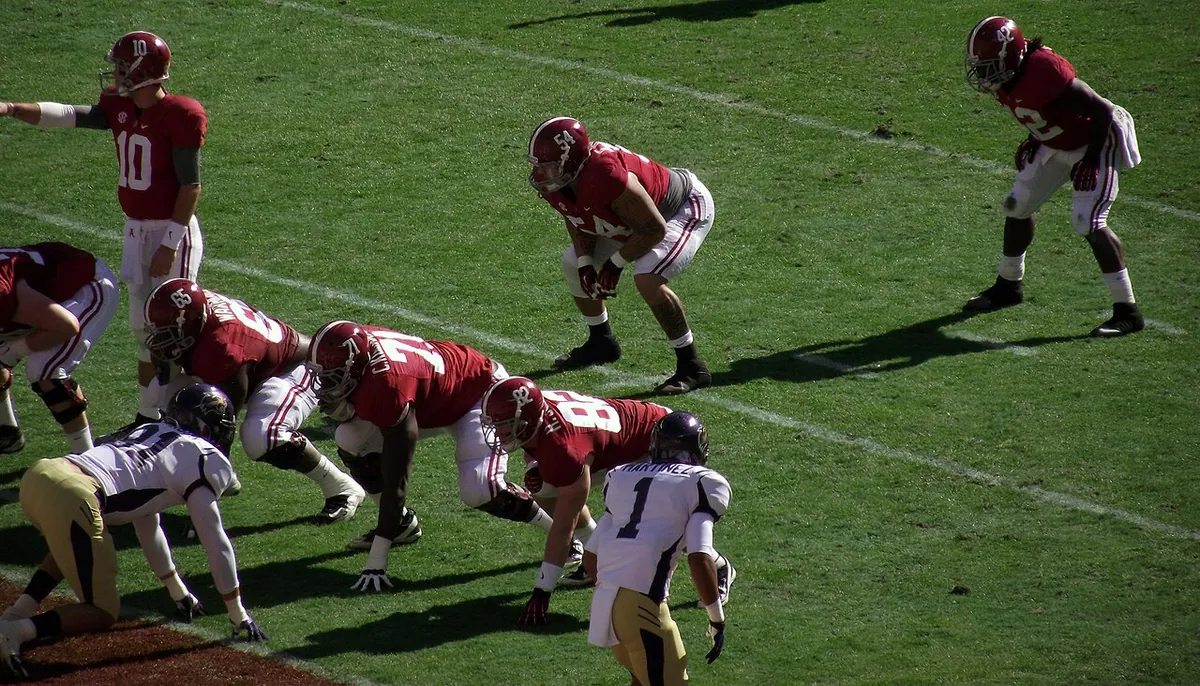
Nose tackle play is defined by specific techniques and gap control responsibilities. The primary alignments are the 0-technique and the 1-technique. A 0-technique nose tackle lines up directly head-up on the center, while a 1-technique lines up on the center's shoulder, typically in the gap between the center and the guard. These alignments target the A-gaps, the running lanes immediately to either side of the center. The nose tackle's key is often the offensive center. He reads the center's block to determine the direction of the play. In a two-gap system, common in traditional 3-4 defenses, the nose tackle is responsible for controlling both A-gaps. He must engage the blocker, shed him, and then tackle the ball carrier in whichever gap the play develops. This requires exceptional strength and technique.
In a one-gap system, the nose tackle is assigned a single A-gap to attack and penetrate. This is more common in 4-3 under fronts or aggressive 3-4 schemes. The stance is also critical. Nose tackles almost always use a three-point or four-point stance to maintain a low pad level, which is essential for gaining leverage against taller offensive linemen. Hand placement and initial punch are taught to control the blocker's chest and keep the defender's frame clean to shed and pursue. While pass-rush moves like the bull rush are part of their arsenal, the core technique revolves around anchor strength, the ability to stand firm against a double team without being moved backward, which is a defining trait of an elite nose tackle.
Video
FAQ
What does a nose tackle do in football?
A nose tackle's primary job is to line up opposite the center and control the middle of the line of scrimmage. He aims to stop inside running plays by clogging the A-gaps and frequently occupies double teams from the center and a guard. By taking on multiple blockers, he frees up linebackers to make tackles. On passing plays, he works to push the pocket inward to disrupt the quarterback, though his main focus is always run defense. His success is often measured by how he changes offensive plans, not by his personal statistics.
Are nose tackles still used in the modern NFL?
Yes, nose tackles are still a vital part of the NFL, particularly for teams that use a base 3-4 defense. As of a 2010 survey, 13 NFL teams ran a 3-4 defense, each requiring at least one nose tackle. While passing offenses have led to more substitution, the position remains crucial for stopping the run. Modern nose tackles like Vita Vea and Dexter Lawrence are also expected to contribute to the pass rush, making them more versatile and valuable on all downs compared to older prototypes.
What is the difference between a nose tackle and a defensive tackle?
A nose tackle is a specific type of defensive tackle defined by his alignment over the center. The term defensive tackle is a general category for all interior defensive linemen. A nose tackle is typically the largest defensive tackle, focused on occupying space and blockers. Other defensive tackles, like the 3-technique, are often leaner and tasked with penetrating gaps to rush the passer and make tackles for loss. The nose tackle's role is more about control, while other defensive tackles are often about disruption.
How many nose tackles are on the field?
In a standard 3-4 defense, there is one nose tackle on the field as the sole interior defensive lineman. In a 4-3 defense, one of the two defensive tackles may be designated as a nose tackle if he lines up over the center, but many 4-3 teams do not use a true nose. In goal-line or short-yardage formations with five defensive linemen, the nose tackle is the innermost player, flanked by two defensive tackles or ends. The number on the field is always tied directly to the defensive formation called.
What body type is ideal for a nose tackle?
The ideal body type for a traditional 3-4 nose tackle is a wide, powerful frame weighing between 320 and 350 pounds. Height is often limited to around 6 feet 3 inches or less to maintain a low center of gravity and gain leverage under offensive linemen. They require exceptional lower-body strength to anchor against double teams and short-area quickness to shed blocks. In a 4-3 scheme, nose tackles can be slightly lighter, around 300 pounds, with more emphasis on agility for gap penetration.
What is the main responsibility of a nose tackle in a 3-4 defense?
The primary responsibility of a nose tackle in a 3-4 defense is to absorb multiple blockers by taking on the center and at least one guard, which clogs the middle and frees up other defensive players to make plays. This position is considered the most physically demanding in football due to the constant double teams. The nose tackle aligns directly across from the offense's center in the 0-technique position. Their key role is to hold the point of attack, control the A-gaps, and stop inside running plays, effectively serving as the anchor of the defensive front.
Sources
- Defensive tackle (Wikipedia) Wikipedia
- Definition & Meaning of "Nose tackle" in English dictionary.langeek.co
- The Complete Guide to the Defensive Tackle Position throwdeeppublishing.com
- Nose Guard Football: Role, Skills, and Techniques, D3d4football d3d4football.com
- Getting to Know the Nose boltsfromtheblue.com