Kyle Field is an American football stadium located on the campus of Texas A&M University in College Station, Texas. It has served as the home of the Texas A&M Aggies football team since 1905, evolving from a simple fenced field with wooden bleachers into one of the largest stadiums in college football. Kyle Field is renowned for its intense game-day atmosphere and has hosted numerous record-setting crowds for football, concerts, and international soccer matches. Kyle Field originated in 1904 when Edwin Jackson Kyle, a horticulture professor and chairman of the Athletic Council, fenced off a section of campus land assigned to him for agricultural use. Using his own money, Kyle purchased lumber for wooden benches in 1905 and later bought a covered grandstand from the Bryan fairgrounds for $650. The Texas A&M Board of Directors officially designated the area as a permanent athletic field on November 11, 1904. The first football game at the rudimentary field was played in 1905, with Texas A&M defeating Houston YMCA 29-0 before a crowd of approximately 500 people. Students soon began unofficially calling the field Kyle Field in honor of its founder. By 1929, the stadium had been expanded into a 32,890-seat horseshoe with space for an additional 5,000 temporary seats.
Mid-Century Expansions and Surface Changes
The demand for a larger stadium grew after the Aggies' undefeated 1919 season, but fundraising efforts initially yielded only $2,400. In 1953, a partial second deck and a press box were added to the west side at a cost of $346,000, raising the official capacity to 41,500 seats. The Texas A&M Board of Regents made the name Kyle Field official in 1956, though students had used it for decades. A more extensive second deck was completed in 1967, along with an upper deck on the east side, increasing capacity. A significant change to the playing surface occurred in 1970 when the original grass was replaced with AstroTurf. The groundskeeping team's work on this surface was recognized with the STMA College Football Field of the Year award in 2004.
- 1953: Partial second deck and press box added ($346,000).
- 1956: Stadium name officially designated as Kyle Field.
- 1967: Second deck completed, capacity to 48,000 ($1.84 million).
- 1970: Original grass surface replaced with AstroTurf.
- 1996: AstroTurf replaced with Tifway 419 Bermudagrass.
- 2004: Grounds crew wins STMA Field of the Year award.
The 1980s and 1990s: Third Deck and The Zone
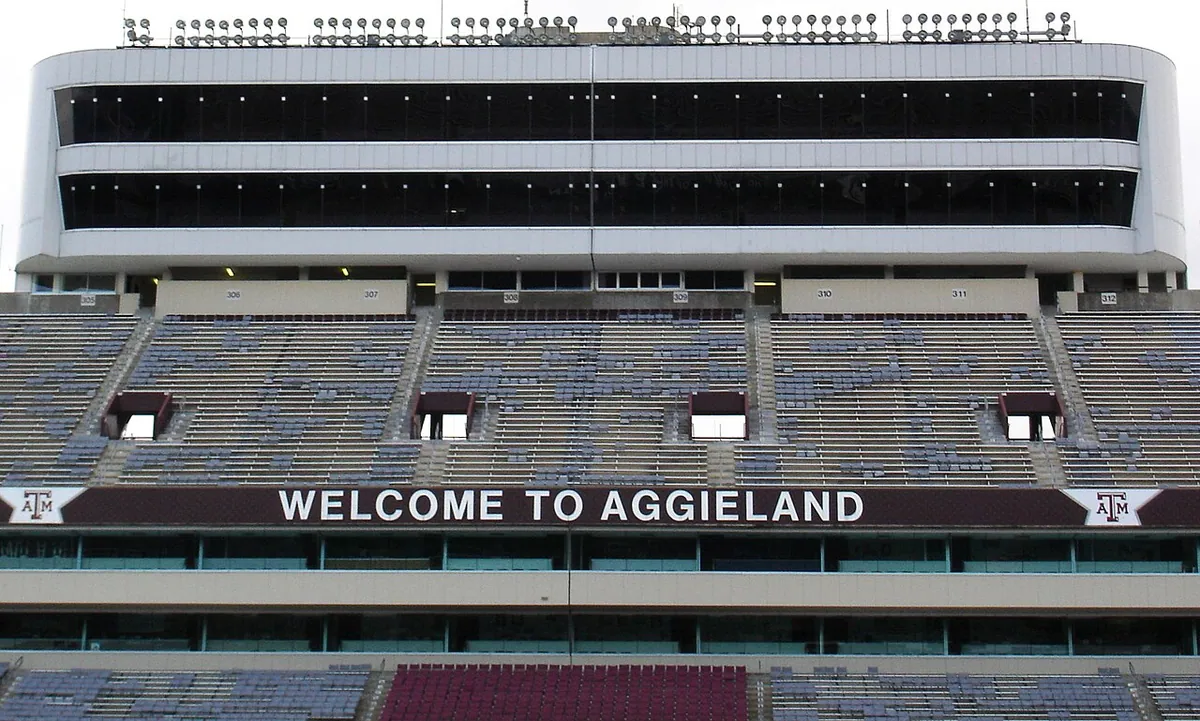
The 1980 expansion added third decks to both the east and west sides of Kyle Field. Construction took place during the football season, with students allowed to occupy new rows as they were completed. In 1981, 16-foot-tall block letters spelling 'KYLE FIELD' were installed on the back of the west side press box. The next major addition was the Bernard C. Richardson Zone, a north end zone complex named for a 1941 petroleum engineering graduate. It sits 65 feet closer to the field than the previous north horseshoe seating. The Zone features four levels, including luxury boxes and The Zone Club, an open-air area with 1,900 armchair seats, a full-service bar, and concession areas. The ground level houses the Texas A&M Sports Museum, funded primarily by former athletes.
- 1979: Third decks added to east and west sides, capacity to 72,000 ($26 million).
- 1999: Bernard C. Richardson Zone opens, adding over 20,000 seats ($32.9 million).
- The Zone includes 1,900 armchair seats in The Zone Club.
- The Zone houses the Texas A&M Sports Museum.
The 2013 to 2015 Redevelopment
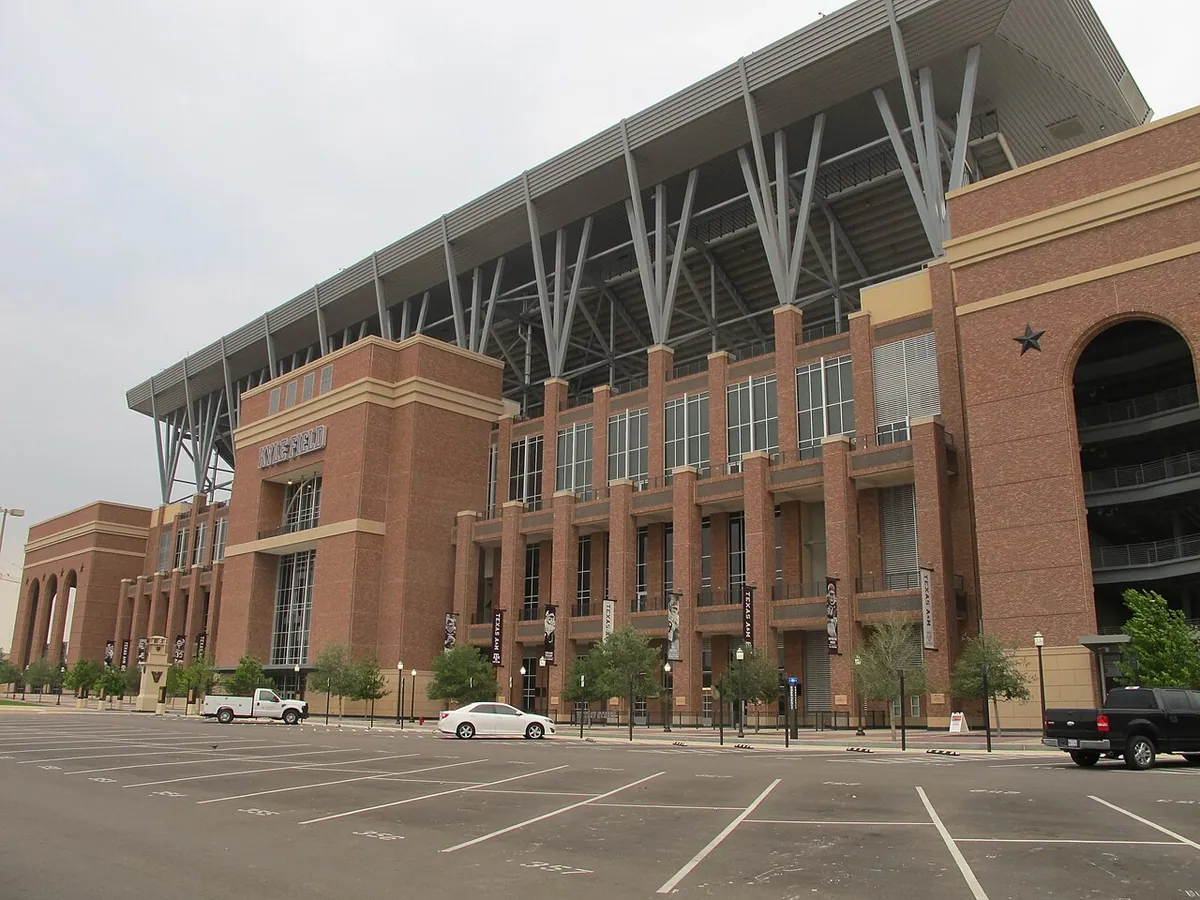
The project was managed by the Manhattan Construction Group and completed in two distinct phases around the football seasons of 2013, 2014, and 2015. Phase I began in November 2013 with the demolition of the first deck on the east side and the construction of the south end zone, which included new seating, media areas, and a commissary. Phase II commenced in November 2014, involving the demolition of the entire west side and the completion of the south end zone. The second phase eliminated the final section of the 1927 stadium, making the east side second deck from 1967 the oldest remaining part. Key engineering feats included lowering the playing field by about 7 feet and moving it 18 feet to the south, allowing for six additional rows of seating around the entire bowl. The renovation also involved demolishing adjacent buildings like G. Rollie White Coliseum and installing a massive new south end zone videoboard measuring 163 feet wide by 47 feet high. The project was completed ahead of schedule and under budget, establishing the current capacity of 102,733 seats.
- Phase I (Nov 2013): Demolition of east side first deck, south end zone construction.
- Playing field lowered 7 feet and moved 18 feet south.
- Adjacent G. Rollie White Coliseum demolished.
- New 163-by-47-foot south end zone videoboard installed.
- Final capacity set at 102,733 seats.
Stadium Features and Technological Upgrades
Modern Kyle Field incorporates advanced technology for fans and teams. The centerpiece of the video display system is the 163-by-47-foot LED videoboard in the south end zone, unveiled in 2014. This was supplemented by the installation of 1,130 feet of LED ribbon boards along the facade of the second deck, one of the longest such boards in collegiate sports. Earlier, in 2006, a previous 3,954-square-foot Mitsubishi Diamond Vision board, dubbed '12th Man TV,' had been installed. The stadium's current playing surface is Latitude 36 Bermudagrass, installed in 2017. The press box, located atop the west deck over 120 feet above the field, was historically known for its noticeable sway during the singing of the Aggie War Hymn, a phenomenon that was somewhat lessened by renovations before the 2014 season. Outside the north end zone in the Zone Plaza is the Reveille cemetery, where the university's canine mascots are buried with a view of a small electronic scoreboard. The stadium also features widened, tree-lined walkways along Houston Street as part of the 2015 redevelopment.
Football History and Notable Games
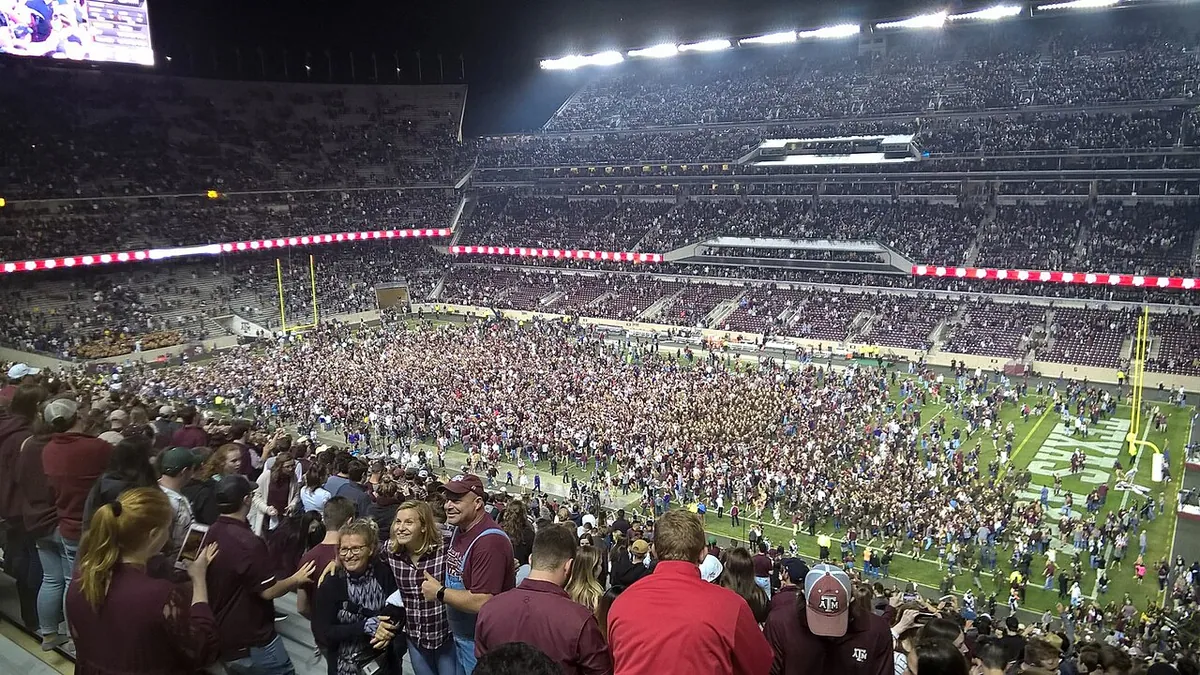
Kyle Field has been the exclusive home of Texas A&M Aggies football for over a century, witnessing the program's evolution through multiple conferences. The stadium hosted its final Southwest Conference game on December 2, 1995, a 16-6 loss to the Texas Longhorns that decided the final SWC championship. Texas A&M played its last Big 12 Conference game and last scheduled game against Texas at Kyle Field on November 24, 2011, losing 27-25. The Aggies' first Southeastern Conference home game was on September 8, 2012, against the Florida Gators. Several games stand out for their emotional and historical significance. On November 26, 1999, one week after the Aggie Bonfire collapse, the unranked Aggies defeated the 5th-ranked Texas Longhorns 20-16 before a then-record crowd of 86,128. On September 22, 2001, the first home game after the September 11 attacks, students organized a 'Red, White and Blue-Out,' with different decks wearing assigned colors, raising over $150,000 for FDNY charities. The stadium's football attendance record of 110,633 was set on October 11, 2014, during a 35-20 loss to Ole Miss, which was at the time the largest crowd for a football game in Texas and SEC history.
| Event | Date | Significance |
|---|---|---|
| First Game | 1905 | Texas A&M 29, Houston YMCA 0 |
| Final SWC Game | Dec. 2, 1995 | Texas 16, A&M 6 (final SWC championship) |
| 1999 Bonfire Game | Nov. 26, 1999 | A&M 20, #5 Texas 16 (86,128 fans) |
| 9/11 Tribute Game | Sept. 22, 2001 | vs. Oklahoma State ('Red, White and Blue-Out') |
| Final Big 12 vs. Texas | Nov. 24, 2011 | Texas 27, A&M 25 |
| First SEC Home Game | Sept. 8, 2012 | vs. Florida Gators |
| Record Football Crowd | Oct. 11, 2014 | 110,633 vs. Ole Miss |
Record Attendance and Non-Football Events
Kyle Field is a multi-purpose venue that holds significant attendance records across several event types. The stadium has also become a venue for international soccer, hosting a friendly between Mexico and Brazil on June 8, 2024, attended by 85,249 fans. Beyond these large-scale events, Kyle Field serves the university and local community in numerous ways. It hosts the Corps of Cadets' annual Parents' Weekend Review and Final Review. From 1990 to 2013, it hosted the 'Cross-Town Showdown' high school football game between Bryan High School and A&M Consolidated High School. The stadium is also used for summer football training camps and various Texas high school football playoff games. Historically, it has been the location for Midnight Yell practices, Muster Day ceremonies, and speeches by U.S. Presidents Franklin D. Roosevelt in 1937 and Dwight Eisenhower in 1946.
- Largest Concert: 110,905 for George Strait (June 15, 2024).
- Largest Soccer Match: 91,102 for Argentina v Honduras (June 6, 2026).
- Site of presidential speeches by F.D. Roosevelt (1937) and D. Eisenhower (1946).
- Used for Texas high school football playoff games.
Financing, Naming, and Cultural Impact
The financing of Kyle Field has evolved from personal investment to massive institutional projects. Founder Edwin Jackson Kyle used $650 of his own money, equivalent to about $25,155 in 2025 dollars, to create the initial field and grandstand. Major 20th-century expansions were funded through university appropriations and donations, such as the $32.9 million Bernard C. Richardson Zone. The stadium's name honors E.J. Kyle, a fact officially decreed by the Board of Directors to correct earlier misconceptions that it was named for Dr. J. Allen Kyle. The atmosphere at Kyle Field is famously intense, with players like safety Marcus Ratcliffe comparing the energy to that of the Roman Colosseum, citing the inability to hear teammates just yards away. Traditions like the swaying during the Aggie War Hymn and the presence of the Reveille cemetery contribute to its unique identity.
Video
FAQ
What is the seating capacity of Kyle Field?
Kyle Field has a seating capacity of 102,733, making it the largest stadium in the Southeastern Conference and the fourth-largest stadium in NCAA football. This capacity was established following a major renovation completed in 2015. The stadium has consistently welcomed over 100,000 fans per game since the 2014 season began. The largest football crowd in the stadium's history was 110,633 for a game against Ole Miss on October 11, 2014.
Who is Kyle Field named after?
Kyle Field is named for Edwin Jackson Kyle, a Texas A&M horticulture professor and 1899 graduate. In 1904, Kyle used his own money and a section of campus land to create the school's first athletic field. Students began unofficially calling it Kyle Field soon after, and the Texas A&M Board of Regents officially ratified the name in 1956. The board specifically decreed that the stadium was named for E.J. Kyle, dispelling any historical confusion that it might have been named for a different individual.
When did Kyle Field open and what major renovations has it had?
Kyle Field opened in its rudimentary form in 1905, with the first permanent concrete stadium opening in 1927. Major expansions occurred in 1953, 1967, 1980, and 1999. This project rebuilt the east and west sides, added a massive south end zone, lowered the field, and installed new video boards, resulting in the current 102,733-seat configuration. The renovation was completed in phases to allow football games to continue throughout construction.
What other events are held at Kyle Field besides football?
Beyond Texas A&M football games, Kyle Field hosts a variety of other events. It has held record-breaking concerts, such as George Strait's 2024 show, and international soccer matches, including Brazil vs. Mexico in 2024 and Argentina vs. Honduras in 2026. The stadium is also used for the Texas A&M Corps of Cadets' annual Parents' Weekend and Final Review military ceremonies. It has historically hosted Texas high school football playoff games and was the site for presidential speeches by Franklin D. Roosevelt in 1937 and Dwight Eisenhower in 1946.
What is the address of Kyle Field?
Kyle Field is located at 756 Houston Street, College Station, Texas 77843, United States. This address places the stadium on the campus of Texas A&M University. It has been the home of Texas A&M Aggies football since 1904 in its earliest form. The stadium's location in College Station has been central to its identity as a major collegiate football venue.
How has the playing surface at Kyle Field changed over the years?
The playing surface at Kyle Field was originally grass from its opening until 1969. AstroTurf was installed in 1970 and used until 1995. Natural grass returned for the 1996 season with Tifway 419 Bermudagrass, which was used until 2017. Since 2017, the field has featured Latitude 36 Bermudagrass. The groundskeeping staff has been highly praised, winning the STMA College Football Field of the Year award in 2004 for their excellent maintenance of the natural turf.
Sources
- Kyle Field (Wikipedia) Wikipedia
- Kyle Field | Athletic Venue History myaggienation.com
- Marcus Ratcliffe Gives Kyle Field Eye-Opening Comparison To Historical Landmark Sports Illustrated