Neyland Stadium is a college football stadium located on the campus of the University of Tennessee in Knoxville, Tennessee. It is the home venue for the Tennessee Volunteers football team and one of the largest stadiums in the United States. The stadium opened on September 24, 1921, as Shields, Watkins Field with a capacity of 3,200 and has undergone 16 expansion projects to reach its current official capacity of 101,915. Named for noted coach Robert Neyland in 1962, the stadium is the home of the Tennessee Volunteers and is located along the Tennessee River. The playing surface retains the original name, Shields, Watkins Field, and the stadium has hosted NFL exhibition games, concerts, and other major events.
Construction and Early History
The idea for the stadium was first developed in 1919. Colonel W.S. Shields, who was the president of Knoxville's City National Bank and a university trustee, provided the initial funding of $42,000 to prepare an athletic field. When the first phase of construction was finished in March 1921, the facility was named Shields, Watkins Field to recognize the donor and his wife, Alice Watkins-Shields. The original structure consisted of a single grandstand on the west side of the field with space for 3,200 people. Students and faculty helped complete the field over two days after initial funds ran out. The first event held was an invitational track meet, followed by the first Tennessee football game on September 24, 1921, a 27-0 victory over Emory & Henry. The stadium was renamed Neyland Stadium in 1962 to honor General Robert Neyland, the former head coach and athletic director.
Stadium Growth and Capacity History
Neyland Stadium has been expanded 16 times since its opening, transforming it from a small grandstand into one of the largest stadiums in the world. The first expansion came in 1926 with the addition of the East Stands, raising capacity to 6,800. In 1930, the West Stands were increased from 17 to 42 rows, bringing capacity to 17,860. The north end zone received a small row of seats in 1937, and the East Stands were expanded in 1938, resulting in a total capacity of 31,390. A major change occurred in 1948 when the south end zone was enclosed in a horseshoe shape with 15,000 seats, pushing capacity to 46,290. The 1960s saw the stadium double-decked, first on the west side in 1962 and then on the east side in 1968, reaching 64,429 seats. The upper decks were connected around the south end zone in 1972 and 1976, and the north end zone was fully enclosed in a bowl shape in 1980. The North Upper Deck was added in 1996. The stadium's highest official capacity was 104,079 in 2000. Subsequent additions of club seats and premium areas adjusted the figure to 102,455 by 2010 and then to 101,915 following renovations completed before the 2022 season.
| Year | Expansion | Approx. Total Capacity |
|---|---|---|
| 1921 | Initial Construction | 3,200 |
| 1948 | South End Zone Horseshoe | 46,290 |
| 1968 | East Upper Deck | 64,429 |
| 2010 | Tennessee Terrace & Club Seats | 102,455 |
| 2022 | Post-Renovation Adjustment | 101,915 |
Major Renovations and Master Plan
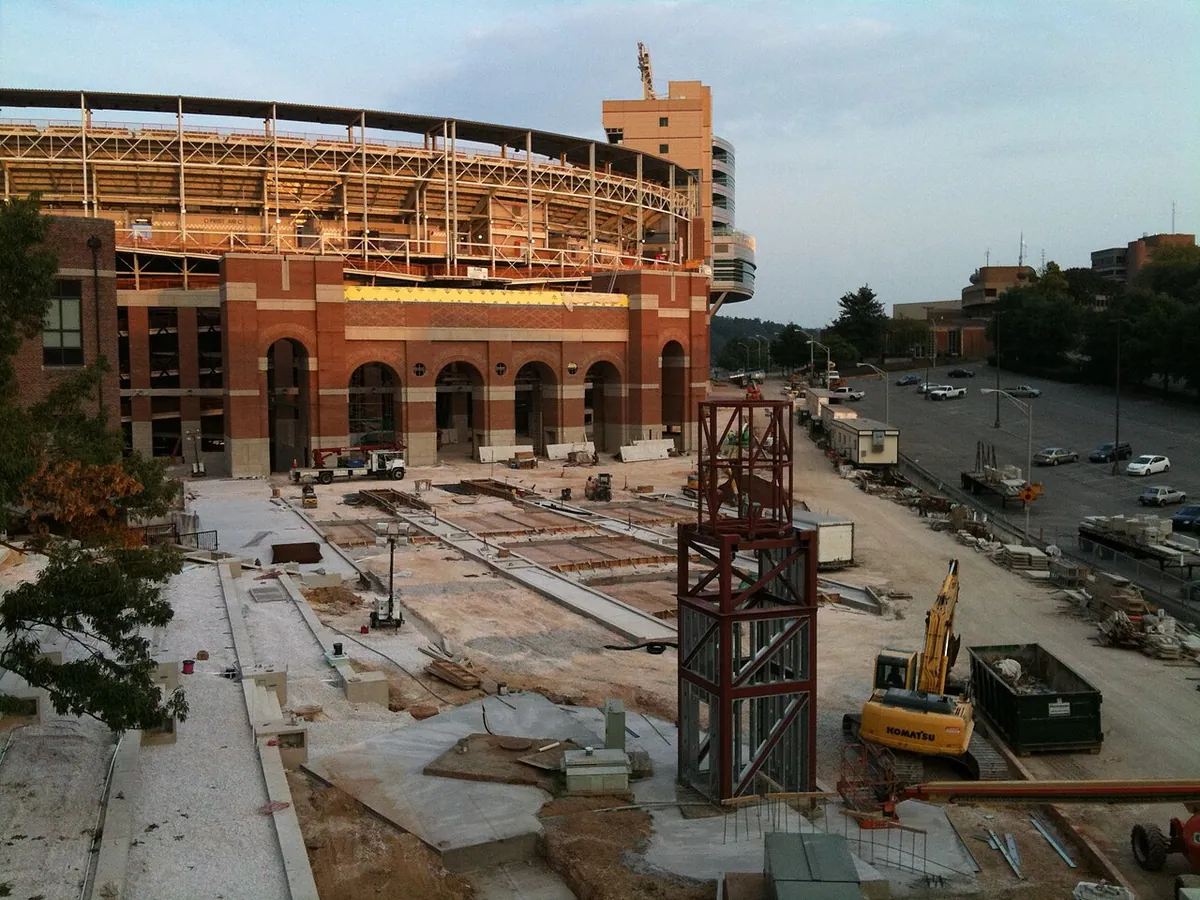
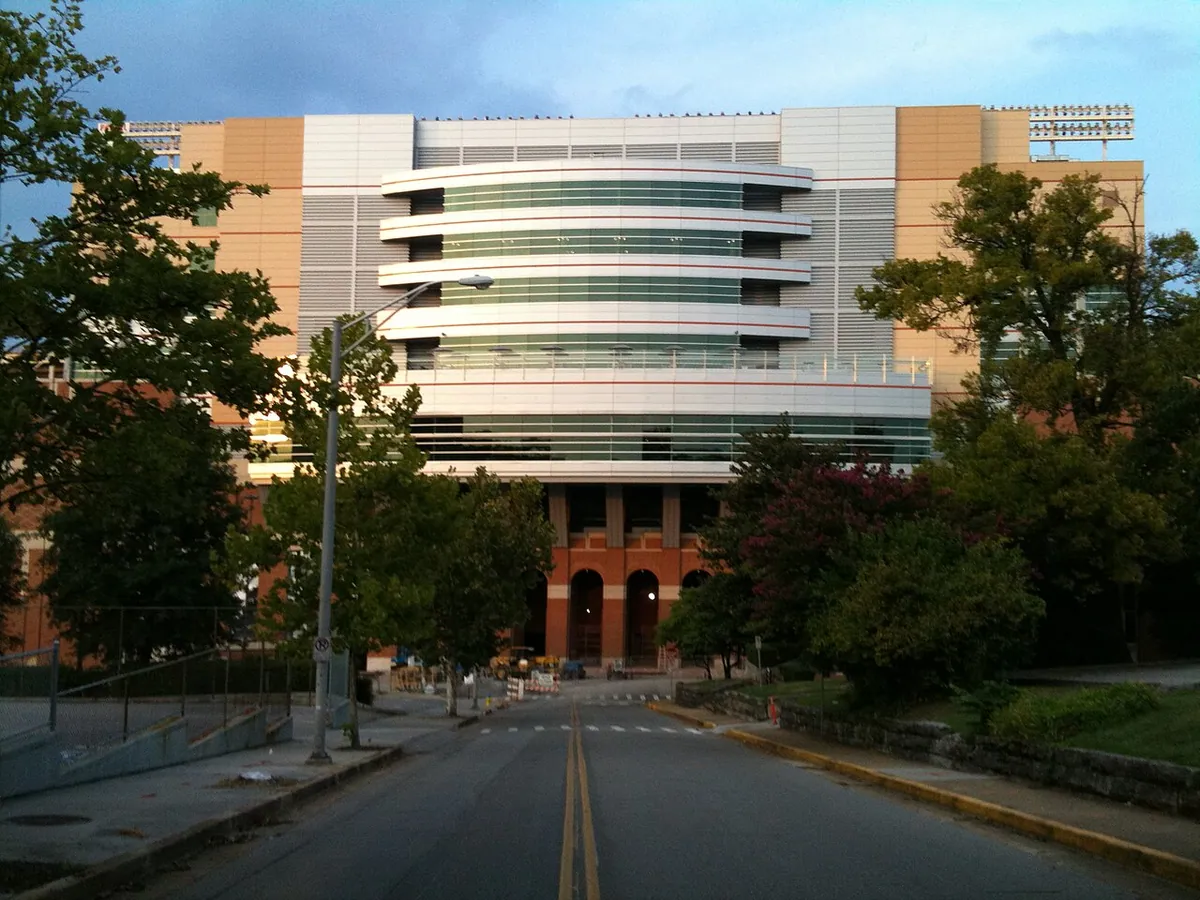
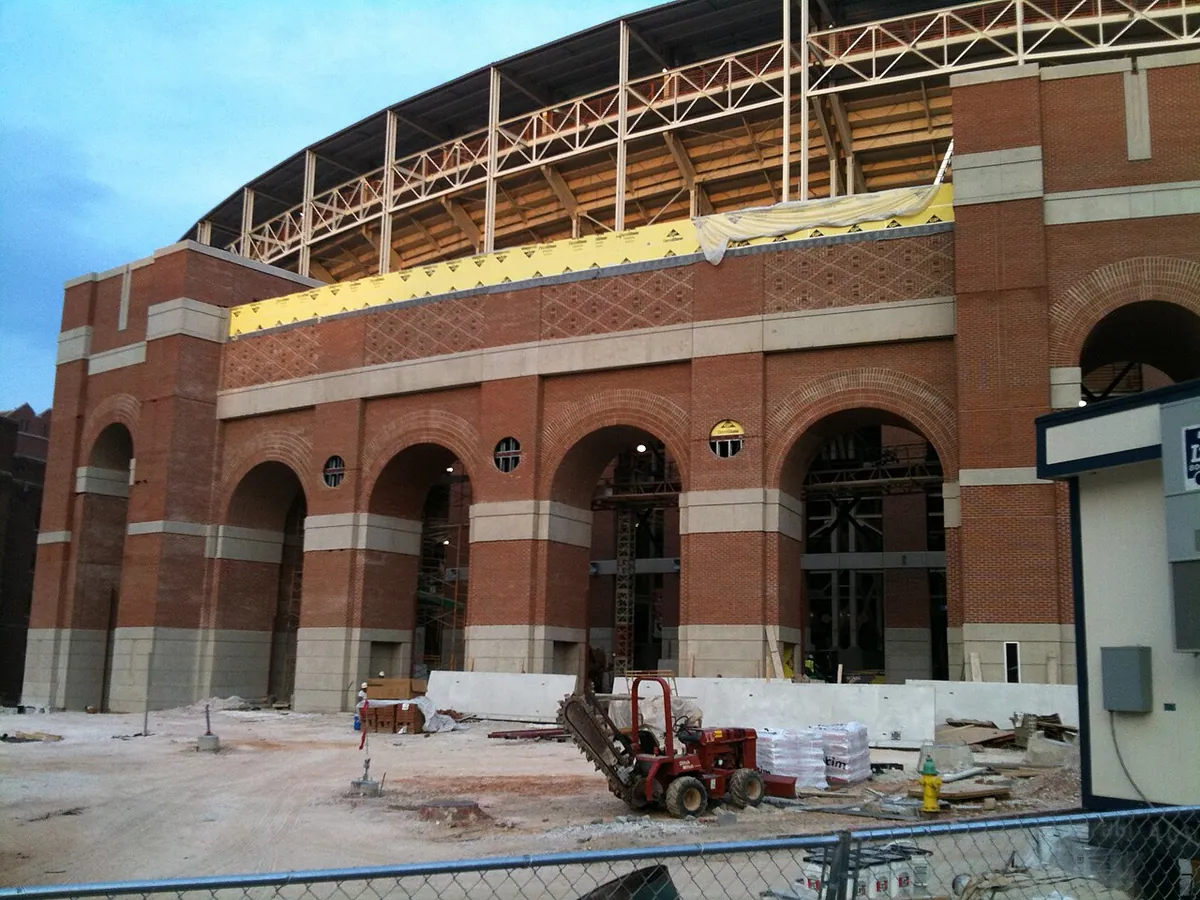
The University of Tennessee began a comprehensive Neyland Stadium Master Plan in 2004 to modernize the aging facility. This long-term strategy called for new premium seating, wider concourses, updated infrastructure, and enhanced entry plazas. The renovations from 2004 to 2010 were carried out in three phases at a total cost of $136.4 million, funded entirely by private donations and revenue from new seating areas. Phase I, completed in 2006 for $26 million, added the East Club Seats with 422 seats and a club room, renovated the north lower concourse, and installed new LED signage and restrooms. The second phase of work was finished in 2008 at a cost of $27.4 million. This stage involved widening the concourse on the west lower level and making improvements to the Peyton Manning Locker Complex. It also included the construction of two new facilities, the Lauricella Center for Letter Winners and the Stokely Family Media Room.
Phase III, the largest phase, was completed in 2010 at a cost of $83 million. It included the construction of the West Club Seats, improvements to executive suites and the press box, renovations to the west top concourse, and the addition of the Tennessee Terrace, which features 1,782 priority seats. This phase also created the Gate 21 Plaza and other entry plazas and installed a statue of General Neyland at the west entrance. A partnership with Pilot was announced to preserve the stadium. The UT Board of Trustees later approved an adjustment to the ongoing renovation project's scope and budget, setting it at $337 million. The project includes new deliverables each football season through the fall of 2026.
Playing Surface and Field Features
The field at Neyland Stadium is officially named Shields, Watkins Field. From the stadium's opening in 1921 through the 1967 season, the surface was natural grass. In 1964, head coach Doug Dickey introduced the now-famous orange-and-white checkerboard pattern in the end zones. In 1968, the university installed an artificial turf surface called Tennessee-Turf, partly to improve drainage. The artificial turf was used through the 1993 season, with the final game on that surface a 62-14 win over Vanderbilt. After the 1993 season, the turf was removed and auctioned off, and natural grass was reinstalled for the 1994 season. The checkerboard end zones were kept, and the midfield logo was changed to the Power T in 1998. A major maintenance practice began in 2007 where the entire grass surface is replaced every year with Tifway Bermuda sod. This grass grows on a 12-inch deep bed of sand, which is designed to provide superior drainage and a consistent playing surface.
Tennessee Volunteers Football History
The Tennessee Volunteers have played all their home games at this stadium since its inaugural season in 1921. Through the first week of the 2022 season, the team's all-time record at Neyland Stadium is 485 wins, 141 losses, and 17 ties, which calculates to a winning percentage of .767. The Volunteers have achieved 37 perfect home records in their history, with the most recent occurring during the 2022 season. The program's longest home winning streak is 30 games, a run that lasted from December 8, 1928, to October 21, 1933. The team has never suffered more than four consecutive losses at home. Six Tennessee teams that won national championships played their home games in this stadium. Furthermore, 23 players and four head coaches who worked at Neyland Stadium have been elected to the College Football Hall of Fame. The stadium has maintained a strong home-field advantage, with the Vols selling out 27 consecutive games entering the 2026 campaign. In the Josh Heupel coaching era from 2021 to the present, the team has drawn a total accumulated attendance of 3,535,030 fans over 36 home games.
Attendance Records and Notable Football Games
The university has recorded attendance figures for Tennessee football games at Neyland Stadium since 1946. The average attendance from 1946 onward is 68,925 fans per home game. The single largest crowd in the stadium's history was 109,061 spectators for the game against the Florida Gators on September 18, 2004, which Tennessee won 30-28. The program set a school record for average home attendance in the 2000 season, drawing 107,595 fans per game. Many of the highest-attended games involve Southeastern Conference rivals, particularly Florida, as shown in the top attendance records. Beyond regular season college games, the stadium has hosted NFL exhibition contests, the most recent being in 1995 between the Washington Redskins and the Houston Oilers. It was also the site of the Knox County Football Jamboree, a preseason high school event, until 2013. One of the most memorable recent games was the 2022 upset of the Alabama Crimson Tide, where Tennessee won 52-49 to end a 15-game losing streak in the rivalry. The victory prompted fans to storm the field, tear down the goalposts, and throw them into the adjacent Tennessee River, resulting in a $100,000 fine from the SEC.
- 109,061 vs. Florida (2004), Tennessee won 30-28.
- 108,768 vs. Florida (2000), Tennessee lost 23-27.
- 108,722 vs. Florida (2002), Tennessee lost 13-30.
- 108,625 vs. UNLV (2004), Tennessee won 42-17.
- 108,472 vs. LSU (2001), Tennessee won 26-18.
- 108,470 vs. Georgia (2005), Tennessee lost 14-27.
- 108,064 vs. Southern Miss (2000), Tennessee won 19-16.
- 107,881 vs. South Carolina (2003), Tennessee won 23-20.
Other Events and Uses
While primarily a football venue, Neyland Stadium has hosted a variety of other large-scale events. It has been used for concerts, political rallies, and religious gatherings. One of the most significant non-sporting events was the Billy Graham Crusade in May 1970, which featured President Richard Nixon as a guest speaker. The Jacksons performed three concerts at the stadium in August 1984 during their Victory Tour, and East Tennessee native Kenny Chesney performed there in June 2003. The stadium was part of the United States' bid to host the 2018 or 2022 FIFA World Cup, and a soccer match was played there on April 27, 1991, between Linfield of Northern Ireland and an American Professional Soccer League all-star team, drawing 12,468 fans. The facility's large capacity and central location have made it a site for university and community events, though its primary focus remains Tennessee football.
Location, Access, and Game Day Traditions
Neyland Stadium is situated on the University of Tennessee campus in Knoxville, with an address of 1235 Phillip Fulmer Way. Its location is directly beside the Tennessee River, which contributes to one of its most unique traditions, the Vol Navy. This tradition began in 1962 when broadcaster George Mooney tied his boat to a tree on the riverbank. On game days, a flotilla of 200 to 400 boats now lines the riverbank for tailgating. Another famed tradition is Running Through the T, which started on September 18, 1965. The Pride of the Southland Marching Band forms a giant Power T on the field during the team's entrance, and the players run onto the field through it. For access, many visitors drive via Interstates 40 and 75. The Knoxville Area Transit system operates game day shuttles from downtown Market Square and the Civic Coliseum, which serves as a park-and-ride lot. Rideshare services like Uber and Lyft have designated drop-off and pick-up zones away from the heaviest stadium congestion to manage traffic flow on game days.
Video
FAQ
What is the capacity of Neyland Stadium?
The official seating capacity of Neyland Stadium is 101,915 as of the 2022 season. This number represents the sixth-largest capacity among college football stadiums in the United States. The stadium's highest official capacity was 104,079 in the year 2000. Recent renovations that added premium club seats and social decks slightly reduced the total number from a previous figure of 102,455 that was in place from 2010 until the 2022 updates.
When was Neyland Stadium built and opened?
Construction on Neyland Stadium began with a groundbreaking ceremony on March 21, 1921. The initial phase was completed later that year, creating a facility then called Shields, Watkins Field. The first event held was an invitational track meet. The first Tennessee Volunteers football game took place at the stadium on September 24, 1921, resulting in a 27-0 victory over Emory & Henry College before an estimated crowd of 3,200 people.
Who is Neyland Stadium named after?
The stadium is named for General Robert Neyland, who served as the head football coach at the University of Tennessee for three separate periods between 1926 and 1952. During his tenure, he compiled an impressive record of 173 wins, 31 losses, and 12 ties. He is widely credited with building the Tennessee football program into a national power. The stadium was renamed in his honor in 1962, while the playing field itself continues to be called Shields, Watkins Field.
What are the major renovations that have been done to Neyland Stadium?
Major renovations began in 2004 with the Neyland Stadium Master Plan. The first three phases, completed by 2010 at a cost of $136.4 million, added club seats on the east and west sides, created the Tennessee Terrace premium section, widened concourses, built new entry plazas, and added a statue of General Neyland. A partnership was announced, and the renovation budget was increased to $337 million, with work continuing through the 2026 season. Recent additions include a new Wi-Fi network, additional videoboards, wider concourses, new Founders Suites, a stadium kitchen, and statues honoring Tennessee's Black football pioneers.
What was the original name and capacity of Neyland Stadium when it opened?
The stadium originally opened in 1921 as Shields-Watkins Field with a single grandstand and a capacity of just 3,200. It was named in honor of the donor, Colonel W.S. Shields, and his wife, Alice Watkins-Shields, who provided the initial capital. The first UT football game at the stadium was a 27 to 0 victory over Emory & Henry on September 24, 1921. The playing surface retains the name Shields, Watkins Field to this day.
What was the first event ever held at Neyland Stadium?
The first event at Neyland Stadium was an invitational track meet held as a celebration after students and faculty finished the field over a two-day period in 1921. The first UT football game at the stadium took place shortly after on September 24, 1921, with the Vols defeating Emory & Henry, 27-0. The stadium, then called Shields-Watkins Field, had an initial capacity of 3,200. The project was initially funded by Colonel W.S. Shields and completed through the efforts of the university community.
Sources
- Neyland Stadium (Wikipedia) Wikipedia
- Neyland Stadium airvuz.com
- Neyland Stadium, Facilities utsports.com
- Neyland Stadium, Knoxville: Capacity & Visitor Guide, MeetStadium meetstadium.com