Sanford Stadium, officially known as Dooley Field at Sanford Stadium, is the on-campus football stadium for the University of Georgia Bulldogs in Athens, Georgia. The stadium opened on October 12, 1929, with a 15-0 victory over Yale. It is known for its natural grass field surrounded by privet hedges, a feature that has defined the venue since its opening and led to the phrase 'between the hedges.' With a current capacity of 93,033, it ranks as the ninth-largest stadium in NCAA football. The stadium has undergone numerous expansions and renovations over its history to accommodate growing crowds and modern amenities.
Construction and Early History
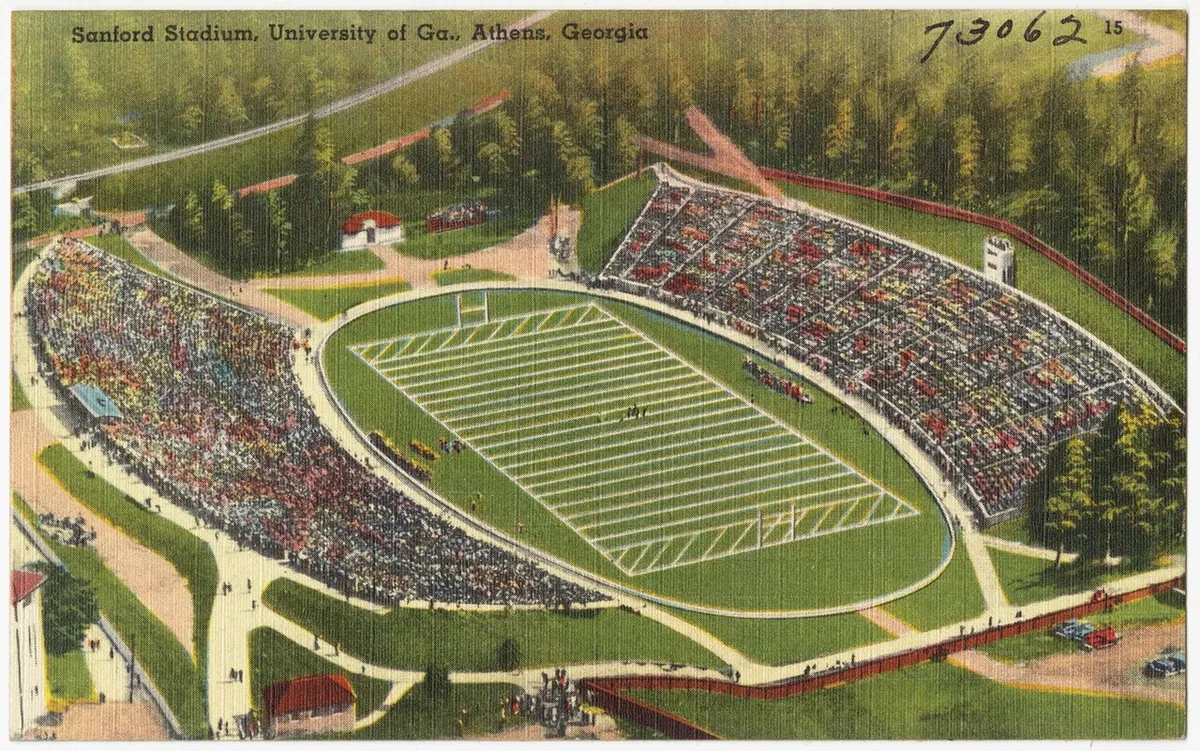
Sanford Stadium was constructed to replace Sanford Field, which had become inadequate for the crowds drawn by Georgia football, especially for games against rival Georgia Tech. In 1928, a $150,000 loan backed by alumni and fans helped finance the $360,000 construction cost, with guarantors receiving lifetime seats. The stadium was built into a natural valley between the university's North and Science campuses, with Tanyard Creek enclosed in a culvert beneath the field, a design that reduced construction costs. Architect T.C. Atwood designed the original 30,000-seat facility, which was built partly using convict labor, a common practice for public works at the time. The stadium opened on October 12, 1929, with Georgia's 15-0 victory over Yale before a crowd reported as the largest to attend a college football game in the South at that time. Yale donated its share of the game receipts to help Georgia pay off the construction loans, which were retired within five years. The stadium was named for Steadman Vincent Sanford, a former English instructor who became university president and a major force behind UGA athletics, having earlier moved the football venue to Sanford Field in 1911.
Capacity and Expansions
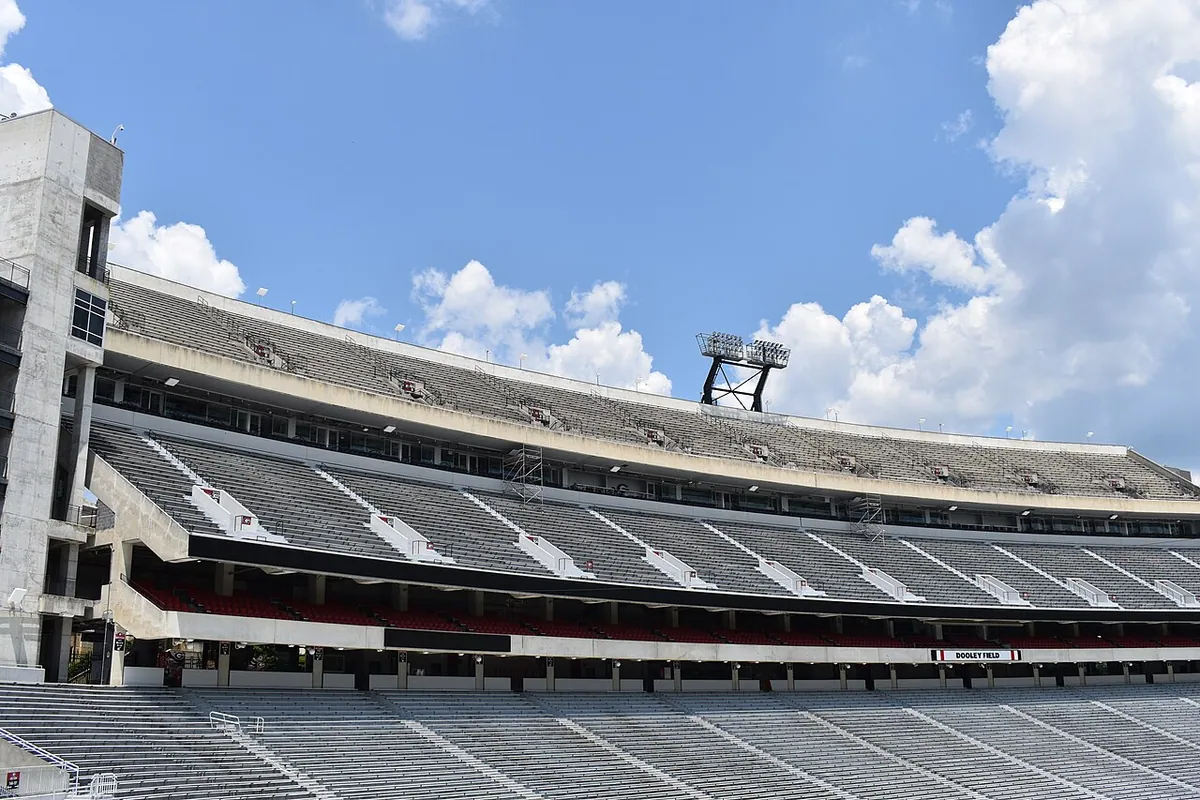
Sanford Stadium has been expanded numerous times to meet demand, growing from its original 30,000 seats to 93,033. The first expansion came in 1949 with 6,000 seats added to the south side, raising capacity to 36,000. Following Vince Dooley's arrival as head coach in 1964, 7,621 bleacher seats were added in the end zones, bringing capacity to 43,621. A major $3 million project in 1967 added upper decks to the grandstands, a press box, and club seating, increasing capacity to 59,200. The east end zone was enclosed in 1981 at a cost of $11.5 million, adding 19,000 seats for a new capacity of 82,122. A partial enclosure of the west end zone in 1991 cost $3.7 million and added 4,205 seats. Luxury suites were added above the south stands in 1994 and expanded in 2000, with these projects costing $18 million and raising capacity to 86,520. A new upper deck on the north side was constructed in 2003 for $25 million, adding 5,500 seats, and 27 SkySuites were added in 2004 for $8 million, bringing capacity to 92,746. A $63 million west side renovation was completed in 2018, relocating the locker room and adding a plaza and recruiting pavilion. The most recent renovation, finished for the 2024 season, expanded concourses, added premium seating and a new press box, and increased the official capacity to 93,033.
| Year | Expansion Focus | New Capacity |
|---|---|---|
| 1949 | South side seats | 36,000 |
| 1964 | End zone bleachers | 43,621 |
| 1981 | Enclosed east end zone | 82,122 |
| 1991 | Partial west end enclosure | 85,434 |
| 2004 | North side SkySuites | 92,746 |
| 2024 | Concourse, premium seating | 93,033 |
Stadium Features and Atmosphere
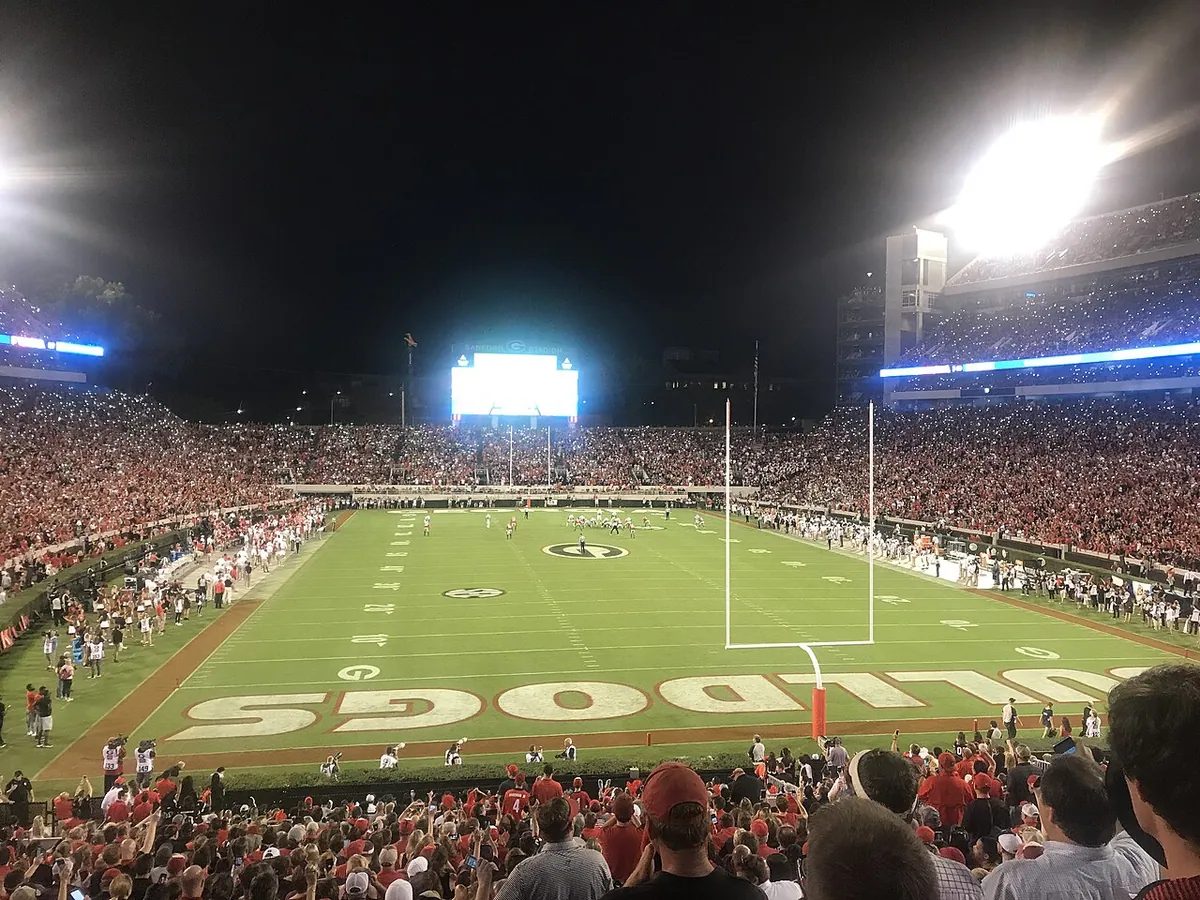
Sanford Stadium is defined by several unique physical and traditional features. The most famous are the privet hedges that surround the playing field, giving rise to the phrase 'between the hedges.' The original hedges were removed for the 1996 Summer Olympics soccer tournament and replaced with cuttings that had been cultivated off-site. A new generation of hedges was planted in May 2024. The stadium has a natural grass surface of Tifton 419 Bermuda Grass, a feature maintained since its opening. Unlike most college football stadiums, Sanford Stadium has an east-west field orientation, a trait it shares with Kroger Field in the SEC. The goal-line markers feature Georgia's oval 'G' logo. A mausoleum in the southwest corner of the stadium entombs the university's deceased Uga mascots. For many years, fans known as the 'Track People' watched games from adjacent railroad tracks until the 1981 expansion blocked the view. The stadium's design, built into a natural valley with views of rolling hills from the open west end, has earned it a reputation as one of the most beautiful on-campus stadiums.
Georgia Bulldogs Football Tenure
The Georgia Bulldogs have played all their home games at Sanford Stadium since it opened in 1929. The program has a long history at the venue, winning national championships in 1942 and 1980, along with 13 Southeastern Conference championships. The playing surface was named Dooley Field in May 2019 in honor of Vince Dooley, the program's all-time winningest head coach and former athletic director. Dooley coached from 1964 through 1988, winning 201 games, one national championship, and six SEC titles. As athletic director from 1979 to 2004, he oversaw 23 national championships across all sports. The team's locker room, the Donald M. Leebern Jr. Locker Room, was renovated in 2017 and features a commons area, lounge, and displays celebrating team accomplishments.
- First Game: October 12, 1929 (Georgia 15, Yale 0).
- First Night Game: October 26, 1940 (Georgia 7, Kentucky 7 tie).
- First 'Blackout' Game: November 10, 2007 (Georgia 45, Auburn 20).
- Field Dedication: September 7, 2019 (Dooley Field).
- Record Attendance Game: September 21, 2019 (Georgia 23, Notre Dame 17).
- Longest Game: November 29, 2024 (Georgia 44, Georgia Tech 42 in 8 OTs).
Notable Football Games and Events
Sanford Stadium has hosted numerous memorable football games throughout its history. The inaugural game in 1929 saw Georgia upset heavily favored Yale 15-0. Georgia defeated Bear Bryant's defending national champion Alabama team 18-17 on September 9, 1965. A dramatic 60-yard field goal by Kevin Butler as time expired gave Georgia a victory over No. 2 Clemson on September 22, 1984. The stadium hosted a No. 1 vs. No. 2 matchup on November 5, 2022, when AP No. 1 Georgia defeated AP No. 2 Tennessee. The venue set its all-time attendance record of 93,246 on September 21, 2019, during a 23-17 victory over Notre Dame. Beyond regular season games, the stadium hosted the medal rounds for men's and women's soccer during the 1996 Summer Olympics, requiring the temporary removal of the hedges. It has also hosted concerts, including Live Between the Hedges with Jason Aldean and Luke Bryan on April 25, 2026, which drew over 60,000 spectators.
Renovations and Modern Upgrades
Beyond capacity expansions, Sanford Stadium has undergone significant renovations to improve facilities and the fan experience. Field-level lights were added in 1940 for the first night game but were later removed. Permanent lighting was reinstalled above the upper deck during the 1981 expansion. A video display was installed above the west end zone in 2005, with a $1.4 million renovation before the 2011 season to expand its display and add high-definition capability. The stadium's floodlighting system was upgraded to a state-of-the-art LED system in 2019 at a cost of around $950,000, first demonstrated during the Notre Dame game. The major west side project completed in 2018 relocated the team locker room to the west side, added a new recruiting pavilion, and created a plaza for fans. These continuous upgrades have modernized the venue while preserving its historic character and the famous hedges.
Records and Attendance
The official seating capacity of Sanford Stadium is 93,033 as of the 2024 season. The all-time record attendance was set on September 21, 2019, when 93,246 spectators watched Georgia defeat Notre Dame. That record was enabled by the addition of 500 temporary aluminum bleachers due to an agreement allocating 8,000 visitor tickets for the series. The stadium's capacity has evolved significantly from its original 30,000 seats. The Georgia Bulldogs have maintained consistently high attendance, with the venue regularly selling out. The stadium also set an NCAA attendance record for a collegiate soccer match on August 20, 2026, when 25,433 fans watched the Georgia women's soccer team defeat James Madison 6-0.
Video
FAQ
When was the first game at Sanford Stadium?
The first game at Sanford Stadium was played on October 12, 1929. The University of Georgia defeated Yale University by a score of 15-0 in that inaugural contest. The crowd was reported to be the largest to attend a college football game in the South at that time. The victory marked the beginning of the stadium's long history as the home of Georgia Bulldogs football.
How popular are Georgia Bulldogs home games?
Georgia Bulldogs home games are consistently among the best-attended in college football. The team's average home attendance has ranked in the nation's top 10 for more than 20 years. Sanford Stadium regularly fills to its full capacity for these games. This sustained fan support reflects the program's success and the venue's reputation.
What was a key SEC championship moment at the stadium?
A key moment occurred on November 14, 1959. Quarterback Fran Tarkenton threw a game-winning touchdown pass to Bill Heron in the final seconds of the game. This play gave Georgia a 14-13 victory over the Auburn Tigers. The win clinched the Southeastern Conference championship for the Bulldogs that season.
Did Georgia ever beat a defending national champion at home?
Yes, Georgia defeated a defending national champion at Sanford Stadium on September 9, 1965. The opponent was the University of Alabama, coached by Bear Bryant. The Bulldogs won the game by a score of 18-17. This victory is remembered as a significant upset in the stadium's history.
What happened after Georgia beat Tennessee in 2000?
On October 7, 2000, Georgia ended a 9-game losing streak against the Tennessee Volunteers with a 21-10 victory. The win prompted a massive celebration from the home fans. Spectators rushed onto the field following the game. As part of the celebration, fans tore down the goalposts at Sanford Stadium.
Who is Sanford Stadium named after and why?
Sanford Stadium is named for Steadman Vincent Sanford, a major early force behind University of Georgia athletics. Sanford arrived at UGA as an English instructor in 1903 and later became the faculty representative to the athletics committee, eventually serving as university president and chancellor of the University System of Georgia. In 1911, he moved the university's football venue from Herty Field to a central campus location named Sanford Field. During the 1920s, he pushed for the construction of a larger stadium after crowds outgrew Sanford Field, leading to the stadium that bears his name.
Sources
- Sanford Stadium (Wikipedia) Wikipedia
- Sanford Stadium ugastadium.com
- Dooley Field at Sanford Stadium georgiadogs.com
- Sanford Stadium: 93,033 Capacity | Georgia Game Day Guide, Fan Stamp fan-stamp.com