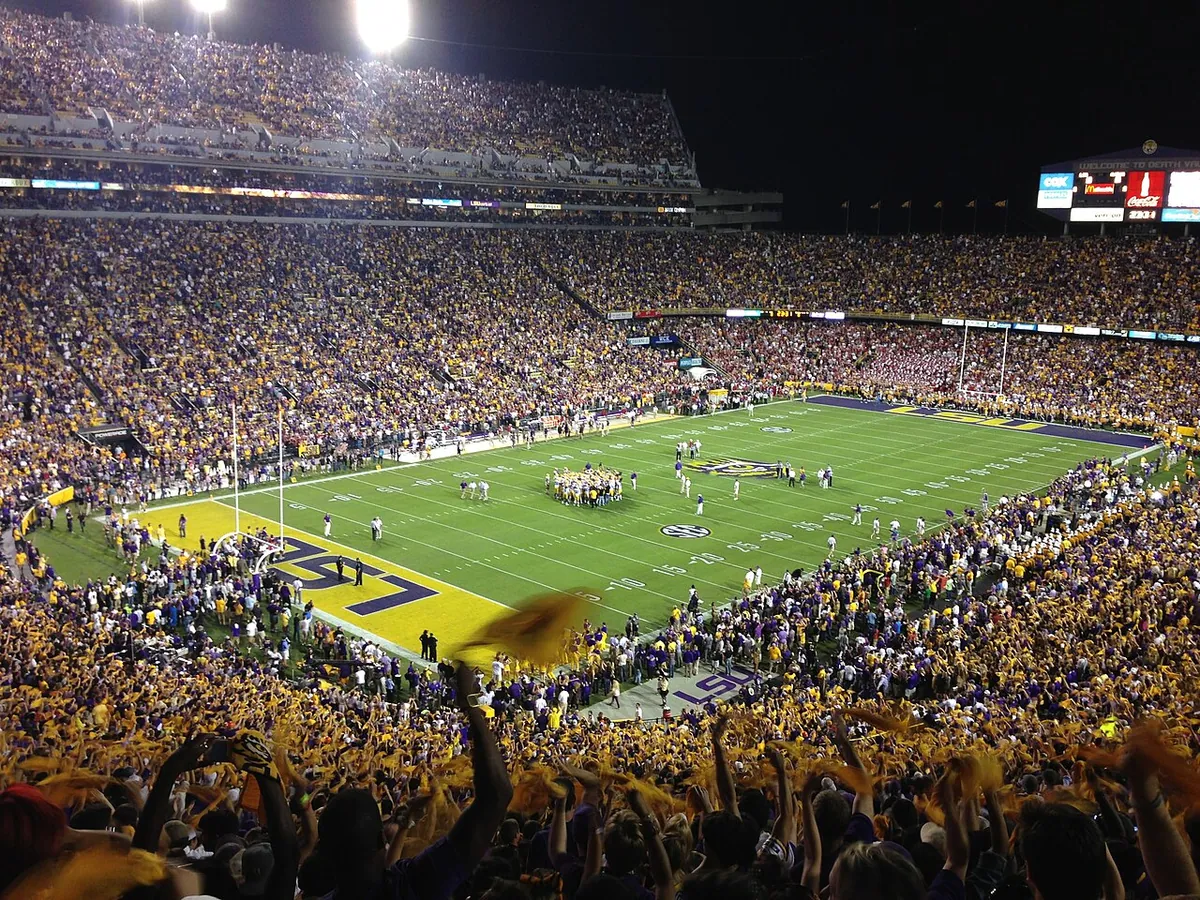
Tiger Stadium, also known as Death Valley, is an outdoor college football stadium located on the campus of Louisiana State University in Baton Rouge, Louisiana. The stadium opened on November 25, 1924, with an initial capacity of 12,000. Through a century of expansions and renovations, it has grown into one of the largest stadiums in the world, with a current official capacity of 102,321. It is the home field for the LSU Tigers football team and is renowned for its loud, intimidating environment, particularly during Saturday night games. The stadium also served as a temporary home for the NFL's New Orleans Saints during the 2005 season.
Construction, Expansion, and Capacity
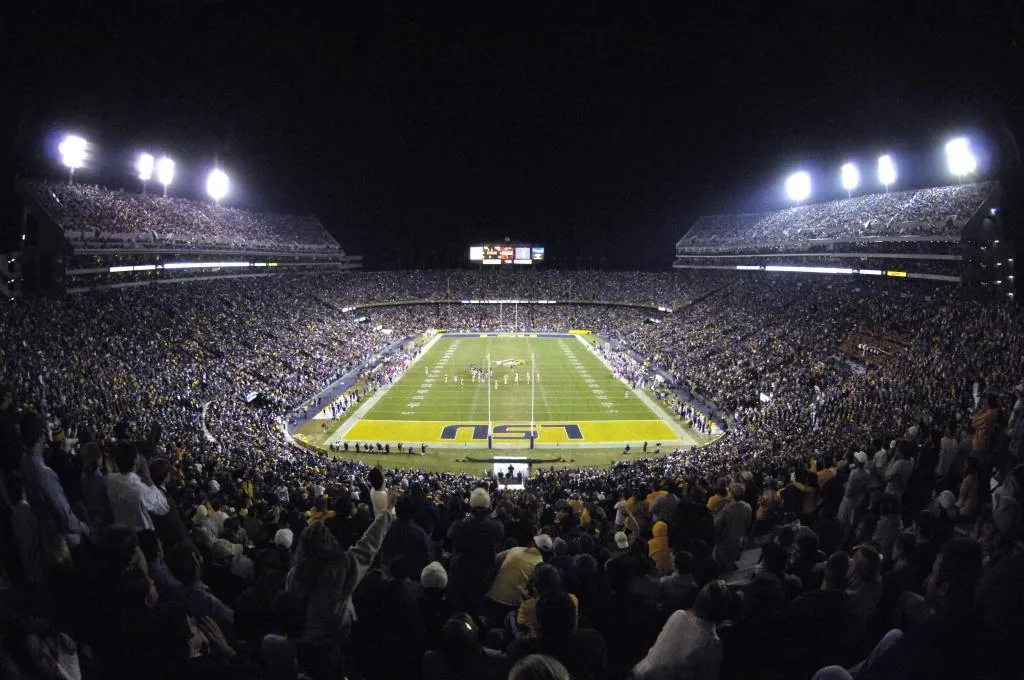
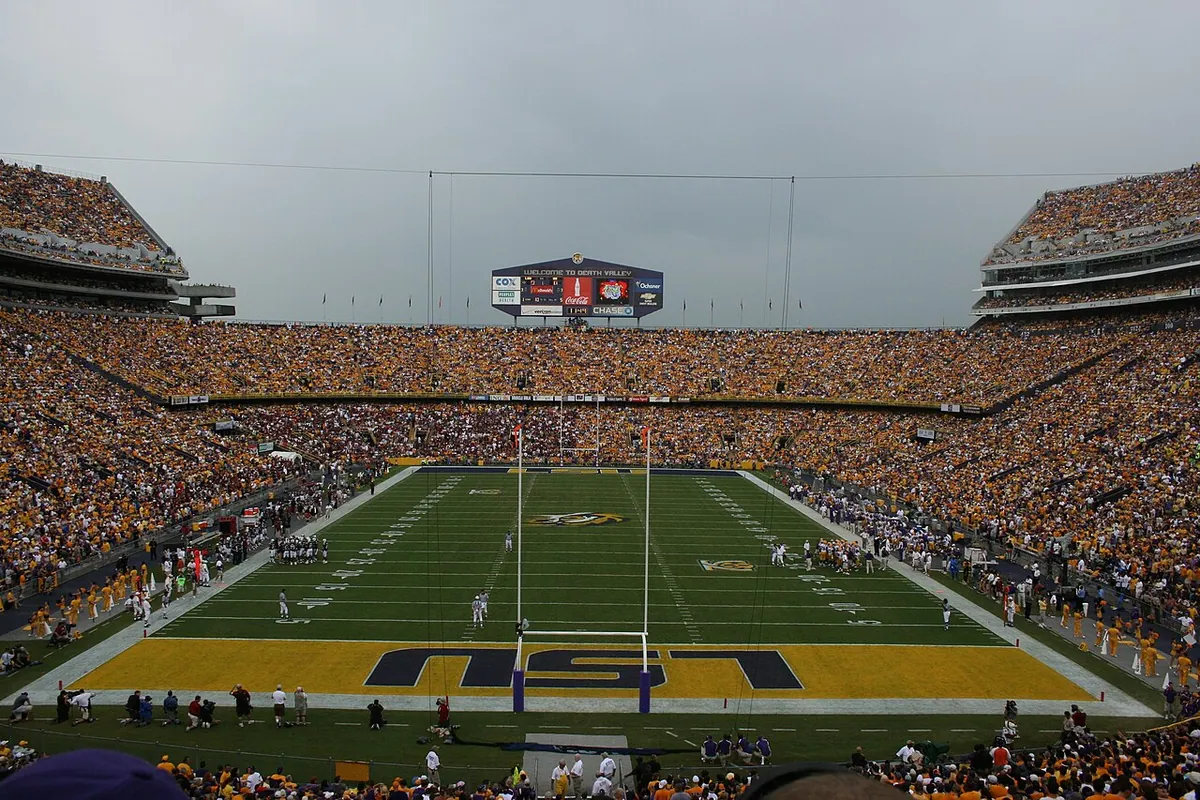
Tiger Stadium opened in 1924 with a single-deck grandstand seating 12,000 fans. The first major expansion came in 1931, adding 10,000 seats to the existing sideline stands. A significant transformation occurred in 1936 when the north end zone was enclosed with 24,000 seats, turning the stadium into a horseshoe and bringing capacity to 46,000. This expansion famously incorporated student dormitories within the stadium structure, a concept attributed to athletic director T.P. Heard and supported by Governor Huey P. Long. The south end zone was double-decked and enclosed in 1953, creating a full bowl with a capacity of 67,720. Further expansions included an upper deck on the west side in 1978 and another on the east side in 2000. The most recent major project was an $80 million south end zone upper deck expansion completed in 2014, which was privately funded by the Tiger Athletic Foundation and increased the official capacity to 102,321. This makes Tiger Stadium the second-largest stadium in the Southeastern Conference, the fifth-largest in NCAA football, and the seventh-largest stadium in the world by capacity.
The stadium's capacity has evolved through numerous phases. It held 80,150 spectators by the end of the 1980s before being listed at 80,000 in 1994. The east upper deck addition in 2000 brought capacity to 91,600. After the west side was rebuilt with suites and a new press box following the 2004 season, capacity was set at 92,400 for the 2006 season. Minor additions before the 2011 season adjusted it to 92,542. The record attendance figure of 102,321 has been reached many times, with a notable occurrence on September 12, 2026, for a game against Louisiana Tech. The stadium's record attendance for a concert is 102,000, set by Garth Brooks on April 30, 2022. The playing surface is natural Celebration Bermuda Grass, and the facility is an open-air, outdoor stadium.
LSU Tigers Football at Tiger Stadium
Tiger Stadium has been the home of LSU Tigers football since its opening game against Tulane in 1924. The team has compiled a formidable home record, posting a 147-25 mark in Tiger Stadium since the 2000 season. LSU established a school record with 22 consecutive home victories from October 24, 2009, to October 13, 2012. The stadium is particularly famous for its night games, a tradition that began in 1931. Since 1960, LSU's record in night games at Tiger Stadium is 201-59-3, compared to a 21-22-3 record in day games over the same span. The atmosphere is consistently rated among the most intimidating in college football, with surveys and media polls repeatedly naming it the most difficult place for a visiting team to play.
The 2024 LSU team won six of its seven home games, averaging 101,235 fans per contest. In 2023, the Tigers went 7-0 at home with an average attendance of 100,742. The 2022 season featured a 6-1 home record and an average of 100,596 fans, including victories over two Top 10 opponents, Ole Miss and Alabama. The 2019 season was especially dominant, as LSU outscored its home opponents by an average of 48-14. That year included a sold-out 102,321 crowd for a win over Florida. The 2014 season marked the opening of the south end zone expansion, and LSU averaged a then-school-record 101,723 fans for seven home games. The stadium's acoustics are noted, with noise levels recorded at 130 decibels during a 2007 game and crowd reactions strong enough to register on campus seismographs.
- 1924: Stadium opens. LSU hosts Tulane.
- 1931: First night game is played at Tiger Stadium.
- 1959: Billy Cannon's Halloween Run punt return touchdown helps LSU defeat Ole Miss 7-3.
- 1988: The "Earthquake Game" against Auburn. Crowd reaction registers on a seismograph.
- 1997: #14 LSU upsets top-ranked Florida 28-21.
- 2007: #1 LSU beats #9 Florida 28-24 in a game where stadium noise hits 130 decibels.
- 2019: LSU finishes 7-0 at home en route to a national championship.
- 2022: LSU defeats #6 Alabama 32-31 before a capacity crowd of 102,321.
NFL Games and Other Football Events
In addition to college football, Tiger Stadium has hosted professional games and other football contests. Following Hurricane Katrina in 2005, the damaged Superdome in New Orleans forced the New Orleans Saints to relocate. Tiger Stadium served as the Saints' temporary home for four regular season games during the 2005 NFL season. The Saints utilized approximately 79,000 seats for these games, as the new west side upper deck was still under construction. The highest combined score in those games was 37 points, occurring when the Chicago Bears defeated the New Orleans Saints 20-17 on November 6, 2005.
The stadium has also been the site of postseason and special football events. The NCAA Division II Grantland Rice Bowl was held at Tiger Stadium in both 1974 and 1975. Furthermore, the first national championship game for high school football was played there on December 31, 1938. Dupont Manual High School from Louisville, Kentucky, won the game, defeating New Britain High School from Connecticut with a final score of 28 to 20.
Renovations and Unique Features
Beyond capacity expansions, Tiger Stadium has undergone significant renovations to improve facilities and the fan experience. Major renovation years include 1994, 2006, 2011, and 2014. The 2006 project involved rebuilding the west side with over 3,200 club and suite seats and a new press box named for longtime sports information director Paul Manasseh. The 2014 south end zone expansion added 70 suites, over 3,000 club seats, and more than 1,500 general admission seats. Later additions include the open-air "Skyline Club" atop the south end zone in 2017 and "The Chute" beer garden below the south bleachers in 2018. Stadium-wide alcohol sales began in 2019. The Jeff Boss Locker Room, named for the longtime equipment manager, is an 8,000-square-foot facility that was renovated prior to the 2014 season. It features 126 lockers, a dedicated area for LSU's first-round NFL draft picks, and team graphics.
Tiger Stadium possesses several unique physical characteristics. The field is marked with yard lines at five-yard intervals, a detail not found in most stadiums. The 20-yard lines have distinctive purple and yellow borders along their entire length. A symbolic crossbar from the goalposts that stood from 1955 to 1984 is mounted above the door from the LSU locker room to the field. Painted with the word "WIN!", it is tradition for every player to touch it on their way onto the field. The stadium's steep, enclosed bowl design is credited with trapping and amplifying crowd noise, contributing to its reputation as an exceptionally loud venue.
Visitor Information and Game Day
Tiger Stadium is located on West Stadium Road on the LSU campus in Baton Rouge. On football game days, the stadium becomes the fifth-largest "city" in Louisiana by population. The venue is a cashless facility, with all transactions conducted by card, though cash-to-card machines are available. A clear bag policy is enforced, with only bags 12x6x12 inches or smaller permitted. The stadium offers guided tours on select dates, starting at the Bill Lawton Room near the north-west corner of the stadium. The tour includes access to areas such as the locker rooms and the field, along with a history of the stadium. Adult tour tickets cost $10, and youth tickets (under 13) are $5.
Parking on campus is organized into color-coded zones, with season passes ranging from $600 to $1,500. Individual game parking in lots like the Old Front Nine is typically $50 per game. Tailgating is a major component of the game day culture, with fans often setting up days in advance. Major access routes include Interstate 10 and Interstate 12. The closest airport is Baton Rouge Metropolitan Airport (BTR), nine miles north, while many fans also fly into New Orleans International Airport (MSY), about 72 miles away. Public transit options are limited, and as of 2024, the local CATS system no longer operates gameday shuttles to the stadium.
Record Attendance and Notable Non-Football Events
The official record attendance for Tiger Stadium is 102,321, a figure tied or set on numerous occasions. The stadium first reached this capacity in 2014 following the south end zone expansion. Notable football games that have drawn 102,321 fans include LSU's victory over Alabama on November 5, 2022, its game against Tennessee on October 8, 2022, and a game against Louisiana Tech on September 12, 2026. Other capacity crowds witnessed games against Florida in 2019, Alabama in 2018 and 2016, Georgia in 2018, and Auburn in 2015. Prior to the 2014 expansion, attendance records climbed gradually, with marks like 92,664 in 2005, 93,129 in 2009, and 101,194 in 2014.
| Rank | Attendance | Visiting Team | Date | Result |
|---|---|---|---|---|
| 1. | 102,321 | Alabama | Nov. 5, 2022 | LSU, 32-31 |
| 1. | 102,321 | Tennessee | Oct. 8, 2022 | Tennessee, 40-13 |
| 1. | 102,321 | Southern | Sep. 10, 2022 | LSU, 65-17 |
| 1. | 102,321 | Florida | Oct. 12, 2019 | LSU, 42-28 |
| 1. | 102,321 | Alabama | Nov. 3, 2018 | Alabama, 29-0 |
The stadium has also hosted major concerts and events. The crowd's reaction during his performance of "Callin' Baton Rouge" was strong enough to register on a seismograph. From 2010 to 2016, the Bayou Country Superfest was held at Tiger Stadium each Memorial Day weekend before moving to the Superdome. Other performers have included Taylor Swift in 2015 and Luke Bryan in 2016. The stadium was also the site of a public inauguration party for Governor Edwin Edwards in 1972.
Recent games
| Date | Game | Week |
|---|---|---|
| Dec 18, 2005 | Carolina Panthers 27 at New Orleans Saints 10 | Week 15 |
| Dec 4, 2005 | Tampa Bay Buccaneers 10 at New Orleans Saints 3 | Week 13 |
| Nov 6, 2005 | Chicago Bears 20 at New Orleans Saints 17 | Week 9 |
| Oct 30, 2005 | Miami Dolphins 21 at New Orleans Saints 6 | Week 8 |
Video
FAQ
Why is LSU's stadium called Death Valley?
Tiger Stadium earned the nickname Death Valley due to its reputation as one of the most intimidating and difficult venues for visiting teams in college football. The steep, enclosed bowl design traps crowd noise, creating an exceptionally loud environment that disrupts opponents. Numerous surveys over decades, including those by the College Football Association, The Sporting News, and ESPN, have consistently ranked it as the toughest place to play. The loud atmosphere and LSU's strong home record gave rise to the Death Valley name.
When did Tiger Stadium open and what was its original size?
Tiger Stadium opened on November 25, 1924. The original structure was a single-deck grandstand designed by the firm Wogan and Bernard with a modest capacity of 12,000 spectators. The inaugural game featured LSU hosting in-state rival Tulane. The stadium was built on the southern edge of the LSU campus in Baton Rouge. From this humble beginning, it has undergone multiple major expansions over the last century to reach its current massive size.
Have any NFL games been played at Tiger Stadium?
Yes, Tiger Stadium has hosted NFL games. Following Hurricane Katrina in 2005, the New Orleans Saints were displaced from their home, the Superdome. Tiger Stadium served as the Saints' temporary home for four regular season games during the 2005 NFL season. The Saints used approximately 79,000 seats for these contests. From the 1999 season through November 27, 2026, a total of four NFL games have been played at the venue.
What was the Earthquake Game at Tiger Stadium?
The Earthquake Game occurred on October 8, 1988, during a matchup between LSU and Auburn. With seconds remaining, LSU quarterback Tommy Hodson threw an 11-yard game-winning touchdown pass to running back Eddie Fuller, giving LSU a 7-6 victory. The crowd's explosive reaction to the score was so powerful that it registered as a legitimate seismic event on a seismograph located in the Louisiana Geological Survey office on campus, approximately 1,000 feet away. This was the first recorded instance of a college football game causing detectable seismic activity.
Can you take a tour of Tiger Stadium?
Yes, guided public tours of Tiger Stadium are offered on select dates. Tours begin at the Bill Lawton Room near the north-west corner of the stadium. The tour includes access to areas such as the locker rooms and the field, along with a history of the stadium. The experience lasts about 45 minutes. As of 2026, adult tickets cost $10, and tickets for youth under 13 years old are $5. The stadium is also a cashless venue, and a clear bag policy is enforced for all events.
What is the current seating capacity of Tiger Stadium at LSU?
The current seating capacity of Tiger Stadium is 102,321. This capacity has been in place since the 2014 expansion project. The stadium opened in 1924 with a capacity of just 12,000, and through numerous renovations and expansions over the decades, it has grown into one of the largest stadiums in college football. It is now the fifth-largest stadium in the NCAA and the second-largest in the Southeastern Conference.
Sources
- Tiger Stadium (Louisiana) (Wikipedia) Wikipedia
- Tiger Stadium, LSUsports.net, The Official Website of LSU Athletics lsusports.net
- Tiger Stadium (LSU), Baton Rouge: Capacity & Visitor Guide, MeetStadium meetstadium.com
- Tiger Stadium visitbatonrouge.com
- nflverse game, roster and draft data nflverse (CC BY 4.0)