Super Bowl XLVII
February 3, 2013 · Mercedes-Benz Superdome, New Orleans, LouisianaScoring summary
Game leaders
Game story
Super Bowl XLVII was the championship game of the 2012 NFL season, played on February 3, 2013. The Baltimore Ravens defeated the San Francisco 49ers by a score of 34-31 at the Mercedes-Benz Superdome in New Orleans, Louisiana. The game is famously known as the Har-Bowl for featuring opposing head coaches John Harbaugh of the Ravens and Jim Harbaugh of the 49ers, who are brothers. Baltimore quarterback Joe Flacco was named the game's Most Valuable Player after leading his team to its second Super Bowl title. The contest also became known as the Blackout Bowl due to a 34-minute power outage in the third quarter.
Date, Venue and Host City Selection
Super Bowl XLVII was played on Sunday, February 3, 2013, with a kickoff time of 5:30 p.m. CST. The game took place at the Mercedes-Benz Superdome in New Orleans, Louisiana. This marked the tenth time the New Orleans area hosted a Super Bowl, tying it with the Miami area for the most by a metropolitan area. It was the seventh Super Bowl played inside the Superdome specifically. The NFL selected New Orleans as the host city during league meetings on May 19, 2009, choosing it over bids from Glendale, Arizona, and Miami Gardens, Florida. This was the first Super Bowl held in New Orleans since Super Bowl XXXVI and the first since the city and stadium underwent major renovations following Hurricane Katrina in 2005. The game's date required adjustments to the 2013 Mardi Gras parade calendar in Orleans Parish, moving parades scheduled for February 3 and earlier ahead by one week.
The 2012 Baltimore Ravens
The Baltimore Ravens finished the 2012 regular season with a 10-6 record, winning the AFC North division. Head coach John Harbaugh, in his fifth season, led a team that ranked 10th in the NFL in points scored per game at 24.9. The offense was commanded by quarterback Joe Flacco, who threw for 3,817 yards and 22 touchdowns against 10 interceptions. His top targets were wide receiver Anquan Boldin, who had 65 catches for 921 yards, and tight end Dennis Pitta, who caught 61 passes. Running back Ray Rice rushed for 1,143 yards and made the Pro Bowl, while the offensive line was anchored by Pro Bowl guard Marshal Yanda and veteran center Matt Birk. In a mid-season change, the team dismissed offensive coordinator Cam Cameron in December and raised quarterbacks coach Jim Caldwell to the position for the playoff run. The Ravens defense allowed 21.5 points per game, ranking 12th in the league. Key defensive players included several notable contributors from the 2012 season.
- Linebacker Ray Lewis announced his retirement before the playoffs after missing most of the season with an arm injury.
- Linebacker Terrell Suggs, a five-time Pro Bowl selection, returned from an Achilles tendon injury to play in the postseason.
- Defensive end Haloti Ngata made the Pro Bowl after recording 51 tackles and 5 sacks.
- Safety Ed Reed, the NFL's all-time leader in interception return yardage, had 58 tackles and 4 interceptions.
- Linebacker Paul Kruger led the team with 9 sacks during the regular season.
Special teams were a major asset, featuring return specialist Jacoby Jones. Jones returned 38 kickoffs for 1,116 yards and two touchdowns, averaging 30.7 yards per return. He also returned a punt for a touchdown. Rookie kicker Justin Tucker was successful on 30 of 33 field goal attempts, a 90.9 percent conversion rate. The team dedicated their season to former owner Art Modell, who died on September 6, 2012.
The 2012 San Francisco 49ers
The San Francisco 49ers posted an 11-4-1 regular season record, winning the NFC West under second-year head coach Jim Harbaugh. The team's season was defined by a quarterback change, as starter Alex Smith was replaced by backup Colin Kaepernick during the season. Kaepernick started the remainder of the season, throwing for 1,814 yards and 10 touchdowns while also rushing for 415 yards and 5 scores. The offense featured Pro Bowl running back Frank Gore, who ran for 1,214 yards, and wide receiver Michael Crabtree, who had a career-high 85 receptions for 1,105 yards. Veteran receiver Randy Moss, signed out of retirement, and tight end Vernon Davis were other key targets. The offensive line sent two players to the Pro Bowl: left tackle Joe Staley and left guard Mike Iupati.
San Francisco's defense was among the league's best, ranking second in points allowed per game at 17.1. Six defensive starters were selected to the Pro Bowl, reflecting the unit's dominance. The defensive line was led by end Justin Smith, who had 66 tackles. The linebacker corps was historically talented, with all four starters earning All-Pro honors. Aldon Smith set a franchise record with 19.5 sacks, NaVorro Bowman had 149 tackles, and Patrick Willis added 120 tackles. The secondary featured Pro Bowl safeties Dashon Goldson and Donte Whitner. On special teams, punter Andy Lee led the NFL with a 43.2 net punting average. Kicker David Akers, though inconsistent, tied the NFL record with a 63-yard field goal in the season opener.
Road Through the Playoffs
The Baltimore Ravens entered the playoffs as the AFC's number 4 seed. Their postseason run began at home against the Indianapolis Colts in the Wild Card round, a game billed as Ray Lewis's final home contest. The Ravens won 24-9, with Flacco throwing for 288 yards and two scores. In the Divisional round, they traveled to face the top-seeded Denver Broncos and quarterback Peyton Manning. Trailing late, Flacco's 70-yard touchdown pass to Jacoby Jones with less than a minute left forced overtime, a play later called the Mile High Miracle. Cornerback Corey Graham intercepted Manning in double overtime, setting up Justin Tucker's game-winning 47-yard field goal for a 38-35 victory. The AFC Championship Game was a rematch with the New England Patriots. The Ravens overcame a 13-7 halftime deficit, intercepting Tom Brady twice in the second half and winning 28-13 to advance to the Super Bowl.
The San Francisco 49ers earned the NFC's number 2 seed and a first-round bye. They hosted the Green Bay Packers in the Divisional round. After throwing an interception returned for a touchdown on his first drive, Colin Kaepernick responded spectacularly. In the NFC Championship Game against the Atlanta Falcons, San Francisco trailed 17-0 early and 24-14 at halftime. The 49ers rallied in the second half, with Frank Gore scoring the go-ahead touchdown late in the fourth quarter to secure a 28-24 victory and a trip to New Orleans.
Game Summary by Quarter and Key Plays
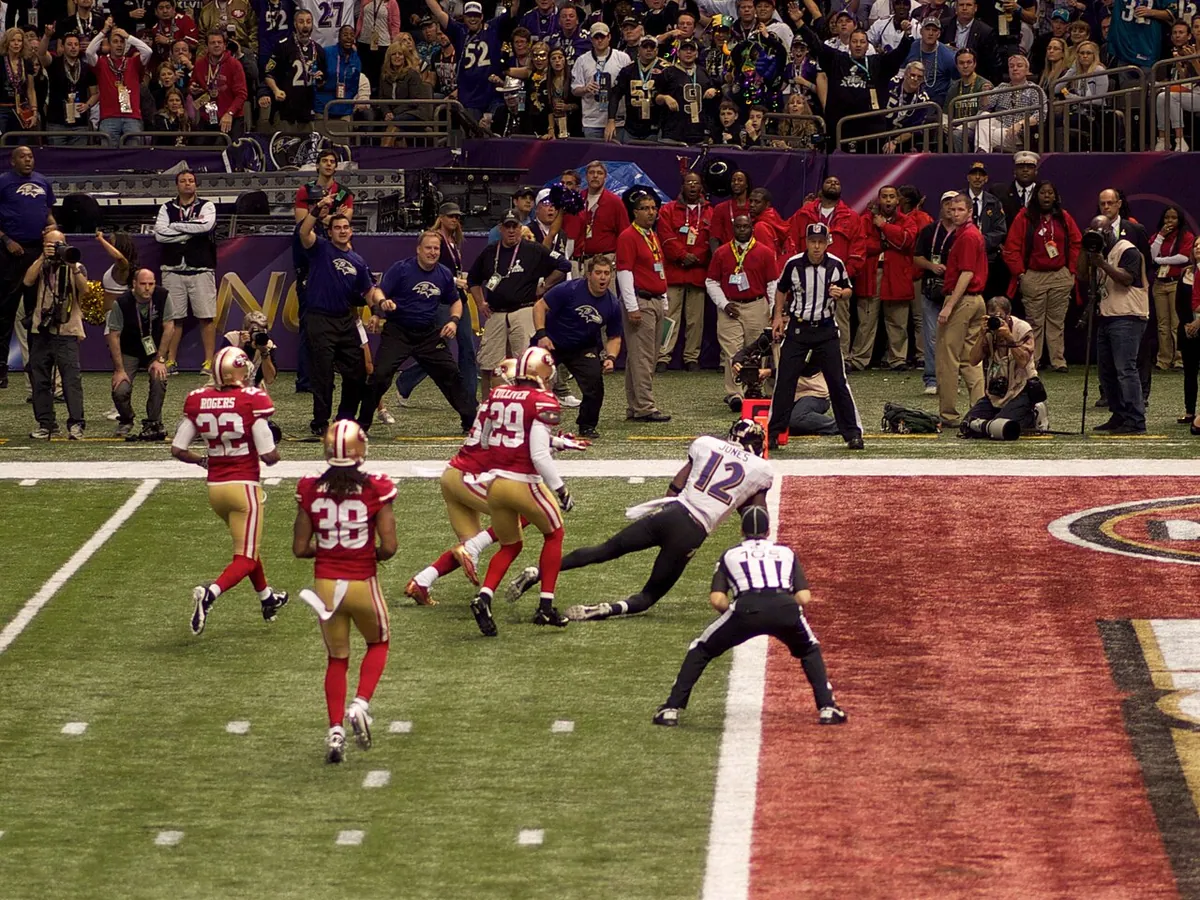
The first quarter began with the Ravens deferring after winning the coin toss. After an exchange of possessions, Joe Flacco engineered a drive culminating in a 13-yard touchdown pass to Anquan Boldin. The 49ers responded with a drive that stalled, leading to a 36-yard David Akers field goal. The score was 7-3 after one quarter. The second quarter saw Baltimore extend its control. Flacco found Dennis Pitta for a 1-yard touchdown on a play-action pass. Later, Flacco launched a deep pass to Jacoby Jones, who caught it, fell, got up, and eluded two defenders for a 56-yard score. Akers kicked a 27-yard field goal as the half expired, making the score 21-6 in favor of Baltimore at halftime.
The third quarter opened with one of the most explosive plays in Super Bowl history. Jacoby Jones received the kickoff in the end zone and returned it 108 yards for a touchdown, matching the Super Bowl record for longest play. This gave the Ravens a 28-6 lead. Moments later, a partial power outage at the Superdome plunged sections of the stadium into darkness, causing a 34-minute delay. After play resumed, the 49ers' offense came alive. Colin Kaepernick connected with Michael Crabtree on a 31-yard touchdown pass. Frank Gore then powered in for a 6-yard rushing touchdown. David Akers added a 34-yard field goal, cutting the deficit to 28-23 by the end of the quarter.
The fourth quarter was defined by tense, score-for-score action and critical defensive stands. Ravens kicker Justin Tucker made a 39-yard field goal to extend the lead to 31-23. The 49ers answered with a drive capped by Kaepernick's 15-yard touchdown run around the right edge, but his two-point conversion pass attempt fell incomplete, leaving the score at 31-29. Tucker then hit a 38-yard field goal to make it 34-29. San Francisco's final chance came on a drive to the Baltimore 7-yard line. On fourth down, Kaepernick's pass intended for Michael Crabtree in the end zone was incomplete amid contact, resulting in a turnover on downs. The Ravens took over and, with 12 seconds left, punter Sam Koch took an intentional safety by running around the end zone, making the final score 34-31.
Statistics and Most Valuable Player
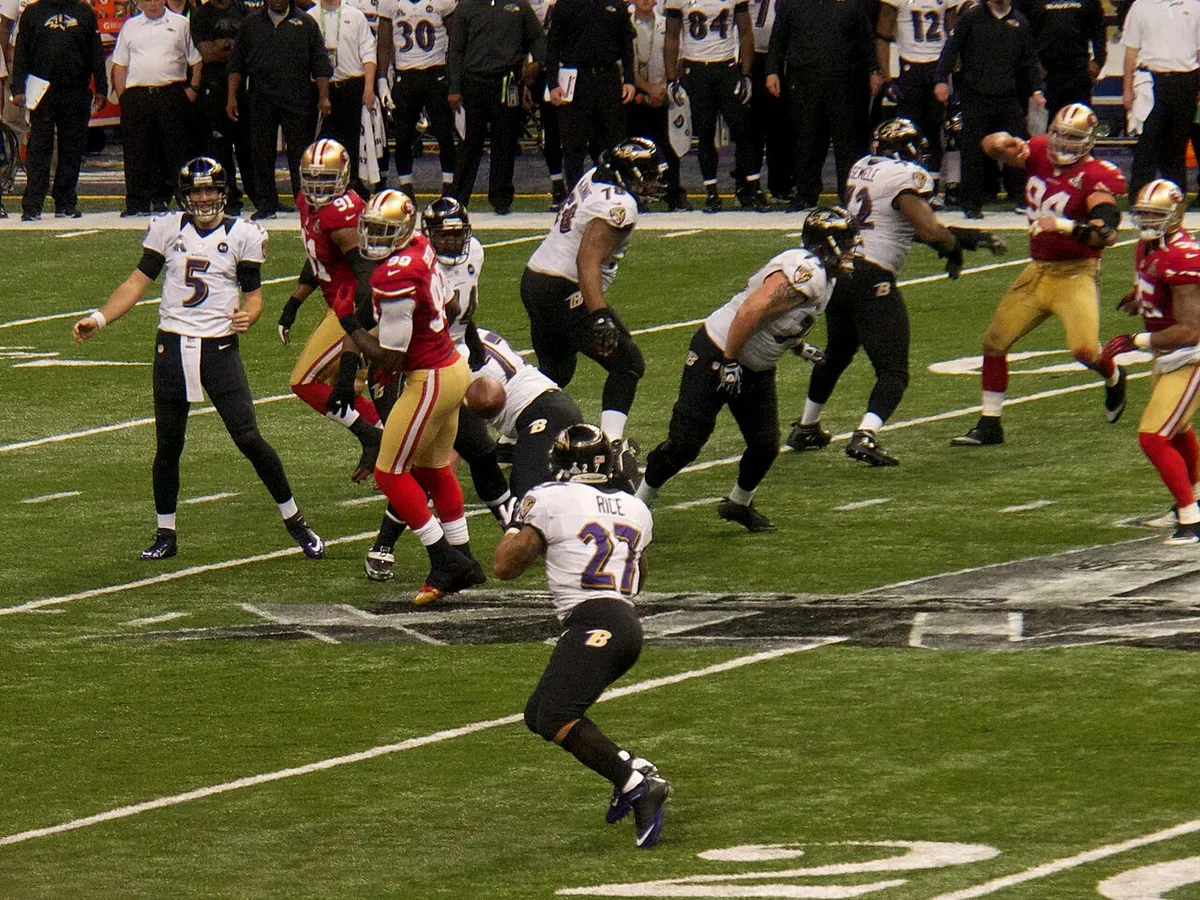
Baltimore Ravens quarterback Joe Flacco was named Super Bowl MVP after a precise and efficient performance. He completed 22 of 33 passes for 287 yards and three touchdowns with no interceptions. Flacco became the fourth consecutive quarterback to win the award, following Drew Brees, Aaron Rodgers, and Eli Manning. Jacoby Jones had a significant all-purpose yardage total for Baltimore, a performance that included his record-tying kickoff return and long reception. The game's statistical battle included several key categories.
| Statistical Category | Baltimore Ravens | San Francisco 49ers |
|---|---|---|
| First Downs | 21 | 23 |
| Turnovers | 0 | 2 |
| Third Down Efficiency | 9/16 (56%) | 2/9 (22%) |
Halftime Show and Television Broadcast
The Super Bowl XLVII halftime show was headlined by pop superstar Beyoncé. Her performance featured a reunion with former Destiny's Child members Kelly Rowland and Michelle Williams, who joined her on stage for a medley of the group's hits. The high-energy production included elaborate choreography and pyrotechnics. CBS held the American television broadcast rights for the game. The network's broadcast team consisted of play-by-play announcer Jim Nantz and color analyst Phil Simms. Steve Tasker and Solomon Wilcots served as sideline reporters on the field. For the national radio audience, Dial Global carried the broadcast with Kevin Harlan on play-by-play and Boomer Esiason providing analysis. The cost for advertisers to reach the massive audience set a new benchmark, as the average price for a 30-second commercial spot reached $4 million.
Viewership, Ratings and Commercial Impact
Super Bowl XLVII drew a massive television audience. According to Nielsen, the game earned a national rating of 46.4 with a 69 market share, meaning nearly 70 percent of televisions in use at the time were tuned to the game. An estimated average of 108.69 million viewers in the United States watched the broadcast. A record 164.1 million people watched at least six minutes of the game, demonstrating its reach beyond dedicated football fans. Local ratings were exceptionally high in markets connected to the teams. The Baltimore area recorded a 59.6 rating, the New Orleans area where the game was played had a 57.1 rating, and the San Francisco area posted a 49.0 rating.
Legacy and Historical Significance
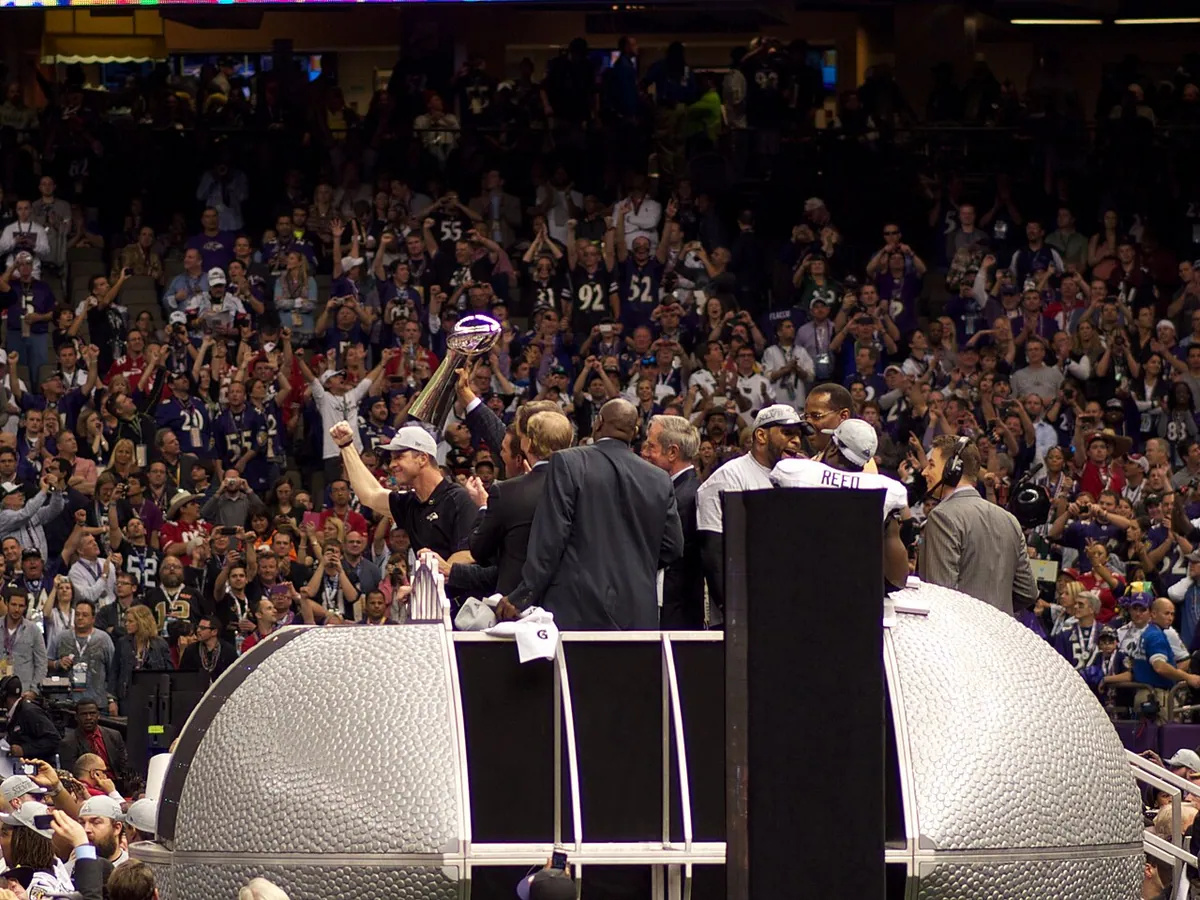
Super Bowl XLVII is remembered for several unique historical firsts and its dramatic narrative. It was the first Super Bowl to feature brothers as opposing head coaches, John and Jim Harbaugh, earning it enduring nicknames like the Har-Bowl and Brother Bowl. The game also marked the first meeting between two teams with undefeated records in previous Super Bowls, with the 49ers at 5-0 and the Ravens at 1-0. The 49ers' loss was their first in a Super Bowl appearance, ending their perfect streak. The 34-minute power outage during the third quarter created an unprecedented mid-game delay, leading to the secondary nickname the Blackout Bowl. The contest served as the final NFL game for two future Hall of Famers: Ravens linebacker Ray Lewis and 49ers receiver Randy Moss. Furthermore, the Ravens' victory secured the second championship in franchise history and, as of 2026, remains the most recent major professional sports title for any team based in Baltimore.
FAQ
Who won Super Bowl XLVII?
The Baltimore Ravens won Super Bowl XLVII. They defeated the San Francisco 49ers by a final score of 34-31 on February 3, 2013. This victory gave the Ravens their second Super Bowl championship in franchise history. The win was sealed by a defensive stop on a fourth-down play and an intentional safety in the game's final moments.
Who was the MVP of Super Bowl 47?
Baltimore Ravens quarterback Joe Flacco was named the Most Valuable Player of Super Bowl XLVII. Flacco completed 22 of 33 passes for 287 yards and three touchdowns without throwing an interception. His performance made him the fourth consecutive quarterback to win the Super Bowl MVP award. Flacco's precise passing helped the Ravens build a large early lead that withstood the 49ers' comeback.
What happened with the power outage in Super Bowl XLVII?
A partial power outage occurred at the Mercedes-Benz Superdome early in the third quarter of Super Bowl XLVII. The outage caused a delay in the game that lasted 34 minutes. Play was suspended with the Baltimore Ravens leading 28-6. After power was restored, the San Francisco 49ers mounted a significant comeback, scoring 17 unanswered points in the quarter. This event led to the game being nicknamed the Blackout Bowl.
Where was Super Bowl XLVII played?
Super Bowl XLVII was played at the Mercedes-Benz Superdome in New Orleans, Louisiana. The game was held on February 3, 2013. This was the tenth Super Bowl hosted by the New Orleans area, tying it with the Miami area for the most hosted by a metropolitan area. It was the first Super Bowl in New Orleans since the stadium and city underwent renovations after Hurricane Katrina.
Why is Super Bowl XLVII called the Har-Bowl?
Super Bowl XLVII is called the Har-Bowl because it featured two brothers as opposing head coaches. John Harbaugh was the head coach of the Baltimore Ravens, and Jim Harbaugh was the head coach of the San Francisco 49ers. This was the first time in Super Bowl history that brothers coached against each other in the championship game. The matchup also earned other nicknames like the Brother Bowl and Super Baugh.
What was the halftime show for Super Bowl 47?
The halftime show for Super Bowl XLVII featured Beyoncé, who performed with a reunion of Destiny's Child alumni Kelly Rowland and Michelle Williams. This performance was a major highlight of the entertainment during the game. The show took place at the Mercedes-Benz Superdome in New Orleans on February 3, 2013. Beyoncé's energetic set was a memorable part of the event that closed the 2012 NFL season.
Sources
- Super Bowl XLVII (Wikipedia) Wikipedia
- Super Bowl XLVII: Ravens vs. 49ers Highlights baltimoreravens.com
- Super Bowl XLVII NFL
- Super Bowl 2013 Final Score: Recap and Scoring Breakdown by Quarter Bleacher Report
- Super Bowl XLVII highlights cbsnews.com
- nflverse game, roster and draft data nflverse (CC BY 4.0)
Road to the Super Bowl
Indianapolis ColtsW 24–9Divisional
@ Denver BroncosW 38–35AFC Championship
@ New England PatriotsW 28–13
Green Bay PackersW 45–31NFC Championship
@ Atlanta FalconsW 28–24