The Detroit Lions Cheerleaders are the National Football League cheerleading squad representing the Detroit Lions, established in 2016. They perform at home games in Ford Field and participate in numerous community events across the Detroit area. The squad is directed by Tori Murphy and marked the team's return to having official cheerleaders after a gap of over 40 years. Alongside the cheerleaders, the team's mascot Roary the Lion and the fight song Gridiron Heroes are part of the game day experience.
The Detroit Lions Cheerleaders
The Detroit Lions Cheerleaders represent the franchise's official return to sideline entertainment after a long hiatus. The organization's first official cheerleading squad operated from 1963 until 1974. For decades afterward, the team did not field an official squad, though an unofficial group called the Detroit Pride performed from 2010. The current Detroit Lions Cheerleaders were formally announced on June 12, 2016, with Rebecca Girard-Smoker named as the inaugural coach. The squad's mission extends beyond game day performances to include active community involvement and mentorship programs for young girls in Detroit.
The cheerleaders perform at all Detroit Lions home games at Ford Field, which has been the team's home stadium since the 2002 season. Their routines are a component of the in-game entertainment, designed to energize the crowd during breaks in play. The squad also represents the Lions at numerous public appearances, charity functions, and youth clinics throughout the year. The director of the squad is Tori Murphy, who oversees all operations, training, and public engagements for the team.
- The first official cheer squad existed from 1963 to 1974.
- The current squad was announced on June 12, 2016.
- Rebecca Girard-Smoker was the inaugural coach in 2016.
- Director Tori Murphy leads the squad.
- The squad performs at Ford Field, the home stadium since 2002.
- They engage in community events and youth mentorship.
Roary the Lion and Mascot History
Roary replaced the team's previous long-time mascot, Bubbles the Lion, who had been the mascot since 1934. Roary's duties include leading cheers, interacting with fans of all ages, and performing comedic skits during games at Ford Field. The mascot also makes frequent community appearances and hosts special events like the Mascot Bowl for children. The history of Lions mascots includes the Baker family. The franchise's first mascot was William Moon Baker, who began portraying a lion in 1934 and continued in the role for 27 years. His son, Bill Baker, then took over the mascot duties in 1960, meaning the Baker family represented the team for nearly 60 consecutive years. In recent years, the Lions have expanded their mascot roster to include international versions for global marketing, such as Reizinho for Brazil and Leo Löwe for Germany. Roary remains the primary mascot.
- Roary the Lion became the official mascot in 2011.
- He replaced the previous mascot, Bubbles the Lion.
- The first mascot was William Moon Baker, starting in 1934.
- Baker served for 27 years, with his son taking over in 1960.
- His son Bill Baker then took over the role.
- The Baker family served for nearly 60 consecutive years.
- International mascots include Leo Löwe for Germany and Reizinho for Brazil.
Fan Culture and Traditions
Detroit Lions fans are known for their loyalty and vocal support, particularly during home games at Ford Field. A central tradition is the singing of the team's official fight song, Gridiron Heroes, which is played after every Lions score. The song's familiar tune and lyrics are a rallying cry that unites the stadium. Another fan tradition involves holding up three fingers, a gesture representing the 313 area code of Detroit.
The team's colors of Honolulu blue and silver are prominently displayed throughout the stadium, with fans often wearing jerseys of current stars and past legends. Tailgating around Ford Field is a major pre-game ritual, where fans gather for food, drinks, and camaraderie hours before kickoff. The Lions have played home games on Thanksgiving Day, a fixture of the team's annual calendar. This national television broadcast often features special uniform elements, such as the throwback jerseys worn from 2001 to 2004. The fan base has endured long playoff droughts but has remained steadfast.
Game Day Atmosphere at Ford Field
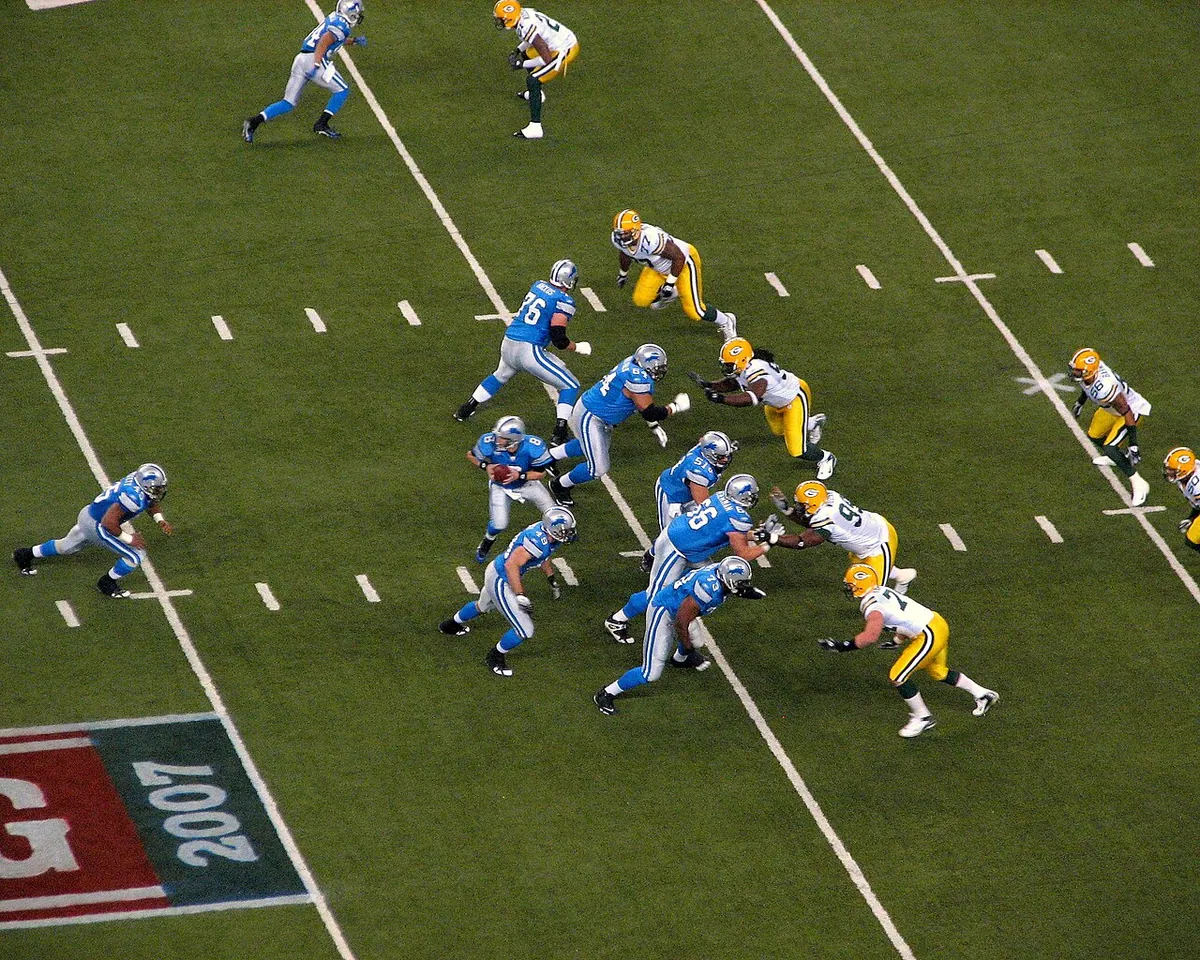
Since opening in 2002, the indoor stadium has provided a consistent and loud environment for Lions home games. The Detroit Lions Cheerleaders perform choreographed routines on the sidelines and in the stands throughout the game. Roary the Lion roams the concourses and field level, taking photos with fans and leading interactive cheers. A key moment occurs after every Lions touchdown, field goal, or safety when the fight song Gridiron Heroes blares through the stadium. The introduction of new uniform combinations in 2024, including the One Pride home jerseys and the Motor City Muscle black alternates, has added visual variety to the in-stadium presentation. The Lions' regular season record from the 1999 season through 2025 was 175-260-2, and the team's 8-3 start to the 2026 season has contributed to a more positive atmosphere. The combination of fan traditions, cheerleading performances, and mascot antics creates a distinctive environment for football in downtown Detroit.
Evolution of Team Identity and Presentation
The team's colors have remained primarily Honolulu blue and silver since 1934, with brief exceptions like the scarlet and black period from 1948 to 1950. Uniform details like sleeve stripes, number outlines, and facemask colors have changed periodically, often reflecting broader NFL trends. A significant modernization occurred in 2009 with a new logo featuring a more aggressive lion with a flowing mane and fangs. The team removed black from its color scheme in 2017, reverting to a focus on Honolulu blue and silver, and added a permanent WCF sleeve tribute to owner William Clay Ford.
The most recent overhaul came in 2024 with a new jersey set that includes three distinct themes. The One Pride home jersey features redefined Honolulu blue with white numbers, while the road 313 white jersey includes a Honolulu blue Detroit wordmark. The alternate Motor City Muscle black jersey, a favorite of head coach Dan Campbell, was reintroduced and is paired with a special Honolulu blue helmet featuring a black leaping lion logo. These uniform changes are part of the game day spectacle.
- Team colors have been Honolulu blue and silver since 1934.
- A scarlet and black uniform period lasted from 1948 to 1950.
- A modernized logo with fangs was introduced in 2009.
- The 2024 jersey set includes One Pride, 313, and Motor City Muscle themes.
- The black alternate jersey returned due to coach Dan Campbell's advocacy.
- The WCF sleeve patch is a permanent tribute to William Clay Ford.
Community Involvement and Global Reach
Beyond game day, the Lions' cheerleaders and mascot program maintain a significant presence in the community and internationally. The Detroit Lions Cheerleaders participate in community events, including charity fundraisers. Roary the Lion is equally active, making appearances at local festivals, corporate events, and youth football clinics. These efforts are designed to foster a positive relationship between the franchise and the city of Detroit, extending the team's brand beyond the football season. The Lions have also developed mascots for international markets as part of the NFL's global expansion efforts. The team created Leo Löwe to engage fans in Germany and Reizinho for Brazil, where the league holds marketing rights. These mascots help cultivate the Lions' fan base abroad.
Video
FAQ
When were the Detroit Lions Cheerleaders established?
The Detroit Lions Cheerleaders were established in 2016. This marked the franchise's return to having an official cheerleading squad after a gap of over 40 years, the previous squad having operated from 1963 to 1974. The squad was announced on June 12, 2016, with Rebecca Girard-Smoker named as the inaugural coach. The current director of the cheerleaders is Tori Murphy. They perform at all home games in Ford Field and engage in extensive community programs.
Who is the Detroit Lions mascot?
The official mascot of the Detroit Lions is Roary the Lion. Roary has held this role since 2011, replacing the previous mascot, Bubbles the Lion. The character is designed to appeal to a younger generation of NFL fans. Roary performs at games, interacts with fans, and makes community appearances. The Lions also have international mascots like Leo Löwe for Germany and Reizinho for Brazil as part of global marketing initiatives.
What is the Detroit Lions fight song?
The Detroit Lions' fight song is titled Gridiron Heroes. It is a traditional team anthem played after every Lions score during home games at Ford Field. The song is a rallying cry for fans and the cheerleaders, who often sing along. This tradition helps unify the crowd and reinforce team spirit during the game.
Where do the Detroit Lions play their home games?
The Detroit Lions play their home games at Ford Field in downtown Detroit. The team moved into the indoor stadium in 2002, after playing home games at the Pontiac Silverdome from 1999 to 2001. Ford Field is the venue for all game day traditions, cheerleading performances, and mascot appearances. It hosts a loud environment for Lions football.
Who was the first official cheerleading squad for the Detroit Lions?
The first official cheerleading squad for the Detroit Lions formed in 1963 and continued until 1974. This squad existed for over a decade before the team went without official cheerleaders for more than 40 years. The current Detroit Lions Cheerleaders squad was not established until 2016. Before the 2016 squad, an unofficial group called the Detroit Pride formed in 2010 to cheer for the team.
Who was the original mascot for the Detroit Lions when the team moved to Detroit?
The original mascot when the Detroit Lions moved to Detroit in 1934 was Bubbles the Lion, portrayed by William "Moon" Baker. Baker spent 27 years in the role starting in the 1930s, establishing a long family tradition. His son Bill later took over the mascot duties in 1960. This history means the Lions' mascot lineage dates back to the very founding of the franchise in Detroit.
Sources
- Detroit Lions Cheerleaders (Wikipedia) Wikipedia
- Detroit Lions (Wikipedia) Wikipedia
- nflverse game, roster and draft data nflverse (CC BY 4.0)