Paul William "Bear" Bryant was an American college football player and coach. He is best known for his 25-year tenure as head coach of the University of Alabama Crimson Tide from 1958 to 1982. During his coaching career, Bryant amassed six national championships and 13 Southeastern Conference titles. He retired with a then-record 323 wins as a head coach in collegiate football history. Bryant died in Tuscaloosa, Alabama on January 26, 1983.
Early Life and Playing Career
Paul William Bryant was born on September 11, 1913, in Moro Bottom, Arkansas. He was the 11th of 12 children born to William Monroe and Ida Kilgore Bryant. He earned his nickname Bear at age 13 after agreeing to wrestle a captive bear during a carnival promotion. Bryant attended Fordyce High School in Arkansas, where he began playing football as an eighth grader. He played offensive line and defensive end, helping his team win the 1930 Arkansas state football championship during his senior season. In 1931, he received a scholarship to play football at the University of Alabama. He played end for the Crimson Tide from 1933 to 1935, earning second-team All-Southeastern Conference honors in 1934 and third-team honors in 1933 and 1935. He was a member of the school's 1934 national championship team, playing opposite future Pro Football Hall of Famer Don Hutson. Bryant was selected by the Brooklyn Dodgers in the fourth round of the 1936 NFL Draft but never played professional football. He graduated from Alabama in 1936.
Assistant Coaching and Military Service
After graduating from Alabama in 1936, Bryant began his coaching career as the line coach at Union University in Tennessee. He served as an assistant at Alabama from 1936 to 1939, a period during which the team compiled a 29-5-3 record. In 1940, he left Alabama to become the line coach at Vanderbilt University under Red Sanders. While at Vanderbilt in 1940, he served as acting head coach for one game, a 7-7 tie against Kentucky, while Sanders recovered from an appendectomy. After the 1941 season, Bryant joined the United States Navy following the attack on Pearl Harbor. During his service, he coached the ends for the Georgia Pre-Flight Skycrackers in 1942. He was later granted an honorable discharge to coach the North Carolina Navy Pre-Flight football team. One of his players at North Carolina was future Hall of Fame quarterback Otto Graham. He attained the rank of lieutenant commander in the navy.
Head Coaching Career: Maryland and Kentucky
Bryant's first head coaching job was at the University of Maryland in 1945. In his lone season, he led the Terrapins to a 6-2-1 record. He left Maryland after a conflict with university president Harry Clifton "Curley" Byrd, who reinstated a player Bryant had suspended. Bryant then became head coach at the University of Kentucky from 1946 to 1953. Under Bryant, Kentucky made its first bowl appearance in 1947 and won its first SEC championship in 1950. The 1950 team finished with an 11-1 record and defeated top-ranked Oklahoma in the Sugar Bowl, ending the Sooners' 31-game winning streak. That season, Bryant was named the SEC Coach of the Year. Kentucky's final AP poll rankings under Bryant included number 11 in 1949, number 7 in 1950, number 15 in 1951, number 20 in 1952, and number 16 in 1953. Bryant left Kentucky after the 1953 season, feeling the basketball program under Adolph Rupp would always be the school's primary sport. While at Kentucky, he attempted to integrate the football squad but was denied by the university president.
Head Coaching Career: Texas A&M and the Junction Boys
In 1954, Bryant accepted the head coaching and athletic director job at Texas A&M University. His first season began with an infamous training camp in Junction, Texas. The camp was so grueling that many players quit, and the Aggies finished the 1954 season with a 1-9 record, Bryant's only losing season as a head coach. The players who remained were known as the Junction Boys. Bryant later admitted he had been too hard on them. He rebuilt the program, leading the 1956 team to a Southwest Conference championship with a 34-21 victory over Texas. In 1957, his player John David Crow won the Heisman Trophy, and the Aggies finished 8-3. Bryant's overall record at Texas A&M was 25-14-2 over four seasons. While at Texas A&M, he again attempted to integrate the team but was told the school would be the last in the Southwest Conference to do so. He left after the 1957 season to return to Alabama.
Alabama Tenure: Building a Dynasty
Bryant returned to Alabama as head coach and athletic director in 1958, succeeding Jennings B. Whitworth. He inherited a program that had won only four games in the previous three seasons. His first team in 1958 went 5-4-1. The 1960 team went 8-1-2 and finished ranked number 9. By his fourth season in 1961, he led Alabama to an 11-0 record and a national championship with a 10-3 Sugar Bowl victory over Arkansas. The next three years featured quarterback Joe Namath. The 1962 team went 10-1 and won the Orange Bowl, finishing number 5. The 1963 team went 9-2 and won the Sugar Bowl, finishing number 8. The 1965 team went 9-1-1 and repeated as national champions after an Orange Bowl win over Nebraska. The 1966 team went undefeated but finished number 3 in the polls behind Notre Dame and Michigan State.
Alabama Tenure: The Wishbone and Later Championships
After the struggles of the late 1960s, Bryant engineered a comeback by switching to the wishbone offense in 1971. He learned the basics from Texas coach Darrell Royal but developed his own successful variations. The 1971 team went undefeated in the regular season but lost 38-6 to Nebraska in the Orange Bowl. The 1972 team started 10-0 before losses to Auburn and Texas. Bryant's teams won three more national championships in the 1970s. The 1973 squad went undefeated in the regular season, split the national title with Notre Dame, and lost 24-23 to them in the Sugar Bowl. The 1978 team split the national title with USC and beat top-ranked Penn State in the Sugar Bowl. The 1979 team capped a perfect 12-0 season with a Sugar Bowl win over Arkansas for Bryant's sixth national title. His final three seasons resulted in records of 10-2 in 1980, 9-2-1 in 1981, and 8-4 in 1982.
Integration, Coaching Style, and Personal Life
For years, Bryant was accused of racism for not recruiting black players, which he attributed to the social climate in Alabama and segregationist governor George Wallace. He recruited Wilbur Jackson in 1969, who signed in the spring of 1970 as Alabama's first black scholarship player. Junior-college transfer John Mitchell became the first black player to see the field for Alabama in 1971 because freshmen were ineligible at the time. By the 1973 season, one-third of the team's starters were African American, and Mitchell was hired as the program's first black assistant coach. Bryant was known for a demanding, disciplined coaching style focused on hard work and sacrifice. He was frequently seen on the sidelines wearing a houndstooth hat, leaning against a goalpost during warmups, and holding a rolled-up game plan. Off the field, Bryant was a heavy smoker and drinker. He suffered a cardiac episode in 1977, entered alcohol rehab, but resumed drinking. He had a mild stroke in 1980 that weakened his left side and another cardiac episode in 1981.
Retirement, Death, and Honors
Bryant retired in December 1982 after 25 years as head coach at Alabama. At retirement, his career record of 323 wins was the most in college football history. He died of a heart attack on January 26, 1983, at Druid City Hospital in Tuscaloosa, just 28 days after coaching his final game. In February 1983, President Ronald Reagan posthumously awarded him the Presidential Medal of Freedom. Bryant was inducted into the College Football Hall of Fame in 1986. The College Football Coach of the Year Award was renamed the Paul Bear Bryant Award in his honor. He was named the NCAA's Coach of the 1960s and was a 10-time SEC Coach of the Year. His overall coaching record was 323-85-17 compiled over 38 seasons at Maryland, Kentucky, Texas A&M, and Alabama.
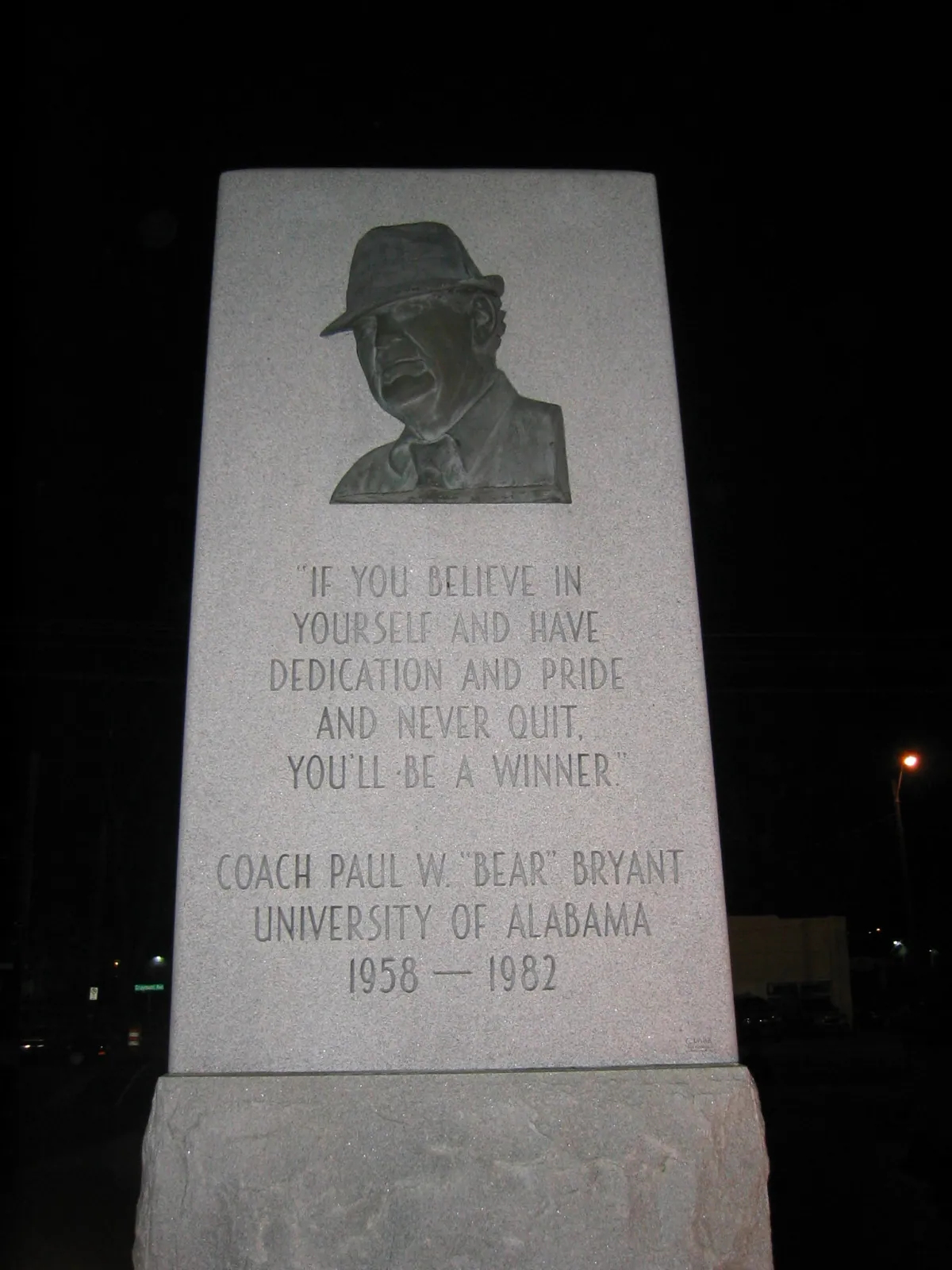
Coaching Tree and Legacy
Numerous coaches who worked under Bear Bryant went on to become head coaches, forming a significant coaching tree. His former player and assistant Gene Stallings became head coach at Texas A&M and Alabama, winning a national championship with the Crimson Tide. Other assistants and players took head coaching positions across college football. Bryant's influence extended through multiple generations of coaches who adopted elements of his disciplined approach and organizational methods. His career was marked by his ability to rebuild programs at Kentucky, Texas A&M, and Alabama. He won a Southwest Conference championship at Texas A&M and 13 SEC championships at Alabama. Bryant's six national championships tied the record for the most by a coach at the time of his retirement.
Video
FAQ
How many national championships did Bear Bryant win?
Bear Bryant won six national championships as head coach of the University of Alabama. The championship seasons were 1961, 1964, 1965, 1973, 1978, and 1979. The 1964 title was shared with Arkansas, and the 1973 and 1978 titles were split with other schools. His teams were recognized as national champions by the major polling services of those eras. These six titles tied the record for the most by a coach at the time of his retirement.
What was Bear Bryant's overall coaching record?
Bear Bryant's overall head coaching record was 323 wins, 85 losses, and 17 ties. This record was compiled over 38 seasons at Maryland, Kentucky, Texas A&M, and Alabama. His bowl game record was 15 wins, 12 losses, and 2 ties. Upon his retirement in 1982, his 323 victories were the most by any head coach in college football history. His winning percentage was .780 over his entire career.
Why is he called Bear Bryant?
He earned the nickname Bear as a 13-year-old in Arkansas. He agreed to wrestle a captive bear during a promotion for a traveling carnival. The bear's muzzle came off during the match, and Bryant jumped out of the ring. The nickname stuck with him throughout his life and became his well-known public name. His given name was Paul William Bryant.
How did Bear Bryant die and what was his health history?
Bear Bryant died of a heart attack on January 26, 1983, at Druid City Hospital in Tuscaloosa, Alabama. He was 69 years old. His death came just 28 days after he coached his final game. Bryant had a history of heart problems, suffering a cardiac episode in 1977, a mild stroke in 1980, and another cardiac episode in 1981. He was a heavy smoker and drinker for most of his adult life.
What is Bear Bryant's legacy and what awards did he receive?
Bear Bryant's legacy includes a then-record 323 career wins and six national championships at Alabama. He was a 10-time SEC Coach of the Year and was named the NCAA's Coach of the 1960s. He received the Presidential Medal of Freedom posthumously in 1983. He was inducted into the College Football Hall of Fame in 1986, and the national coach of the year award was renamed in his honor. The University of Alabama named several facilities for him, including a museum, a hall, a drive, and the football stadium.
Where did Bear Bryant play college football and what was his position?
Bear Bryant played college football for the University of Alabama Crimson Tide from 1933 to 1935 as an end. He was a member of the school's 1934 national championship team and was named second team All-Southeastern Conference in 1934, and third-team all-conference in both 1933 and 1935. During his playing years, he was the self-described 'other end' playing opposite the star Don Hutson. Bryant also played with a partially broken leg in a 1935 game against Tennessee.
Sources
- Bear Bryant (Wikipedia) Wikipedia
- Paul "Bear" Bryant Biography & History bryantawards.org
- Bear Bryant, Quotes, Death & Facts biography.com
- Bear Bryant | History | Research Starters | EBSCOhost ebsco.com
- Bear: The Hard Life and Good Times of Alabama's Coach Bryant goodreads.com