First played in 1902, the Rose Bowl Game in Pasadena, California, was the first postseason football game ever established and is nicknamed The Granddaddy of Them All. The game is the centerpiece of the Pasadena Tournament of Roses Association's New Year celebration, which also includes the Rose Parade. Historically featuring a matchup between the Big Ten and Pac-12 conferences, the Rose Bowl has been a part of the Bowl Championship Series and, since 2014, the College Football Playoff. The Rose Bowl Game originated as the Tournament East-West football game on January 1, 1902. It was created to help fund the cost of the Rose Parade, part of a Tournament of Roses festival that began in 1890. The inaugural game was a lopsided affair where Fielding H. Yost's Michigan team defeated Stanford 49-0, prompting Stanford to quit in the third quarter. Football returned permanently on New Year's Day 1916, when Washington State defeated Brown University 14-0, establishing the annual tradition that continues today. Since 1945, the Rose Bowl has been the highest attended college football bowl game. The game's nickname, The Granddaddy of Them All, was popularized by broadcaster Keith Jackson.
Venue: From Tournament Park to the Rose Bowl Stadium
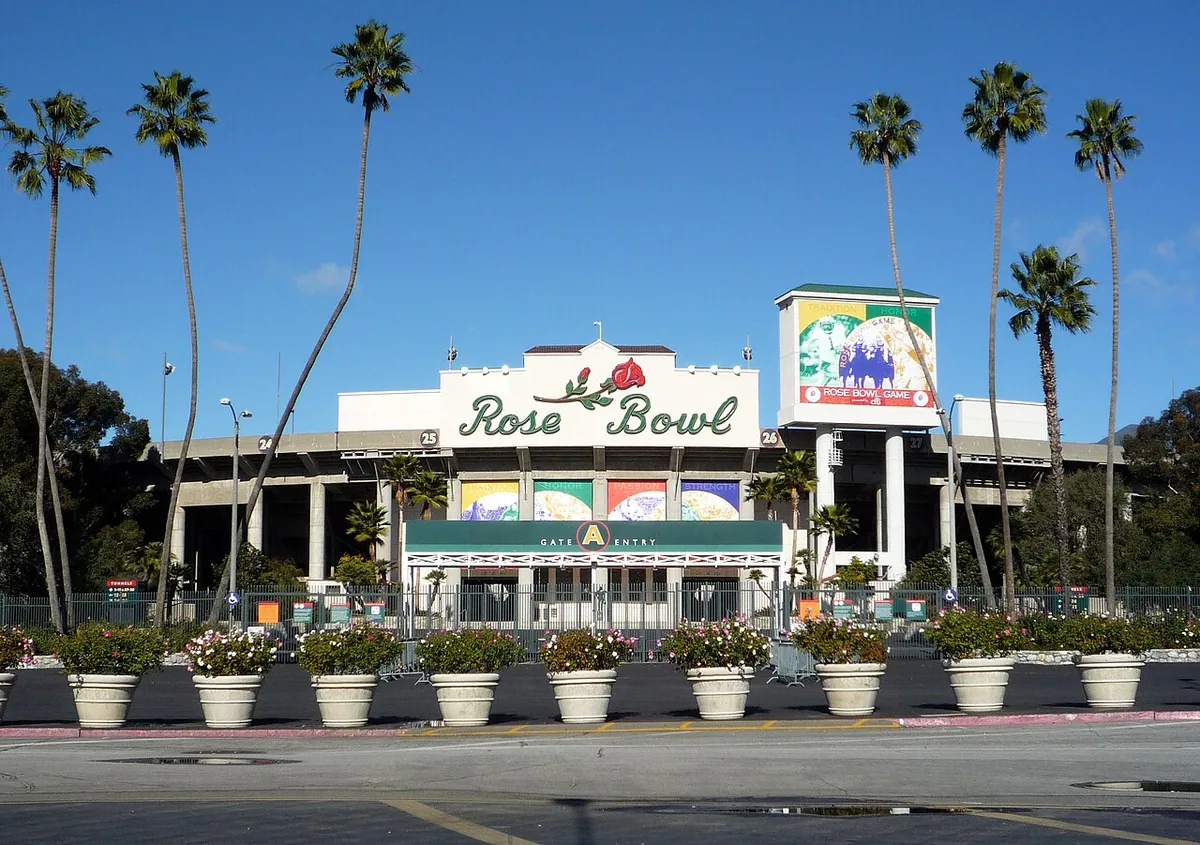
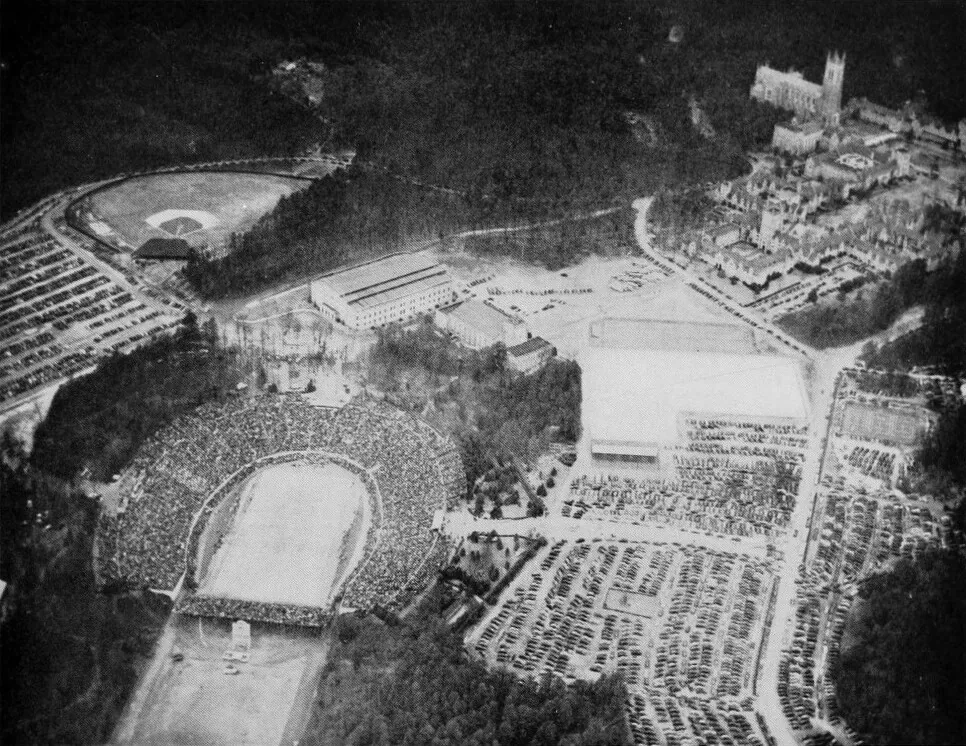
The first games were played at Tournament Park in Pasadena, located near the Caltech campus. As crowds grew, the venue was deemed unsuitable, leading to the construction of a dedicated stadium. The Rose Bowl stadium , designed after the Yale Bowl, opened in October 1922 and hosted its first game on January 1, 1923. The stadium's name was initially debated between Tournament of Roses Stadium and Tournament of Roses Bowl before Rose Bowl was settled on. The seating capacity has been reconfigured several times, with a peak capacity of 104,594 from 1972 to 1997. Its official capacity of 92,542 as of 2012 made it the largest stadium hosting a postseason bowl game, and it is the only College Football Playoff bowl held in a non-NFL stadium. The game has experienced temporary venue changes. During World War II, fears of a Japanese attack on the West Coast prompted the 1942 game to be moved to Duke Stadium in Durham, North Carolina . More recently, the 2021 game was relocated to AT&T Stadium in Arlington, Texas, due to COVID-19 restrictions in California.
Conference Tie-Ins and Selection History
From 1917, the game selected a team from the Pacific Coast Conference, the predecessor of the Pac-12. A formal agreement beginning with the 1947 Rose Bowl created the traditional matchup between the champions of the Big Ten Conference and the predecessor of the Pac-12, which continued to 2023. This pairing had exceptions, particularly when a team qualified for a national championship game. For a number of years, both conferences had a no repeat rule that prevented a team from appearing in consecutive Rose Bowls. The PCC rule affected the 1955 and 1958 games, and the Big Ten rule affected the 1966 game before the Big Ten abolished it in 1972. Both conferences also originally had exclusive agreements that barred member schools from playing in any other bowl game, a rule abolished before the 1975 season. The Big Ten was not part of any agreement for the 1961 and 1962 games, and its 1961 champion Ohio State declined the invitation to the 1962 game after its faculty council voted it down. The Rose Bowl joined the Bowl Championship Series in 1998, which allowed the Big Ten or Pac-12 champion to play for the national title if ranked first or second. During the BCS era, the Rose Bowl served as the national championship game in 2002 and 2006.
Playoff Evolution and Future Format
In 2014, the Rose Bowl became part of the College Football Playoff. In the four-team playoff, it served as a semifinal in 2015, 2018, 2021, and 2024. In years when it was not a semifinal, the game hosted the top available teams from the Big Ten and Pac-12 conferences. The Pac-12 tie-in ended in 2023, and the Big Ten tie-in lasted through the 2026 edition. Beginning with the 2027 Rose Bowl, the game will no longer have a conference tie-in and will feature playoff participants. The College Football Playoff will expand again to 24 teams starting with the 2027-28 season, and an exclusive media rights agreement with ESPN to televise new CFP games runs through the 2031-32 season.
Sponsors, Payouts, and the Leishman Trophy
Like many major bowl games, the Rose Bowl has had presenting sponsors whose names are incorporated into the game's official title. Northwestern Mutual was the presenting sponsor when the game hosted its first playoff semifinal in 2015. The current sponsor is Prudential Financial, with the game officially titled the Rose Bowl Game presented by Prudential. The payout to participating conferences has been substantial, reported at 35 million dollars per conference as of 2016. The winning team is awarded the Leishman Trophy. This trophy is named for William L. Leishman and Lathrop K. Leishman, former presidents of the Tournament of Roses who played a significant part in the game's history.
Records and Most Appearances
The record for most points scored by a single team in a game is 59, set by Oregon in their 2015 CFP semifinal victory over Florida State. Teams have been held scoreless on 18 occasions in the game's history. Since the game's inception in 1902, 112 games have been played through the 2026 edition. The game has seen numerous undefeated teams face off, with ten such matchups occurring in the period before the formal conference agreements. Individual game records have been set in recent years, such as in the 2022 game where Ohio State quarterback C.J. Stroud threw for 573 yards and six touchdowns, both Rose Bowl records. His receiver, Jaxon Smith-Njigba , set an FBS bowl game record with 347 receiving yards in that same contest. Attendance figures have varied, with 93,986 spectators at the 2006 BCS title game and 94,118 at the 2011 game between TCU and Wisconsin.
- Most points (single game): 59 (Oregon, 2015)
- Games played through 2026: 112
- First game: January 1, 1902 (Michigan 49, Stanford 0)
- Most recent game (2026): Indiana 38, Alabama 3
- Scoreless games: 18 occurrences
- Notable attendance: 94,118 (2011, TCU vs. Wisconsin)
Notable Games and Memorable Moments
The 1925 game featured Knute Rockne's Notre Dame, with its Four Horsemen, against Pop Warner's Stanford, with Elmer Layden scoring three touchdowns, two on interception returns over 70 yards. In 1929, California's Roy Riegels famously ran 65 yards the wrong way with a fumble, earning the nickname Wrong Way Riegels. The 1997 game saw Ohio State quarterback Joe Germaine lead a last-minute drive, hitting David Boston for a game-winning touchdown with 19 seconds left to defeat Arizona State 20-17. Vince Young authored back-to-back noted performances for Texas, accounting for 372 total yards and five touchdowns in a 2005 win over Michigan and then 467 total yards in the 2006 BCS National Championship Game victory over USC. The 2022 game was an offensive display where Ohio State defeated Utah 48-45 on a last-second field goal, with C.J. Stroud and receiver Jaxon Smith-Njigba setting multiple records. As a College Football Playoff semifinal, the 2024 game saw Michigan defeat Alabama 27-20 in overtime, with a defensive stop on fourth down securing the win.
Recent Results and Playoff Era Performance
The 2022 game was a non-playoff edition where Ohio State defeated Utah 48-45. The 2024 Rose Bowl served as a CFP semifinal, with Michigan beating Alabama in overtime to advance to the national championship. The 2025 game was historic as the first Rose Bowl played under the expanded 12-team playoff format, where Ohio State dominated Oregon 41-21 in a quarterfinal matchup. The most recent game, played on January 1, 2026, saw the Indiana Hoosiers deliver a commanding 38-3 victory over the Alabama Crimson Tide . Looking ahead, the 2027 Rose Bowl Game presented by Prudential is scheduled for January 1, 2027, and will be a CFP quarterfinal, continuing its role in the playoff rotation without its traditional conference tie-ins. The public ticket sale for the 2027 game has been announced by the Pasadena Tournament of Roses.
| Year | Winner | Score | Loser |
|---|---|---|---|
| 2022 | Ohio State | 48-45 | Utah |
| 2024 | Michigan | 27-20 (OT) | Alabama |
| 2025 | Ohio State | 41-21 | Oregon |
| 2026 | Indiana | 38-3 | Alabama |
The Rose Bowl Hall of Fame and Associated Events
The Rose Bowl Game maintains a Hall of Fame to honor individuals who have contributed significantly to its legacy. The Hall of Fame class of 2026 includes Don Bunce, Bob Chandler, Les Richter, and Frank Sinkwich. The game is also part of a larger celebration that includes the Rose Parade, which features floats covered in flowers, marching bands, and equestrian units. The Rose Bowl stadium itself hosts other events, including the Rose Bowl Half Marathon & 5K. Furthermore, the Rose Bowl Game awards the Keith Jackson Postgraduate Scholarship, named for the famed broadcaster, with Michigan's Caleb Boyd being a recent recipient.
Video
FAQ
Where is the Rose Bowl Game played?
The Rose Bowl Game is played at the Rose Bowl stadium in Pasadena, California. The stadium opened in 1922 and has been the game's permanent home since the 1923 edition. Before that, games were held at Tournament Park in Pasadena. The game has experienced temporary venue changes, moving to Durham, North Carolina, in 1942 due to World War II security concerns and to Arlington, Texas, in 2021 due to COVID-19 restrictions. The Rose Bowl stadium is the largest venue hosting a postseason bowl game and is the only College Football Playoff bowl not held in an NFL stadium.
What is the history of the Rose Bowl Game?
The Rose Bowl Game began on January 1, 1902, as the Tournament East-West football game to help fund the Rose Parade. Michigan's 49-0 win over Stanford was so one-sided that football was replaced by other events for 13 years. The game returned permanently in 1916. A stadium was built in 1922, and from 1947 to 2023, the game traditionally featured the Big Ten champion versus the Pac-12 champion. It joined the Bowl Championship Series in 1998 and hosted the BCS title game in 2002 and 2006. Since 2014, it has been part of the College Football Playoff, serving as a semifinal and, since the 2024 season, as a quarterfinal.
Who won the most recent Rose Bowl Game?
The most recent Rose Bowl Game was played on January 1, 2026, and was won by the Indiana Hoosiers, who defeated the Alabama Crimson Tide by a score of 38-3. In the previous year, 2025, the Ohio State Buckeyes won the first Rose Bowl played under the 12-team College Football Playoff format, defeating the Oregon Ducks 41-21. The 2024 game was a CFP semifinal where the Michigan Wolverines beat the Alabama Crimson Tide 27-20 in overtime. The 2022 edition saw the Ohio State Buckeyes defeat the Utah Utes 48-45.
When is the Rose Bowl Game played?
The Rose Bowl Game is traditionally played on January 1, New Year's Day. The game maintains a schedule exception where it is played on Monday, January 2, whenever New Year's Day is a Sunday. Since the playoff expanded to 12 teams in the 2024 season, it has been the only playoff bowl outside the semifinal rotation, which lets it keep its New Year's Day slot. The next scheduled game is the Rose Bowl Game presented by Prudential on January 1, 2027.
What conference tie-ins does the Rose Bowl Game have?
From 1917, the Rose Bowl selected a team from the Pac-12 Conference or its predecessor each year. Starting in 1947, it traditionally featured the champion of the Big Ten Conference against the champion of the Pac-12 Conference. This agreement had exceptions when a team qualified for the national championship game. With the expansion of the College Football Playoff to 12 teams, the Rose Bowl now serves as a quarterfinal game each year. The Big Ten tie-in lasted through the 2026 edition, after the Pac-12 tie-in had ended in 2023. Beginning with the 2027 Rose Bowl, the game will no longer have a conference tie-in and will feature playoff participants.
Why was the 1942 Rose Bowl Game not played in Pasadena?
The 1942 Rose Bowl Game was not played in Pasadena due to security concerns following the Japanese attack on Pearl Harbor. Fears of a possible attack on the West Coast led to the game being moved to Duke Stadium in Durham, North Carolina. Duke University invited the game and Oregon State to play there. After Allied victories in 1942 reduced the perceived threat, the game returned to the Rose Bowl stadium in Pasadena for the following year.
Sources
- Rose Bowl Game (Wikipedia) Wikipedia
- Tournament of Roses, Rose Bowl Game, Official Athletics Website rosebowlgame.com
- Rose Bowl: Memorable moments, all-time history NCAA
- Rose Bowl History, Diamond Travel diamondtravel.com