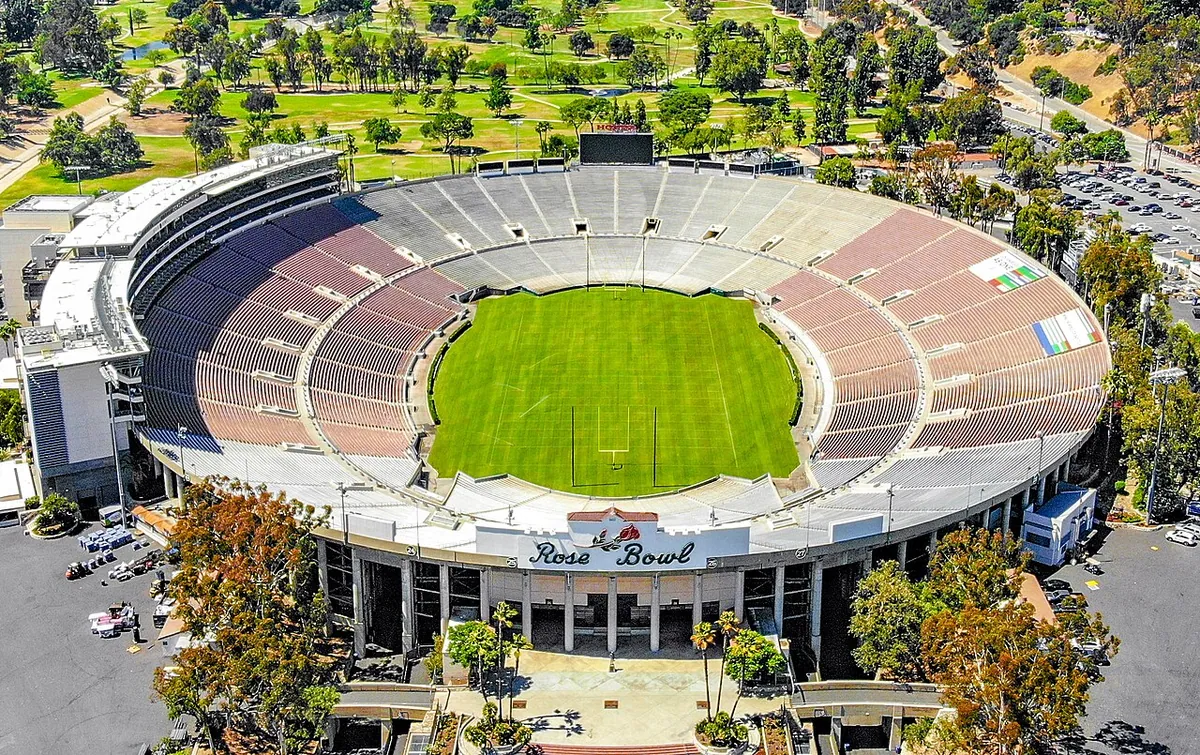
The Rose Bowl is an outdoor athletic stadium located in Pasadena, California, approximately 10 miles north-northeast of downtown Los Angeles. It is best known as a college football venue, hosting the annual Rose Bowl Game and serving as the home of UCLA Bruins football since 1982. The stadium has also hosted five Super Bowl games, the third most of any venue, and numerous other major sporting events. The Rose Bowl stadium is situated in the Arroyo Seco area of Pasadena, approximately 10 miles north-northeast of downtown Los Angeles at an elevation of 830 feet above sea level. The Pasadena Tournament of Roses Association sought to build a permanent stadium to replace the temporary stands at Tournament Park, which were inadequate for crowds exceeding 40,000. Architect Myron Hunt designed the stadium in 1921, drawing influence from the Yale Bowl in New Haven, Connecticut. Construction began on February 27, 1922, and was completed in October of the same year. The stadium was originally built as a horseshoe shape before the southern stands were completed in 1928, forming a complete bowl. The field's alignment is nearly north-south, offset slightly to the northwest. The stadium was dedicated officially on January 1, 1923, during the Rose Bowl game where USC defeated Penn State 14-3.
Capacity and Seating Evolution
The seating capacity of the Rose Bowl has changed numerous times throughout its history due to expansions and renovations. The original wooden benches were replaced by aluminum benches in 1969, and new grandstand and loge seats were installed in 1971. Official capacity was lowered following the 1998 Rose Bowl. Different figures are reported for current capacity because lower-level seats behind team benches are not used for some events. UCLA reports the capacity at 91,136 for its games, while the Tournament of Roses reports it at 92,542 for the Rose Bowl Game. The record attendance of 106,869 was set at the 1973 Rose Bowl. For the 2021 season, UCLA used a tarp to cover the north upper end zone, reducing official capacity to 69,747 seats. The stadium is among the largest stadiums in the United States.
Major Renovation Projects
The Rose Bowl has undergone several major renovation projects to modernize facilities while preserving its historic character. A significant renovation originally budgeted at $152 million in 2010 saw costs increase to $170 million during construction, with most work completed by 2013. This project included the construction of the seven-story Terry Donahue Pavilion, named for the former UCLA football head coach. The structure contains 54 luxury suites, 48 loge boxes, 1,200 club seats, modern press boxes, and a broadcast center renamed The Keith Jackson Broadcast Center in December 2015. A 30 feet tall by 77 feet wide LED video display board was installed at the north end of the stadium as part of this renovation. The facility that once served as the original locker room was restored in 2017 and turned into a museum with sections on the stadium's construction, the Rose Bowl games, UCLA football, and the Super Bowls. In 2026, 5,000 bench seats in the South end are to be transformed into a field-level club called the South Field Club at an expected cost of about $30 million, part of an $80 million renovation campaign ahead of the 2028 Olympic Games.
The Rose Bowl Game Tradition
The Rose Bowl stadium is intrinsically linked to college football, primarily through its hosting of the annual Rose Bowl Game. The game is played on New Year's Day, or on January 2 if January 1 is a Sunday, following the Tournament of Roses Parade. Since its opening, the stadium has hosted the bowl game every year except in 1942, when it was moved to Duke University due to security concerns after Pearl Harbor, and in 2021, when it was played at AT&T Stadium in Arlington, Texas due to COVID-19 pandemic restrictions. The Rose Bowl Game is often called The Granddaddy of Them All because it is the oldest bowl game.
UCLA Bruins Tenancy and Rivalry
The UCLA Bruins have called the Rose Bowl stadium home since the 1982 season, moving from the Los Angeles Memorial Coliseum when the Oakland Raiders relocated there. The Bruins played two consecutive Rose Bowl games in their new home stadium in 1983 and 1984. The travel distance for UCLA to home games is 26 miles from campus to Pasadena. The stadium hosts the UCLA, USC rivalry game in even-numbered years, alternating with the Coliseum. In the first rivalry game at the stadium in 1982, fans of both teams sat on opposite sides, but by 1984, USC fans were moved to end zone seats. In November 2025, it was reported that the Bruins were planning on breaking their lease to move to SoFi Stadium in Inglewood. On February 21, 2026, UCLA confirmed it would play its 2026 home games at the Rose Bowl while litigation continued.
- UCLA began playing home games at the Rose Bowl in 1982.
- The Bruins played in the Rose Bowl game in 1983 and 1984 after moving.
- The largest UCLA crowd was 105,464 at the 1976 Rose Bowl.
College Football Playoff Era
With the introduction of the College Football Playoff (CFP) in the 2014 season, the Rose Bowl became one of six primary bowls in the rotation. Every three years, the Rose Bowl hosts a CFP semifinal game matching two of the top four teams selected by the committee. Other semifinals include the 2018 game where Georgia beat Oklahoma 54-48 in double overtime before 80,072 spectators, and the 2024 game where Michigan beat Alabama 27-20 in overtime before 83,928 fans. The stadium has also hosted College Football Playoff quarterfinal games. The Rose Bowl is eligible to bid on hosting the CFP National Championship Game but has no plans to do so.
| Season | Game | Date | Winner | Loser | Spectators |
|---|---|---|---|---|---|
| 2014 | CFP Semifinal | January 1 | Oregon (59) | Florida State (20) | 91,322 |
| 2017 | CFP Semifinal | January 1 | Georgia (54) | Oklahoma (48) | 80,072 |
| 2020 | CFP Semifinal | January 1 | Alabama (31) | Notre Dame (14) | 18,373 |
| 2023 | CFP Semifinal | January 1 | Michigan (27) | Alabama (20) | 83,928 |
| 2024 | CFP Quarterfinal | January 1 | Ohio State (41) | Oregon (21) | 90,732 |
| 2025 | CFP Quarterfinal | January 1 | Indiana (38) | Alabama (3) | 90,278 |
NFL Super Bowls and Other Events
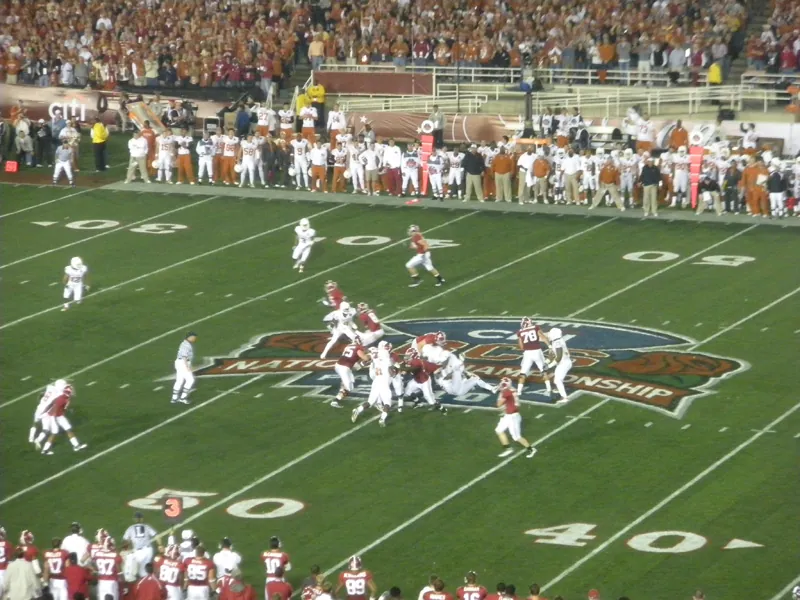
These NFL championship games were played in the stadium. The stadium is also a noted soccer venue, having hosted the 1994 FIFA World Cup Final, the 1999 FIFA Women's World Cup Final, and the gold medal match of the 1984 Summer Olympics. It has hosted numerous CONCACAF, Copa America, and United States Soccer Federation matches. The stadium hosts the world's largest flea market, concerts, religious services, and filmings.
Stadium Features and Amenities
The Rose Bowl stadium includes several notable features and amenities for visitors. The Court of Champions at the stadium's south end displays Rose Bowl game records along with the names of coaches and MVP players on plaques. Statues at the stadium include one of Jackie Robinson, dedicated in 2017, and one of Brandi Chastain, added in 2019. A statue honoring broadcaster Keith Jackson was unveiled at the stadium's Rose Plaza in December 2019. The commemorative Brick Campaign, completed in 2014, features a large Tournament of Roses logo and donor bricks arranged by universities in front of the south main entrance. For parking during major events, the 36 holes of Brookside Golf Course are used, providing 20,000 spaces when weather permits, along with nine paved lots offering another 6,000 vehicle spaces. The stadium offers monthly public tours that include behind-the-scenes access to areas like the original 1922 locker room museum, the Terry Donahue Pavilion, and the press box.
Ownership, Management, and Future
The Rose Bowl stadium and the adjacent Brookside Golf and Country Club are owned by the city of Pasadena. Management is handled by the Rose Bowl Operating Company, a non-profit organization whose board is selected by Pasadena city council members, with one member each from UCLA and the Pasadena Tournament of Roses. The stadium's name was originally Tournament of Roses Stadium or Tournament of Roses Bowl before being settled as Rose Bowl before the 1923 game. The stadium is scheduled to host the men's and women's soccer gold medal matches at the 2028 Summer Olympics in Los Angeles.
Video
FAQ
Where is the Rose Bowl stadium located?
The Rose Bowl stadium is located at 1001 Rose Bowl Drive in Pasadena, California. Pasadena is a northeast suburb of Los Angeles, situated approximately 10 miles from downtown. The stadium sits in the Arroyo Seco area at an elevation of 830 feet above sea level. Its specific coordinates are 34.161 degrees north latitude and 118.168 degrees west longitude.
What is the seating capacity of the Rose Bowl?
The Rose Bowl's seating capacity varies by event. For UCLA Bruins football games, the capacity is reported as 91,136, while for the Rose Bowl Game it is 92,542. The stadium's maximum stated capacity was 104,091 from 1972 to 1997. The all-time record attendance is 106,869, set during the 1973 Rose Bowl. For the 2021 season, UCLA reduced capacity to 69,747 using a tarp.
When was the Rose Bowl stadium built and opened?
Construction on the Rose Bowl began on February 27, 1922, and was completed in October 1922. The first game was played on October 28, 1922, a regular season contest where California beat USC 12-0. The stadium was officially dedicated on January 1, 1923, during the Rose Bowl game where USC defeated Penn State 14-3. The architect was Myron Hunt and the original cost was $272,198.
Which football teams call the Rose Bowl home?
The UCLA Bruins college football team has been the primary tenant since 1982. Before dropping football in 1993, Caltech played most of its home games at the Rose Bowl from the time of its construction. The stadium is not a permanent home for any NFL team but has hosted five Super Bowls. It also hosts the annual Rose Bowl Game, a postseason college football contest.
What is the record attendance for an event at the Rose Bowl stadium?
The record attendance at the Rose Bowl stadium is 106,869 spectators, set during the 1973 Rose Bowl game. This record crowd occurred when the stadium's maximum stated seating capacity was 104,091, a figure it held from 1972 to 1997. The Rose Bowl has hosted many other large crowds, such as 94,118 for a 2011 game between TCU and Wisconsin. While the modern all-seated capacity is lower, this historic record demonstrates the stadium's ability to host massive events.
How many Super Bowl games have been played at the Rose Bowl?
Five Super Bowl games have been played at the Rose Bowl stadium, which is the third-most of any venue. The stadium's history of hosting major events extends beyond college football, including these premier NFL championships. This contributes to its reputation as a world-class, multi-purpose venue. The Rose Bowl has also hosted other significant football championships, including BCS National Championship Games.
Sources
- Rose Bowl (stadium) (Wikipedia) Wikipedia
- Rose Bowl Stadium, Visit Pasadena visitpasadena.com
- Rose Bowl History, Diamond Travel diamondtravel.com
- Why UCLA's Stadium Steals All the Attention Sports Illustrated
- Built in 1922 the Rose Bowl Stadium is known mainly for the New Year's Tournament of Roses Football Game Stock Photo alamy.com