The Big Ten Football Championship Game is an annual postseason contest that determines the conference's season champion. Since its inception in 2011, the game has been held at Lucas Oil Stadium in Indianapolis, Indiana, and will be discontinued following its 2026 edition. The Big Ten Conference is the oldest NCAA Division I conference, founded in 1896, and currently comprises 18 universities competing at the highest level of college football. Its members are primarily large public research institutions spanning from the Midwest to the West Coast and Mid-Atlantic regions. The conference's official name was the Intercollegiate Conference of Faculty Representatives until 1987.
Member Universities and Locations
The Big Ten Conference consists of 18 full member institutions and two affiliate members. The conference's geographic footprint extends from the Midwest to the Northeast, Mid-Atlantic, and Pacific regions. Prominent Midwestern members include the University of Michigan in Ann Arbor, Ohio State University in Columbus, and the University of Wisconsin in Madison. The 2014 expansion added the University of Maryland in College Park and Rutgers University in New Brunswick, New Jersey. The 2024 expansion added four West Coast schools formerly of the Pac-12 Conference: the University of California, Los Angeles (UCLA), the University of Southern California (USC), the University of Oregon in Eugene, and the University of Washington in Seattle. The conference also has two affiliate members for specific sports: Johns Hopkins University for men's and women's lacrosse and the University of Notre Dame for men's ice hockey.
The University of Chicago was a founding member but permanently left the conference in 1946. Penn State University joined in 1990, the University of Nebraska joined in 2011, and Maryland and Rutgers joined in 2014. The member institutions are characterized by large enrollments, with 15 schools enrolling more than 30,000 students, and substantial research activity, collectively engaging in $9.3 billion in funded research annually. All full members except the University of Nebraska are members of the Association of American Universities, and all full members are members of the Big Ten Academic Alliance.
Conference History and Realignment
The Big Ten Conference was founded on February 8, 1896, as the Intercollegiate Conference of Faculty Representatives, predating the NCAA itself. The conference was founded in 1896 with members that included the University of Chicago, University of Illinois, University of Michigan, University of Minnesota, Northwestern University, Purdue University, and University of Wisconsin. Indiana University and the University of Iowa joined in 1899, and Ohio State University joined in 1912. The University of Michigan left the conference from 1907 to 1916 due to a dispute over rules before returning. The conference was first referred to as the Big Nine in 1899 and the Big Ten in December 1916. The conference did not formally adopt the 'Big Ten' name until 1987, though it was in common use for decades prior.
A major shift occurred after World War II when the University of Chicago departed in 1946. Michigan State University was admitted in 1950 for non-football sports, restoring the conference to ten members for those sports, with football joining in 1953. The league remained stable for 40 years until Penn State University joined in 1990, creating an 11-team league. The NCAA at the time required 12 teams with two divisions to hold a football championship game, which the Big Ten achieved with the addition of the University of Nebraska in 2011. Further expansion in 2014 brought in the University of Maryland and Rutgers University, growing the conference to 14 members. The most dramatic realignment was announced in 2022 and 2023, with UCLA, USC, Oregon, and Washington agreeing to join from the Pac-12, effective in 2024. This move brought the Big Ten to its current 18-team size.
- 1896: Conference founded with seven charter members at the Palmer House hotel in Chicago.
- 1917: Michigan returns, establishing the ten-team lineup.
- 1946: University of Chicago leaves the conference.
- 1950: Michigan State University joins for non-football sports.
- 1990: Penn State University joins.
- 2011: University of Nebraska joins, enabling a championship game.
- 2014: University of Maryland and Rutgers University join.
- 2024: UCLA, USC, Oregon, and Washington join.
Football Divisions and Competitive Format
Through the 2023 season, Big Ten football teams were organized into two divisions. The divisions were initially named Legends and Leaders. The scheduling arrangement required schools to face each of the other schools in their division, plus three crossover opponents from the other division, one of which was a permanent rivalry game. This structure was designed to maintain long-standing historical rivalries while creating a path to a championship game. The winners of each division would then meet in the Big Ten Football Championship Game.
With the expansion to 18 teams in 2024, the conference eliminated divisions. Starting in the 2024 season, the Big Ten Championship Game has featured the top two teams in the overall conference standings. The conference had previously announced a move to a nine-game conference schedule beginning in 2017. The champion is officially the winner of the championship game, a format that will remain in place through the final game in 2026. After the 2026 season, the College Football Playoff will expand to 24 teams, and the Big Ten Football Championship Game will be discontinued.
Championship Game and Recent Results
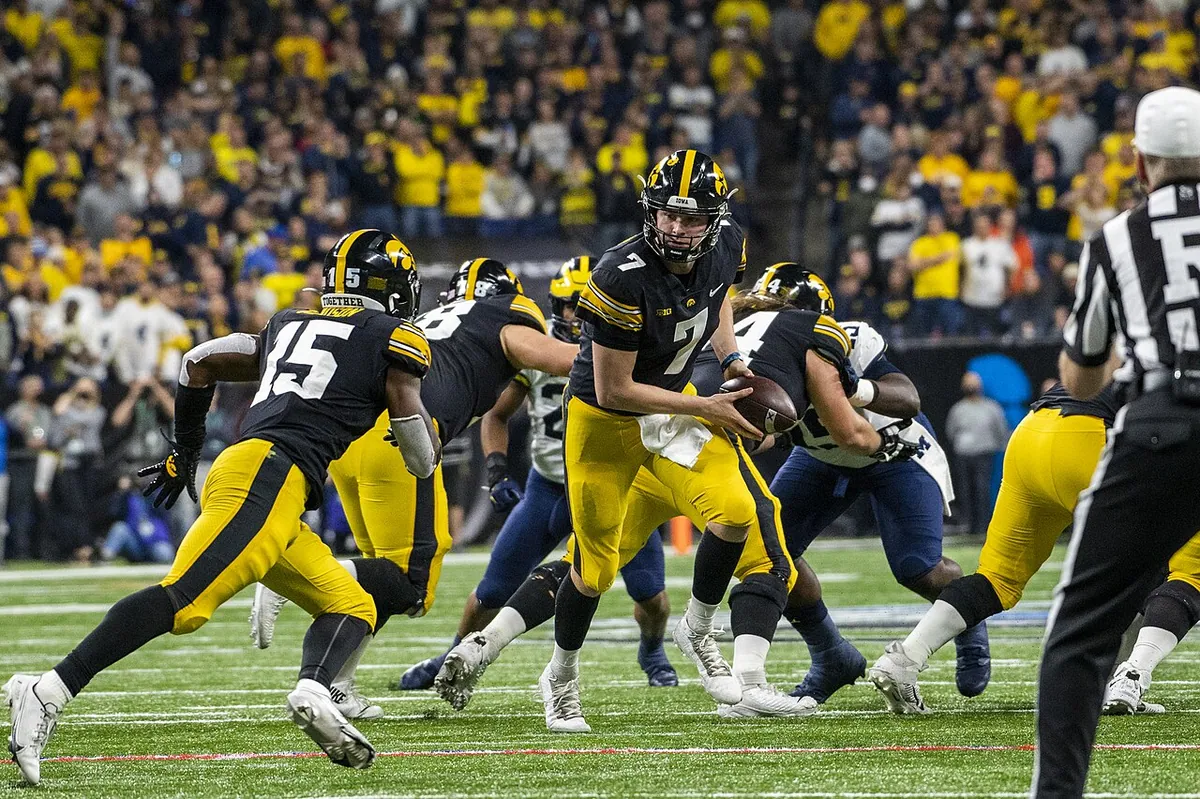
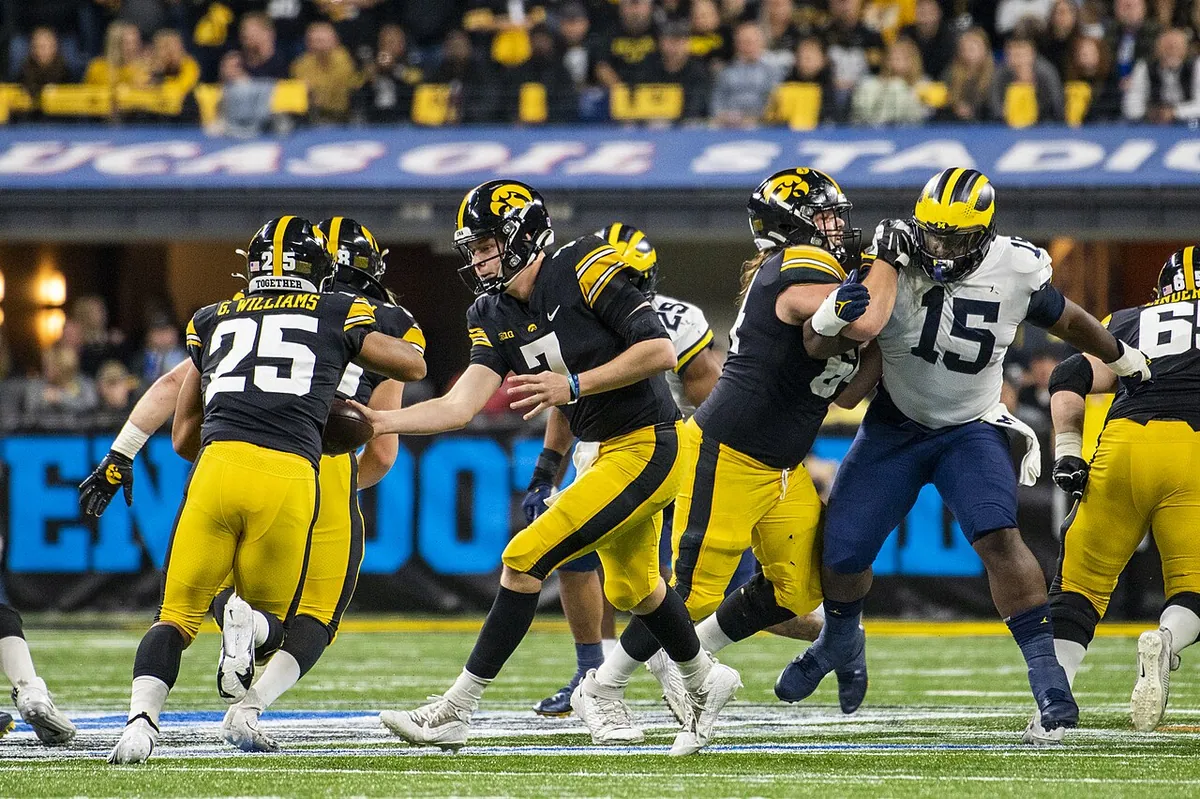
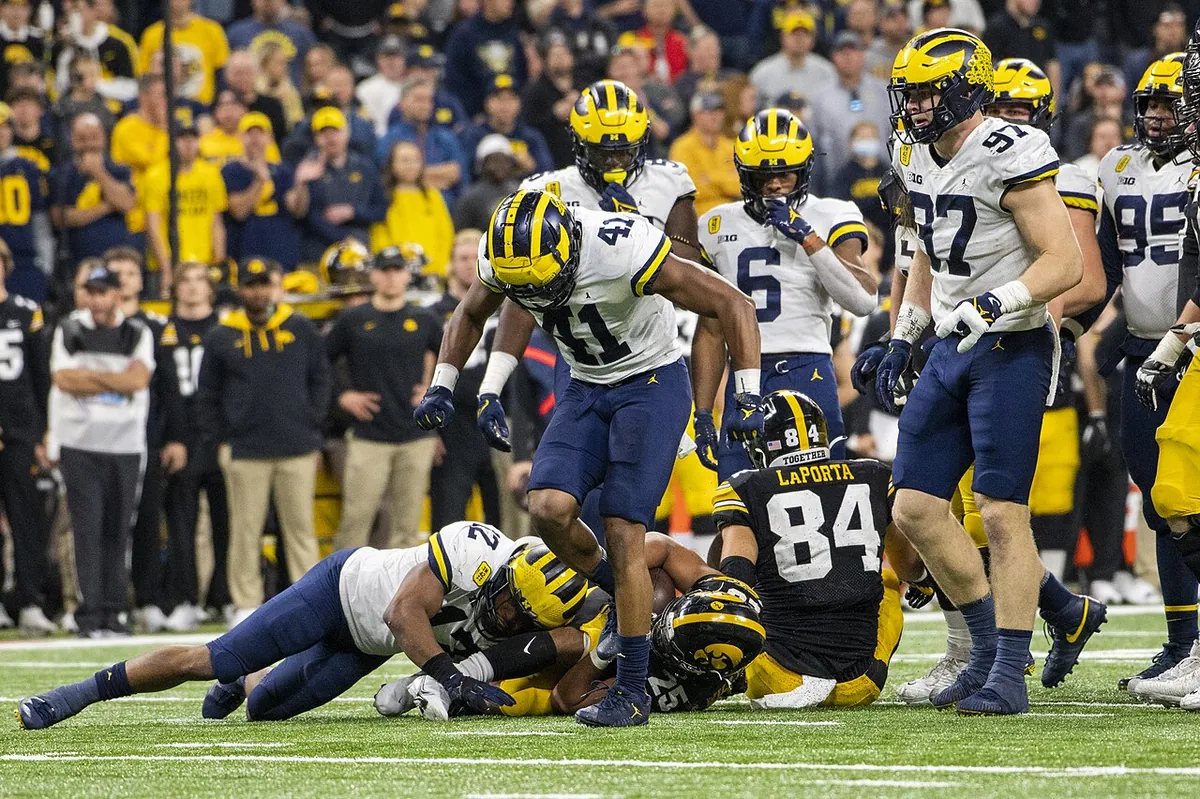
The Big Ten Football Championship Game was established in 2011 following the addition of Nebraska, which gave the conference the 12 teams then required by the NCAA to host such an event. The game has been held annually at Lucas Oil Stadium in Indianapolis, with its title sponsored by Discover Card since 2017. The winner receives the Stagg Championship Trophy, and the game's most valuable player is awarded the Grange-Griffin MVP Trophy. The game has been televised, with Fox as a primary broadcast partner. The 2026 season will mark the 16th and final edition of the championship game, scheduled for December 5, 2026, in Indianapolis. Its discontinuation is a result of the College Football Playoff's expansion to 24 teams beginning in 2027.
Ohio State has been the most successful program in the championship game era, appearing in seven games and winning five titles between 2011 and 2025. Wisconsin won the inaugural game in 2011. The 2025 championship was won by the Indiana Hoosiers. As of late November 2026, the final championship game participants have not been determined, with several teams including Indiana, UCLA, Ohio State, Oregon, and Iowa still in contention during the final week of the regular season. The game's media rights were initially secured by Fox Sports in a six-year agreement from 2011 to 2016 reported to be worth between $20 and $25 million per season.
National Championships and Historical Success
Several Big Ten member schools have won national championships in football. The University of Michigan and Ohio State University have been prominent national powers. The University of Southern California, a new member in 2024, has won multiple national titles. The conference's history includes early success from the University of Chicago, which won a national championship in 1905. Michigan State's football team entered the conference in 1953 on a strong run, going 9-1 and winning the Rose Bowl in its first Big Ten season. The Big Ten's overall record in games since its founding is 7567 wins, 5805 losses, and 394 ties for a .564 winning percentage.
Media Rights and Conference Headquarters
The Big Ten Conference has a comprehensive media rights portfolio. Its television partners include Fox, CBS, and NBC, which share broadcast rights for football games across their networks and streaming platforms. BTN broadcasts hundreds of sporting events annually. Streaming is integrated into the media strategy through partners like Fox, Peacock (NBC), and Paramount+ (CBS). The conference headquarters is located in Rosemont, Illinois, a suburb of Chicago.
The office houses the conference administration under Commissioner Tony Petitti, who began his tenure in 2023. The headquarters manages all conference operations, including championships, officiating, compliance, and media partnerships. The Big Ten Network was a first-of-its-kind cable network and provided significant new revenue ahead of the 2011 expansion. The media landscape changed dramatically after the 1984 NCAA v. Oklahoma court case, which stripped the NCAA of control over football television rights and opened the door for conferences to negotiate their own lucrative deals.
Video
FAQ
How many teams are in the Big Ten football conference?
There are 18 full member universities that compete in Big Ten football. This includes traditional Midwestern powers like Michigan, Ohio State, and Wisconsin, along with East Coast members Maryland and Rutgers, and the four new West Coast members: UCLA, USC, Oregon, and Washington. The conference grew from 14 to 18 teams in 2024. All 18 teams compete in the NCAA Football Bowl Subdivision (FBS). The conference also has two affiliate members, Johns Hopkins and Notre Dame, for specific non-football sports.
Where is the Big Ten championship game played?
The Big Ten Football Championship Game has been held at Lucas Oil Stadium in Indianapolis, Indiana, every year since its inception in 2011. The game is scheduled to remain there through its final edition in 2026. The conference announced in June 2014 that the game would continue at Lucas Oil Stadium through the 2024 season, and it has remained there since. The 2026 championship is set for December 5 at Lucas Oil Stadium.
Who were the original Big Ten football teams?
The Big Ten Conference was founded in 1896 with seven charter members. The original football teams were the University of Chicago, University of Illinois, University of Michigan, University of Minnesota, Northwestern University, Purdue University, and University of Wisconsin. Lake Forest College was invited to the initial 1895 meeting but did not join the conference. Indiana and Iowa joined in 1899, and Ohio State joined in 1912. The University of Chicago is the only founding member to have permanently left the conference, departing in 1946.
How does the Big Ten determine its football champion?
From 2011 through 2023, the champion was determined by a championship game between the first-place teams from each of the conference's two divisions. Starting with the 2024 season and the expansion to 18 teams, the conference eliminated divisions. Now, the top two teams in the overall conference standings at the end of the regular season meet in the Big Ten Football Championship Game. The winner of that game is crowned the conference champion. This format will be used through the 2026 season.
What is the history of Big Ten conference realignment?
The Big Ten has undergone several phases of realignment. After a stable period from 1953 to 1990, Penn State joined in 1990. Nebraska joined in 2011, enabling a championship game. Maryland and Rutgers joined in 2014, expanding the league to 14 teams. The most significant realignment occurred in 2024 with the addition of UCLA, USC, Oregon, and Washington from the Pac-12, bringing the total to 18 teams. The conference also explored adding Kansas, Missouri, and Rutgers in the 1990s and held talks with Notre Dame in 1999.
Which Big Ten team has won the most football national championships?
Among current members, several have won multiple national championships. The University of Southern California has won multiple national titles. Michigan and Ohio State have also won national championships. The University of Chicago, a former member, won a national title in 1905.
Sources
- Big Ten Conference (Wikipedia) Wikipedia
- Big Ten Football Championship Game (Wikipedia) Wikipedia
- Big Ten Expansion History: Looking Back at Every Major Change to the Conference Sports Illustrated