The Grand Valley State Lakers football program represents Grand Valley State University in Allendale, Michigan, competing in NCAA Division II. Founded in 1970, the Lakers have developed into one of the most successful programs in Division II history, with four national championships and 17 conference titles. The team plays its home games at Lubbers Stadium and is a member of the Great Lakes Intercollegiate Athletic Conference (GLIAC). Under the leadership of head coach Scott Wooster, the program maintains a tradition of winning with an all-time winning percentage of .747, which is the highest in NCAA Division II.
Program Founding and Early History
The Grand Valley State football program began with a junior varsity schedule in 1970 before fielding its first varsity team in 1971. Robert "Rip" Collins served as the inaugural head coach, but the program struggled initially, going 0-13 over its first two varsity seasons while being outscored 534-58. The Lakers did not have a dedicated home field for their first two seasons, even playing a game at Soldier Field in Chicago during their inaugural season. E. James Harkema took over as head coach in January 1973, coinciding with the opening of a new on-campus football field. The 1974 season marked Grand Valley's entry into conference play as a founding member of the Great Lakes Intercollegiate Athletic Conference, where they finished third with a 6-3 record. A landmark victory came in 1976 when the Lakers defeated defending national champion and top-ranked Northern Michigan 31-14, a win that significantly boosted the program's recruiting profile and national recognition.
The program's first period of sustained success began under Harkema in the late 1970s. Utilizing a potent passing attack led by quarterback Roy Gonzalez, the Lakers won a GLIAC championship in 1977. The 1978 team achieved a then-school record 9-3 mark, won a second consecutive GLIAC title, and advanced to the NAIA national semifinals. That season featured standout offensive tackle Ron Essink, who was an All-American in 1978 and later enjoyed an NFL career with the Seattle Seahawks. The stadium surrounding the field was formally dedicated and named Arend D. Lubbers Stadium on September 15, 1979, though the team posted a 4-5 record that season. Harkema coached the Lakers to winning records from 1980 through 1982 before resigning in November 1982.
Conference Membership and Moves
Grand Valley State's conference affiliation has been central to its identity and scheduling. The program was a charter member of the Great Lakes Intercollegiate Athletic Conference (GLIAC) upon its formation for the 1974 season. The Lakers competed in the GLIAC, winning championships in 1977 and 1978 under Coach Harkema. In 1990, Grand Valley State joined with other GLIAC members and schools from the Heartland Conference to form the Midwest Intercollegiate Football Conference (MIFC). This move was part of a broader restructuring to create a stronger football-centric league. The Lakers found immediate success in the new conference, winning the inaugural MIFC crown in 1990 and sharing the title in 1992.
The MIFC era lasted through the 1998 season. The GLIAC has remained the program's conference home ever since. Within the GLIAC, Grand Valley State has established itself as a leading program, winning or sharing 17 conference titles (GLIAC and MIFC combined) as noted in the program's history. The conference provides the primary competition for the Lakers and includes several of their most historic rivals, making each season a battle for GLIAC supremacy.
Head Coaching Eras and Records
The Grand Valley State football program has been shaped by a series of successful head coaches, each building upon the foundation of their predecessors. His tenure ended when he resigned to accept the head coaching job at Eastern Michigan in November 1982. Beck's offensive innovations led to an 11-0 regular season and the final Great Lakes Conference Championship in 1989. Notably, Beck hired a young Brian Kelly as a graduate assistant and defensive backs coach in 1987. The search results and notes confirm Brian Kelly was hired as a graduate assistant in 1987 under Tom Beck, and the Wikipedia notes cover his impact over 17 seasons, though his specific head coaching start year is not provided in the given excerpts. The current head coach is Scott Wooster, who is in his second season in 2026 with a record of 22-4, maintaining the program's position as a GLIAC contender. The program's coaching lineage has been integral to building its .747 all-time winning percentage.
National and Conference Championships
Grand Valley State football is defined by its championship success. The Lakers have won four NCAA Division II national championships since 2001. The first title came in 2002 when quarterback Curt Anes, the Harlon Hill Trophy winner, led a 14-0 team to a dramatic victory over Valdosta State. The Lakers led 24-6 in the fourth quarter before Valdosta State tied the game, and Anes then drove the team for a last-minute winning touchdown pass to David Kircus. The program's history notes that the team has appeared in six national title games since 2001, winning four. Search results reference multiple national championships in the 2000s, indicating the scope of the team's titles.
At the conference level, Grand Valley State has won or shared 17 GLIAC and MIFC championships. The titles began with GLIAC crowns in 1977 and 1978. After joining the MIFC, the Lakers won championships in 1990 and 1992. Upon returning to the GLIAC, the program entered a period of unprecedented dominance, winning numerous conference titles throughout the 2000s and beyond. Recent teams have completed undefeated regular seasons to win GLIAC championships. This consistent conference success has been the foundation for the program's 20 playoff appearances. The 2001 team had a 10-0 regular season before advancing to the national title game.
Lubbers Stadium
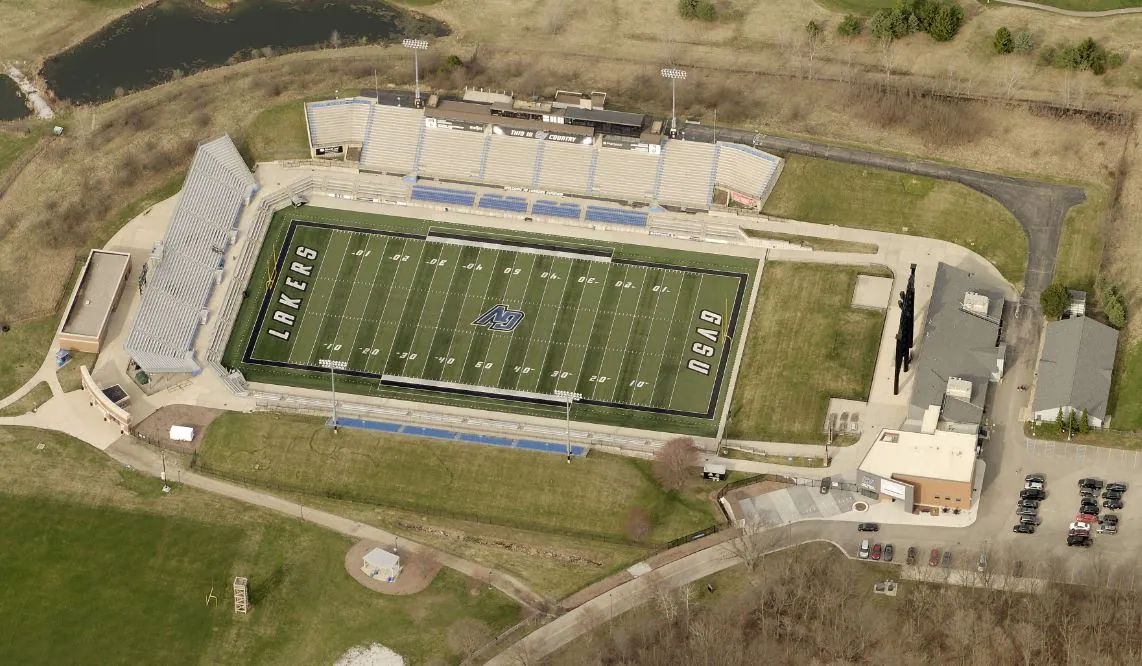
Grand Valley State has played its home games at Lubbers Stadium since the facility opened on September 15, 1973, with a win over Kalamazoo College. Originally known as Lakers Stadium, it was formally renamed in honor of university president Arend D. Lubbers during a dedication ceremony in 1979. The stadium's permanent seating capacity was 4,146 at its dedication in 1979. Through a series of expansions and renovations, primarily driven by the program's success and growing fan base, the official capacity has been increased to 10,444 as of the 2012 renovation. The stadium features a FieldTurf playing surface installed in 2012 and a large video scoreboard that is among the largest in Division II.
The stadium has undergone significant transformations to accommodate demand. Expansions are noted in the stadium's history, including projects in 1998, 2008, 2011, and 2012. The 2012 project involved lowering the field by eight feet to add four rows of seating in a horseshoe configuration, contributing 2,000 seats. A football operations building at the north end was renovated and expanded in 2019, becoming the Jamie Hosford Football Center. Despite the official capacity, attendance regularly exceeds 10,444, with a record crowd of 17,007 attending the 2021 game against rival Ferris State. The stadium is designed to allow for future expansion up to approximately 20,000 seats, reflecting the program's ambitious growth trajectory.
Rivalries and Notable Games
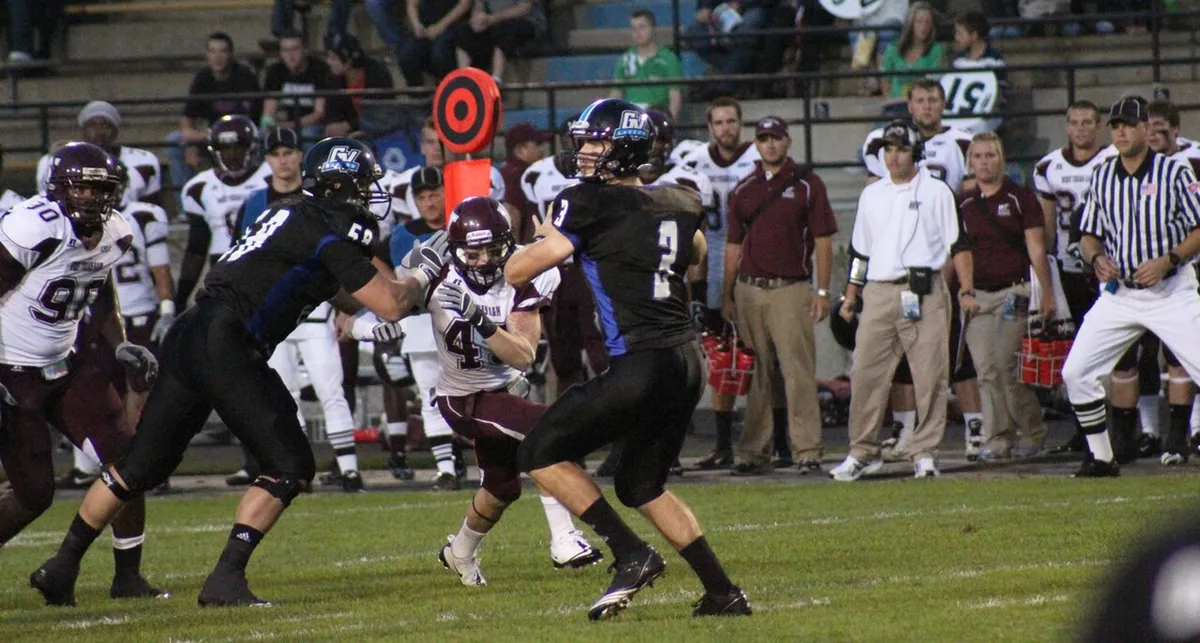
Grand Valley State maintains several intense rivalries, primarily within the GLIAC, that define its annual schedule. The most prominent rivalry is with the Ferris State Bulldogs. This matchup consistently draws the largest crowds to Lubbers Stadium, including the stadium record attendance of 17,007 in 2021. The series is highly competitive and often has championship implications for both the GLIAC and the NCAA playoff picture. Another key rivalry is with the Saginaw Valley State Cardinals, a long-standing series that dates back to the early years of both programs in the GLIAC and MIFC. Games against Wayne State also hold historical significance within the conference framework.
Several individual games stand out in program lore. The 1976 victory over top-ranked Northern Michigan is considered the win that put Grand Valley State on the national map. The 2002 national championship victory over Valdosta State, secured by a last-minute touchdown pass from Curt Anes to David Kircus, cemented the program's arrival as a national power. The 1989 91-0 victory over Valparaiso featured one of the most explosive offenses in school history, as the team led Division II in total offense and scoring that year. More recently, the annual clashes with Ferris State have often decided the GLIAC champion and served as de facto playoff games, highlighting the consistent quality of both programs.
Notable NFL Players and Awards
While Grand Valley State has not produced a Heisman Trophy winner, it has had significant success at the Division II level with the Harlon Hill Trophy, awarded to the Division II player of the year. Quarterback Curt Anes won the award in 2002 after leading the Lakers to their first national title. Quarterback Jeff Fox was a finalist for the trophy in 1998, marking the program's first player to be in contention for the award. These achievements highlight the elite individual talent developed within the program during its championship eras. Anes also set a Division II record for passing efficiency in 2002 with a rating of 221.6.
Grand Valley State has sent 28 players to the NFL since 1974, with seven of those players being drafted. While the program has not had a first-round draft pick, several Lakers have forged substantial professional careers. Offensive tackle Ron Essink, an All-American in 1978, played several seasons for the Seattle Seahawks. Fullback Eric Lynch, a star of the late 1980s teams who scored 21 touchdowns in 1989, played for the Detroit Lions. In the modern era, linebacker Matthew Judon has become the program's most notable NFL alumnus. As of the 2026 NFL season, four Grand Valley State alumni are on active rosters: Matthew Judon (San Francisco 49ers), Caleb Murphy (Los Angeles Chargers), Jahdae Walker (Chicago Bears), and Jay'Viar Suggs (New Orleans Saints).
Recent Seasons and Current Status
The 2026 season, under second-year head coach Scott Wooster, saw the team compile a 9-3 overall record with a 4-3 mark in GLIAC play. The team finished the regular season on a four-game winning streak, demonstrating strong form heading into the postseason. This continued success is built on a foundation of strong recruiting, player development, and a culture of winning established over decades. The program's all-time record of 439-148-3 gives it the highest winning percentage in NCAA Division II history. With 166 Consensus All-Americans, 20 playoff appearances, and four national championships, Grand Valley State is consistently ranked among the nation's elite Division II programs. The combination of a passionate fan base, modern facilities at Lubbers Stadium, and a tradition of championship expectations ensures the Lakers will continue to be a competitive force in the GLIAC and on the national stage.
NFL players from Grand Valley State
| Player | Pos | Years | Main team |
|---|---|---|---|
| Matthew Judon | OLB | 2016–2026 | Baltimore Ravens |
| Brandon Carr | CB | 2008–2020 | Dallas Cowboys |
| Jeff Chadwick | WR | 1983–1992 | Detroit Lions |
| Dan Skuta | OLB | 2009–2017 | Cincinnati Bengals |
| Charles D. Johnson | WR | 2013–2019 | Minnesota Vikings |
| Rob Rubick | TE | 1982–1988 | Detroit Lions |
| Ron Essink | OT | 1980–1985 | Seattle Seahawks |
| Caleb Murphy | LB | 2023– | Los Angeles Chargers |
| Cameron Bradfield | OT | 2011–2016 | Jacksonville Jaguars |
| Tim Lelito | G | 2013–2017 | New Orleans Saints |
| Eric Lynch | RB | 1992–1996 | Detroit Lions |
| Nick Keizer | TE | 2018–2021 | Kansas City Chiefs |
| Nick McDonald | C | 2010–2014 | New England Patriots |
| Jahdae Walker | WR | 2025– | Chicago Bears |
| David Kircus | WR | 2003–2006 | Detroit Lions |
Video
FAQ
What conference is Grand Valley State football in?
Grand Valley State University's football team competes in the Great Lakes Intercollegiate Athletic Conference (GLIAC). The Lakers were founding members of the GLIAC in 1974, left to join the Midwest Intercollegiate Football Conference from 1990 to 1998, and then returned to the GLIAC where they have remained ever since. Within the GLIAC, Grand Valley State has been a leading program, winning multiple conference championships. The conference includes rivals such as Ferris State, Saginaw Valley State, and Wayne State, which are all listed as primary rivalries for the Lakers.
Who is the head coach of Grand Valley State football?
The head coach of Grand Valley State football is Scott Wooster. As of the 2026 season, Wooster is in his second year leading the program and has compiled a record of 22-4. The team's official website and schedule for 2026 list him as the head coach. He follows a lineage of coaches that have built the program's .747 all-time winning percentage. Under his leadership, the 2026 team finished with a 9-3 overall record and a 4-3 mark in GLIAC play.
What is the name and capacity of Grand Valley State's football stadium?
Grand Valley State plays its home games at Arend D. Lubbers Stadium on the university's main campus in Allendale, Michigan. The stadium opened in 1973 and was formally dedicated and named in 1979. Through multiple expansions, its official seating capacity is 10,444 as of the 2012 renovations. However, attendance regularly exceeds this number, with a record crowd of 17,007 set in 2021 for a game against Ferris State. The stadium features FieldTurf, a large video scoreboard, and the Jamie Hosford Football Center for team operations.
How many national championships has Grand Valley State football won?
Grand Valley State University football has won four NCAA Division II national championships. The program's history notes it has appeared in six national title games since 2001, winning four of them. The first championship came in 2002 with a 14-0 team led by Harlon Hill Trophy winner Curt Anes. These championships established Grand Valley State as a dynasty within Division II football.
What NFL players came from Grand Valley State?
Grand Valley State has produced 28 NFL players since 1974, with seven of those players being selected in the NFL Draft. Notable alumni include offensive tackle Ron Essink, who played for the Seattle Seahawks after being an All-American in 1978, and fullback Eric Lynch, who played for the Detroit Lions. The most prominent recent alumnus is linebacker Matthew Judon, a multiple-time Pro Bowl selection. As of the 2026 NFL season, four Grand Valley State alumni are on active rosters: Matthew Judon (49ers), Caleb Murphy (Chargers), Jahdae Walker (Bears), and Jay'Viar Suggs (Saints).
What is Grand Valley State football's all-time record?
Through the 2026 season, the Grand Valley State Lakers football program has an all-time record of 439 wins, 148 losses, and 3 ties. This equates to a winning percentage of .747, which is the highest all-time winning percentage in NCAA Division II football history. The record reflects the program's success since its founding in 1970, including its four national championships and 17 conference titles. The Lakers also have a strong home record of 219-46-1 at Lubbers Stadium, contributing significantly to the overall winning percentage.
Sources
- Grand Valley State Lakers football (Wikipedia) Wikipedia
- nflverse game, roster and draft data nflverse (CC BY 4.0)
- Lubbers Stadium (Wikipedia) Wikipedia