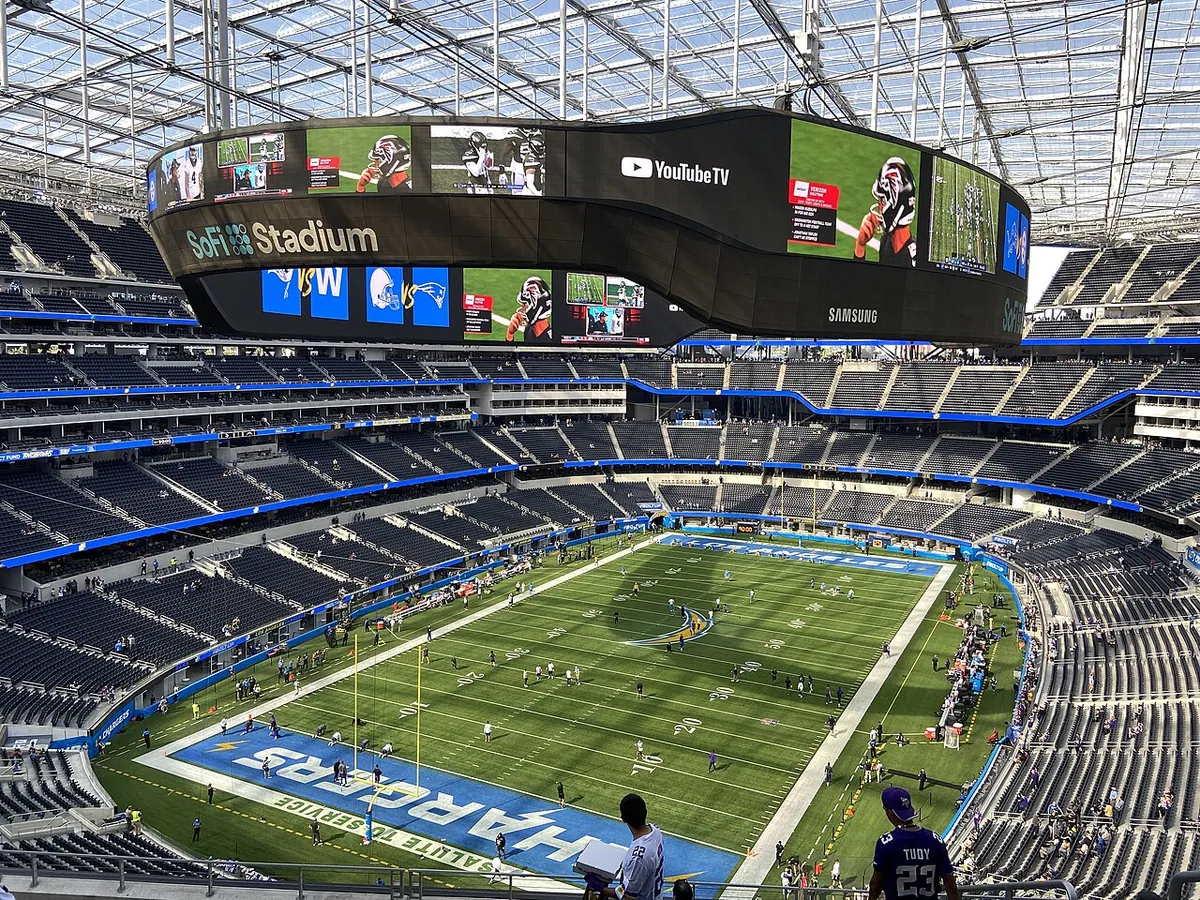
The Los Angeles Chargers are a professional American football team based in the Greater Los Angeles area that plays in the West division of the American Football Conference (AFC) in the National Football League. The franchise was founded on August 14, 1959, and began play in 1960 as a charter member of the American Football League before moving to San Diego in 1961. The team spent 56 seasons in San Diego, won the AFL championship in 1963 and joined the NFL through the AFL-NFL merger in 1970. Its only Super Bowl appearance came after the 1994 season, when it lost Super Bowl XXIX to the San Francisco 49ers 49-26. The Chargers returned to Los Angeles in 2017 and since 2020 have played their home games at SoFi Stadium in Inglewood, California, which they share with the Los Angeles Rams.
Founding in Los Angeles and the AFL Years in San Diego
The Chargers were born on August 14, 1959, when Barron Hilton, a 32-year-old hotel executive and son of Hilton Hotels founder Conrad Hilton, was awarded a Los Angeles franchise in the new American Football League. General manager Frank Leahy picked the name, which Hilton liked because fans were yelling charge and sounding the bugle at Dodger Stadium and at USC games. The 1960 team played at the Los Angeles Memorial Coliseum, won the AFL Western division and lost the championship game to Houston. Crowds were meager, so Hilton moved the club 120 miles south to San Diego in 1961, where Balboa Stadium was expanded to 34,000 seats.
Coach Sid Gillman spread the field for the passing game, and his teams won division championships in 5 of the AFL's first 6 years. The club won the 1963 AFL title with a 51-10 win over the Boston Patriots and lost the 1964 and 1965 title games to the Buffalo Bills, with stars such as Lance Alworth, Keith Lincoln, Paul Lowe, John Hadl and Ron Mix. Hilton sold the team in 1966 to a group that included Eugene V. Klein, and in 1967 it moved into the new 60,835-seat San Diego Stadium, later called Jack Murphy Stadium and then Qualcomm Stadium. Gillman finished with an 87-57-6 record in 11 seasons, the best of any coach in team history, and the Chargers entered the NFL through the AFL-NFL merger in 1970.
Air Coryell, Dan Fouts and Super Bowl XXIX
After a 2-11-1 record in 1973, the Chargers hired Don Coryell as head coach in 1978, and his pass-heavy offense, known as Air Coryell, revived the team. With quarterback Dan Fouts throwing to Charlie Joiner and Kellen Winslow, San Diego led the league in passing yards from 1978 to 1983 and again in 1985. The team made 4 consecutive playoff appearances from 1979 to 1982, won AFC West titles in 1979, 1980 and 1981 and reached the AFC Championship Game after the last two of those seasons. That run also produced the playoff game of the 1981 season known as the Epic in Miami. Coryell finished with a 72-60-0 record from 1978 to 1986, and in 1984 Klein sold the franchise to Alex G. Spanos, a businessman from Stockton, California. Bobby Ross arrived from Georgia Tech in 1992 and immediately led the Chargers back to the playoffs with an AFC West title. Two years later a defense led by Junior Seau, Rodney Harrison and Leslie O'Neal carried the team to its first AFC championship with a 17-13 win over the Pittsburgh Steelers. The Chargers hold the lowest postseason winning percentage in the league at .364.
The Rivers and Tomlinson Era
Marty Schottenheimer took over in 2002, and in 2004 the Chargers drafted Eli Manning with the first overall pick and traded him to the New York Giants for quarterback Philip Rivers, because Manning did not want to play for San Diego. The team went 12-4 that year and won the AFC West, and Rivers became the starter in 2006 and stayed through the 2019 season. The 2006 team went 14-2, the best record in franchise history, with running back LaDainian Tomlinson, fullback Lorenzo Neal, tight end Antonio Gates and linebacker Shawne Merriman. A 24-21 Divisional round loss to the New England Patriots ended that season, and the club fired Schottenheimer despite the record. Since 1999 the head coaches have compiled these records.
| Head coach | Seasons | Regular season | Playoffs |
|---|---|---|---|
| Mike Riley | 1999 to 2001 | 14-34 | No games |
| Marty Schottenheimer | 2002 to 2006 | 47-33 | 0-2 |
| Norv Turner | 2007 to 2012 | 56-40 | 3-3 |
| Mike McCoy | 2013 to 2016 | 27-37 | 1-1 |
| Anthony Lynn | 2017 to 2020 | 33-31 | 1-1 |
| Brandon Staley | 2021 to 2023 | 24-24 | 0-1 |
| Giff Smith | 2023 | 0-3 | No games |
| Jim Harbaugh | 2024 to 2026 | 23-21 | 0-2 |
Former Oakland Raiders coach Norv Turner led his first team past the Tennessee Titans and the Indianapolis Colts before a 21-12 loss to New England in the AFC Championship Game after the 2007 season. Turner's teams won the division again in 2008 and 2009, and the 2009 club won 11 games in a row from October 25, 2009, to January 3, 2010. Mike McCoy, a former Denver Broncos offensive coordinator, beat the Cincinnati Bengals 27-10 in a Wild Card game in his first season. San Diego then missed the postseason in each of the next 3 seasons before the team left the city.
Return to Los Angeles and the Stadium Story
Owner Dean Spanos announced the move back to Los Angeles in a letter to the city of San Diego on January 12, 2017, ending 56 seasons in San Diego. The team agreed to pay the NFL a $645 million relocation fee and became the second former San Diego franchise to move to Los Angeles, after the Clippers in 1984. Its temporary home, the StubHub Center in Carson, held 30,000 fans, well below the 50,000 minimum the NFL set for temporary homes. The first game there drew just over 25,000, split roughly evenly with fans of the visiting Miami Dolphins, and USA Today described the 2018 home opener as essentially a Kansas City Chiefs home game. Over its history the franchise has used these home fields.
- Los Angeles Memorial Coliseum, home for the first season in 1960
- Balboa Stadium in San Diego, expanded to 34,000 seats for the 1961 move
- San Diego Stadium, later Jack Murphy Stadium and Qualcomm Stadium, from 1967 to 2016
- StubHub Center in Carson, now Dignity Health Sports Park, from 2017 to 2019
- SoFi Stadium in Inglewood, shared with the Rams, from 2020 to the present
Weak turnout reportedly led the team to lower its initial revenue goal for SoFi Stadium from $400 million to $150 million, and the club receives only 18.75% of season ticket revenues through 2040. Attendance improved after the move to Inglewood, and average attendance in 2022 ranked in the top third of the league for a second consecutive year. That year the team also announced its new headquarters in El Segundo, known as The Bolt. One San Diego era game was played far from home, when wildfires moved an October 27, 2003, Monday Night Football game against the Dolphins to Sun Devil Stadium, then the home of the Arizona Cardinals.
Justin Herbert, Jim Harbaugh and the Current Team
Anthony Lynn's 2018 team went 12-4 and beat the Baltimore Ravens in the Wild Card round before losing 41-28 to the eventual Super Bowl champion New England Patriots. After Rivers left in free agency, Tyrod Taylor started on September 13, 2020, but a week later he suffered a punctured lung while receiving a pain-killing injection. Rookie Justin Herbert took over and broke multiple rookie records in a 7-9 season that included a 45-0 loss to New England, the worst blowout loss in team history. Brandon Staley was hired on January 17, 2021, and his 2022 team lost a Wild Card game 31-30 to the Jacksonville Jaguars after leading 27-0.
Staley and general manager Tom Telesco were fired on December 15, 2023, one day after a 63-21 loss to the Las Vegas Raiders. The Chargers signed Jim Harbaugh on January 24, 2024, a former Chargers quarterback who had coached the San Francisco 49ers from 2011 to 2014 and won the 2024 national championship at Michigan. His first two teams both went 11-6 and lost in the Wild Card round, to the Houston Texans 32-12 and to the New England Patriots 16-3. The 2026 team stood at 1-9 through November 27, 2026, and with Herbert ruled out by a concussion, DJ Uiagalelei was named the Week 12 starter against New England for his first career NFL start.
Name, Colors and Hall of Fame Members
Apart from color changes, the Chargers have used an arc-shaped lightning bolt logo since 1960, and the AFL era shield logo with a horse head, a lightning bolt and the word Chargers returned for on-field use in 2018. The original colors were powder blue, gold and white, and in 1974 the team switched to dark royal blue and became one of the first NFL teams, with the Kansas City Chiefs, to use a facemask color other than gray. The uniforms moved to navy blue in 1985, and powder blue later returned on alternate uniforms before the club readopted it as the primary uniform color in 2019. The current colors are powder blue, sunshine gold and white.
The Pro Football Hall of Fame includes 9 players and 2 coaches from the Chargers. The players are wide receivers Lance Alworth and Charlie Joiner, defensive end Fred Dean, quarterback Dan Fouts, offensive tackle Ron Mix, tight ends Kellen Winslow and Antonio Gates, linebacker Junior Seau and running back LaDainian Tomlinson. The coaches are Sid Gillman, who also served as general manager, and Don Coryell. Forbes valued the franchise at $5.1 billion in August 2024, which placed it 20th among NFL teams.
Video
FAQ
What were the Los Angeles Chargers called before they moved back to Los Angeles?
The team was the Los Angeles Chargers in its first season in 1960 and became the San Diego Chargers after moving south in 1961. It kept the San Diego name for 56 seasons, through the 2016 season. Owner Dean Spanos announced the return to Los Angeles on January 12, 2017. The club has played as the Los Angeles Chargers again since the 2017 season.
Who moved to Los Angeles first, the Chargers or the Rams?
The Rams moved back first, returning to Los Angeles a year before the Chargers after 21 seasons in St. Louis from 1995 to 2015. The Chargers followed in 2017 after 56 seasons in San Diego. The Chargers had started in Los Angeles in 1960 before leaving for San Diego in 1961. Since 2020 both teams have played their home games at SoFi Stadium in Inglewood.
Have the Chargers ever won a Super Bowl?
The Chargers have never won a Super Bowl. Their only appearance came in Super Bowl XXIX after the 1994 season, when they lost 49-26 to the San Francisco 49ers. The franchise's league title is the 1963 AFL championship, won 51-10 over the Boston Patriots. Since 1999 the team has reached one conference championship game, a 21-12 loss to the New England Patriots after the 2007 season.
Where do the Los Angeles Chargers play their home games?
The Chargers play at SoFi Stadium in Inglewood, California, which they share with the Los Angeles Rams. They moved in for the 2020 season after playing from 2017 to 2019 at the StubHub Center in Carson, the 30,000-seat home of the LA Galaxy. In San Diego the team played at San Diego Stadium, later Qualcomm Stadium, from 1967 to 2016. The team headquarters, The Bolt, is in El Segundo, California.
Who owns the Los Angeles Chargers?
The Chargers are owned by Dean Spanos, and A. G. Spanos is the team president. The Spanos family bought the franchise in 1984, when Eugene V. Klein sold it to Alex G. Spanos, a businessman from Stockton, California. The original owner was hotel heir Barron Hilton, who sold the team in 1966. Forbes valued the franchise at $5.1 billion in August 2024.
Who is the head coach of the Chargers?
Jim Harbaugh has been head coach of the Chargers since January 24, 2024. He played quarterback for the team from 1999 to 2000 and later coached the San Francisco 49ers and the University of Michigan. His first two Chargers teams each went 11-6 and reached the playoffs, and the team was 1-9 in the 2026 season through November 27. Joe Hortiz is the general manager.
Sources
- Los Angeles Chargers (Wikipedia) Wikipedia
- Chargers Home | Los Angeles Chargers, chargers.com chargers.com
- Team History Pro Football Hall of Fame
- Los Angeles Chargers News, Scores, Stats, Schedule NFL
- Los Angeles Chargers | Sports and Leisure | Research Starters ebsco.com
- nflverse game, roster and draft data nflverse (CC BY 4.0)