The Los Angeles Rams are a professional American football team based in the Greater Los Angeles area and a member of the NFC West division of the National Football League. Founded on April 11, 1936, as the Cleveland Rams, the franchise moved to Los Angeles in 1946, to St. Louis after the 1994 season and back to Los Angeles in 2016. It is the only NFL franchise to win championships representing three different cities, with titles in Cleveland in 1945, Los Angeles in 1951 and 2021 and St. Louis in 1999. The Rams play at SoFi Stadium in Inglewood, California, which they share with the Los Angeles Chargers. Sean McVay has been head coach since 2017, and the team was 7-4 in the 2026 season through November 27.
The Cleveland Rams and the 1945 Title
The Cleveland Rams were founded on April 11, 1936, by Ohio attorney Homer Marshman and player-coach Damon Wetzel, a former Ohio State star. Wetzel, who served as general manager, chose the name because his favorite college team was the Fordham Rams, and Marshman, the principal owner, also liked it. The team spent its first season in the short-lived American Football League and finished second at 5-2-2. It joined the NFL on February 12, 1937, as the fourth in a string of short-lived Cleveland franchises.
The early Rams played in three stadiums over several losing seasons, although rookie halfback Parker Hall was the league MVP in 1939. Dan Reeves, an heir to a grocery chain fortune, bought the club with Fred Levy Jr. in June 1941, and the team sat out the 1943 season because of a wartime shortage of players. In 1945, under coach Adam Walsh, rookie quarterback Bob Waterfield from UCLA passed, ran and kicked his way to the MVP award as the Rams went 9-1. They won the championship 15-14 over the Washington Redskins on December 16, with the margin provided by a safety when a Sammy Baugh pass hit the goal post and bounced back through his own end zone, a play the NFL changed its rules to prevent the next season.
Los Angeles, Integration and the 1951 Championship
On January 12, 1946, the other owners denied Reeves permission to move the champions to Los Angeles, but he threatened to leave pro football altogether and a settlement let the team go. The Rams became the only NFL champion to play the following season in another city, and the league became the first coast-to-coast professional sports business. A precondition for leasing the 103,000-seat Los Angeles Memorial Coliseum was that the team integrate, and the Rams signed Kenny Washington on March 21, 1946, and Woody Strode on May 7, 1946. They were the first African-American athletes with an NFL contract since 1932.
The first years in Los Angeles brought a costly battle with the Dons of the All-America Football Conference, until the Dons were folded into the Rams late in 1949. In 1948 halfback Fred Gehrke painted horns on the team's helmets, creating the first helmet emblem in pro football. From 1949 to 1955 the Rams played in four NFL Championship Games and won the 1951 title, with Waterfield and Norm Van Brocklin throwing long passes to Elroy Hirsch and Tom Fears. Hirsch had 1,495 receiving yards and 17 touchdowns that season, and the 1950 Rams became the first pro football team to have all their games televised.
Crowds followed the wide-open style, and a 1957 game against the San Francisco 49ers drew 102,368 fans to the Coliseum. Attendance there topped 80,000 on 22 occasions during the team's first 20 years in Los Angeles. The Rams set an NFL attendance record in 1957 that stood until 2006, and they were so popular that the new Los Angeles Chargers of the AFL moved to San Diego rather than compete with them. Reeves also started the Free Football for Kids program and became the first owner to employ a full-time scouting staff.
Fearsome Foursome, the 1970s and Anaheim
The Rams slipped after 1955 and did not return to championship contention until 1967 under George Allen, whose 49-19-4 record over five seasons is the best by any Rams coach. His defensive line of Rosey Grier, Merlin Olsen, Deacon Jones and Lamar Lundy became known as the Fearsome Foursome. The 1967 team, led by quarterback Roman Gabriel, became the first NFL team to draw more than one million spectators in a season, and Gabriel was voted league MVP in 1969. Allen never won a playoff game with the Rams, however, and left after the 1970 season to coach Washington.
In 1972 Robert Irsay bought the Rams for $19 million and traded the franchise to Carroll Rosenbloom for the Baltimore Colts. The Rams then won seven straight NFC West titles from 1973 to 1979, first under Chuck Knox and then Ray Malavasi, with defensive end Jack Youngblood as the defining player of the decade. They lost their first four conference championship games of the 1970s, but the 1979 team, only 9-7 in the regular season, beat Dallas 21-19 and Tampa Bay 9-0 to reach its first Super Bowl. Playing at the Rose Bowl in Pasadena, the Rams led Pittsburgh at the end of the third quarter before losing Super Bowl XIV, 31-19.
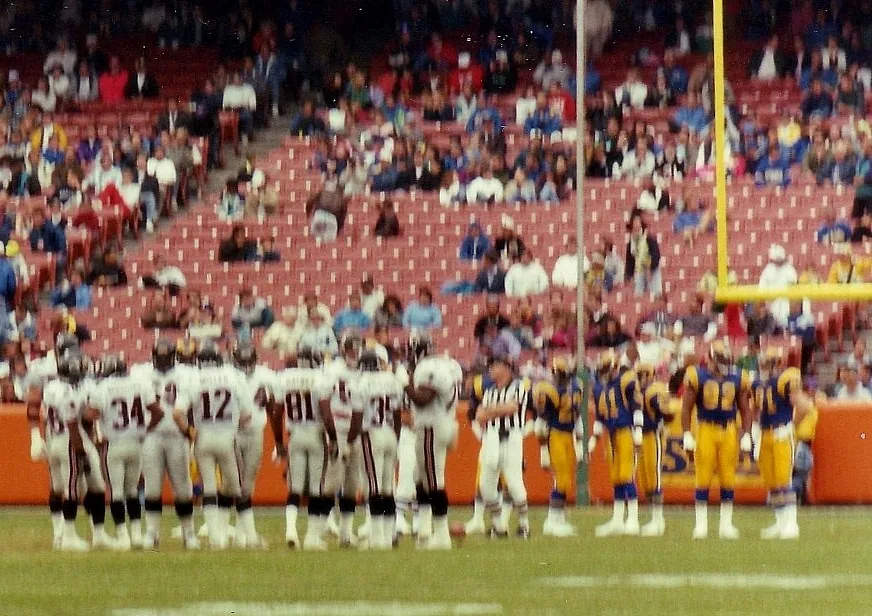
Rosenbloom drowned before the 1979 season, and his widow Georgia Frontiere inherited 70 percent of the team. In 1980 the Rams moved from the Coliseum, whose 92,604 seats were rarely sold out, so that most home games were blacked out on local television, to Anaheim Stadium in Orange County, reconfigured for football with 69,008 seats. The Oakland Raiders moved into the Coliseum in 1982, dividing the Rams' traditional fan base. After the 1994 season the team left Southern California for St. Louis.
St. Louis and the Greatest Show on Turf
The Rams began play in St. Louis in 1995 and hired former Philadelphia Eagles coach Dick Vermeil in 1997. Two years later, with quarterback Kurt Warner and running back Marshall Faulk, the team went 13-3 and opened the era known as the Greatest Show on Turf. It beat Tampa Bay 11-6 in the NFC Championship Game and the Tennessee Titans 23-16 in Super Bowl XXXIV on January 30, 2000, at the Georgia Dome. Vermeil retired after the victory and was replaced by offensive coordinator Mike Martz.
Counting all games, the Rams won 9 straight from January 16, 2000, to October 15, 2000, a run that included a 57-point game against the San Diego Chargers on October 1, 2000. The 2001 team went 14-2, the best Rams record of any season since 1999, and beat Philadelphia 29-24 for the NFC title before losing Super Bowl XXXVI to the New England Patriots, 20-17. The decline that followed bottomed out at 1-15 under Steve Spagnuolo in 2009, and Jeff Fisher's teams from 2012 to 2016 never posted a winning record. After the 2015 season the owners approved the team's request to return to Los Angeles.
Back in Los Angeles and the McVay Era
The Rams played at the Los Angeles Memorial Coliseum from 2016 to 2019 and hired Sean McVay as head coach in 2017. His second team went 13-3 and beat New Orleans 26-23 for the NFC title, but lost Super Bowl LIII to the Patriots, 13-3. In 2020 the Rams moved into the newly built SoFi Stadium in Inglewood with the Chargers. The following year the club made aggressive moves at the trade deadline, and it won Super Bowl LVI over the Cincinnati Bengals on February 13, 2022, becoming the second NFL team to win the Super Bowl in its home stadium. The franchise's league titles, won in three different cities, are listed below.
- 1945: NFL champions as the Cleveland Rams, 15-14 over Washington
- 1951: NFL champions in Los Angeles
- 1999 season: Super Bowl XXXIV champions in St. Louis
- 2021 season: Super Bowl LVI champions in Los Angeles, 23-20 over Cincinnati
Since 1999 the Rams have gone 216-220-1 in the regular season through 2025 and 16-10 in the playoffs. The 2025 team went 12-5 and reached the NFC Championship Game, where it lost 31-27 to the Seattle Seahawks. Through November 27, 2026, McVay's record stood at 99-61 in the regular season and 10-6 in the playoffs. Les Snead is general manager, Kevin Demoff is team president and Stan Kroenke owns the franchise, which was valued at an estimated $13.5 billion in 2026.
SoFi Stadium, Identity and the 2026 Season
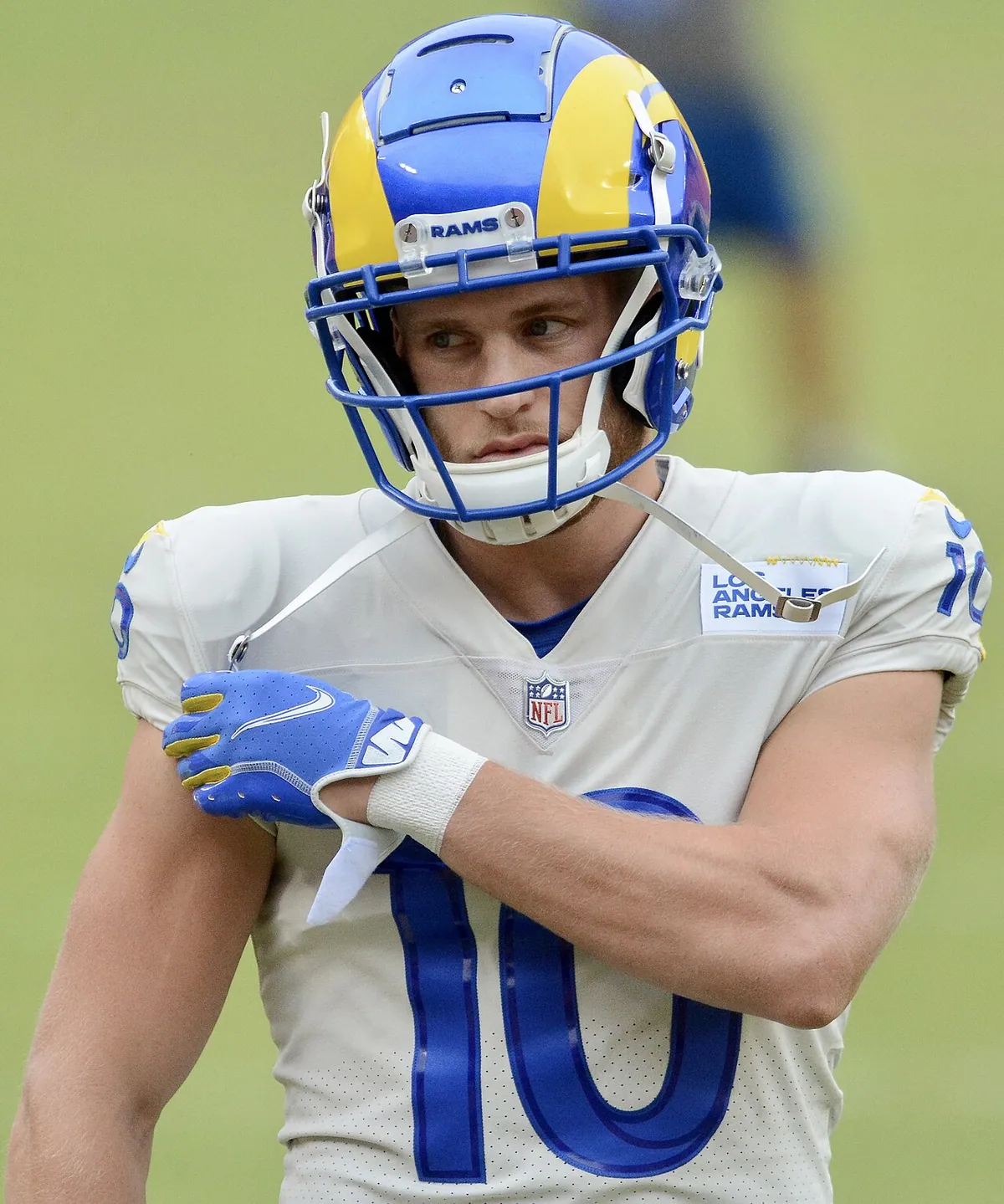
SoFi Stadium opened in 2020 and hosted the Rams' Super Bowl LVI victory, and the team is headquartered at the Rams Village at Warner Center in Los Angeles. The colors are Rams royal, sol, white and midnight, and the mascot is Rampage. Off the field, front office staff take part in monthly days of service, volunteering with local nonprofits. Since the St. Louis years the team has also staged an Annual Community Improvement Project that has funded playgrounds, school murals and a refurbished field for the Boys and Girls Club.
The 2026 Rams were 7-4 through November 27 after five straight wins, including a 34-6 victory over the Arizona Cardinals in Week 10. On Thanksgiving Eve, in the team's first game on the night before the holiday, Los Angeles beat the Green Bay Packers 26-13 at SoFi Stadium for its first win over Green Bay since 2018. Blake Corum ran for a career-high 184 yards on a career-high 32 carries on his 26th birthday, and the defense intercepted Jordan Love twice. Before the game the club honored the Fearsome Foursome, and the result swapped the two teams' positions in the NFC playoff picture.
Video
FAQ
What were the Los Angeles Rams called before?
The team began as the Cleveland Rams, founded on April 11, 1936. Co-founder Damon Wetzel chose the name because his favorite college team was the Fordham Rams. The club kept the Rams name when it moved to Los Angeles in 1946. From 1995 through 2015 it played as the St. Louis Rams before returning to Los Angeles in 2016.
How many cities have the Rams played in?
The Rams have represented three cities: Cleveland, Los Angeles and St. Louis. They played in Cleveland from 1936 until the 1945 championship season and moved to Los Angeles in 1946. From 1980 their home was Anaheim Stadium in Orange County, and after the 1994 season they moved to St. Louis. The team returned to Los Angeles in 2016 and has won championships in all three cities.
How many Super Bowls have the Rams won?
The Rams have won 2 Super Bowls in 5 appearances. They beat the Tennessee Titans 23-16 in Super Bowl XXXIV as the St. Louis Rams and the Cincinnati Bengals 23-20 in Super Bowl LVI at SoFi Stadium. They lost Super Bowl XIV to Pittsburgh, Super Bowl XXXVI to New England and Super Bowl LIII to New England. Before the Super Bowl era they won NFL championships in 1945 and 1951.
What was the Greatest Show on Turf?
The Greatest Show on Turf was the name given to the high-scoring St. Louis Rams teams that began with the 1999 season. Quarterback Kurt Warner and running back Marshall Faulk led an offense coached first by Dick Vermeil and then by Mike Martz. The 1999 team won Super Bowl XXXIV over the Tennessee Titans. The 2001 team went 14-2 and reached Super Bowl XXXVI, which it lost 20-17 to the New England Patriots.
Who were the Rams' Fearsome Foursome?
The Fearsome Foursome was the Rams defensive line of the 1960s, made up of Rosey Grier, Merlin Olsen, Deacon Jones and Lamar Lundy. The unit was built by head coach George Allen, who led the team from 1966 to 1970. It helped return the Rams to contention in 1967, when they reached the conference championship. The club honored the group before its Thanksgiving Eve game against Green Bay in 2026.
Who is the head coach of the Los Angeles Rams?
Sean McVay has been head coach of the Rams since 2017. He led the team to Super Bowl LIII after the 2018 season and to a win in Super Bowl LVI after the 2021 season. Through November 27, 2026, his record was 99-61 in the regular season and 10-6 in the playoffs. He works with general manager Les Snead and quarterback Matthew Stafford.
Sources
- Los Angeles Rams (Wikipedia) Wikipedia
- TheRams.com therams.com
- Los Angeles Rams team history Pro Football Hall of Fame
- Los Angeles Rams | Sports and Leisure | Research Starters | EBSCOhost ebsco.com
- Los Angeles Rams News, Scores, Stats, Schedule NFL
- nflverse game, roster and draft data nflverse (CC BY 4.0)