The Indianapolis Colts are a professional American football team based in Indianapolis, Indiana, that plays in the South division of the American Football Conference (AFC) in the National Football League (NFL). The franchise was founded in Baltimore on January 23, 1953, won NFL championships there in 1958, 1959 and 1968, and won Super Bowl V after the 1970 season. Owner Robert Irsay moved the team to Indianapolis in March 1984, and with Peyton Manning at quarterback the Colts won Super Bowl XLI after the 2006 season. Since the 2008 season the team has played its home games at Lucas Oil Stadium, and since 1987 it has served as host team for the NFL Scouting Combine. Shane Steichen is the head coach, and Carlie Irsay-Gordon is the owner.
Baltimore Beginnings and the Unitas Championships
Baltimore first had a team called the Colts in 1947, when the Miami Seahawks of the All-America Football Conference moved to the city and took a name honoring its history of horse breeding and racing. That club joined the NFL in 1950, played only that season and was disbanded. In 1953 a local group led by Carroll Rosenbloom won the rights to a new Baltimore franchise and received the remains of the Dallas Texans. The NFL considers the Texans and the Colts separate teams, so the Colts are legally a 1953 expansion team.
The first team went 3-9 under Keith Molesworth, and the Colts did not post a winning record until 1957. Under coach Weeb Ewbank and quarterback Johnny Unitas, the 1958 team went 9-3 and beat the New York Giants 23-17 in the NFL Championship Game, the first game played under the overtime rule, which was seen by 45 million people. The 1959 team also went 9-3 and beat the Giants again for a second title. Don Shula replaced Ewbank in 1963, and in his second season the team went 12-2 but lost the championship game to the Cleveland Browns 27-0.
In 1968 the Colts beat the Browns 34-0 for their third NFL Championship and entered Super Bowl III as 18-point favorites over the New York Jets of the American Football League. The Jets were led by Joe Namath and Matt Snell and coached by Ewbank, who had won 2 NFL Championships in Baltimore. Their 16-7 win, the first Super Bowl victory for the AFL, surprised many in the sports media. For the 1970 merger, Rosenbloom agreed with Art Modell of the Browns and Art Rooney of the Pittsburgh Steelers to move their 3 teams into the American Football Conference alongside the 10 AFL clubs.
Super Bowl V and the Last Baltimore Years
New head coach Don McCafferty led the 1970 team to an 11-2-1 record and the AFC East title. The Colts beat the Cincinnati Bengals 17-0 and won the first AFC Championship Game over the Oakland Raiders 27-17. In Super Bowl V, the first after the merger, Jim O'Brien kicked a field goal with 5 seconds left to beat the Dallas Cowboys 16-13 for the fourth NFL championship in team history. The 1971 team reached the AFC Championship Game but lost to the Miami Dolphins.
On July 13, 1972, Rosenbloom traded the franchise to Robert Irsay in exchange for the Los Angeles Rams, citing friction with the city and the local press. Unitas was traded to the San Diego Chargers after the 1972 season. Led by quarterback Bert Jones, the 1976 NFL MVP, and a defensive line nicknamed the Sack Pack, the Colts reached the playoffs from 1975 to 1977 but lost in the divisional round each time. The 1977 loss to Oakland in double overtime, remembered for the Ghost to the Post play, was the last playoff game for the team in Baltimore.
The team then had 9 consecutive losing seasons beginning in 1978. In 1981 the defense allowed an NFL-record 533 points and recorded only 13 sacks, and the 0-8-1 record of the strike-shortened 1982 season earned the first overall pick. Stanford quarterback John Elway refused to play for Baltimore and forced a trade to Denver. The team went 7-9 in 1983 and played its final home game in Baltimore on December 18, 1983, against the Houston Oilers.
The Move to Indianapolis
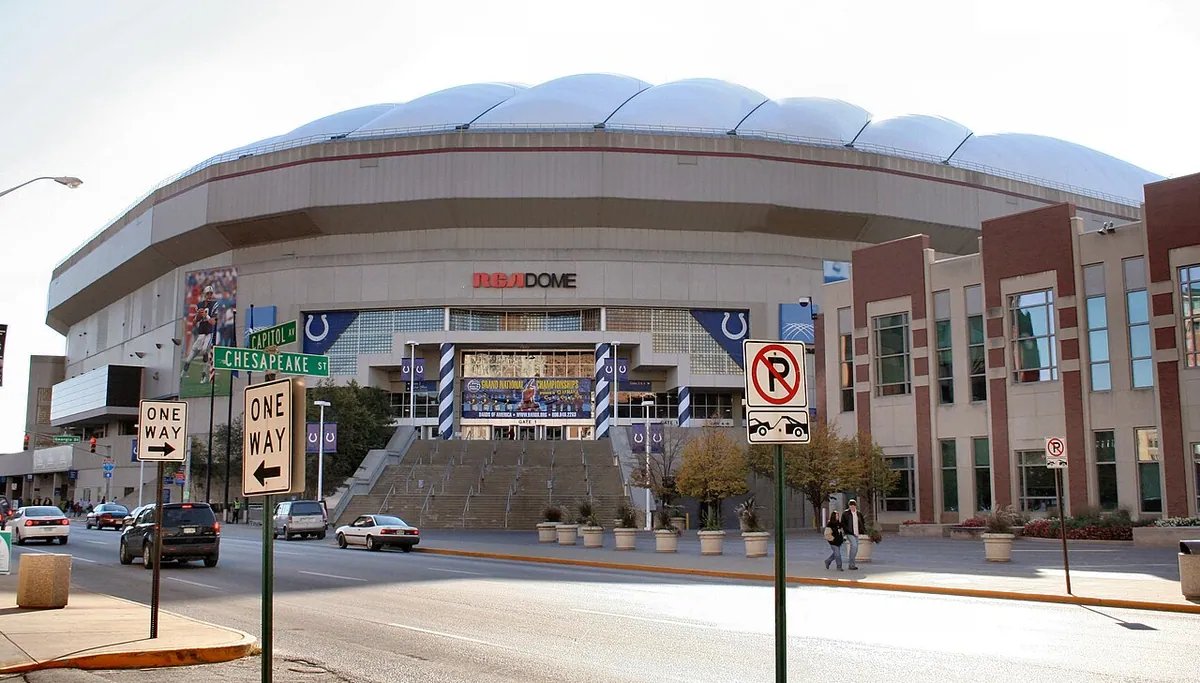
Irsay had pressed for upgrades to Memorial Stadium or a new stadium, but city officials could not use taxpayer funds, and falling attendance and revenue strained relations further. He talked with several cities and narrowed the list to Indianapolis and Phoenix. Indianapolis had built the Hoosier Dome, later renamed the RCA Dome, specifically for an NFL team. When the Maryland General Assembly considered a bill that would let Baltimore seize the team by eminent domain, Irsay began serious talks with Hudnut, and Indianapolis offered loans, the dome and a training complex.
Moving vans from the Indianapolis company Mayflower Transit reached the team's Maryland training complex on the morning of March 29, 1984, and by midday they had left for Indianapolis with everything the club owned. The Baltimore Colts' Marching Band had to scramble to keep its equipment and uniforms from being shipped too. The legal fight that followed ended with a settlement in March 1986, in which the lawsuits were dismissed and the Colts agreed to endorse a new NFL team for Baltimore. Indianapolis received more than 143,000 season ticket requests in 2 weeks, and the team kept the Colts name even though the city had no history of horse breeding or racing.
The team reached the postseason only once in its first 11 seasons in Indianapolis. It went 4-12 in 1984, started 0-13 in 1986, which cost coach Rod Dowhower his job, and in 1987 traded for future Hall of Fame running back Eric Dickerson and won the AFC East at 9-6. The 1991 team went 1-15, and Ted Marchibroda, who had coached the Colts from 1975 to 1979, returned in 1992. With running back Marshall Faulk, the second overall pick in 1994, and quarterback Jim Harbaugh, the 1995 team won the first playoff game for Indianapolis and came within a Hail Mary reception of Super Bowl XXX against the Pittsburgh Steelers.
Peyton Manning, Tony Dungy and Super Bowl XLI
Robert Irsay died in January 1997, and his son Jim Irsay became principal owner and hired Bill Polian as general manager. Polian hired Jim Mora as head coach and drafted Tennessee quarterback Peyton Manning, son of Archie Manning, first overall in 1998. Manning threw a league-high 28 interceptions as a rookie but also passed for 3,739 yards and 26 touchdowns, and after the team added running back Edgerrin James, the 1999 Colts went 13-3 and won their first division title since 1987. Since the 1999 season the Colts have gone 259-177-1 in the regular season through 2025 and 13-15 in 28 playoff games.
Tony Dungy, formerly head coach of the Tampa Bay Buccaneers, replaced Mora in 2002. His teams won the AFC South in 2003 and 2004 but lost to Tom Brady and the New England Patriots in the playoffs both years, starting a rivalry between the clubs and their quarterbacks. In 2005 the Colts opened 13-0 and finished 14-2, the best record in the league, while Manning and Marvin Harrison set the NFL record for touchdowns by a quarterback and receiver pair. A divisional loss to the Pittsburgh Steelers 21-18 ended that season.
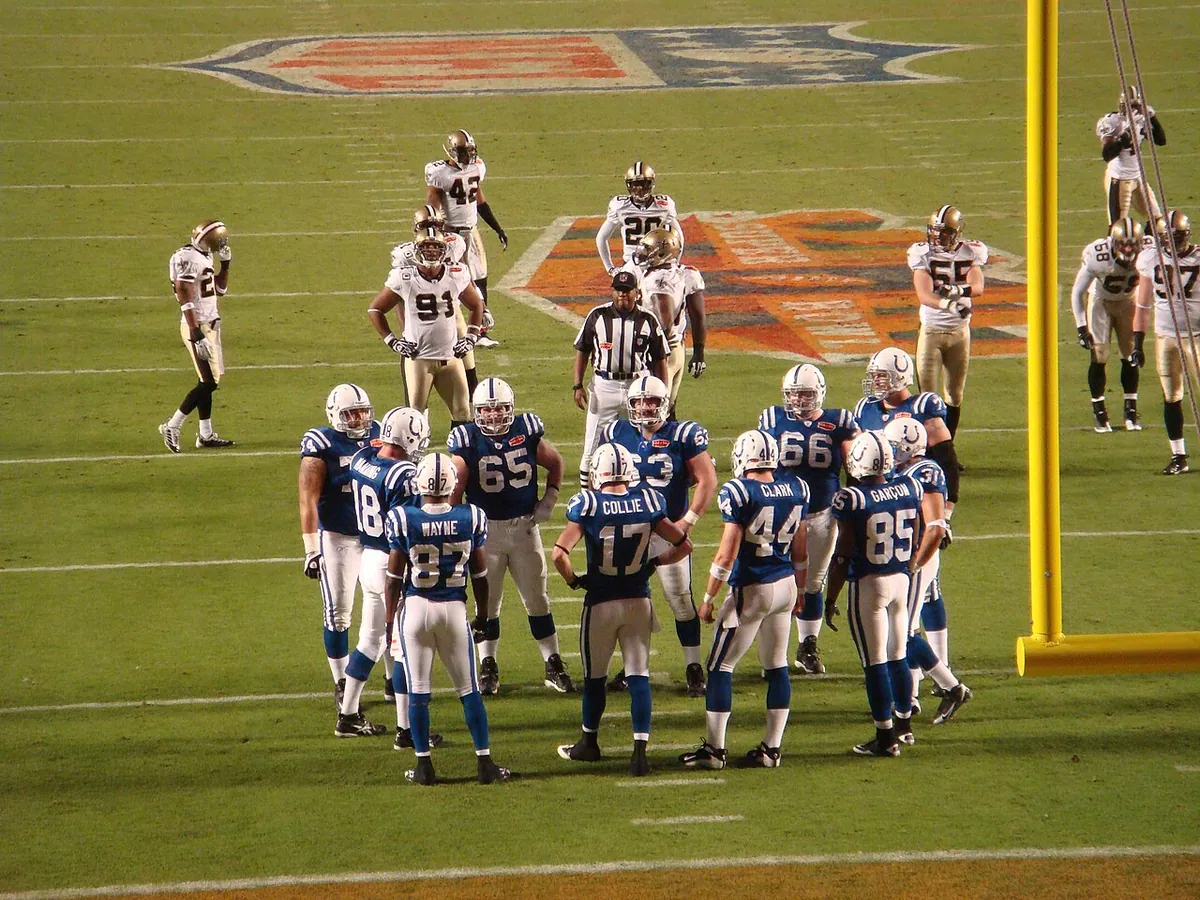
The 2006 team started 9-0, finished 12-4 and beat the Kansas City Chiefs and the Baltimore Ravens in the playoffs. In the AFC Championship Game against New England, the Colts came back from a 21-3 deficit to win 38-34. On February 4, 2007, at Dolphin Stadium, they beat the Chicago Bears 29-17 in Super Bowl XLI, the first Super Bowl appearance for the franchise since 1970 and the first for Indianapolis. Under Jim Caldwell the 2009 team won 14 straight games, the longest streak since 1999, and beat the New York Jets 30-17 for the AFC title before losing Super Bowl XLIV to the New Orleans Saints 31-17.
Andrew Luck, Head Coaches and the Current Team
The 2011 team went 2-14, and Andrew Luck was the starting quarterback from 2012 to 2018. Under Chuck Pagano the Colts went 11-5 in each of the 2012, 2013 and 2014 seasons, and the 2014 team reached the AFC Championship Game, where it lost to New England 45-7. Luck's sudden retirement in 2019 began a series of short-term starters, with Jacoby Brissett, Philip Rivers, Carson Wentz and Matt Ryan before the team drafted Anthony Richardson in 2023 and signed Daniel Jones in 2025. The head coaches since 1999 and their records with the club compare as follows.
| Head coach | Seasons | Regular season | Playoffs |
|---|---|---|---|
| Jim Mora | 1999 to 2001 | 29-19 | 0-2 |
| Tony Dungy | 2002 to 2008 | 85-27 | 7-6 |
| Jim Caldwell | 2009 to 2011 | 26-22 | 2-2 |
| Chuck Pagano | 2012 to 2017 | 53-43 | 3-3 |
| Frank Reich | 2018 to 2022 | 40-33-1 | 1-2 |
| Jeff Saturday | 2022 | 1-7 | No playoffs |
| Shane Steichen | 2023 to 2026 | 28-34 | No playoffs |
Frank Reich's 2018 team went 10-6 and reached the Divisional round, and his 2020 team went 11-5 before a 27-24 Wild Card loss to the Buffalo Bills. Jeff Saturday finished the 2022 season as interim coach. Shane Steichen took over in 2023, and his teams went 9-8, 8-9 and 8-9 in his first 3 seasons. The 2026 team stood at 3-8 through November 27, 2026.
Stadiums, Identity and Rivals
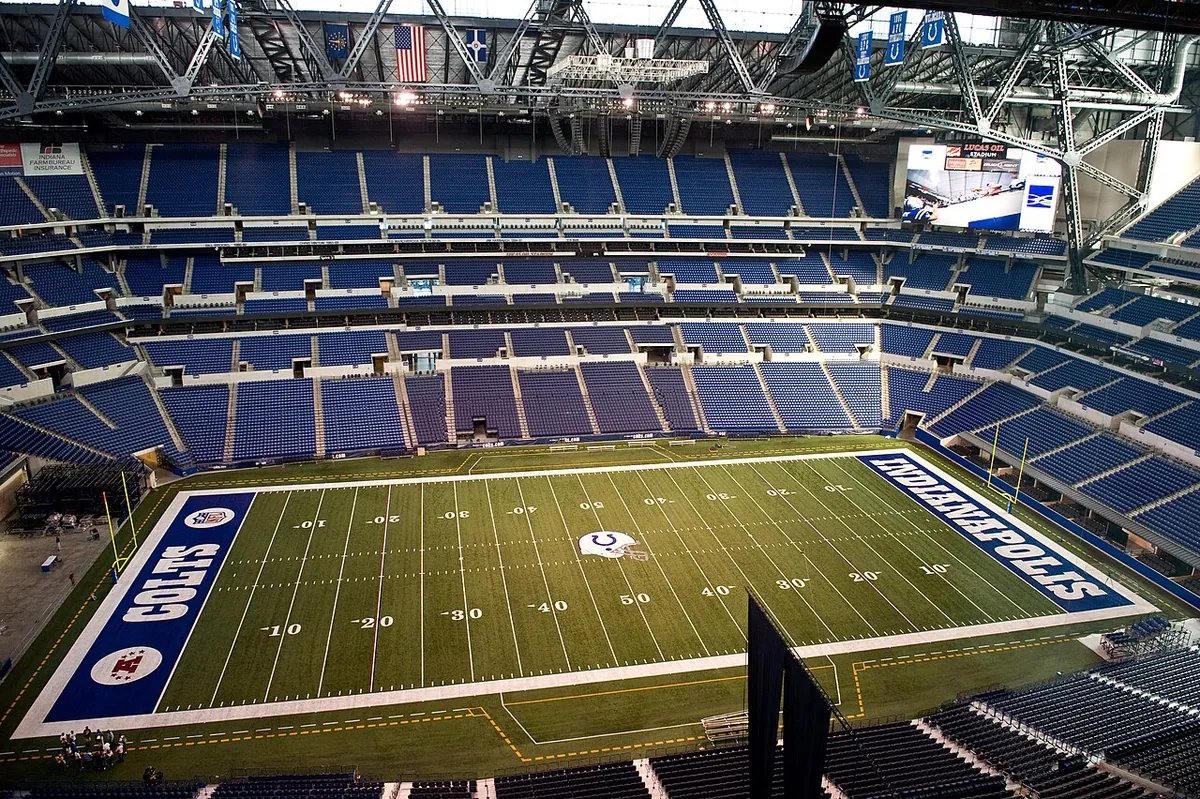
The RCA Dome, opened as the Hoosier Dome, was home to the Colts from 1984 to 2007. Lucas Oil Stadium opened in 2008 with 67,000 seats and was sold out for every game in 2010. Attendance later fell each season from 2015 to 2018, to a low of 59,199 per home game, before rebounding to an average of 65,767 in 2024. The team headquarters is the Indiana Farm Bureau Football Center in Indianapolis.
The move left a lasting link with Baltimore, whose new team became the Ravens because the Colts kept their nickname, and the Colts beat the Ravens on the way to Super Bowl XLI before losing a Wild Card game to them 24-9 after the 2012 season. The New York Jets have also met the Colts often in the playoffs, from Super Bowl III to a 41-0 Jets win after the 2002 season. The rivalry with the New England Patriots grew out of the duels between Manning and Tom Brady. The playoff meetings with New England since 1999 ended this way.
- 2003 season: AFC Championship Game, lost 24-14.
- 2004 season: Divisional round, lost 20-3.
- 2006 season: AFC Championship Game, won 38-34.
- 2013 season: Divisional round, lost 43-22.
- 2014 season: AFC Championship Game, lost 45-7.
The team colors are speed blue, white, facemask gray and anvil black, and the mascot is Blue. The franchise counts 22 Pro Football Hall of Famers and 20 members of its Ring of Honor, and Hall of Famers linked to the club include Peyton Manning, Marvin Harrison, Edgerrin James, Dwight Freeney, Marshall Faulk and Tony Dungy. In 2025 the Colts were valued at $5.9 billion, 26th among NFL teams. Jim Irsay was principal owner from 1997 through 2025, and Carlie Irsay-Gordon, Casey Foyt and Kalen Jackson are now listed as owners, with Ed Dodds serving as interim general manager.
Video
FAQ
Why did the Colts move from Baltimore to Indianapolis?
Owner Robert Irsay wanted upgrades to Memorial Stadium or a new stadium, and Baltimore officials could not use taxpayer funds to build one. Indianapolis had built the Hoosier Dome specifically for an NFL team and offered loans and a training complex. When the Maryland General Assembly considered a bill to let Baltimore seize the team by eminent domain, Irsay closed the deal. Mayflower Transit vans moved the team's belongings out of Maryland on March 29, 1984.
How many Super Bowls have the Colts won?
The Colts have won 2 Super Bowls in 4 appearances. As the Baltimore Colts they lost Super Bowl III to the New York Jets and won Super Bowl V over the Dallas Cowboys 16-13. In Indianapolis they won Super Bowl XLI over the Chicago Bears 29-17 and lost Super Bowl XLIV to the New Orleans Saints 31-17. Before the Super Bowl era the team also won NFL Championships in 1958, 1959 and 1968.
Where do the Indianapolis Colts play their home games?
The Colts play at Lucas Oil Stadium in Indianapolis, which opened in 2008 and seats 67,000. From 1984 to 2007 they played at the RCA Dome, which opened as the Hoosier Dome. In Baltimore the team played at Memorial Stadium. The Colts have also served as host team for the NFL Scouting Combine in Indianapolis since 1987.
Who owns the Indianapolis Colts?
Carlie Irsay-Gordon is listed as the owner of the Colts, along with Casey Foyt and Kalen Jackson. Robert Irsay acquired the team from Carroll Rosenbloom on July 13, 1972, and moved it to Indianapolis in 1984. His son Jim Irsay took over as principal owner after Robert died in January 1997. Jim Irsay's time in charge lasted through 2025, and Ed Dodds is the interim general manager.
Who is the head coach of the Indianapolis Colts?
Shane Steichen has been the head coach since 2023. Through November 27, 2026, his teams have a regular-season record of 28-34, and the 2026 team stood at 3-8. Before him Frank Reich coached from 2018 to 2022, with Jeff Saturday finishing the 2022 season as interim coach. Tony Dungy coached the team to its Super Bowl XLI title after the 2006 season.
What were the Indianapolis Colts called before?
The team was the Baltimore Colts from its founding in 1953 until the move to Indianapolis in 1984. An earlier Baltimore team of the All-America Football Conference had first used the name, which referred to the city's history of horse breeding and racing. The franchise kept the name after moving, even though Indianapolis had no such history. Baltimore later received a new NFL team, which became the Ravens.
Sources
- Indianapolis Colts (Wikipedia) Wikipedia
- Indianapolis Colts | Sports and Leisure | Research Starters | EBSCOhost ebsco.com
- Indianapolis Colts Pro Football Hall of Fame
- nflverse game, roster and draft data nflverse (CC BY 4.0)