The Hoosier Dome, later known as the RCA Dome, was a domed stadium located in Indianapolis, Indiana. It served as the home of the Indianapolis Colts of the National Football League for 24 seasons from 1984 through 2007. The stadium was constructed as part of the Indiana Convention Center expansion and was specifically built to attract an NFL franchise to the city. It hosted numerous significant football games, including the 2006 AFC Championship Game, before being demolished in 2008. The venue also held major basketball tournaments, concerts, and other sporting events, playing a significant role in the city's development.
Construction and Opening
Groundbreaking for the Hoosier Dome took place on May 27, 1982, as part of a joint venture with an expansion of the Indiana Convention Center. The project was a key component of a downtown revitalization strategy aimed at boosting both sports and tourism. Funding came from a mix of private grants, including $25 million from the Lilly Endowment and $5 million from the Krannert Charitable Trust, and a $47 million municipal bond repaid through a 1 percent food and beverage tax in Marion County. The stadium officially opened on August 5, 1984, with a total construction cost of $77.5 million. Its completion was instrumental in luring the Baltimore Colts to Indianapolis, with the team's relocation finalized on March 29, 1984, just months before the dome opened.
The dome was designed by the architectural firm HNTB Browning Day Pollack Mullins Inc., with structural engineering by Geiger Engineers and general contracting by Huber, Hunt & Nichols. The air-supported roof design was pioneered by engineers David Geiger and Walter Bird, making the stadium similar in appearance and function to the Metrodome in Minneapolis. The stadium was not built primarily for football but as a versatile convention and event space that could accommodate a wide range of activities. The successful attraction of the Colts validated the city's investment and strategy for urban renewal and economic growth.
Stadium Design and Features
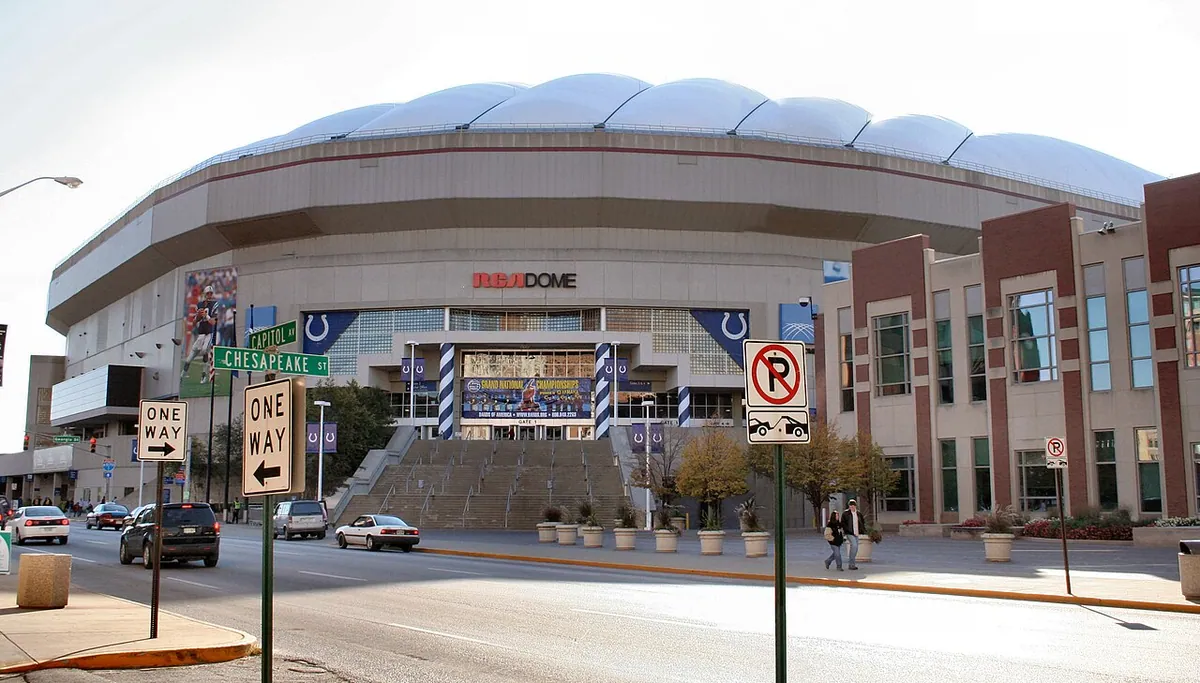
The Hoosier Dome was an air-supported structure, similar in design to the Hubert H. Humphrey Metrodome in Minneapolis. Its roof was held aloft by internal air pressure and was made of Teflon-coated fiberglass on the exterior with a canvas interior. Warning signs were posted at the exits cautioning patrons of high winds created by the pressure differential when leaving the facility. The stadium contained 104 executive suites and was owned and operated by the Capital Improvement Board of Indianapolis.
The playing surface was AstroTurf from the stadium's opening in 1984 until it was replaced with FieldTurf in 2005. Seating capacity for football fluctuated over the years due to modifications. The capacity figures changed multiple times throughout the stadium's life, reflecting renovations and reconfigurations. This made it one of the smallest stadiums in the NFL by seating count during that period. The roof material expanded and contracted with weather, causing the ceiling height to vary by up to 5 feet.
- 1984 to 1991: 60,127 seats
- 1992 to 1995: 60,129 seats
- 1996 to 1997: 60,272 seats (maximum pre-renovation)
- 1998: 60,567 seats
- 1999 to 2002: 56,127 seats (post-renovation)
- 2003 to 2005: 55,506 seats
- 2006 to 2008: 55,531 seats (final capacity)
Indianapolis Colts Tenancy and NFL Games
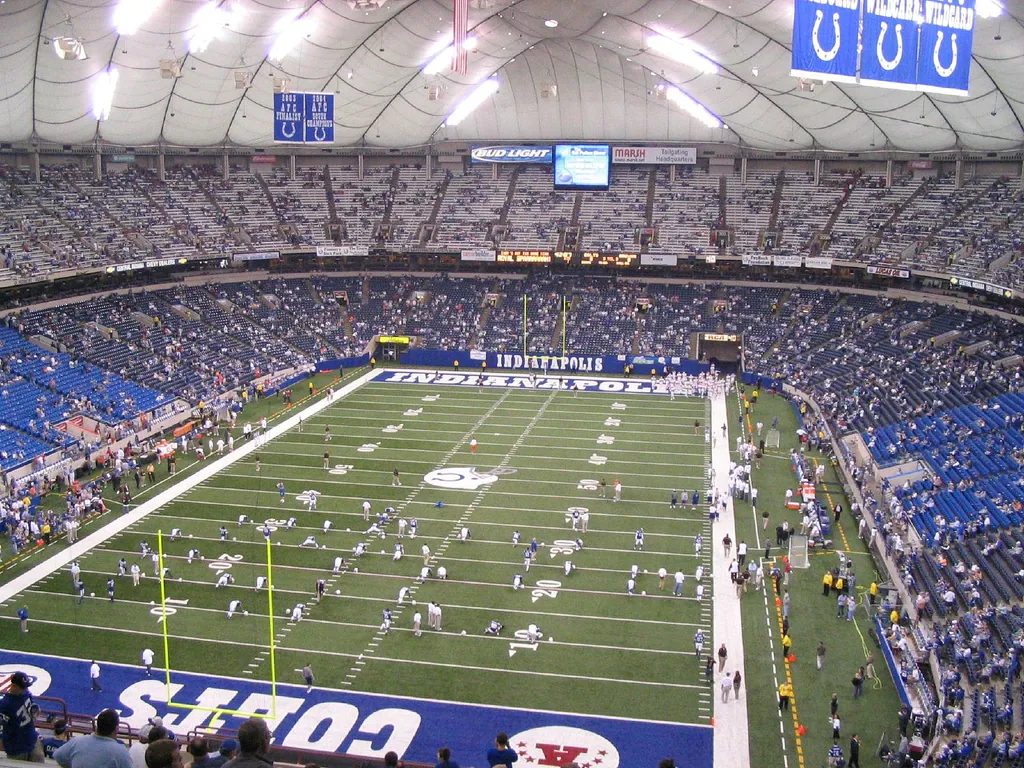
The Indianapolis Colts played their first preseason game in the Hoosier Dome on August 11, 1984, defeating the New York Giants 26-20 before a sellout crowd. Their first regular season game there was on September 2, 1984. The Colts called the stadium home for 24 seasons, through the end of the 2007 NFL season. The Colts' tenure included significant postseason moments, both triumphant and disappointing. The stadium hosted one AFC Championship Game, on January 21, 2007, where the Colts staged a memorable comeback to defeat the New England Patriots 38-34.
It also was the site for three AFC Divisional Round games (1999, 2005, 2007) and three AFC Wild Card games (2003, 2004, 2006). The Colts lost all three Divisional Round games held there, including a notable 21-18 upset by the Pittsburgh Steelers in the 2005 playoffs. The final NFL game played in the stadium was a 28-24 Divisional Round loss to the San Diego Chargers on January 13, 2008. The highest combined score in an NFL game at the venue from 1999 to 2007 was 76 points, occurring when the Colts beat the Green Bay Packers 45-31 on September 26, 2004. The Colts' overall record at the dome during its tenure included 107 regular season wins, 85 losses, and a 4-3 playoff record from 1984 to 2007. Other preseason NFL action included a game between the Buffalo Bills and Chicago Bears on August 26, 1984, which had been scheduled before the Colts' move was confirmed. The venue was also the site of the NFL Scouting Combine every February, where draft prospects are evaluated. It never hosted a Super Bowl, but its playoff history remains a key part of the Colts' legacy in Indianapolis.
Other Football and Major Sporting Events
Beyond Colts games, the Hoosier Dome hosted a variety of other football events. The annual Circle City Classic, a historically black college football game, was held at the stadium. The dome's versatility made it a premier location for major sporting events beyond football, drawing national and international competitions to Indianapolis. The stadium was a major venue for basketball in the city, hosting numerous high-profile events over its 24-year history. It also accommodated a wide range of other athletic competitions and large-scale entertainment. The stadium held many significant basketball tournaments and games.
- 1984: Exhibition game featuring an NBA All-Star team led by Larry Bird vs. the U.S. Olympic team.
- 1985: NBA All-Star Game, setting an NBA record crowd of 43,146.
- 1990: Indiana High School Athletic Association boys and girls basketball finals, with 41,046 for the boys semifinals and finals.
- 1991, 1997, 2000, 2006: NCAA Men's Division I Basketball Final Four.
- 2005: NCAA Women's Final Four.
- 2002: Site for the FIBA Men's Basketball World Championship.
During the 1987 Pan American Games, the dome hosted gymnastics, handball, and the closing ceremonies. It was also famous for WrestleMania VIII in 1992, which set the venue's all-time attendance record of 62,167. Other regular events included the Bands of America Grand Nationals, Drum Corps International competitions, AMA Supercross races from 1992 to 2008, and Monster Jam events. The 2004 U.S. Olympic Team Wrestling Trials were also conducted at the dome.
Naming Rights, Renovations, and Final Years
The stadium was originally named the Hoosier Dome. In 1994, RCA Corporation purchased the naming rights for $10 million for a 10-year term, with two 5-year options available at $3.5 million each. The venue was subsequently renamed the RCA Dome. Major renovations were undertaken in 1999 to expand the suite level and add club seating. The playing surface was also upgraded from the original AstroTurf to FieldTurf in 2005.
At the end of 2004, the Colts organization revealed its intention to construct a new stadium in downtown Indianapolis. This decision marked the beginning of the end for the RCA Dome. The team's move to the newly constructed, retractable-roof Lucas Oil Stadium was finalized for the 2008 NFL season. Monster Jam events were held at the dome, with the last one occurring in 2008 before the facility closed. The announcement of the new stadium project signaled the city's commitment to maintaining a modern NFL venue.
Closure, Demolition, and Legacy
The Colts' move to Lucas Oil Stadium for the 2008 season sealed the fate of the RCA Dome. The roof was deflated on September 24, 2008, a process that took approximately 35 minutes. The remaining structure was imploded on December 20, 2008, by Controlled Demolition, Inc., in a demolition featured on the National Geographic show Blowdown. Approximately 13 acres of the Teflon-coated roof fabric were salvaged by the nonprofit People for Urban Progress and recycled into products like bags, wallets, and public shade structures. The site was cleared to allow for an expansion of the Indiana Convention Center, which was completed in 2011. The Hoosier Dome's legacy is tied to the transformation of Indianapolis into a major sports destination. It successfully attracted and housed an NFL franchise for nearly a quarter-century. Its demolition was not an end but a transition, as the space was repurposed to continue supporting the city's convention and tourism economy, with the new convention center space directly connecting to its successor, Lucas Oil Stadium.
- Concerts: Pink Floyd (1987 reunion), The Rolling Stones, Monsters of Rock Festival (1988), Farm Aid IV (1990).
- Community Events: Indiana State School Music Association State Marching Band Competition, local high school commencements, the 1990 General Conference Session of Seventh-day Adventists.
- Racing: The Thunder in the Dome midget car race (1985 to 2001).
- Gymnastics: 1991 World Artistic Gymnastics Championships.
Video
FAQ
What was the Hoosier Dome?
The Hoosier Dome was a domed stadium in Indianapolis, Indiana, that opened in 1984. It was the home of the Indianapolis Colts NFL team from 1984 until 2007. The stadium was built as part of the Indiana Convention Center and was designed with an air-supported Teflon roof. It was renamed the RCA Dome in 1994 after a naming rights deal and was demolished in 2008 following the Colts' move to Lucas Oil Stadium. The stadium was a multipurpose venue that hosted football, basketball, concerts, and numerous other major events throughout its operational life.
What was the capacity of the Hoosier Dome?
The football capacity of the Hoosier Dome changed several times due to renovations. Before modifications in 1999, the maximum seating for football was 60,272. After the 1999 renovations added club seats and expanded suites, the capacity was reduced. The all-time record attendance for any event was 62,167, set at WrestleMania VIII in 1992. The capacity figures were adjusted nearly every few years throughout its operational life, reflecting changes in seating configurations.
Why was the Hoosier Dome demolished?
The Hoosier Dome was demolished to make way for an expansion of the adjacent Indiana Convention Center. The Indianapolis Colts moved into the new Lucas Oil Stadium for the 2008 NFL season, rendering the old dome obsolete. The roof was deflated in September 2008, and the structure was imploded on December 20, 2008. The cleared land was used for new convention space, which connects to Lucas Oil Stadium. The demolition was part of a planned redevelopment to enhance Indianapolis's convention facilities after the Colts departed for their new home.
Did the Hoosier Dome host a Super Bowl?
No, the Hoosier Dome never hosted a Super Bowl. Its primary football tenant was the Indianapolis Colts, and it did host several significant NFL playoff games. The most notable was the 2006 AFC Championship Game on January 21, 2007, where the Colts defeated the New England Patriots 38-34. The stadium also hosted three AFC Divisional Round games and three AFC Wild Card games during the Colts' tenure. Despite being a domed stadium, it was not selected to host the NFL's championship game during its 24 years of operation.
What replaced the Hoosier Dome?
The Indianapolis Colts moved to Lucas Oil Stadium, a retractable-roof stadium that opened in 2008. The physical site of the Hoosier Dome was replaced by an expansion of the Indiana Convention Center. This new convention space was completed in 2011 and connects to Lucas Oil Stadium via a walkway that passes under a railroad track, similar to how the old dome connected to the original convention center. The Colts have played all their home games at Lucas Oil Stadium since the 2008 season, and the convention center expansion continues to serve the city's tourism industry.
What was the cost to build the Hoosier Dome and how was it financed?
The total construction cost for the Hoosier Dome was $77.5 million. Financing came from a combination of private grants and public bonds. Private contributions included $25 million from the Lilly Endowment and $5 million from the Krannert Charitable Trust. The remaining $47 million was funded through a municipal bond, which was repaid via a controversial 1 percent tax on food and beverage sales in Marion County. The stadium was owned by the public Capital Improvement Board. This funding model was part of a broader strategy to revitalize downtown Indianapolis through sports and convention infrastructure, which proved successful in attracting an NFL team.
Sources
- RCA Dome (Wikipedia) Wikipedia
- Hoosier Dome indyencyclopedia.org
- RCA Dome, History, Photos & More of the former NFL stadium of the Indianapolis Colts Stadiums of Pro Football
- Hoosier Dome, Indianapolis retroseasons.com
- nflverse game, roster and draft data nflverse (CC BY 4.0)