The New York Giants are a professional American football team based in the New York metropolitan area that competes in the East division of the National Football Conference (NFC) in the National Football League. Founded on August 1, 1925, the Giants were one of 5 teams that joined the NFL that year and are the only one of that group still in existence. The team has won 8 NFL championships, those of 1927, 1934, 1938 and 1956 and Super Bowls XXI, XXV, XLII and XLVI, a total surpassed only by the Green Bay Packers and the Chicago Bears. The Giants play their home games at MetLife Stadium in East Rutherford, New Jersey, which they share with the New York Jets. The Mara family has owned part of the club since its founding, and today John Mara and Steve Tisch are the owners.
Tim Mara, the Polo Grounds and the First Title
On August 1, 1925, the NFL granted Tim Mara and Will Gibson a franchise for their new team in New York City, and before the first season had ended Mara had invested another $25,000 to keep it alive. The Giants played their first game on October 4 as an exhibition in New Britain, Connecticut, winning 26-0 before a crowd of 10,000. Their first NFL game came a week later, on October 11, 1925, a 14-0 loss to the Providence Steam Roller at the Cycledrome in Providence. On December 6, 1925, more than 70,000 fans came to the Polo Grounds to see Red Grange and the Chicago Bears beat the Giants 19-7, and the team finished its first season 8-4.
Grange and his agent answered in 1926 by forming a rival American Football League with a team called the Yankees in New York, but that league folded after its only season. In 1927 the Giants went 11-1-1 and won their first NFL title behind a defense led by tackle Steve Owen that allowed 20 points in 13 games. After the 1928 season Mara bought the entire Detroit Wolverines squad, mainly to acquire quarterback Benny Friedman, and merged it into the Giants. In December 1930 the team beat a Notre Dame all-star team assembled by Knute Rockne at the Polo Grounds, a game that raised $100,000 for the jobless of New York City and is often credited with establishing the legitimacy of the professional game.
Steve Owen, the Sneakers Game and the Greatest Game
Steve Owen coached the team for 23 seasons until 1953 and finished with a 153-108-17 record. Beginning with the start of divisional play in 1933, the Giants won 8 Eastern division titles in 14 seasons. In the 1934 NFL Championship Game they beat the Bears on an icy field while wearing sneakers for better traction, a game remembered as the Sneakers Game, and in 1938 they won a third title 23-17 over the Green Bay Packers. Center and linebacker Mel Hein, who did not miss a game in 15 seasons, and halfback Ken Strong were standouts of the era, and the 1944 defense allowed only 7.5 points per game.
The Giants moved to Yankee Stadium in 1956 and won the NFL title in their first season there with future Hall of Famers Frank Gifford, Sam Huff and Roosevelt Brown. Head coach Jim Lee Howell had Vince Lombardi coaching the offense and Tom Landry coaching the defense. The 1958 NFL Championship Game, a 23-17 overtime loss to the Colts, is often called "The Greatest Game Ever Played" and helped grow the popularity of the NFL. In 1963 league MVP Y. A. Tittle threw a then-record 36 touchdown passes, but a 14-10 loss to the Bears was the team's fifth defeat in a title game in 6 years.
Lean Years and the Parcells Champions
An aging roster fell to 2-10-2 in 1964, the start of a 15-year stretch with only 2 winning seasons and no playoff appearances. After the Giants lost their first meeting with the New York Jets 37-14 in a 1969 preseason game before 70,874 fans at the Yale Bowl, Wellington Mara fired coach Allie Sherman. The team traded quarterback Fran Tarkenton back to the Minnesota Vikings after the 1971 season and won only 23 games from 1973 to 1979. A feud between Wellington Mara and his nephew Tim Mara eased when Commissioner Pete Rozelle recommended a neutral general manager, George Young.
The rebuilding began with the drafting of quarterback Phil Simms in 1979 and linebacker Lawrence Taylor in 1981, when Taylor won both Defensive Rookie of the Year and Defensive Player of the Year and the Giants reached the playoffs for the first time since 1963. Defensive coordinator Bill Parcells became head coach in 1983, and in 1986 Taylor was named league MVP as the Big Blue Wrecking Crew defense led a 14-2 team. The Giants beat the San Francisco 49ers 49-3 and the Washington Redskins 17-0 in the playoffs, and Simms was the Super Bowl XXI MVP after completing 22 of 25 passes at the Rose Bowl in Pasadena. The 1990 team went 13-3, set a then NFL record for the fewest turnovers in a season with 14, beat the 49ers 15-13 at San Francisco and won Super Bowl XXV over the Buffalo Bills.
Fassel, Coughlin and the Patriots Super Bowls
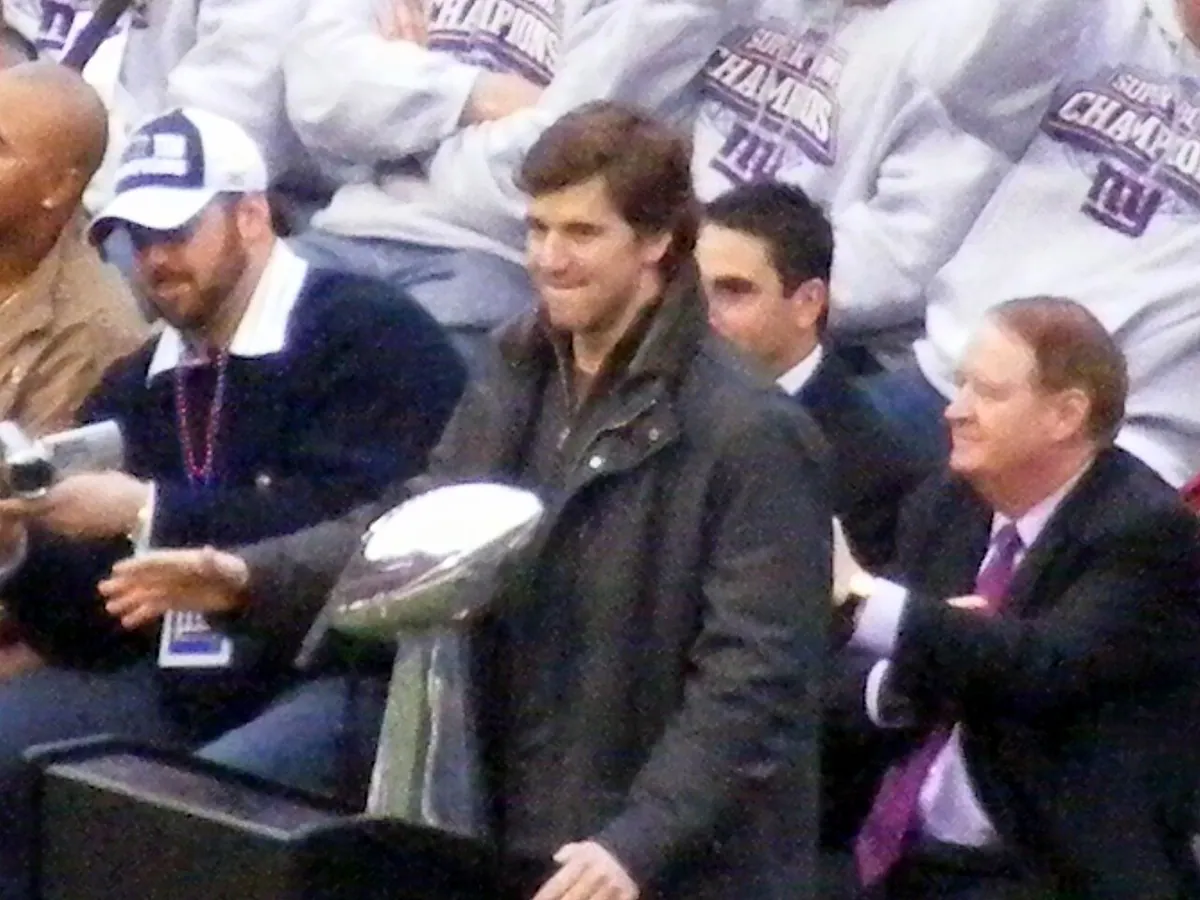
Jim Fassel became the 16th head coach in 1997, and before the 1999 season the Giants signed quarterback Kerry Collins. The 2000 team went 12-4 and routed the Minnesota Vikings 41-0 in the NFC Championship Game at Giants Stadium before losing the Super Bowl on January 28, 2001, at Raymond James Stadium. Tom Coughlin took over in 2004 and coached the team through the 2015 season. His 2007 team beat the Green Bay Packers 23-20 in the NFC Championship Game and then, led by quarterback Eli Manning and defensive end Michael Strahan, defeated the previously unbeaten New England Patriots in Super Bowl XLII on February 3, 2008, at University of Phoenix Stadium.
That title run was part of an 8-game winning streak from January 6, 2008, to October 5, 2008, the longest for the team since 1999. Manning and the Giants won a second Super Bowl 4 years later in a rematch with the Patriots, Super Bowl XLVI on February 5, 2012, at Lucas Oil Stadium, after a 20-17 NFC Championship Game win over the San Francisco 49ers. Coughlin's teams went 8-3 in the postseason. The 5 Super Bowl appearances in franchise history ended this way.
| Season | Head coach | Opponent | Result |
|---|---|---|---|
| 1986 | Bill Parcells | Denver Broncos | Won 39-20 |
| 1990 | Bill Parcells | Buffalo Bills | Won 20-19 |
| 2000 | Jim Fassel | Baltimore Ravens | Lost 34-7 |
| 2007 | Tom Coughlin | New England Patriots | Won 17-14 |
| 2011 | Tom Coughlin | New England Patriots | Won 21-17 |
Stadiums, Names and Rivalries
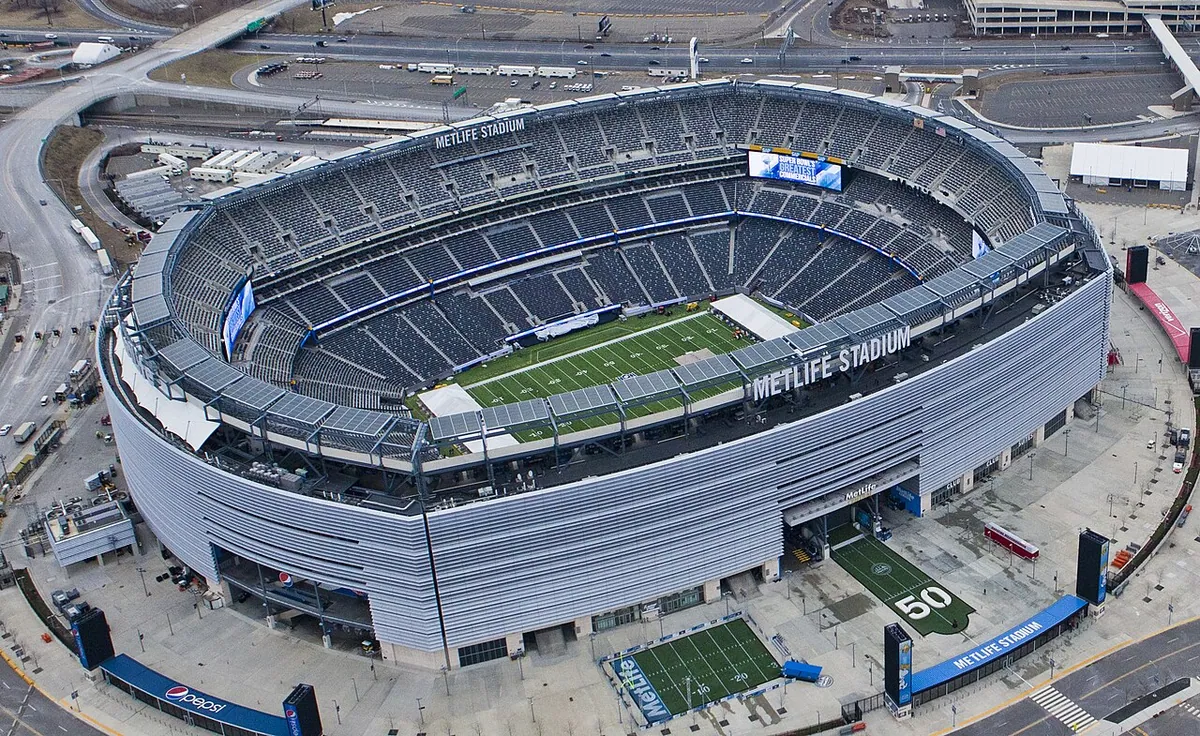
The Giants have played in both New York and New Jersey. The Polo Grounds was their first home field, and for decades they shared stadiums with baseball teams before moving into a building of their own. Renovation of Yankee Stadium forced the team to play temporarily in Connecticut and in Queens. Their home fields have been these.
- Polo Grounds, the first home field, from 1925
- Yankee Stadium in the Bronx, from 1956
- Yale Bowl in New Haven, Connecticut, in 1973 and 1974
- Shea Stadium in Queens, in 1975
- Giants Stadium at the Meadowlands in East Rutherford, New Jersey, from 1976 to 2009
- MetLife Stadium, shared with the Jets, since 2010
To distinguish itself from the baseball Giants, the club was incorporated as the New York National League Football Company in 1929 and became New York Football Giants, Inc. in 1937. The baseball team moved to San Francisco after the 1957 season, but the football team still uses New York Football Giants as its corporate name. Fans and writers also call the team Big Blue, the G-Men and the Jints, a deliberately mangled contraction that began with the baseball club. The name Big Blue Wrecking Crew refers mainly to the defense of the 1980s and early 1990s.
The rivalry with the Philadelphia Eagles is the oldest in the NFC East, dating to 1933, and it has been called the best rivalry in the NFL in the 21st century. A low point for the Giants came in 1978 with the Miracle at the Meadowlands, when a fumble by quarterback Joe Pisarcik as the team tried to run out the clock was returned for the winning touchdown by Herman Edwards. Philadelphia also ended the Giants' postseason after the 2006, 2008 and 2022 seasons. The Jets, the other tenant of MetLife Stadium, first met the Giants in that 1969 preseason game at the Yale Bowl.
Ownership and the Current Team
The Giants have been a family enterprise from the start, with founder Tim Mara succeeded by his sons Jack and Wellington. On February 20, 1991, Jack's son Tim Mara sold his shares to Preston Robert Tisch, who bought 50 percent of the club, and Wellington Mara and Tisch served as co-chief executive officers until their deaths in 2005. John Mara is now president and co-owner, and Steve Tisch is co-owner and chief executive officer. Forbes ranked the Giants as the third most valuable NFL team in 2026, and the franchise has been valued at $6.8 billion.
Since 2011 the team has had only 3 winning seasons, in 2012, 2016 and 2022, and as of 2025 it held the longest active division title drought in the NFC at 14 seasons. Brian Daboll coached from 2022 to 2025, and John Harbaugh became head coach in 2026. The Giants were 6-3-1 and in first place in their division through November 27, 2026, after a 23-18 win over the Jacksonville Jaguars in Week 11, with quarterback J.J. McCarthy at the helm and Malik Nabers named NFC Offensive Player of the Month. Eli Manning advanced in the voting for the Pro Football Hall of Fame Class of 2027, and Tom Coughlin was among the 5 head coach nominees.
Video
FAQ
How many Super Bowls have the New York Giants won?
The Giants have won 4 Super Bowls in 5 appearances. They beat the Denver Broncos in Super Bowl XXI and the Buffalo Bills in Super Bowl XXV under Bill Parcells. Under Tom Coughlin they beat the New England Patriots in Super Bowl XLII and again in Super Bowl XLVI. Their only Super Bowl loss came against the Baltimore Ravens after the 2000 season.
What is the official name of the New York Giants?
The team's legal name is New York Football Giants, Inc., adopted in 1937. It was first incorporated in 1929 as the New York National League Football Company. The longer name separated the football team from the New York Giants baseball team. The baseball club moved to San Francisco after the 1957 season, but the football team kept the corporate name.
Why do the New York Giants play in New Jersey?
The Giants moved into Giants Stadium at the Meadowlands in East Rutherford, New Jersey, in 1976, their first stadium of their own. The site is 5 miles west of New York City. Before that the team had played at the Polo Grounds, Yankee Stadium, the Yale Bowl and Shea Stadium. Since 2010 the Giants have played at MetLife Stadium in the same sports complex, which they share with the Jets.
Who owns the New York Giants?
The Giants are owned by John Mara, who is also team president, and Steve Tisch, the chief executive officer. Tim Mara founded the team in 1925, and his family has been part of the ownership ever since. Preston Robert Tisch bought 50 percent of the club in 1991. Forbes ranked the Giants as the third most valuable NFL team in 2026.
Who is the head coach of the New York Giants?
John Harbaugh is the head coach of the New York Giants in the 2026 season. He followed Brian Daboll, who coached the team from 2022 to 2025. Under Harbaugh the Giants were 6-3-1 through November 27, 2026, and led their division. Joe Schoen is the general manager.
Who are the biggest rivals of the New York Giants?
The Philadelphia Eagles are the oldest rival of the Giants in the NFC East, and the series dates to 1933. That rivalry has been called the best in the NFL in the 21st century. The Giants also share MetLife Stadium with the New York Jets, whom they first met in a 1969 preseason game. In the early decades the Chicago Bears were a frequent opponent in NFL title games.
Sources
- New York Giants (Wikipedia) Wikipedia
- Giants.com giants.com
- Giants team history Pro Football Hall of Fame
- New York Giants | Sports and Leisure | Research Starters | EBSCOhost ebsco.com
- New York Giants News, Scores, Stats, Schedule NFL
- New York Giants on the Forbes NFL Team Valuations List Forbes
- nflverse game, roster and draft data nflverse (CC BY 4.0)