State Farm Stadium is a retractable roof stadium located in Glendale, Arizona, a suburb west of Phoenix. It opened on August 1, 2006, and serves as the home venue for the Arizona Cardinals of the National Football League and the annual Fiesta Bowl. The stadium has a fixed seating capacity of 63,400, which is expandable for major events, and features a unique roll-in natural grass field. It has hosted three Super Bowls, two BCS National Championship games, the College Football Playoff National Championship, and the NCAA Men's Final Four. The venue is a major part of the Phoenix metropolitan area's sports and entertainment scene.
Construction and Financing
The ceremonial groundbreaking for the stadium took place on April 12, 2003, after years of planning and site selection. The Cardinals had played at Sun Devil Stadium in Tempe since moving to Arizona in 1988 but sought a modern, revenue-generating facility of their own. Several cities, including Tempe, Avondale, Mesa, and Glendale, submitted bids to host the new stadium. Glendale was ultimately selected, offering $36 million in infrastructure improvements and 11,000 parking spots. Construction lasted three years, with the 63,400-seat venue opening on August 1, 2006. The overall construction budget was $455 million. This sum was allocated as $395.4 million for the stadium building, $41.7 million for improvements to the site, and $17.8 million for the purchase of the land. Funding was a public-private partnership, with the Arizona Sports and Tourism Authority contributing $302.3 million, the Arizona Cardinals contributing $143.2 million, and the City of Glendale contributing $9.5 million. The stadium was designed by Eisenman Architects in partnership with HOK Sport, now Populous, and built by the Hunt Construction Group. The structural engineering for the bowl was handled by TLCP Structural, Inc., while Walter P Moore engineered the retractable roof.
Design and Engineering Features
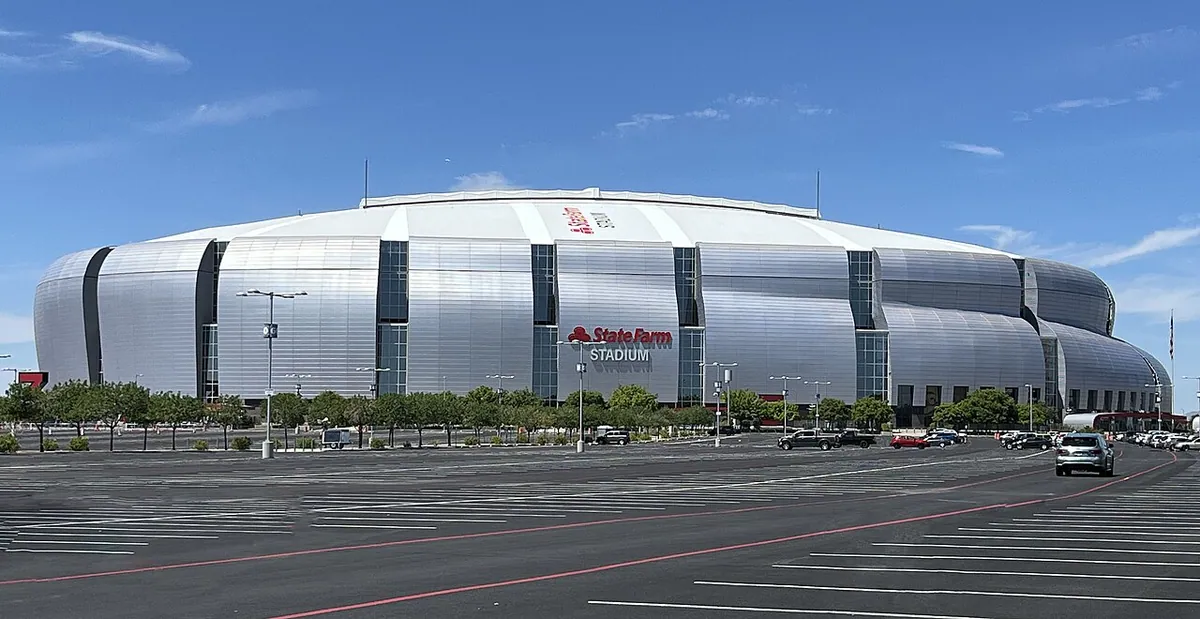
State Farm Stadium is noted for its innovative engineering, featuring the first completely retractable roof built on an incline and the first retractable natural grass playing surface in North America. The roof is made of translucent Birdair fabric and opens in approximately 12 minutes using a 480-horsepower system powered by eight cable drums or winches. Every winch is driven by four motors, each with 7.5 horsepower, that spool a cable measuring one and a half inches thick. The natural grass field, Tifway 419 Hybrid Bermuda, is grown in a single 40-inch deep tray measuring 234 feet wide by 403 feet long. The entire 19-million-pound tray rolls on 546 steel wheels resting on 13 railroad-like tracks and can be moved the 740 feet in or out of the stadium in about 70 minutes. The stadium's exterior features shimmering metal panels that reflect the desert light and 21 vertical glass-walled slots that offer views of the desert horizon. The surrounding 25-acre area is called Sportsman's Park and includes an 8-acre landscaped tailgating area known as the Great Lawn. The approximate elevation at field level is 1,070 feet above sea level.
Capacity and Seating Configuration
The fixed seating capacity for football is 63,400, providing outstanding, unobstructed views for fans. For mega-events like Super Bowls, college football championships, the NFC Championship Game, and the NCAA Final Four, the capacity can be expanded by 8,800 seats. This expansion uses risers and portable X-frame folding seats, bringing the total seated capacity to 72,200. The end zone area where the field tray rolls in and out can be expanded to accommodate an additional tier of seating. The venue contains 88 luxury suites, called luxury lofts, with space allocated for 16 future suites as the stadium matures. There are also 7,505 club seats available for premium experiences. The stadium encompasses over 1.7 million square feet of space and offers more than 350,000 square feet of meeting, special event, and show space.
Arizona Cardinals and NFL History
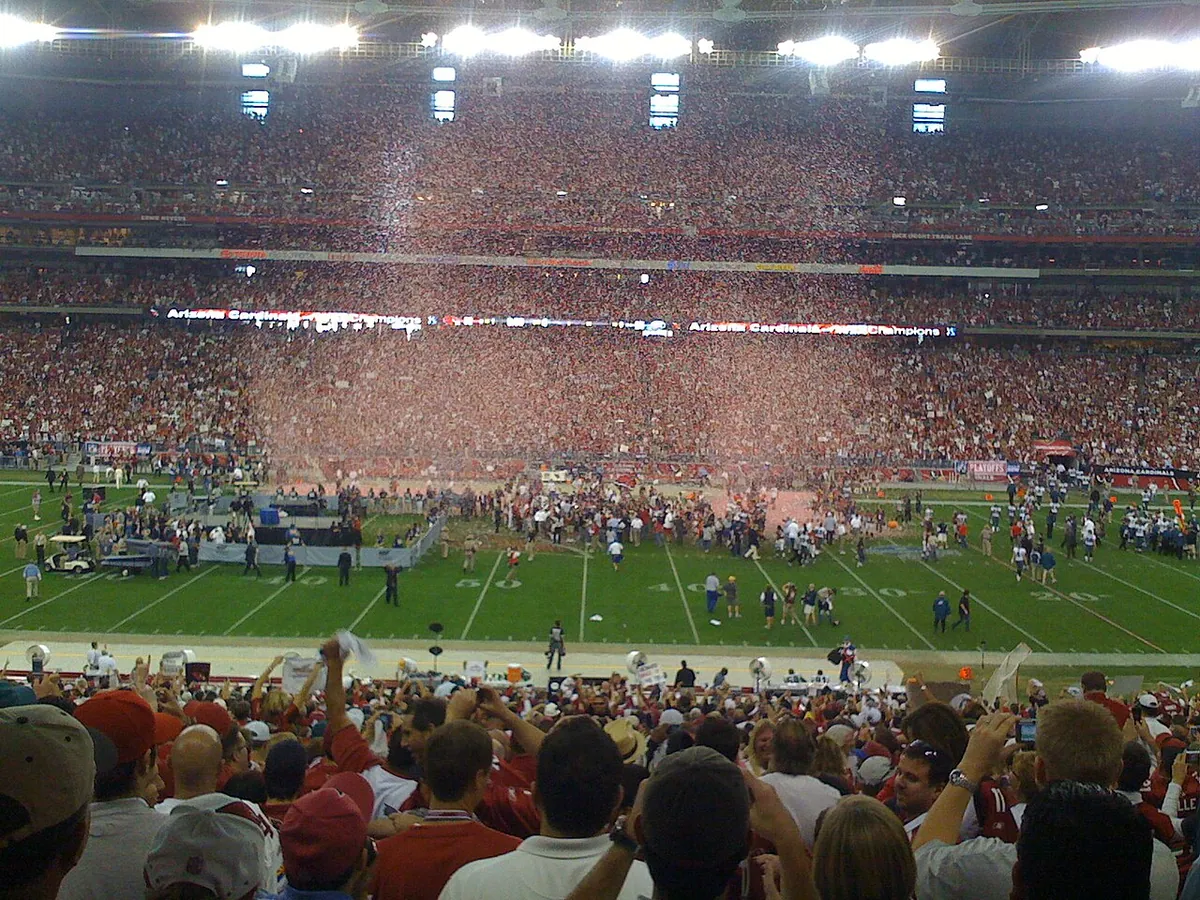
The Arizona Cardinals have played all their home games at the stadium since the 2006 NFL season. From the 2006 season through November 27, 2026, the stadium has hosted 173 NFL games, comprising 165 regular season contests and 8 playoff games. The first preseason game was on August 12, 2006, a 21-13 Cardinals victory over the Pittsburgh Steelers. The inaugural regular season game was on September 10, 2006, a 34-27 win over the San Francisco 49ers. The stadium's air-conditioning system allowed the Cardinals to host a season-opening game for the first time since moving to Arizona. A notable early game occurred on October 16, 2006, when the Chicago Bears overcame a 20-point deficit to defeat the Cardinals. The stadium hosted its first playoff game on January 3, 2009, ending a long drought for the franchise as the Cardinals beat the Atlanta Falcons 30-24. On January 18, 2009, the venue hosted the NFC Championship Game, where the Cardinals defeated the Philadelphia Eagles 32-25 to advance to Super Bowl XLIII. During the 2020 season, due to COVID-19 restrictions in California, the San Francisco 49ers were forced to play three home games at State Farm Stadium against the Buffalo Bills, Washington Football Team, and Seattle Seahawks. The stadium also hosted an NFL playoff game on January 13, 2025, when the Los Angeles Rams faced the Minnesota Vikings there because Southern California wildfires prevented use of SoFi Stadium.
Super Bowls and Pro Bowl
State Farm Stadium has established itself as a premier destination for the NFL's biggest game, having hosted three Super Bowls. The initial Super Bowl at the venue was Super Bowl XLII on February 3, 2008. In that game, the New York Giants beat the New England Patriots, who entered the game undefeated, by a final score of 17 to 14. The paid attendance for that event was 71,101 spectators. The second was Super Bowl XLIX on February 1, 2015, where the New England Patriots beat the Seattle Seahawks 28-24 with 70,288 in attendance. That year, the stadium also hosted the Pro Bowl, marking the first time the Pro Bowl was held at the same location as the Super Bowl since 2010. The third was Super Bowl LVII on February 12, 2023, featuring a 38-35 victory for the Kansas City Chiefs over the Philadelphia Eagles in front of 67,827 fans. These events have generated significant economic impact for the region, with the stadium's events since 2006 contributing over $1 billion to Arizona's economy. The successful bids for these games were collaborative efforts involving the Arizona Sports and Tourism Authority, the Arizona Cardinals, and host committees.
| Super Bowl | NFC Team | AFC Team | Score | Attendance |
|---|---|---|---|---|
| XLII (2008) | New York Giants | New England Patriots | 17-14 | 71,101 |
| XLIX (2015) | Seattle Seahawks | New England Patriots | 28-24 | 70,288 |
| LVII (2023) | Philadelphia Eagles | Kansas City Chiefs | 38-35 | 67,827 |
College Football and the Fiesta Bowl
The Fiesta Bowl has been played at State Farm Stadium every year since January 1, 2007, replacing Sun Devil Stadium as its home. The first Fiesta Bowl at the stadium was a classic, with the Boise State Broncos defeating the Oklahoma Sooners 43-42 in overtime before 73,719 fans. Just one week later, the stadium hosted its first BCS National Championship Game, where the Florida Gators beat the Ohio State Buckeyes 41-14 with 74,628 in attendance. The stadium set its college football attendance record on January 10, 2011, when 78,603 fans saw the Auburn Tigers defeat the Oregon Ducks 22-19 in the BCS National Championship Game. The venue hosted the College Football Playoff National Championship on January 11, 2016, featuring Alabama and Clemson before a crowd of 75,765. It has also served as a College Football Playoff semifinal site, hosting the Fiesta Bowl in December 2016, 2019, and 2022. The most recent Fiesta Bowl listed was the 2026 edition, where the Miami (FL) Hurricanes defeated the Ole Miss Rebels 31-27 with an attendance of 67,928. The 2021 Fiesta Bowl between Iowa State and Oregon was held with only family members of the universities in attendance due to COVID-19 protocols, so no official attendance was recorded.
- 2007 Fiesta Bowl: No. 9 Boise State 43, No. 7 Oklahoma 42 (OT), Attendance: 73,719
- 2007 BCS National Championship: No. 2 Florida 41, No. 1 Ohio State 14, Attendance: 74,628
- 2011 BCS National Championship: No. 1 Auburn 22, No. 2 Oregon 19, Attendance: 78,603
- 2016 CFP National Championship: No. 2 Alabama 45, No. 1 Clemson 40, Attendance: 75,765
- 2022 Fiesta Bowl (CFP Semifinal): No. 3 TCU 51, No. 2 Michigan 45, Attendance: 71,723
- 2026 Fiesta Bowl: No. 10 Miami (FL) 31, No. 6 Ole Miss 27, Attendance: 67,928
Other Major Sporting Events
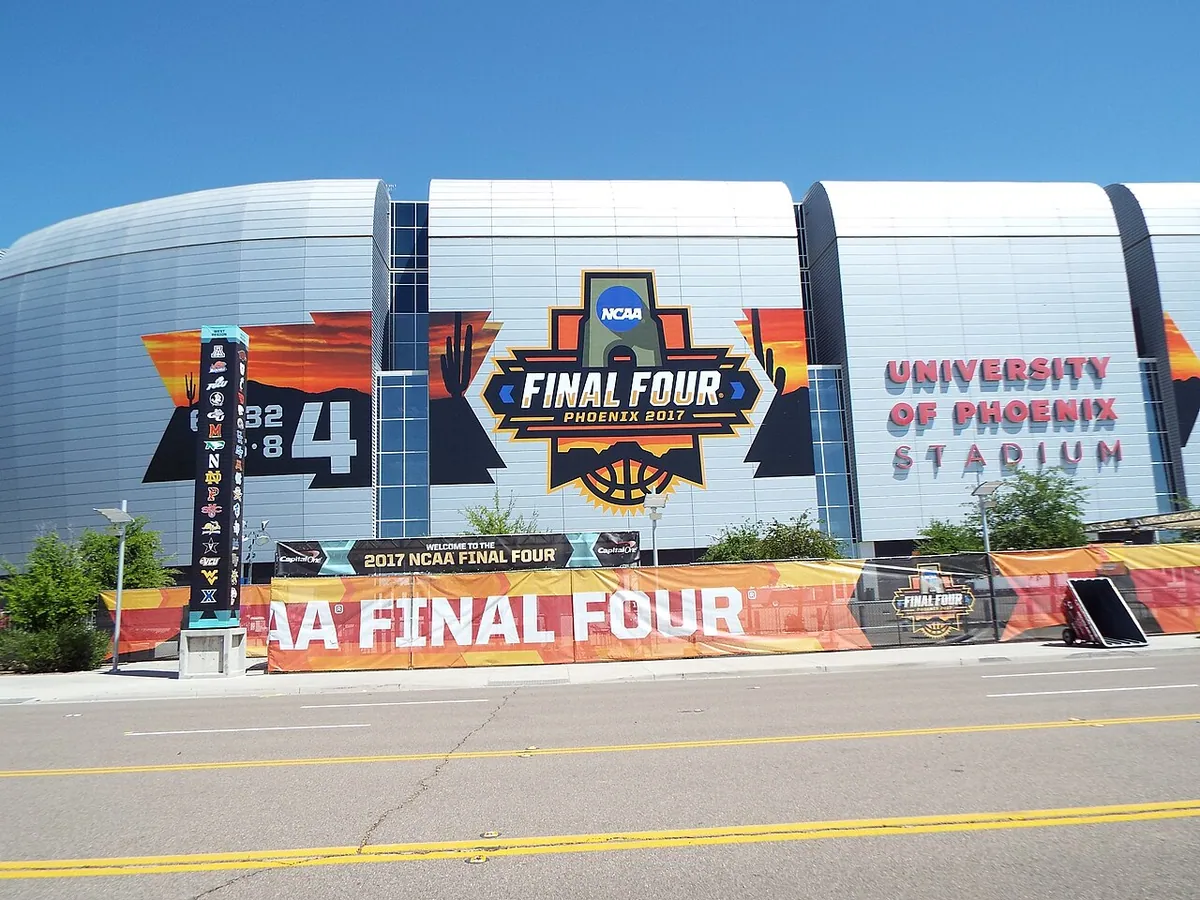
Beyond football, State Farm Stadium has hosted a wide array of major sporting events, demonstrating its multipurpose design. The venue has been the site for the NCAA Men's Final Four basketball tournament twice, first in 2017 and then again in 2024. The 2017 Final Four culminated in North Carolina defeating Gonzaga 71-65 for the national championship, while the 2024 Final Four saw UConn defeat Purdue 75-60 to repeat as champions. The stadium also hosted the NCAA West Regional semifinals and finals in 2009. For international soccer, the venue has been a frequent site for matches. It hosted its first U.S. Men's National Team match on February 7, 2007, a 2-0 victory over Mexico before 62,462 fans. The stadium was a venue for the 2015 CONCACAF Gold Cup, the 2016 Copa América Centenario, and the 2024 Copa América. It hosted the first semi-final of the 2019 CONCACAF Gold Cup, where Mexico defeated Haiti 1-0. The stadium also hosted a memorable club friendly on August 1, 2013, where Real Madrid defeated the LA Galaxy 3-1. In professional wrestling, the venue hosted WrestleMania XXVI on March 28, 2010, with 72,219 fans in attendance, grossing $5.8 million in ticket sales.
Naming Rights History and Renovations
The stadium opened in 2006 as Cardinals Stadium. In September of that same year, the University of Phoenix acquired the naming rights in a 20-year agreement, and the venue became University of Phoenix Stadium. In September 2018, insurance company State Farm secured an 18-year naming rights deal, and the facility was renamed State Farm Stadium. The stadium has undergone several renovations to enhance the fan experience and maintain its status as a top-tier venue. Renovations were completed in 2014 and 2017, though specific details of those projects are not extensively documented. In 2024, the Arizona Cardinals announced a new round of renovations to add two luxury clubs: the Casitas Garden Club on the south end and the Morgan Athletic Club on the north end. The project also includes the addition of new tunnel seats and field seats. These ongoing updates ensure the stadium remains competitive for hosting major sporting events and providing premium amenities. The venue's operational success is managed under the ownership of the Arizona Sports and Tourism Authority.
Initial Events and Public Opening
The stadium's calendar filled quickly after its August 2006 opening with a diverse set of inaugural events. The public grand opening tours were held on August 19 and 20, 2006, and were attended by 120,000 people. The first monster truck event, the AMP Motorsports Tour, was held on August 26, 2006. The first international soccer match took place on October 31, 2006, featuring Chivas against Club America. The first major concert was performed by the Rolling Stones on November 8, 2006. Between its opening on August 4, 2006, and the BCS National Championship on January 8, 2007, the stadium hosted 91 events representing 110 event days. This rapid schedule demonstrated the facility's versatility and immediate impact on the region's event landscape. The stadium's design, with its retractable roof and field, allowed for efficient transitions between football games, concerts, trade shows, and other functions.
Recent games
| Date | Game | Week |
|---|---|---|
| Jan 10, 2027 | San Francisco 49ers at Arizona Cardinals | Week 18 |
| Jan 3, 2027 | Las Vegas Raiders at Arizona Cardinals | Week 17 |
| Dec 20, 2026 | New York Jets at Arizona Cardinals | Week 15 |
| Dec 6, 2026 | Philadelphia Eagles at Arizona Cardinals | Week 13 |
| Nov 29, 2026 | Washington Commanders at Arizona Cardinals | Week 12 |
| Nov 15, 2026 | Los Angeles Rams 34 at Arizona Cardinals 6 | Week 10 |
| Oct 25, 2026 | Denver Broncos 30 at Arizona Cardinals 16 | Week 7 |
| Oct 11, 2026 | Detroit Lions 45 at Arizona Cardinals 21 | Week 5 |
| Sep 20, 2026 | Seattle Seahawks 31 at Arizona Cardinals 7 | Week 2 |
| Dec 21, 2025 | Atlanta Falcons 26 at Arizona Cardinals 19 | Week 16 |
| Dec 7, 2025 | Los Angeles Rams 45 at Arizona Cardinals 17 | Week 14 |
| Nov 23, 2025 | Jacksonville Jaguars 27 at Arizona Cardinals 24 | Week 12 |
Video
FAQ
Where is State Farm Stadium located?
State Farm Stadium is located at 1 Cardinals Drive in Glendale, Arizona. Glendale is a suburb situated west of Phoenix within the Phoenix metropolitan area. The stadium's coordinates are 33 degrees 31 minutes 41 seconds north latitude and 112 degrees 15 minutes 47 seconds west longitude. It sits at an elevation of approximately 1,060 feet above mean sea level.
What is the capacity of State Farm Stadium?
The stadium has a fixed seating capacity of 63,400 for standard football games. For major events like Super Bowls or college championships, seating can be expanded by adding 8,800 seats, bringing the total to 72,200. With standing room areas utilized, the venue can accommodate crowds of at least 78,600 people. This expanded capacity was used for the 2011 BCS National Championship Game, which set a college football attendance record for the stadium.
When did State Farm Stadium open and what did it cost?
State Farm Stadium opened on August 1, 2006, after construction began with a groundbreaking on April 12, 2003. The total cost of the project was 455 million dollars. This overall figure included 395.4 million dollars for the stadium structure itself, 41.7 million dollars for site improvements, and 17.8 million dollars for the land. When adjusted for inflation, this amount equals about 727 million dollars in 2025 currency.
Does State Farm Stadium have a retractable roof and real grass?
Yes, the stadium features both a retractable roof and a natural grass playing surface. The roof is constructed from translucent Birdair fabric and is the first retractable roof built on an incline, taking roughly 12 minutes to open fully. The grass is a Tifway 419 Hybrid Bermuda variety grown in a massive tray on wheels. This tray can be rolled completely outside the stadium building to receive sunlight and necessary care.
How many Super Bowls has State Farm Stadium hosted?
The stadium has been the site for three Super Bowl games. The first was Super Bowl XLII on February 3, 2008, where the New York Giants beat the New England Patriots by a score of 17 to 14 with 71,101 paid attendees. The second was Super Bowl XLIX on February 1, 2015, a 28 to 24 victory for the New England Patriots over the Seattle Seahawks. The third was Super Bowl LVII on February 12, 2023, which saw the Kansas City Chiefs defeat the Philadelphia Eagles 38 to 35.
What other major events are held at State Farm Stadium?
The stadium is the permanent home of the annual Fiesta Bowl college football game. It has hosted the BCS National Championship Game twice, in 2007 and 2011, and the College Football Playoff National Championship in 2016. For basketball, it hosted the NCAA Men's Final Four tournament in 2017 and again in 2024. The venue has also staged major international soccer tournaments, WWE's WrestleMania, and serves as a site for concerts, trade shows, and consumer expos.
Sources
- State Farm Stadium (Wikipedia) Wikipedia
- About | State Farm Stadium statefarmstadium.com
- State Farm Stadium: History, Capacity, Events & Significance sportsmatik.com
- About AZSTA, Prop. 302, State Farm Stadium & Board Leadership az-sta.com
- nflverse game, roster and draft data nflverse (CC BY 4.0)