The Arizona Cardinals are a professional American football team based in the Phoenix metropolitan area that plays in the West division of the National Football Conference. Founded in Chicago in 1898 as the Morgan Athletic Club and a charter member of the NFL since September 17, 1920, the Cardinals are the oldest continuously run professional football franchise in the United States. The team moved to St. Louis in 1960 and to Arizona in 1988, and it plays its home games at State Farm Stadium in Glendale, which opened in 2006. The Cardinals won NFL championships in 1925 and 1947, both in Chicago, and reached their only Super Bowl after the 2008 season, losing Super Bowl XLIII 27-23 to the Pittsburgh Steelers. Owned by Michael Bidwill and coached by Mike LaFleur, the franchise holds the longest active championship drought in North American sports.
Chicago origins and the early championships
The franchise traces its history to 1898, when a neighborhood group on the South Side of Chicago began playing as the Morgan Athletic Club. Chicago painting and building contractor Chris O'Brien acquired the team and moved it to Normal Field on Racine Avenue, and it played as the Racine Normals until 1901. That year O'Brien bought used jerseys from the University of Chicago, described their faded maroon as cardinal red, and the team became the Racine Street Cardinals. The club has worn cardinal red jerseys ever since, and its names over the years trace the moves of the franchise.
- Morgan Athletic Club, 1898
- Racine Normals, until 1901
- Racine Street Cardinals, from 1901
- Racine Cardinals, on joining the league in 1920
- Chicago Cardinals, from 1922
- St. Louis Cardinals, from 1960
- Phoenix Cardinals, from 1988
- Arizona Cardinals, from March 17, 1994
The Cardinals were a charter member of the American Professional Football Association, renamed the National Football League two years later, and became the Chicago Cardinals in 1922 to avoid confusion with the Horlick-Racine Legion. In 1920 the Cardinals faced a challenge for territorial rights in Chicago from a team called the Tigers, and they won a game against them for those rights, 6-0, on a touchdown by Paddy Driscoll. In 1925 they were awarded the league championship after the Pottsville Maroons were suspended for playing a game in another team's territory, a title still disputed by supporters of Pottsville. On Thanksgiving Day in 1929, running back Ernie Nevers scored all 40 points in a 40-6 win over the Chicago Bears, an NFL record.
Charles W. Bidwill bought the team in 1932, beginning a continuous period of family ownership, and kept it running through the Depression and the World War II years. His building program produced the team that won the 1947 NFL Championship Game 28-21 over the Philadelphia Eagles, eight months after his death. Coach Jimmy Conzelman is in the Pro Football Hall of Fame, as is Charley Trippi of the famed Dream Backfield with Paul Christman, Pat Harder, Marshall Goldberg and Elmer Angsman. The Cardinals returned to the title game in 1948 but lost the rematch 7-0 in a snowstorm in Philadelphia, and by the late 1950s, after years of losing seasons and losing fans to the crosstown Bears, the club was close to bankruptcy.
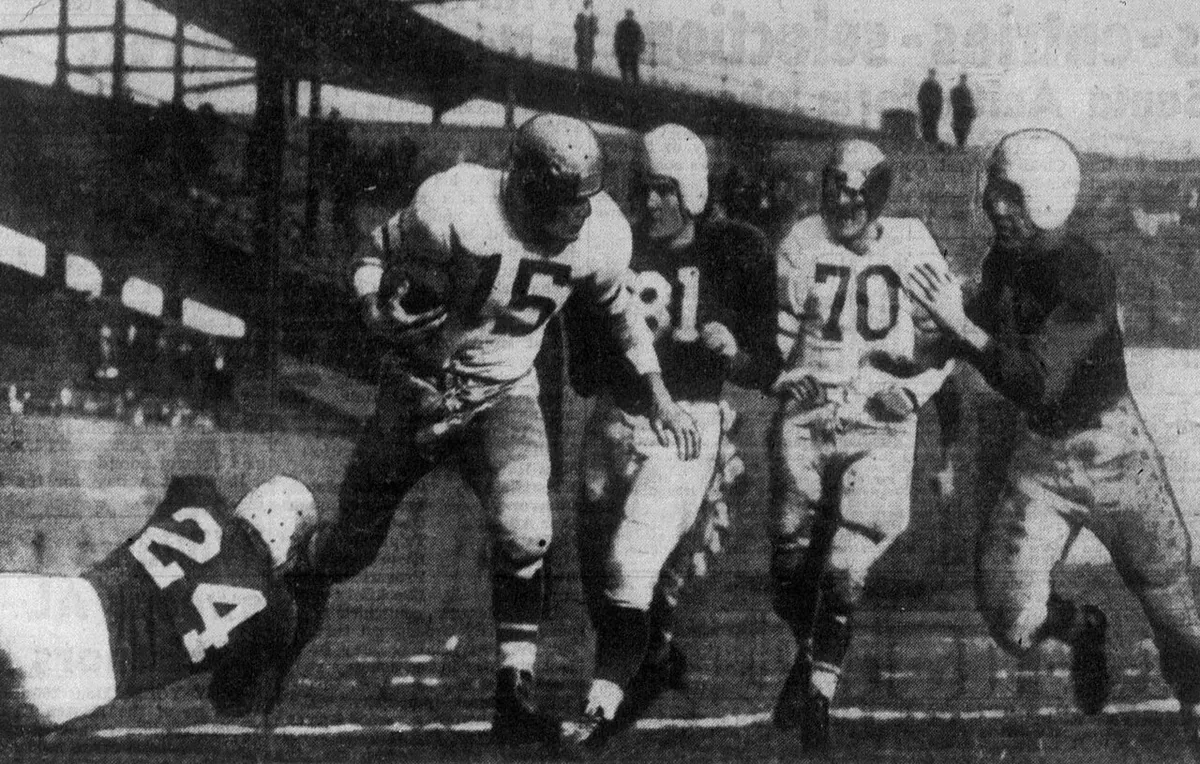
The St. Louis Cardinals
With the rival American Football League forming, the NFL allowed the Bidwill family to move the team to St. Louis, Missouri, in 1960. There the club was commonly called the Big Red, the Gridbirds or the Football Cardinals, to avoid confusion with the baseball Cardinals of Major League Baseball. A drawing of a cardinal's head was added to both sides of the helmet, and the print logo became a cardinal carrying a football in front of the Gateway Arch. The Cardinals won the Playoff Bowl, a game for third place, 24-17 over the Green Bay Packers in 1964, and they finished half a game behind the Cleveland Browns in the division race in both 1964 and 1968.
The mid-1970s were the best years in St. Louis, when the team won NFC East titles in 1974 and 1975 but lost in the first round of the playoffs each time. In 28 years in the city the Cardinals reached the postseason only three times, in 1974, 1975 and 1982, and never hosted or won a playoff game. Poor results and an aging stadium, by then 21 years old, caused attendance to dwindle. Owner Bill Bidwill decided to move the team, and not long after the 1987 season he agreed on a handshake deal with state and local officials in Arizona.
Arizona and State Farm Stadium
The team began play in 1988 as the Phoenix Cardinals and changed its name to the Arizona Cardinals on March 17, 1994. For 18 seasons it played at Sun Devil Stadium on the campus of Arizona State University in Tempe, and the flag of Arizona was added to the jersey sleeves in 1989. Because autumn temperatures in Arizona frequently rise above 100 °F, the Cardinals, like a few other warm-climate teams, wore white jerseys at home in the first half of the season and made opponents play in darker colors. From 1988 to 2012, except in 2005, the team held its summer training camp at Northern Arizona University in Flagstaff.
In 2006 the Cardinals moved into the new University of Phoenix Stadium in Glendale, a suburb northwest of Phoenix, known since 2018 as State Farm Stadium. With the roof closed for early-season games and the temperature inside at 70 °F, the team switched to red jerseys at home full time. The new stadium brought quick success, with division titles and the run to Super Bowl XLIII, and since 2013 the team has also held its training camp there. The executive offices and training facility remain in Tempe and are scheduled to move to north Phoenix in 2028.
Super Bowl XLIII and the playoff record
The 1998 season ended two long droughts, as the Cardinals reached the playoffs for the first time in 16 years and won their first postseason game since 1947, 20-7 over the Dallas Cowboys in the wild card round. Ken Whisenhunt took over as head coach in 2007, and in the 2008 postseason, led by quarterback Kurt Warner, the Cardinals beat the Atlanta Falcons, the Carolina Panthers and, 32-25 in the NFC Championship Game, the Philadelphia Eagles. In Super Bowl XLIII on February 1, 2009, at Raymond James Stadium, they lost 27-23 to the Pittsburgh Steelers in the final seconds. The next season they won a second straight NFC West title before losing 45-14 to the eventual champion New Orleans Saints.
Bruce Arians became head coach in 2013, and in 2015 the Cardinals set a franchise-best 13-3 record and earned a first-round bye as the second seed in the NFC. They beat the Green Bay Packers 26-20 in overtime, the first playoff win for quarterback Carson Palmer, but lost the NFC Championship Game 49-15 to the Carolina Panthers after committing seven turnovers. The Cardinals are the only NFL team that has never lost a home playoff game, with a 5-0 record that includes the 1947 championship game. Since their title game appearances of 1947 and 1948 they have won five division titles.
- 1974, NFC East
- 1975, NFC East
- 2008, NFC West
- 2009, NFC West
- 2015, NFC West
Overall the Cardinals have reached the playoffs 11 times and won 7 playoff games, 3 of them in the 2008 postseason, and their all-time record including playoffs stood at 603-836-41 at the end of the 2025 season. In 37 seasons in Arizona they have made 6 playoff appearances and won 3 division titles and 1 NFC championship. Since the 1999 season the team has gone 181-254-2 in the regular season through 2025 and 5-5 in the playoffs. As of 2025 their drought of 78 seasons without a championship was the longest active one in North American sports, ahead of the Cleveland Guardians of Major League Baseball, who last won the World Series in 1948.
Uniforms, colors and rivals
For most of their history the Cardinals have worn white helmets, white pants with red stripes and either red or white jerseys. Starting in 1947 the team used a logo of a northern cardinal perched on the laces of a football in printed materials. In 1990 new coach Joe Bugel added red pants to be worn with the white jerseys, copying his former employer, the Washington Redskins. In 2005 the club made its first major uniform changes in a century, updating the cardinal-head logo, which some fans had mocked as a parakeet, and bringing back black as an accent color after an eight-year absence.
Uniform choices have also been used as a home-field tactic. From 1970 through 1983, and in many seasons between 1989 and 2002, the Cardinals wore white when hosting the Dallas Cowboys to force them into their supposedly jinxed blue jerseys. New uniforms introduced before the 2023 season made all-red the home look and all-white the road look, with all-black as the alternate. Ahead of the 2025 season the team introduced a Rivalries uniform, to be worn once per season at home against each NFC West opponent for three seasons.
The team colors are cardinal red, white, black and grey, and the mascot is named Big Red, one of the nicknames used for the team in St. Louis. In Chicago the Cardinals shared the city with the Bears, the only other NFL charter member still in operation, and lost many fans to their crosstown rivals in the 1950s. Today the other clubs of the NFC West are the opponents honored by the Rivalries uniform. The only NFC Championship Game the Cardinals have won since the merger came against the Philadelphia Eagles, the same opponent they met in the title games of 1947 and 1948.
The Cardinals today
Kliff Kingsbury was hired in 2019, and the team used the first overall pick of the 2019 draft on Oklahoma quarterback Kyler Murray. The Cardinals went 11-6 in 2021 and returned to the playoffs for the first time since 2015, losing to the Los Angeles Rams in the wild card round, but Kingsbury was fired after a 4-13 season in 2022. Jonathan Gannon coached the next three seasons, and in 2025 the Cardinals became the first team in NFL history to lose three consecutive games on last-second field goals. After a 3-14 finish Gannon was fired on January 5, 2026, and less than a month later the team hired Los Angeles Rams offensive coordinator Mike LaFleur.
The Cardinals were 3-8 in the 2026 season through November 27. Quarterback Carson Beck remained sidelined with a bad back before the Week 12 game against the Washington Commanders, so Josh Johnson was set to start. The team changed defensive coordinators in midseason, with Teryl Austin taking over on an interim basis, while Nathaniel Hackett serves as offensive coordinator. Michael Bidwill is the owner and Monti Ossenfort the general manager.
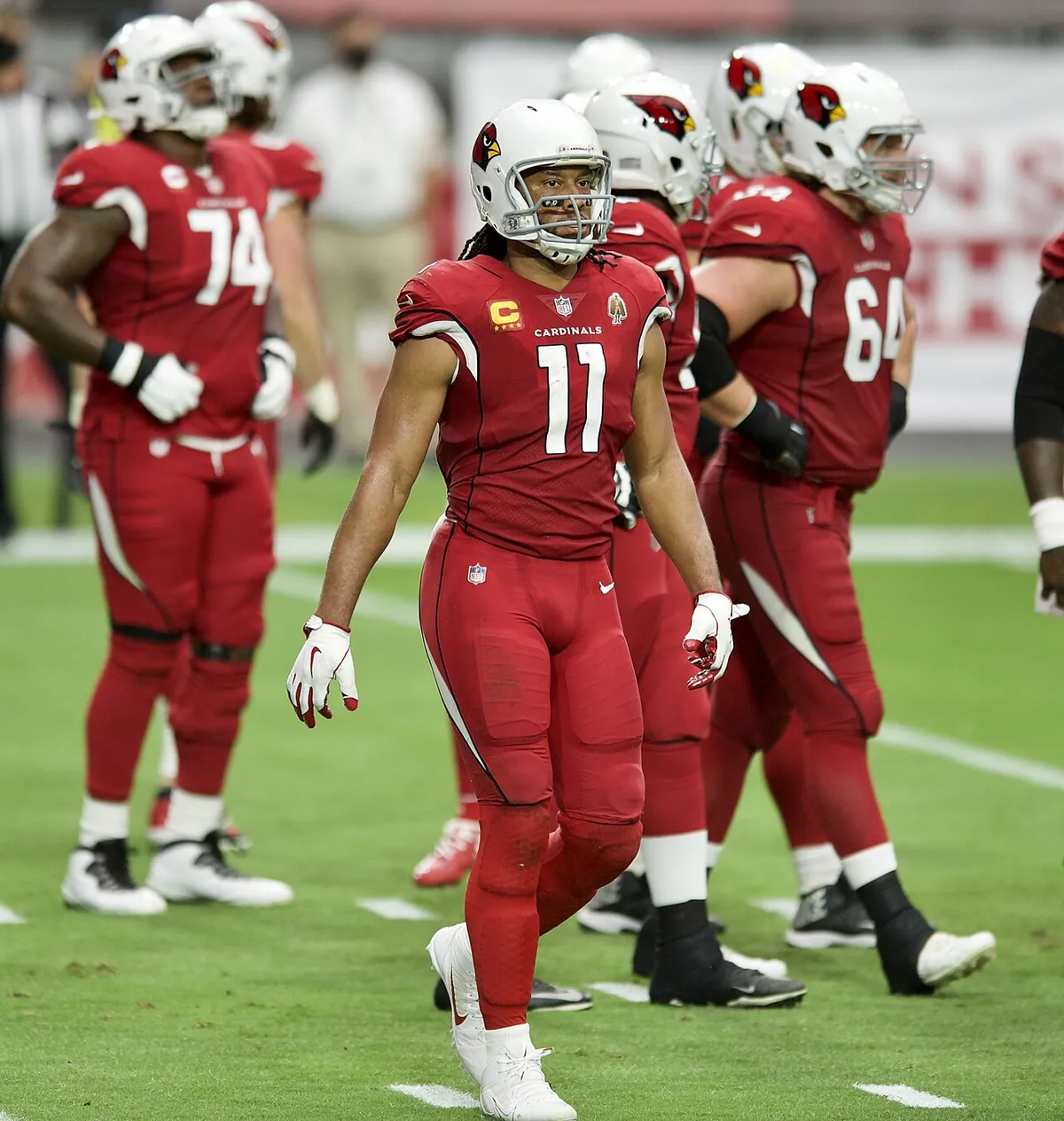
Video
FAQ
Have the Arizona Cardinals ever won a Super Bowl?
The Arizona Cardinals have never won a Super Bowl. Their only appearance came in Super Bowl XLIII on February 1, 2009, when they lost 27-23 to the Pittsburgh Steelers in the final seconds. The franchise did win NFL championships in 1925 and 1947, both while it was based in Chicago. As of 2025 its drought of 78 seasons without a title was the longest active one in North American sports.
What team did the Arizona Cardinals used to be?
The Arizona Cardinals began in 1898 as the Morgan Athletic Club on the South Side of Chicago. The team later played as the Racine Normals and the Racine Street Cardinals, joined the league in 1920 as the Racine Cardinals and became the Chicago Cardinals in 1922. It moved to St. Louis in 1960 as the St. Louis Cardinals and to Arizona in 1988 as the Phoenix Cardinals. The current name, Arizona Cardinals, was adopted on March 17, 1994.
Are the Arizona Cardinals the oldest NFL team?
The Cardinals are the oldest continuously run professional football franchise in the United States, with roots going back to 1898. They joined the league as a charter member on September 17, 1920. Along with the Chicago Bears, they are one of only two NFL charter member franchises still in operation. The team has called three cities home since joining the NFL, spending 40 seasons in Chicago before moving to St. Louis and then to Arizona.
Where do the Arizona Cardinals play their home games?
The Cardinals play at State Farm Stadium in Glendale, a suburb northwest of Phoenix. The stadium opened in 2006 as University of Phoenix Stadium, and its roof allows games to be played in comfortable conditions during hot Arizona autumns. From 1988 to 2005 the team played at Sun Devil Stadium on the campus of Arizona State University in Tempe. The team headquarters is in Tempe and is scheduled to move to north Phoenix in 2028.
Who owns the Arizona Cardinals?
Michael Bidwill is the owner of the Arizona Cardinals. The Bidwill family has owned the team continuously since Charles W. Bidwill bought it in 1932. In the late 1950s the owner was Violet Bidwill Wolfner, who sought a new city before the move to St. Louis in 1960, and later Bill Bidwill moved the team to Arizona in 1988. Monti Ossenfort serves as general manager under the current ownership.
Who is the head coach of the Arizona Cardinals?
Mike LaFleur is the head coach of the Arizona Cardinals. He was hired less than a month after Jonathan Gannon was fired on January 5, 2026, following a 3-14 season. LaFleur had been the offensive coordinator of the Los Angeles Rams. His staff includes offensive coordinator Nathaniel Hackett and interim defensive coordinator Teryl Austin.
Sources
- Arizona Cardinals (Wikipedia) Wikipedia
- Arizona Cardinals Home: The official source of the latest Cardinals headlines, news, videos, photos, tickets, rosters and game day informati azcardinals.com
- Arizona Cardinals team history Pro Football Hall of Fame
- nflverse game, roster and draft data nflverse (CC BY 4.0)