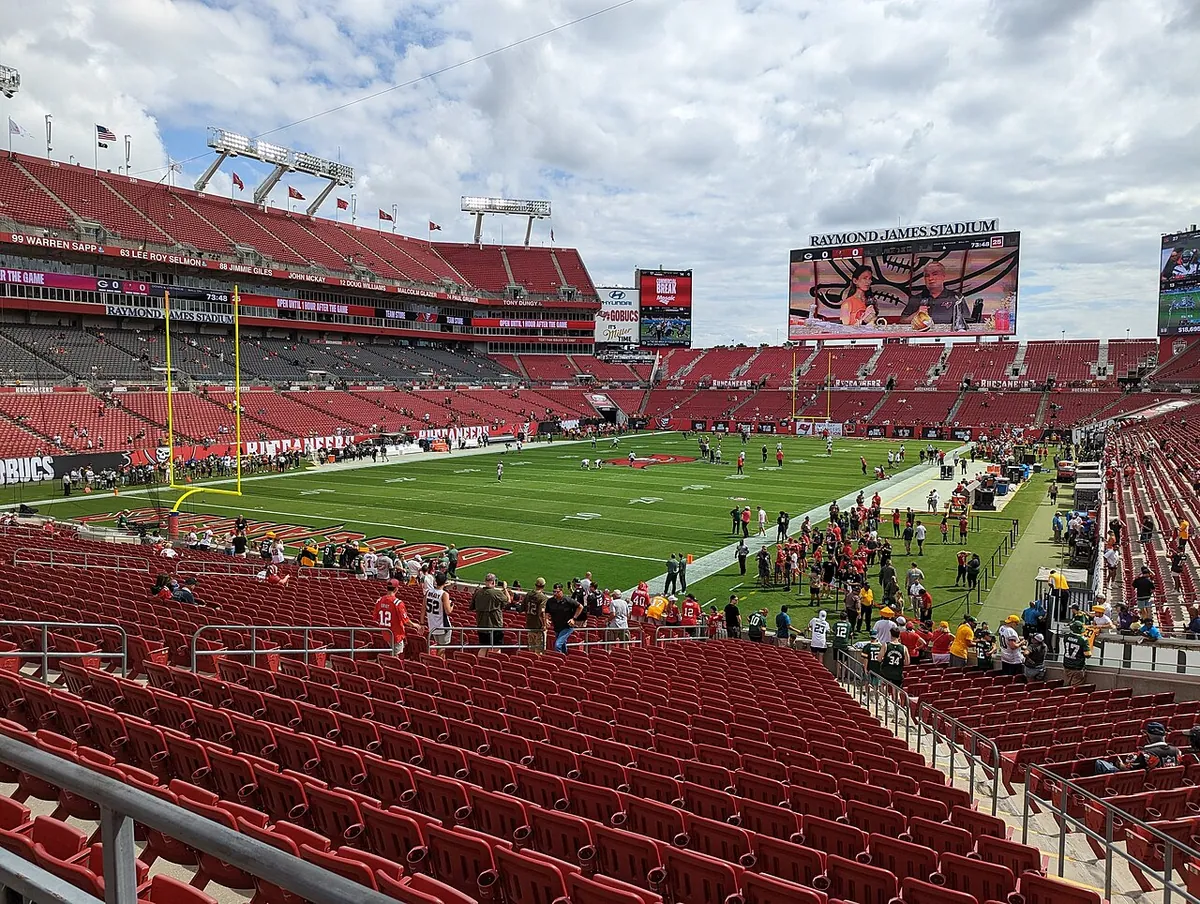
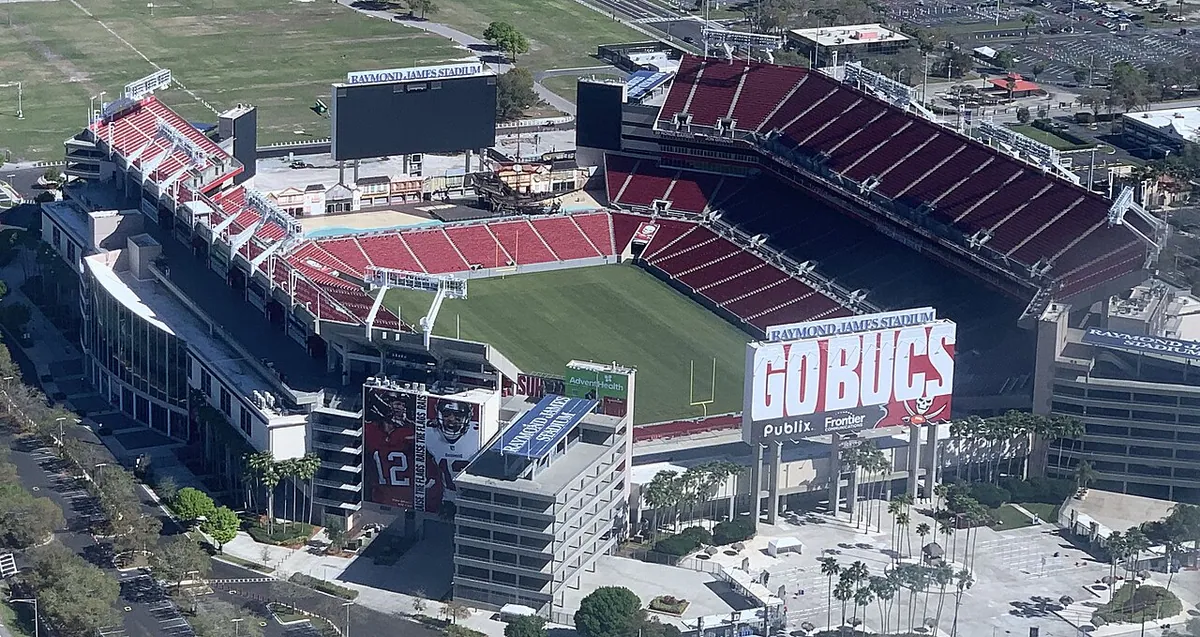
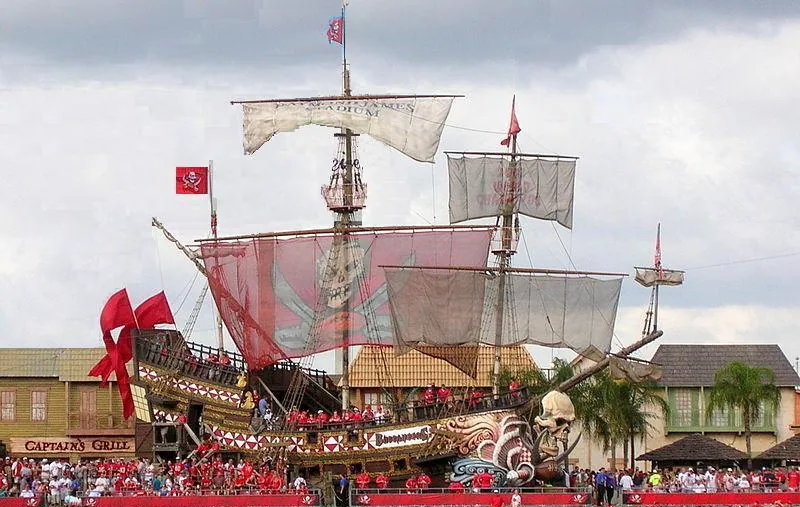
Raymond James Stadium in Tampa, Florida, opened on September 20, 1998, as a publicly financed replacement for the aging Tampa Stadium and is owned by Hillsborough County and operated by the Tampa Sports Authority. The venue is the home of the NFL's Tampa Bay Buccaneers and the University of South Florida (USF) Bulls college football team, who have been tenants since the stadium's opening. With a standard capacity of 69,218 that is expandable to approximately 75,000 for special events, the stadium has hosted three Super Bowls, the College Football Playoff National Championship, and annual college bowl games. Its most distinctive feature is a 103-foot replica pirate ship located in the north end zone, and the facility is named for Raymond James Financial, which has held the naming rights since 1998. The stadium's natural grass playing surface has been consistently rated among the best in the NFL by the players' association.
Financing and Construction History
The drive for a new stadium began immediately after Malcolm Glazer purchased the Tampa Bay Buccaneers in 1995 for a record $192 million, as he deemed the 28-year-old Tampa Stadium inadequate. Initial plans for a $168 million stadium funded by a rental car surtax and event-related fees were rejected by the Glazer family within hours because it would reduce their revenue. When alternative public financing was not quickly agreed upon, the Glazers threatened to relocate the franchise and began meeting with officials from other cities. In early 1996, local government proposed a 30-year half-cent sales tax increase known as the Community Investment Tax to fund public improvements and a new stadium, which required a public referendum. The Buccaneers launched an intensive public relations campaign, and Malcolm Glazer promised to pay half the construction cost if fans made 50,000 deposits on 10-year season ticket commitments. Former Tampa mayor Bill Poe sued to stop the referendum, claiming it violated Florida's constitutional ban on public support for private companies, but his objections were rejected.
The referendum was held on September 3, 1996, and the ballot measure passed by a margin of 53% to 47%. Following the vote, the Buccaneers' season ticket deposit drive failed to reach its target of 50,000 commitments, falling short by 17,000 deposits at the deadline set by the team. As a result of this shortfall, the Buccaneers organization rescinded its earlier offer to contribute half of the stadium's construction costs. Consequently, the $168.5 million facility was designed and built entirely at public expense. The Buccaneers and the Tampa Sports Authority signed a lease where local government paid most operating and maintenance costs while the franchise kept nearly all event proceeds. Bill Poe sued again to challenge this lease, and while a local court ruled in his favor, the Supreme Court of Florida ultimately ruled the lease constitutional because the stadium provided a public benefit. Groundbreaking took place on October 15, 1996, and the stadium was completed in time for its opening on September 20, 1998.
Stadium Design, Capacity, and Features
Raymond James Stadium is an open-air facility with a natural grass playing surface of Tifway 419 Bermuda grass. The stadium's seating capacity has changed several times since its opening, starting at 66,321 in 1998 to 2000 and reaching its current standard configuration of 69,218 in 2022. It can be expanded to approximately 75,000 for major events like Super Bowls or the College Football Playoff National Championship through the addition of temporary bleachers. The record attendance of 74,512 was set at the 2017 College Football Playoff National Championship game. The most recognizable feature is the 103-foot-long, 43-ton steel-and-concrete replica pirate ship permanently located in the north end zone area called Buccaneer Cove. The ship's cannons fire after every Buccaneers score, with seven blasts for a touchdown and three for a field goal, and also fire when the Buccaneers' offense enters the opponent's red zone.
The stadium's original video system featured two 2,200-square-foot Daktronics displays, which were among the largest in the NFL when built. A major renovation from 2016 to 2018, costing over $160 million, completely upgraded the stadium's technology and amenities. The renovation installed two massive 9,600-square-foot HD video boards in the north and south end zones and four large 2,300-square-foot HD video tower walls in the corners. This system provides over 31,000 square feet of video display space, ranking as the third-largest video board system in the NFL. A new sound system with over 400 speakers providing 750,000 watts of power was also installed. The West Club was expanded by 25% to 60,000 square feet and equipped with 178 4K video monitors. The East Club was completely renovated to 64,000 square feet, featuring a 10,000-square-foot sports bar named Bar 76, a reference to the Buccaneers' inaugural 1976 season. The luxury suites were renovated with retractable windows, multiple HD TVs, and open floor plans.
NFL Tenancy: Tampa Bay Buccaneers Game History
The Tampa Bay Buccaneers have played their home games at Raymond James Stadium since it opened in 1998. From the 1999 season through November 27, 2026, the stadium has hosted 231 NFL games, comprising 219 regular season contests and 12 playoff games. The Buccaneers' inaugural game at the venue was a 27-15 victory over the Chicago Bears on September 20, 1998. The highest combined score in an NFL game at the stadium from the 1999 to 2026 seasons is 73 points, achieved in a 38-35 Buccaneers victory over the St. Louis Rams on December 18, 2000. For the 2022 season, temporary bleachers were erected in the south end zone, adding approximately 3,600 seats and leading to the three highest-attended regular season games in stadium history.
The largest was 69,305 for a Week 15 game against the Cincinnati Bengals on December 18, 2022, which the Bengals won 34-23. The second largest was 69,298 for a Week 17 game against the Carolina Panthers on January 1, 2023, a 30-24 Buccaneers victory. The third largest was 69,197 for a Week 3 game against the Green Bay Packers on September 26, 2022, where the Packers won 14-12. Prior to the 2022 temporary seating, the largest regular season crowd was 65,808 for a game against the Philadelphia Eagles on October 22, 2006. After the temporary seats were removed for 2023, the largest crowd was 65,854 for a game against the Detroit Lions on October 15, 2023.
Super Bowl History at Raymond James Stadium
Raymond James Stadium has hosted the Super Bowl three times, in 2001, 2009 and 2021. Super Bowl XXXV was played on January 28, 2001, following the 2000 NFL season, and saw the Baltimore Ravens defeat the New York Giants by a score of 34-7 before a crowd of 71,921. Super Bowl XLIII followed on February 1, 2009, after the 2008 season, with the Pittsburgh Steelers winning a close contest over the Arizona Cardinals 27-23, with an attendance of 70,774. In Super Bowl LV on February 7, 2021, after the 2020 season, the Tampa Bay Buccaneers defeated the Kansas City Chiefs 31-9 and became the first team in NFL history to both play and win a Super Bowl in their home stadium.
| Season | Super Bowl | Date | Winning Team | Score | Losing Team | Score | Attendance |
|---|---|---|---|---|---|---|---|
| 2000 | XXXV | January 28, 2001 | Baltimore Ravens | 34 | New York Giants | 7 | 71,921 |
| 2008 | XLIII | February 1, 2009 | Pittsburgh Steelers | 27 | Arizona Cardinals | 23 | 70,774 |
For Super Bowl LV, the league treated the game as a neutral site event. The pirate ship's Buccaneers-logo sails were replaced with Super Bowl sails, and the Buccaneers were not permitted to fire the ship's cannons during the game except during player introductions. After the game concluded, the cannons were fired 31 times to represent the Buccaneers' 31 points. The Buccaneers were coincidentally the designated home team for that Super Bowl, as the home team designation alternates between conferences annually. Temporary bleachers were erected in the end zones for Super Bowls held at the stadium.
NFL Playoff Games and Other Professional Events
Beyond the Super Bowls, Raymond James Stadium has hosted numerous NFL playoff games involving the Buccaneers. Notable playoff games include an NFC Divisional game on January 15, 2000, where the Buccaneers defeated the Washington Redskins 14-13, and an NFC Wild Card game on January 16, 2022, where the Buccaneers beat the Philadelphia Eagles 31-15. The stadium also hosted the Tampa Bay Mutiny of Major League Soccer from 1999 until the team folded after the 2001 season. The Mutiny played their first game at the stadium on March 20, 1999, losing 5-2 to D.C. United before a crowd of 16,872. In their final season at Raymond James Stadium in 2001, the Mutiny averaged 10,479 fans per match. The stadium has also been home to an XFL team and was the site of WrestleMania 37 in April 2021. Select NFL playoff games at Raymond James Stadium include.
| Season | Round | Date | Result | Attendance |
|---|---|---|---|---|
| 1999 | NFC Divisional | January 15, 2000 | Buccaneers 14, Redskins 13 | 65,835 |
| 2002 | NFC Divisional | January 12, 2003 | Buccaneers 31, 49ers 6 | 65,599 |
| 2005 | NFC Wild Card | January 7, 2006 | Redskins 17, Buccaneers 10 | 65,514 |
| 2021 | NFC Divisional | January 23, 2022 | Rams 30, Buccaneers 27 | 65,597 |
| 2024 | NFC Wild Card | January 12, 2025 | Commanders 23, Buccaneers 20 | 64,614 |
College Football Events and USF Bulls Tenancy
The University of South Florida Bulls football program has been a tenant of Raymond James Stadium since it opened in 1998, making USF one of the few college programs that plays in an NFL stadium. The stadium also hosts two annual postseason bowl games: the ReliaQuest Bowl has been held there every year since 1999, and the Gasparilla Bowl has been played there since 2018. Furthermore, the stadium served as the site of the ACC Championship Game in 2008 and 2009. In 2017, the stadium hosted the College Football Playoff National Championship, the first time the event was held in the southeastern United States. In that game, the Clemson Tigers beat the Alabama Crimson Tide , a rematch of the championship game from the previous season. That contest set the stadium's all-time attendance record of 74,512. Raymond James Stadium is scheduled to host its second College Football Playoff National Championship in 2029.
The highest-attended USF Bulls home game at Raymond James Stadium drew 69,383 for a game against the 4th-ranked Florida State Seminoles on September 29, 2012, which Florida State won 30-17. The second highest is 67,012 for a game against the 5th-ranked West Virginia Mountaineers on September 28, 2007, which the 18th-ranked USF Bulls won 21-13. The third highest is 66,469 for a game against the 19th-ranked Miami Hurricanes on November 28, 2009, which Miami won 31-10. Members of the NFL Players Association have consistently rated the Tifway 419 Bermuda grass playing surface at Raymond James Stadium as one of the best in the league, a fact that benefits both the Buccaneers and the USF Bulls.
Naming Rights, Renovations, and Legal Issues
Before the stadium opened, its naming rights were purchased by St. Petersburg-based Raymond James Financial in June 1998 for $32.5 million in a 13-year agreement. This contract has been renewed on two occasions, in 2006 and again in 2016, and is now set to expire in 2027. This duration makes it the second-longest continuously active naming rights agreement for any stadium in the National Football League. The stadium is commonly referred to by the nickname "Ray Jay" and was sometimes derisively called "the CITS" (Community Investment Tax Stadium) by local sportscaster Chris Thomas , referencing its public financing. Under a renovation deal reached in December 2015, the public share was at least $29 million and the Buccaneers covered the rest, gaining the right from 2018 onward to move one home game elsewhere.
The stadium has faced several legal and operational issues since its opening. After the stadium opened, roughly 50,000 red seats manufactured by Hussey Seating began fading to pink because a UV inhibitor had been left out of the plastic mixture. After a nearly two-year legal battle, Hussey Seating agreed to a $1.5 million settlement with the Tampa Sports Authority, and all of the affected seats were replaced in the spring of 2006. In April 2003, a dispute arose when the Tampa Sports Authority proposed transferring stadium ownership to Hillsborough County to avoid property taxes, a move the Buccaneers blocked unless the county agreed to pay more for gameday security and increase insurance coverage. The dispute was resolved in December 2003 when the county legally declared the stadium a condominium, took ownership, and agreed to refund the team's property tax payments annually. The Buccaneers were given ownership of portions of the structure as part of this change.
Non-Football Events and Cultural Significance
Raymond James Stadium hosts a wide array of non-football events, establishing its role as a major multi-purpose venue for the Tampa Bay area. It has been the site of major concerts for global superstars including Kenny Chesney, U2, Beyoncé, One Direction, Ed Sheeran, Taylor Swift, and The Rolling Stones. The stadium hosted the International Indian Film Academy Awards (IIFA). It is also a regular venue for Monster Jam monster truck shows. The replica pirate ship in Buccaneer Cove was built by the same company that produces props for Walt Disney World. An animatronic parrot perched on the ship's stern is controlled by radio remote and interacts with fans during Buccaneers games, even picking individuals out of the crowd. During games, the song "Yo Ho (A Pirate's Life for Me)" from Pirates of the Caribbean is played, signaling crew on the ship to throw beads and T-shirts to spectators in a segment known as a "Mini Gasparilla."
A 2009 players' survey rated the stadium's turf the second best in the NFL. League insiders have referred to the stadium as the "crown jewel" of the NFL. The stadium also holds a SAFETY Act designation from the U.S. Department of Homeland Security. The stadium has also hosted soccer matches and equestrian sports competitions.
Recent games
| Date | Game | Week |
|---|---|---|
| Jan 3, 2027 | Los Angeles Rams at Tampa Bay Buccaneers | Week 17 |
| Dec 20, 2026 | New Orleans Saints at Tampa Bay Buccaneers | Week 15 |
| Dec 6, 2026 | Los Angeles Chargers at Tampa Bay Buccaneers | Week 13 |
| Nov 30, 2026 | Carolina Panthers at Tampa Bay Buccaneers | Week 12 |
| Nov 1, 2026 | Atlanta Falcons 0 at Tampa Bay Buccaneers 16 | Week 8 |
| Oct 18, 2026 | Pittsburgh Steelers 26 at Tampa Bay Buccaneers 19 | Week 6 |
| Oct 4, 2026 | Green Bay Packers 17 at Tampa Bay Buccaneers 14 | Week 4 |
| Sep 27, 2026 | Minnesota Vikings 23 at Tampa Bay Buccaneers 16 | Week 3 |
| Sep 20, 2026 | Cleveland Browns 23 at Tampa Bay Buccaneers 19 | Week 2 |
| Jan 3, 2026 | Carolina Panthers 14 at Tampa Bay Buccaneers 16 | Week 18 |
| Dec 11, 2025 | Atlanta Falcons 29 at Tampa Bay Buccaneers 28 | Week 15 |
| Dec 7, 2025 | New Orleans Saints 24 at Tampa Bay Buccaneers 20 | Week 14 |
Video
FAQ
What is the address and location of Raymond James Stadium?
Raymond James Stadium is situated at 4201 North Dale Mabry Highway in Tampa, Florida. Its specific geographic coordinates are 27 degrees, 58 minutes, and 33 seconds north latitude and 82 degrees, 30 minutes, and 12 seconds west longitude. The facility is owned by Hillsborough County and managed on a daily basis by the Tampa Sports Authority. It was constructed to replace the older Tampa Stadium, which was demolished in 1999 after the new venue opened. During construction, the facility was known as Tampa Community Stadium.
How many people can Raymond James Stadium hold for a football game?
The standard seating configuration for Raymond James Stadium holds 69,218 spectators as of the 2022 season. For major events such as the Super Bowl or college football national championship, temporary seating can be installed to increase capacity to around 75,000. The highest recorded attendance for any event is 74,512, set during the 2017 College Football Playoff National Championship game. The stadium's capacity has been adjusted several times throughout its history, including configurations of 66,321, 65,657, 65,856, 65,890, 65,618, and currently 69,218.
Which Super Bowls have been played at Raymond James Stadium and who won them?
Raymond James Stadium has been the site of three Super Bowl games. Super Bowl XXXV took place on January 28, 2001, and ended with the Baltimore Ravens beating the New York Giants by a score of 34 to 7. Super Bowl XLIII was held on February 1, 2009, resulting in a 27 to 23 victory for the Pittsburgh Steelers over the Arizona Cardinals. Super Bowl LV occurred on February 7, 2021, and saw the Tampa Bay Buccaneers defeat the Kansas City Chiefs 31 to 9. The Buccaneers' win in Super Bowl LV was historically significant as it marked the first time a team played and won the championship game in its own home stadium.
What college football teams and events use Raymond James Stadium?
The University of South Florida Bulls have used Raymond James Stadium as their home field for college football since the stadium opened in 1998. The venue also annually hosts the ReliaQuest Bowl, a postseason game that has been played there since 1999, and the Gasparilla Bowl, which has been held there since 2018. It served as the neutral site for the ACC Championship Game in both 2008 and 2009. The most notable college event was the 2017 College Football Playoff National Championship, where Clemson defeated Alabama before a record crowd.
What are the unique features of Raymond James Stadium?
The stadium's most famous feature is a 103-foot-long, 43-ton replica of a pirate ship located in the north end zone area known as Buccaneer Cove. The ship is equipped with cannons that fire after Buccaneers scores and during specific game situations. The facility contains one of the largest video display systems in the NFL, with over 31,000 square feet of high-definition screens installed during a major renovation. The natural grass playing surface, made of Tifway 419 Bermuda grass, has been consistently rated highly by members of the NFL Players Association. Other distinctive elements include an animatronic parrot on the pirate ship, a two-story fishing village facade, and nearly 200 executive suites for premium guests.
Who owns the naming rights and how was the stadium financed?
The naming rights are held by Raymond James Financial, a financial services company based in St. Petersburg, Florida. The firm secured the initial 13-year agreement for $32.5 million in 1998, and subsequent extensions in 2006 and 2016 have prolonged the partnership through the 2027 season. This makes it the second-longest ongoing naming rights deal for any stadium in the NFL. The stadium's $168.5 million construction was fully funded by public money after voters passed a half-cent sales tax increase called the Community Investment Tax in September 1996. The Buccaneers withdrew an offer to share costs when a season ticket drive fell short, leaving taxpayers to cover the entire project. Under the lease, the Tampa Sports Authority covers most operational expenses while the Buccaneers retain the majority of revenue from events.
Sources
- Raymond James Stadium (Wikipedia) Wikipedia
- About RJS, Raymond James Stadium raymondjamesstadium.com
- Raymond James Stadium tampasportsauthority.com
- Tampa Bay Buccaneers Stadium History & Records | Archive buccaneersfan.com
- Raymond James Stadium, USF Athletics gousfbulls.com
- nflverse game, roster and draft data nflverse (CC BY 4.0)