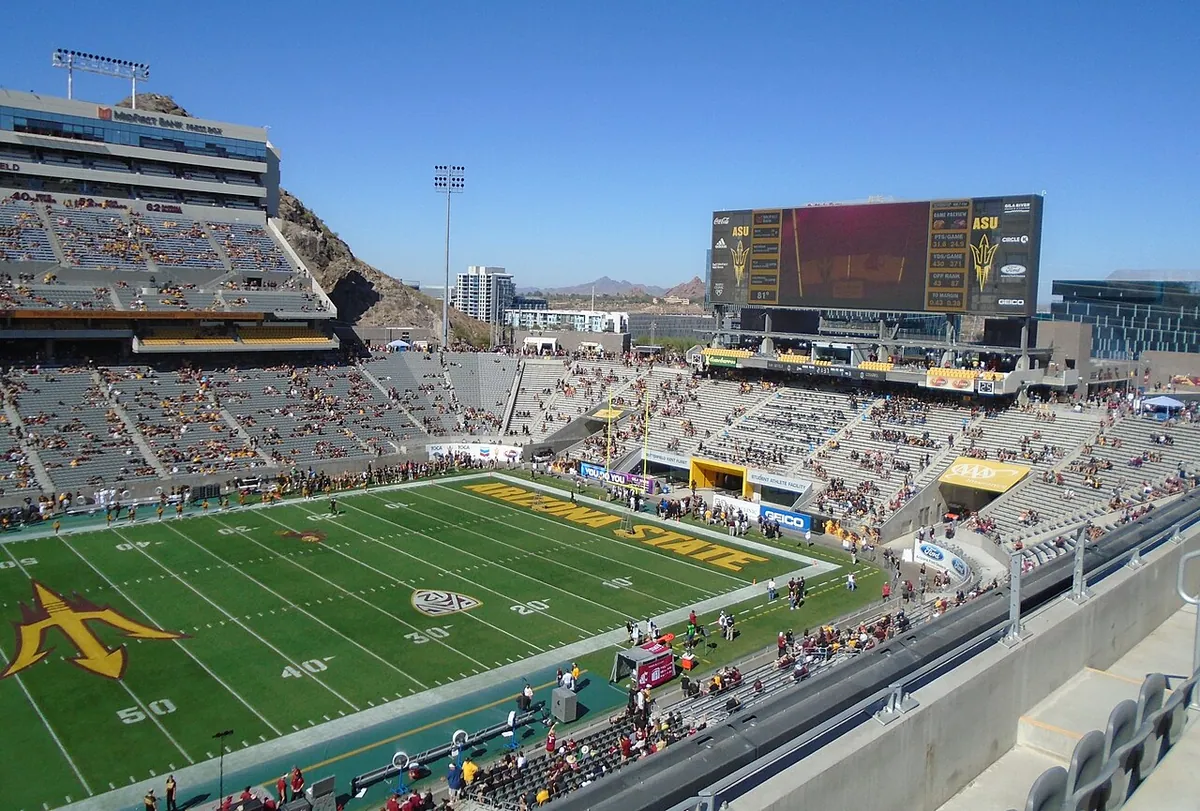
Mountain America Stadium, originally known as Sun Devil Stadium, is an outdoor college football stadium located on the campus of Arizona State University in Tempe, Arizona. It opened on October 4, 1958, and serves as the home field for the Arizona State Sun Devils football team of the Big 12 Conference. The stadium has a current seating capacity of 53,599, which was the capacity as of 2018 following a major renovation project. The natural grass playing surface is named Frank Kush Field in honor of the noted former ASU coach Frank Kush.
Construction and Early Expansion
The stadium's construction began in January 1958 with F. H. Antrim Construction Company as the general contractor, based on designs from Edward L. Varney Associates. It opened just nine months later on October 4, 1958, with an initial capacity of 30,000 seats and a construction cost of $1 million. The first game was a 16-13 victory for Arizona State over West Texas State. The original designers did not waterproof the concrete structure, assuming the desert climate would prevent water damage. This assumption proved flawed decades later when pressure washing and increased event frequency led to significant structural issues. The capacity table shows the stadium held 30,450 seats from 1958 through 1965.
The stadium underwent its first major expansion in 1966, raising capacity to 41,000 seats. Another expansion occurred in 1970, with the capacity table showing a new figure of 50,300 seats from 1970 to 1975. The period from 1976 to 1977 saw the most dramatic physical changes to that point. The 1976 renovation added seating to the south end zone along with press and sky boxes, boosting capacity to 57,722. The following year, the completion of an upper tier brought the total to 70,311 seats. Further additions in 1988 included 1,700 seats and the Carson Student Athlete Center. The capacity table lists a peak of 74,865 seats from 1989 to 1991. The Carson Student Athlete Center became the home of the ASU Athletic Department.
Structural Issues and the $304 Million Renovation
By 2007, engineers discovered that the stadium's concrete base was buckling due to rusting structural steel, a direct result of the lack of waterproofing. The designers had not anticipated the venue hosting an NFL team, a major bowl game, and numerous concerts, which led to frequent cleaning with pressure washers and chemicals. Engineers estimated that $45 million in repairs would be needed to maintain the stadium beyond 2010. In response, legislation allowed the Arizona Board of Regents to establish a district to collect revenue from local businesses to fund athletic facility renovations. A comprehensive modernization project estimated at $300 million was unveiled in April 2012.
The renovation plan was unveiled in April 2012, aiming to reduce capacity to between 55,000 and 60,000 seats, add field turf, and install fabric roof shading. An initial plan for a full roof was later scrapped to control costs. In October 2013, approximately 5,700 upper-deck seats in the north endzone were removed, reducing capacity to 65,870 for the 2014 season. The Cactus Bowl was moved to Chase Field in 2016 to accommodate construction. The project was carried out in phases from 2015 to 2019 by a joint venture of Hunt Construction Group and Sundt Construction, with design by HNTB Corp. and Gould Evans, and was completed in August 2019 at a final cost of $304 million.
- Phase 1 (2015): Removed sections of the upper deck and replaced south end zone bleachers with a steel and concrete structure.
- Phase 2 (2016): Demolished and rebuilt the west side lower bowl and loge level, and began construction on a north-end athletic facility.
- Phase 3 (2017): Completed the north-end athletic facility and installed a new, large video board above the north end zone.
- Phase 4 (2018): Rebuilt the east side of the lower bowl.
- Phase 5 (2019): Completed club areas and finalized the renovation.
Arizona State Sun Devils and Frank Kush Field
The Arizona State Sun Devils have called the stadium home since its opening game in 1958. On September 21, 1996, the playing surface was officially named Frank Kush Field in his honor. That same night, the Sun Devils delivered one of the program's most famous victories, shutting out the top-ranked Nebraska Cornhuskers 19-0. Frank Kush Field received the Collegiate Football Field of the Year award from the Sports Field Management Association in 2025. The stadium has been the site of many significant ASU seasons, including the 2025 campaign where the team achieved a perfect 6-0 home record, won the Big 12 Championship, and advanced to the College Football Playoff Quarterfinals. Former Sun Devil and Arizona Cardinal Pat Tillman is one of the many noted players associated with the stadium, and his jersey number has been retired by both ASU and the Cardinals.
Bowl Game History: Fiesta and Cactus Bowls
The Fiesta Bowl acted as the BCS National Championship Game twice during this tenure, following the 1998 and 2002 college football seasons. The 1999 championship game between Tennessee and Florida State, which drew 80,470 fans, was one of these title contests. The bowl's long run ended when it relocated to the newly built State Farm Stadium in Glendale. When stadium renovations began in 2015, the Cactus Bowl was moved to Chase Field in Phoenix to allow construction to proceed. The bowl has remained at Chase Field since but is scheduled to return to Mountain America Stadium in 2026.
Professional Football Tenancy and NFL Era
Professional football arrived at the stadium with a 1975 NFL preseason game between the New York Jets and Minnesota Vikings. The United States Football League's Arizona Wranglers and Outlaws called the stadium home from 1983 to 1985. The facility became a full-time NFL venue in 1988 when the St. Louis Cardinals relocated to Arizona, becoming the Phoenix Cardinals. Their first regular season game was a 17-14 Monday Night Football loss to the Dallas Cowboys on September 12, 1988. The team, renamed the Arizona Cardinals in 1994, intended the stay to be temporary but remained for 18 seasons due to delays in building a dedicated stadium.
The team compiled a 64-80 home record during their 18 seasons, with their only playoff appearance coming in 1998. Home games often failed to sell out, leading to local television blackouts under the NFL's policy at the time. The stadium frequently saw a large influx of opposing fans, particularly from the Dallas Cowboys, creating a road-game atmosphere. Disputes over alcohol sales and advertising revenue with the university were a persistent source of friction. The Cardinals ended their tenancy with a 27-21 victory over the Philadelphia Eagles on Christmas Eve 2005. The highest-scoring contest in that span occurred on November 18, 2001, when the Arizona Cardinals defeated the Detroit Lions 45-38, combining for 83 total points. The stadium also hosted a relocated Monday Night Football game on October 27, 2003, when the San Diego Chargers and Miami Dolphins played there due to wildfires in California, with the Dolphins winning 26-10 before a capacity crowd admitted with free tickets. In 2019, the stadium briefly housed the Arizona Hotshots of the Alliance of American Football before the league folded in April of that year.
Super Bowl XXX and Other Major Events
The Dallas Cowboys defeated the Pittsburgh Steelers 27-17 in front of 76,347 spectators to claim their fifth Vince Lombardi Trophy. This Super Bowl was held at the stadium. Beyond football, the stadium has a diverse event history. Pope John Paul II held a Mass for an estimated 75,000 people at the stadium on September 14, 1987, during his tour of the United States. All imagery and references to the Sun Devil mascot were removed or covered for the solemn occasion. The venue has been a location for numerous films, including "A Star Is Born" (1976), "Used Cars" (1980), "Raising Arizona" (1987), and "Jerry Maguire" (1996).
Naming Rights, Transportation, and Fan Access
On August 2, 2023, Arizona State University announced a 15-year naming rights partnership with Mountain America Credit Union, renaming the facility Mountain America Stadium, Home of the ASU Sun Devils. The playing surface retains its independent honorific, Frank Kush Field. The stadium is accessible via multiple transportation options. The Valley Metro light rail stops at the Veterans Way/College Ave station directly west of the venue. The Tempe Streetcar serves the Marina Heights stop on the north side, and the local Orbit bus service provides free circulation on game days.
Numerous parking lots surround the stadium, including the Black, Pink, Copper, Orange, and Maroon lots, each with specific access routes from streets like Rural Road, Sixth Street, and Rio Salado Parkway. Designated parking is available for guests with state-issued disabled placards, and cart service is offered from drop-off points. The stadium provides bicycle racks on the south and northeast sides and skateboard racks near the south end. Sun Devil Athletics maintains detailed policies on bag sizes, prohibited items, and concessions, and operates a Designated Driver program to ensure a safe and enjoyable experience for all attendees. The stadium's location between two buttes provides a distinctive scenic backdrop for events.
Recent games
| Date | Game | Week |
|---|---|---|
| Dec 24, 2005 | Philadelphia Eagles 21 at Arizona Cardinals 27 | Week 16 |
| Dec 11, 2005 | Washington Redskins 17 at Arizona Cardinals 13 | Week 14 |
| Nov 27, 2005 | Jacksonville Jaguars 24 at Arizona Cardinals 17 | Week 12 |
| Nov 6, 2005 | Seattle Seahawks 33 at Arizona Cardinals 19 | Week 9 |
| Oct 23, 2005 | Tennessee Titans 10 at Arizona Cardinals 20 | Week 7 |
| Oct 9, 2005 | Carolina Panthers 24 at Arizona Cardinals 20 | Week 5 |
| Sep 18, 2005 | St. Louis Rams 17 at Arizona Cardinals 12 | Week 2 |
| Jan 2, 2005 | Tampa Bay Buccaneers 7 at Arizona Cardinals 12 | Week 17 |
| Dec 19, 2004 | St. Louis Rams 7 at Arizona Cardinals 31 | Week 15 |
| Dec 12, 2004 | San Francisco 49ers 31 at Arizona Cardinals 28 | Week 14 |
| Nov 28, 2004 | New York Jets 13 at Arizona Cardinals 3 | Week 12 |
| Nov 14, 2004 | New York Giants 14 at Arizona Cardinals 17 | Week 10 |
Video
FAQ
What is Sun Devil Stadium called now?
The stadium is now officially named Mountain America Stadium, Home of the ASU Sun Devils. This change took effect in 2023 following a 15-year naming rights agreement with Mountain America Credit Union. The venue was known as Sun Devil Stadium from its opening in 1958 until the renaming. The natural grass playing surface inside continues to be called Frank Kush Field, a name dedicated in 1996 to the former head coach.
What is the seating capacity of Mountain America Stadium?
The current seating capacity of Mountain America Stadium is 53,599, a figure first listed as of 2018. This represents a significant reduction from its historical peak of 74,865 seats in 1989. The capacity has changed many times, including 70,311 in the late 1970s and 71,706 in the early 2000s. The modern capacity was part of a $304 million renovation project that concluded in 2019.
How long did the Arizona Cardinals play at Sun Devil Stadium?
The Arizona Cardinals played at Sun Devil Stadium for 18 full NFL seasons, from 1988 through the 2005 season. The team moved from St. Louis and was initially known as the Phoenix Cardinals. They played their final game there on Christmas Eve 2005, a 27-21 win over the Philadelphia Eagles. During their tenure, the Cardinals compiled a regular season home record of 64 wins and 80 losses.
What major structural issue was discovered with the stadium in 2007?
In 2007, engineers discovered the stadium's concrete base was buckling due to rusting structural steel. This was caused because the original 1958 designers did not waterproof the structure, assuming a desert stadium would not need it. However, pressure washing for cleaning and the stadium's increased use for NFL games, bowl games, and concerts introduced more water than anticipated. Repairs estimated at 45 million dollars were needed to maintain the stadium beyond 2010.
When was Sun Devil Stadium opened and what was its original capacity?
Sun Devil Stadium opened on October 4, 1958, with an original seating capacity of 30,000. The inaugural game saw Arizona State defeat West Texas State 16-13. The stadium was built at a cost of $1 million, which would be equivalent to about $11.2 million in 2025. It was designed by Edward L. Varney Associates and constructed by F. H. Antrim Construction Company, marking the beginning of its long history on the Arizona State University campus.
What bowl games were historically hosted at Sun Devil Stadium?
Sun Devil Stadium hosted the Fiesta Bowl annually from 1971 to 2006, including when it served as the BCS National Championship Game in the 1998 and 2002 seasons. After the Fiesta Bowl moved, the stadium then hosted the Cactus Bowl from 2006 to 2015. The Cactus Bowl was temporarily moved to Chase Field during stadium renovations but is scheduled to return to the stadium in 2026. These events cemented the venue's reputation as a major college football destination.
Sources
- Mountain America Stadium (Wikipedia) Wikipedia
- Mountain America Stadium thesundevils.com
- Mountain America Stadium, Home of the ASU Sun Devils, Virtual Tours tours.asu.edu
- Arizona State Sun Devils football baike.baidu.com
- Mountain America Stadium thesportsdb.com
- nflverse game, roster and draft data nflverse (CC BY 4.0)