The Minnesota Vikings are a professional American football team based in Minneapolis, Minnesota, and a member of the North division of the National Football Conference (NFC) in the National Football League (NFL). The franchise was granted on January 28, 1960, as the 14th in the NFL and played its first season in 1961. Its name refers to the Vikings of medieval Scandinavia and reflects the Scandinavian American culture of Minnesota. The Vikings won the NFL Championship in 1969, the last title game played before the merger with the American Football League, and they have reached 4 Super Bowls without winning one. Home games are played at U.S. Bank Stadium in the Downtown East section of Minneapolis, the team is owned by Zygi Wilf, and Kevin O'Connell is the head coach.
Founding, the AFL Switch and the First Season
In August 1959 the Minnesota businessmen Bill Boyer, H. P. Skoglund and Max Winter were awarded a franchise in the new American Football League. Five months later, in January 1960, the group gave up its AFL membership under pressure from the NFL and, joined by Bernard H. Ridder, received the NFL's 14th franchise with play set to begin in 1961. Ole Haugsrud also joined the ownership because his sale of the Duluth Eskimos back to the league in the 1920s gave him 10 percent of any future Minnesota team. The club was named the Minnesota Vikings on September 27, 1960, and the teams of Haugsrud's old school, Central High School in Superior, Wisconsin, had also been called the Vikings and wore purple and yellow.
Bert Rose, a former public relations director of the Los Angeles Rams, became the first general manager, and quarterback Norm Van Brocklin was hired as the first head coach on January 18, 1961. With the first overall pick of the 1961 draft the Vikings chose running back Tommy Mason of Tulane, and they took Georgia quarterback Fran Tarkenton in the third round. The first regular-season game, on September 17, 1961, ended in a 37-13 win over the Chicago Bears, with Tarkenton coming off the bench to throw 4 touchdown passes and run for a fifth score. The expansion team finished 3-11, and over its first 7 seasons it went 32-59-7 with only one winning record, 8-5-1 in 1964.
Bud Grant, the Purple People Eaters and Four Super Bowls
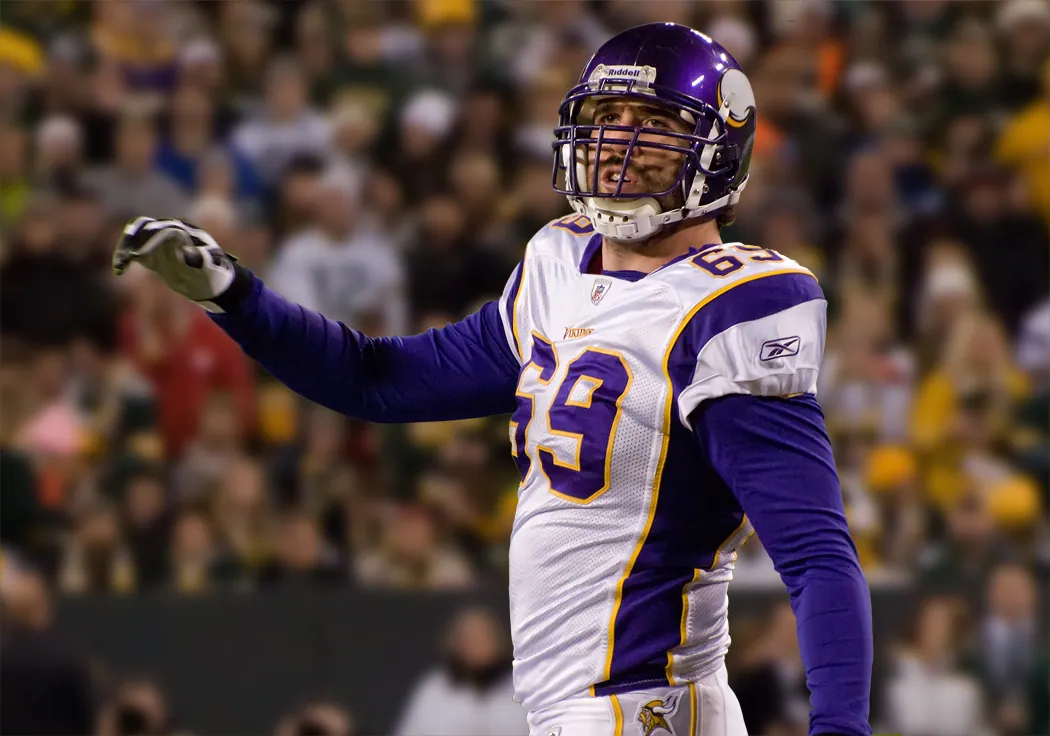
Van Brocklin resigned on February 11, 1967, and on March 7 the Vikings traded Tarkenton to the New York Giants for a package of draft choices. On March 10, 1967, the team hired Bud Grant, who had led the Winnipeg Blue Bombers of the Canadian Football League to 4 Grey Cup championships in 10 years. Joe Kapp, an 8-year CFL veteran and Grey Cup champion, took over at quarterback. In the late 1960s the Vikings built a defensive line known as the Purple People Eaters, led by Alan Page, Carl Eller, Gary Larsen and Jim Marshall, and in 1968 it carried the team to its first Central Division title and first playoff berth.
The 1969 team went 12-2, and on January 4, 1970, it beat the Cleveland Browns 27-7 at Metropolitan Stadium in the last NFL Championship Game before the merger, the first such title for a modern expansion team. Alan Page won the Associated Press NFL Most Valuable Player award in 1971 as the first defensive player to receive it. Tarkenton came back in a trade with the Giants on January 27, 1972, running back Chuck Foreman arrived as the top pick of the 1973 draft, and from Grant's second season on the Vikings won 11 division titles in 13 years. The 1975 team opened 10-0 but lost a playoff game to the Dallas Cowboys 17-14 on the Roger Staubach pass to Drew Pearson that became known as the Hail Mary. All 4 Super Bowl trips of the Grant era ended in defeat.
- Super Bowl IV, after the 1969 season: lost 23-7 to the Kansas City Chiefs.
- Super Bowl VIII, after the 1973 season: lost 24-7 to the Miami Dolphins at Rice Stadium in Houston.
- Super Bowl IX, January 12, 1975: lost 16-6 to the Pittsburgh Steelers at Tulane Stadium in New Orleans.
- Super Bowl XI, January 9, 1977: lost 32-14 to the Oakland Raiders at the Rose Bowl in Pasadena, California.
Tarkenton retired after the 1978 season holding the league passer records in attempts (6,467), completions (3,686), yards (47,003) and touchdowns (342). Grant first retired on January 27, 1984, came back on December 18, 1984, after the team lost a franchise-worst 13 games under Les Steckel, and retired for good on January 6, 1986. He left with a regular-season record of 158-96-5 over 18 seasons in Minnesota. At that point he held the 6th best winning record for a coach in NFL history, with 168 career wins including playoffs.
Burns, Green and the 1998 Season
Longtime assistant Jerry Burns was named head coach on January 7, 1986, and after the strike-shortened 1987 season his 8-7 team upset the New Orleans Saints 44-10 and the San Francisco 49ers 36-24, with Anthony Carter setting the playoff record of 227 receiving yards against the 49ers. That run ended at RFK Stadium on January 17, 1988, when Darrin Nelson dropped a fourth-down pass at the goal line with the Vikings trailing Washington 17-10 in the NFC Championship Game. On October 12, 1989, the club acquired Herschel Walker from Dallas for players and draft choices that the Cowboys used on Emmitt Smith and Darren Woodson on the way to 3 Super Bowl victories. Dennis Green followed Burns and in 10 seasons won 4 NFC Central titles, reached the playoffs 8 times and compiled a record of 97-62.
The 1998 team, with quarterback Randall Cunningham, running back Robert Smith, receiver Cris Carter and rookie Randy Moss, set a then NFL record with 556 points and went 15-1. In the NFC Championship Game at the Metrodome, kicker Gary Anderson, who had just completed the first perfect regular season in NFL history, missed a 38-yard field goal with just over 2 minutes left, and the Atlanta Falcons tied the game on their next drive. In a controversial decision Green ran out the clock and let the game go to overtime, where Morten Andersen won it for Atlanta 30-27 with a 38-yard field goal. The Vikings became the first 15-1 team to fail to reach the Super Bowl.
Head Coaches and Results Since 1999
Since the 1999 season the Vikings have gone 233-202-2 in the regular season through 2025 and 6-11 in 17 playoff games. In that span the team has not reached a Super Bowl, but it played in 3 conference championship games. It lost 41-0 to the New York Giants after the 2000 season, 31-28 to the New Orleans Saints after the 2009 season and 38-7 to the Philadelphia Eagles after the 2017 season. The head coaches of this period and their records with the club are listed below.
| Head coach | Seasons | Regular season | Playoffs |
|---|---|---|---|
| Dennis Green | 1999 to 2001 | 26-21 | 2-2 |
| Mike Tice | 2001 to 2005 | 32-33 | 1-1 |
| Brad Childress | 2006 to 2010 | 39-35 | 1-2 |
| Leslie Frazier | 2010 to 2013 | 21-32-1 | 0-1 |
| Mike Zimmer | 2014 to 2021 | 72-56-1 | 2-3 |
| Kevin O'Connell | 2022 to 2026 | 50-28 | 0-2 |
The 2009 team under Brad Childress went 12-4 and beat the Giants 44-7 at the Metrodome on January 3, 2010, while Leslie Frazier's 2011 team went 3-13, the worst record since 1999. Mike Zimmer's 2017 team went 13-3 and reached the NFC Championship Game. Kevin O'Connell won 13 games in his first season in 2022, and his 2024 team went 14-3, the best regular-season record since 1999, before a 27-9 Wild Card loss to the Los Angeles Rams. On September 21, 2025, the Vikings beat the Cincinnati Bengals 48-10 at U.S. Bank Stadium, their biggest win since 1999. From December 7, 2025, to October 25, 2026, they won 11 games in a row, the longest winning streak in that span.
Metropolitan Stadium, the Metrodome and U.S. Bank Stadium
From 1961 to 1981 the Vikings played at Metropolitan Stadium in suburban Bloomington, where the capacity grew from 40,800 to 47,900 and the frozen field built the team's cold-weather reputation. The last game there, on December 20, 1981, was a 10-6 loss to the Kansas City Chiefs. The Hubert H. Humphrey Metrodome in downtown Minneapolis, with a capacity of 63,000, opened with a 7-3 preseason win over the Seattle Seahawks on August 21, 1982, and later hosted Super Bowl XXVI. The team played its last game there on December 29, 2013, a 14-13 win over the Detroit Lions, and the building carried the name Mall of America Field from 2010 to 2013.
TCF Bank Stadium also served as a home venue from 2010 to 2015. U.S. Bank Stadium opened for the 2016 season in the Downtown East section of Minneapolis, with a translucent roof and a capacity of 66,860. The team's offices and practice fields moved on May 15, 1981, to Winter Park in Eden Prairie, named after founder Max Winter, and the headquarters today is the TCO Performance Center in Eagan. Summer training camp was held at Bemidji State University from 1961 to 1965 and then at Minnesota State University in Mankato, one of the longest continuously running camps in the NFL.
Colors, Rivals, Fans and the Franchise Today
The team colors are purple, gold and white, the mascot is Viktor the Viking and the fight song is Skol, Vikings. The club joined the newly formed NFC Central in 1970 and now plays in the NFC North, where it has a recognized rivalry with the Detroit Lions. Fans are encouraged to wear Vikings purple every Friday during the season, and the Minnesota Vikings Foundation, a public charity, works on youth health and education. The franchise has 15 members in the Pro Football Hall of Fame, and across its full history it has the highest regular-season and combined winning percentage among NFL teams that have not won a Super Bowl.
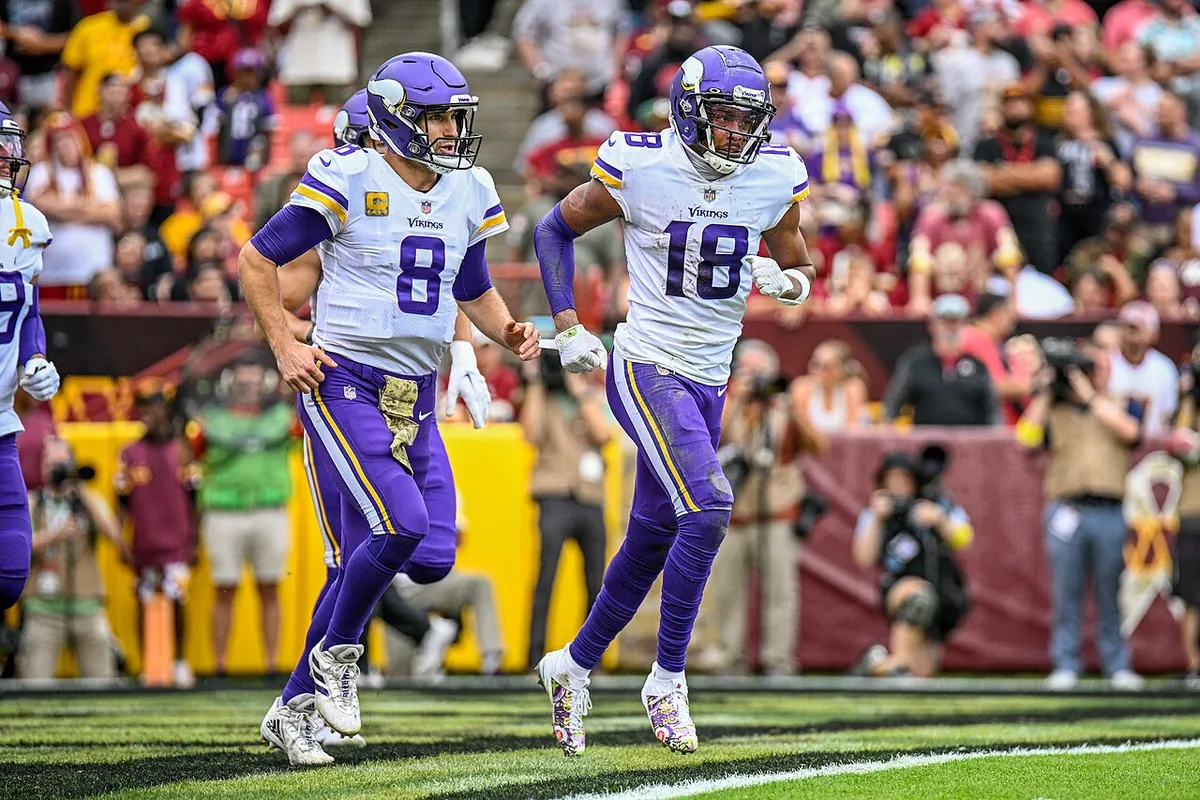
Zygi Wilf owns the team, with Mark Wilf as president and Nolan Teasley as general manager. The 2026 season under O'Connell stood at 7-3 through November 27, 2026, after a 35-10 loss to the San Francisco 49ers in Mexico City in Week 11. Kirk Cousins returned to the team in 2026, and the roster includes Aaron Jones Sr. and receiver Justin Jefferson. The Vikings were also part of the first international game in the NFL, a 28-10 win over the St. Louis Cardinals at Wembley Stadium in London on August 6, 1983.
Video
FAQ
Have the Minnesota Vikings ever won a Super Bowl?
No, the Vikings have played in 4 Super Bowls and lost all of them. They lost Super Bowl IV to the Kansas City Chiefs, Super Bowl VIII to the Miami Dolphins, Super Bowl IX to the Pittsburgh Steelers and Super Bowl XI to the Oakland Raiders. The franchise did win the NFL Championship in 1969 by beating the Cleveland Browns 27-7 in the last title game before the merger. Since 1999 the team has reached the NFC Championship Game 3 times, after the 2000, 2009 and 2017 seasons, without advancing to the Super Bowl.
When were the Minnesota Vikings founded?
The NFL awarded the franchise on January 28, 1960, at the league owners' meetings in Miami, making it the 14th franchise in the league. The ownership group of Bill Boyer, Ole Haugsrud, Bernie Ridder, H. P. Skoglund and Max Winter had first been granted a team in the American Football League in August 1959 before switching to the NFL. The club took the name Minnesota Vikings on September 27, 1960. It played its first game on September 17, 1961, and beat the Chicago Bears 37-13.
Where do the Minnesota Vikings play their home games?
The Vikings play at U.S. Bank Stadium in the Downtown East section of Minneapolis, which opened for the 2016 season. The stadium has a translucent roof and a capacity of 66,860. Before that the team played at Metropolitan Stadium in Bloomington from 1961 to 1981 and at the Hubert H. Humphrey Metrodome from 1982 to 2013. TCF Bank Stadium also hosted home games between 2010 and 2015, and the team headquarters is the TCO Performance Center in Eagan.
Who owns the Minnesota Vikings?
Zygi Wilf is the owner of the Minnesota Vikings, and Mark Wilf serves as team president. Nolan Teasley is the general manager and Kevin O'Connell is the head coach. The original owners were Minnesota businessmen who first held an AFL franchise and then joined the NFL in January 1960. Max Winter, one of those founders and the namesake of the Winter Park facility, served as team president from 1965 to 1987.
Who is the head coach of the Minnesota Vikings?
Kevin O'Connell has been the head coach since the 2022 season. Through November 27, 2026, his teams have a regular-season record of 50-28 and a playoff record of 0-2. His 2024 team went 14-3, the best regular-season mark for the franchise since 1999, and his 2026 team stood at 7-3 in late November. Before him the job belonged to Mike Zimmer from 2014 to 2021, and in the early decades Bud Grant led the team to all 4 of its Super Bowl appearances.
How many Minnesota Vikings are in the Pro Football Hall of Fame?
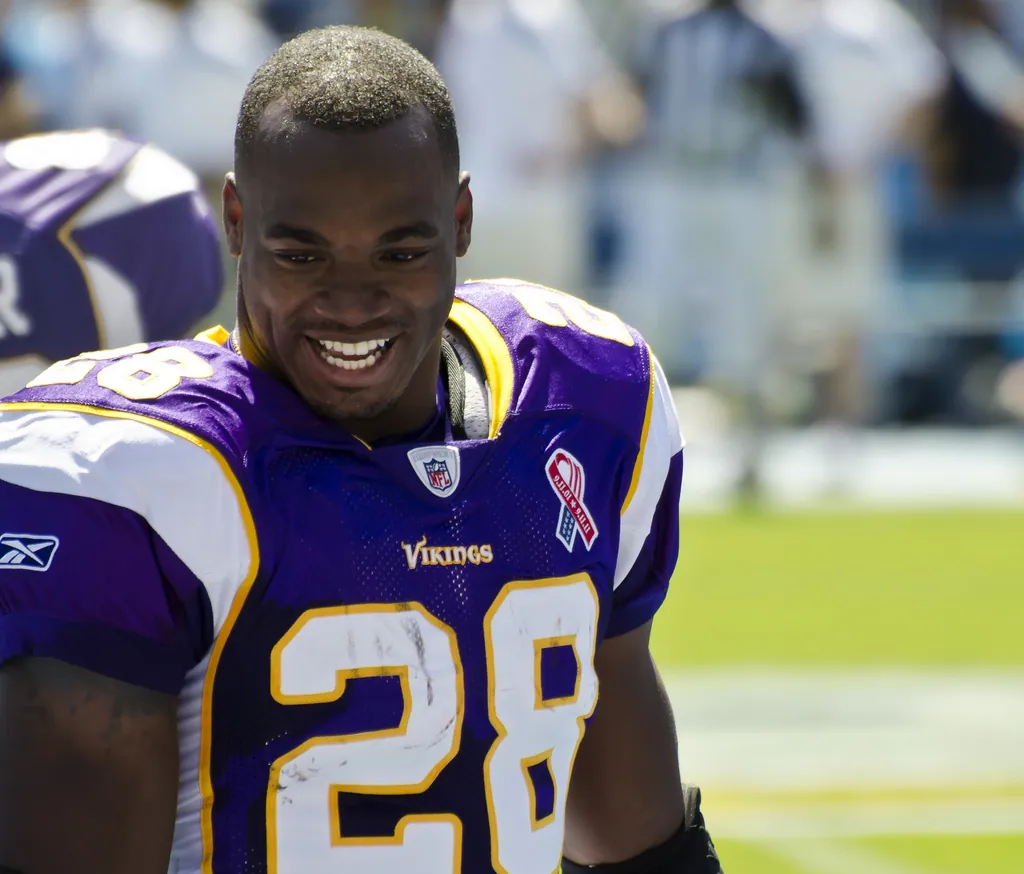
The Vikings have 15 members in the Pro Football Hall of Fame. Fran Tarkenton was the first Vikings player elected, and he was inducted on August 2, 1986. He had retired after the 1978 season holding the league passing records in attempts, completions, yards and touchdowns. Adrian Peterson is among 3 Vikings being evaluated for the 2027 Hall of Fame class.
Sources
- Minnesota Vikings (Wikipedia) Wikipedia
- Minnesota Vikings vikings.com
- Minnesota Vikings News, Scores, Stats, Schedule NFL
- Team history Pro Football Hall of Fame
- Minnesota Vikings, Franchise Leaders - 1961 to 2021 (61 seasons) retroseasons.com
- 5 franchises the Minnesota Vikings have a history of trouncing thevikingage.com
- nflverse game, roster and draft data nflverse (CC BY 4.0)