U.S. Bank Stadium is an indoor stadium located in Minneapolis, Minnesota. It opened in 2016 and serves as the home venue for the Minnesota Vikings of the National Football League. The stadium was constructed on the former site of the Hubert H. Humphrey Metrodome at a cost of $1.061 billion. It features a distinctive fixed roof made of ETFE and has hosted major events including Super Bowl LII and the 2019 NCAA Men's Final Four.
Proposal and Funding Timeline
The journey to build U.S. Bank Stadium involved over a decade of proposals, debates, and shifting plans. This early plan called for a retractable roof and extensive surrounding urban development. A major alternative emerged in May 2011, when Ramsey County officials agreed with the Vikings to build a stadium in Arden Hills at a total cost of $1.057 billion, but this plan faced a significant funding shortfall. The turning point came on March 1, 2012, when Governor Mark Dayton announced an agreement to build a fixed-roof stadium on the existing Metrodome site in downtown Minneapolis. The final funding package totaled $1.061 billion, with contributions from three primary sources.
- $348 million from the state of Minnesota.
- $150 million from the city of Minneapolis.
- $551 million from the Minnesota Vikings organization and private contributions.
Construction and Accelerated Opening
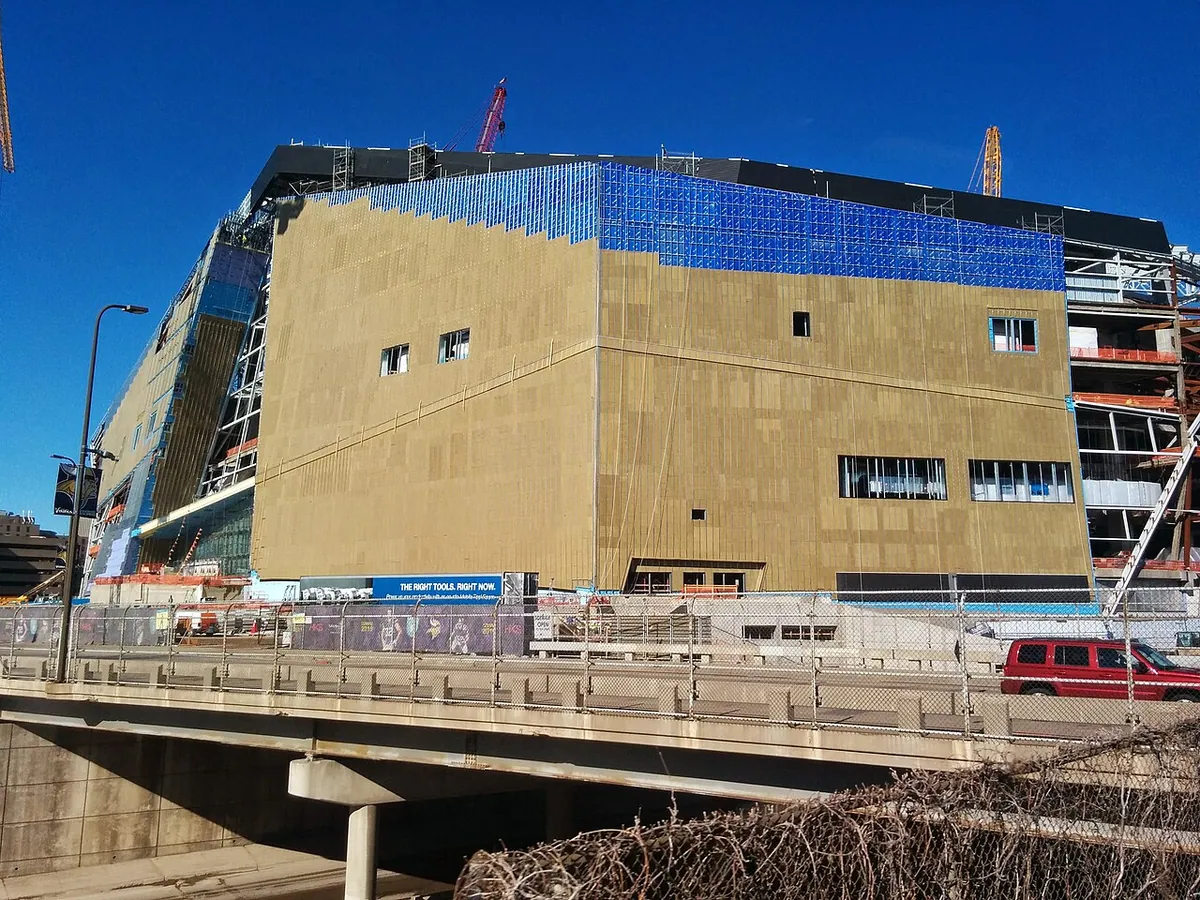
Following the groundbreaking ceremony on December 3, 2013, Mortenson Construction led a rapid and complex build. The project was notable for its accelerated schedule, being completed in just two and a half years and finishing six weeks early. This was significantly faster than the construction timelines for most other NFL stadiums built in the same era. The project required an immense workforce, with over 8,000 workers contributing more than four million labor hours to the effort. The construction set new benchmarks for local business involvement and workforce participation, far exceeding the established project goals. A key architectural and engineering challenge was the installation of the signature roof system, which required 18,812 tons of structural steel and involved 39 major crane picks using up to 18 cranes. This innovative steel work later earned a 2018 AISC IDEAS2 Merit Award. The stadium opened to the public on July 22, 2016, with a two-day open house that attracted over 190,000 visitors.
Design and Architectural Features
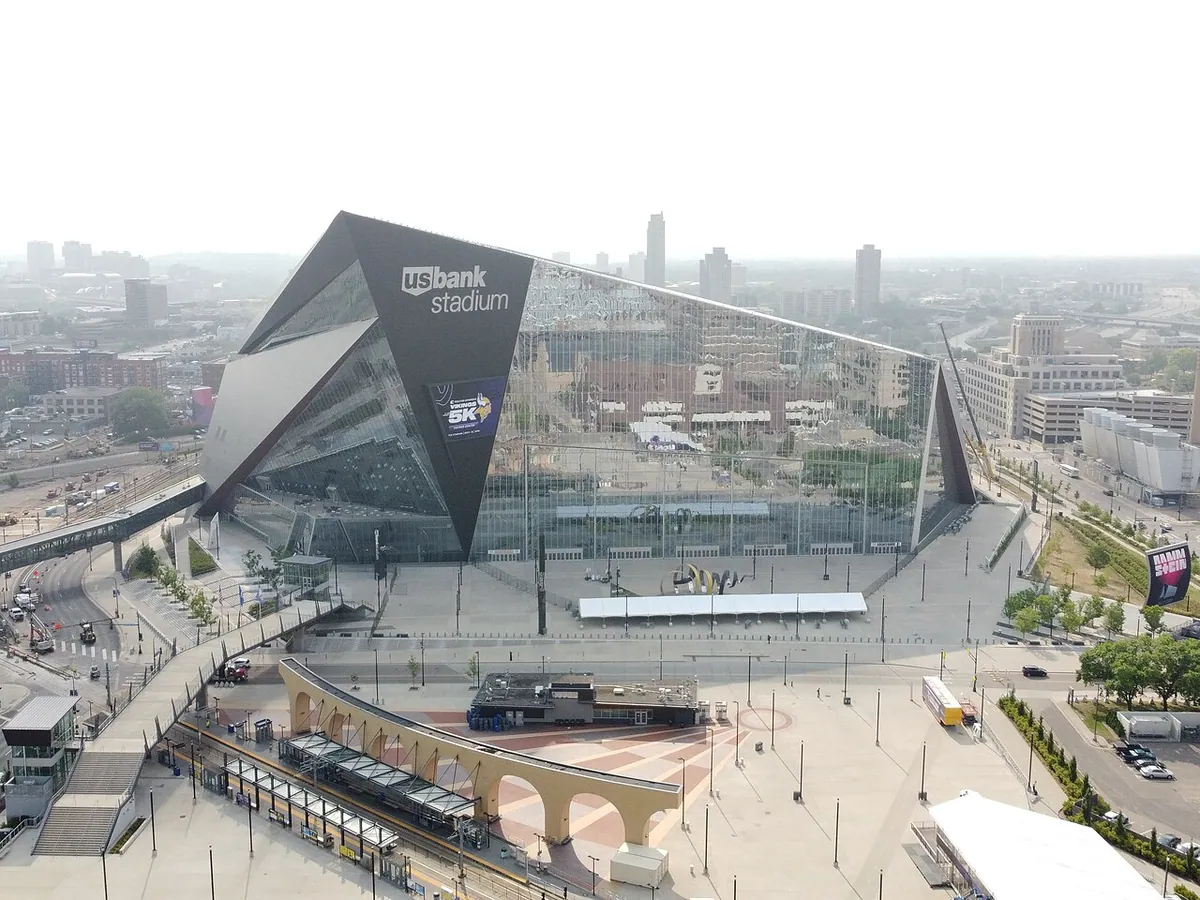
Architects from HKS were tasked with creating an indoor stadium that felt open and connected to its urban environment, a direct response to the shortcomings of the windowless Metrodome. While a retractable roof was desired by the team and considered in early 2007 and 2009 proposals, it was ultimately rejected due to high cost and the engineering challenge of operating it reliably in Minnesota's sub-freezing winter conditions. The final design features a permanent, asymmetrical roof clad in 240,000 square feet of ETFE, a transparent fluoropolymer plastic. This material, a clear plastic, is used for 60% of the roof, flooding the interior with natural light and coining the project slogan 'clear is the new retractable'. The roof's steep, slanted design is inspired by Nordic vernacular architecture and functionally manages heavy snow loads by directing meltwater into a heated gutter system. The stadium's extensive use of glass, however, created an unintended consequence due to its location on the Mississippi Flyway bird migration route. The highly reflective glass has resulted in a high number of bird fatalities, leading to a 2019 study and recommendations for treating the glass to reduce its reflectivity.
Stadium Technology and Amenities
U.S. Bank Stadium was built with advanced technology systems to ensure a high-quality experience for fans, players, and event operators. The infrastructure includes a robust network of 1,600 DAS antennas, 300 amplifiers, and over 47 miles of fiber optic cable to provide reliable cellular service and high-speed data for nearly 70,000 concurrent users. The venue features extensive video and scoring systems, including large-format video boards, ribbon boards, and a full in-house video production control room. For premium guests, the stadium offers 131 executive suites and club seats. A unique design element places some club seats directly at field level, offering closer proximity to the action than any other NFL stadium. The playing surface is Act Global Xtreme Turf DX, a synthetic turf system. In the NFL Players Association's 2026 report cards, this surface received a B grade, which was the highest rating given to any artificial turf field in the league that year.
- 1,600 DAS antennas for cellular coverage.
- Over 47 miles of fiber optic cable.
- 131 executive suites.
- 131 executive suites. Club seats, some at field level.
- In-house video production control room.
Capacity and Football Attendance
It settled at a standard configuration of 66,860 seats, which can be expanded to a maximum of 73,000. The record attendance for any event is 72,711, set during the 2019 NCAA Men's Final Four basketball tournament. Minnesota Vikings games consistently sell out, with annual average attendance figures from 2016 through 2024 ranging from 66,687 to 66,929 per game in seasons with full fan access. The 2020 season was played without fans in attendance due to the COVID-19 pandemic. Rivalry games against the Green Bay Packers have drawn some of the largest crowds. For example, the 2024 season high was 67,031 for the Packers game, and the 2023 season saw highs of 67,003 for games against the Packers and the Kansas City Chiefs.
| Season | Total Attendance | Games |
|---|---|---|
| 2016 | 534,289 | 8 |
| 2017 | 533,764 | 8 |
| 2018 | 534,491 | 8 |
| 2019 | 534,804 | 8 |
| 2020 | No attendance | 8 |
| 2021 | 533,613 | 8 |
| 2022 | 600,183 | 9 |
| 2023 | 535,308 | 8 |
| 2024 | 535,438 | 8 |
Football Tenants and Notable Games
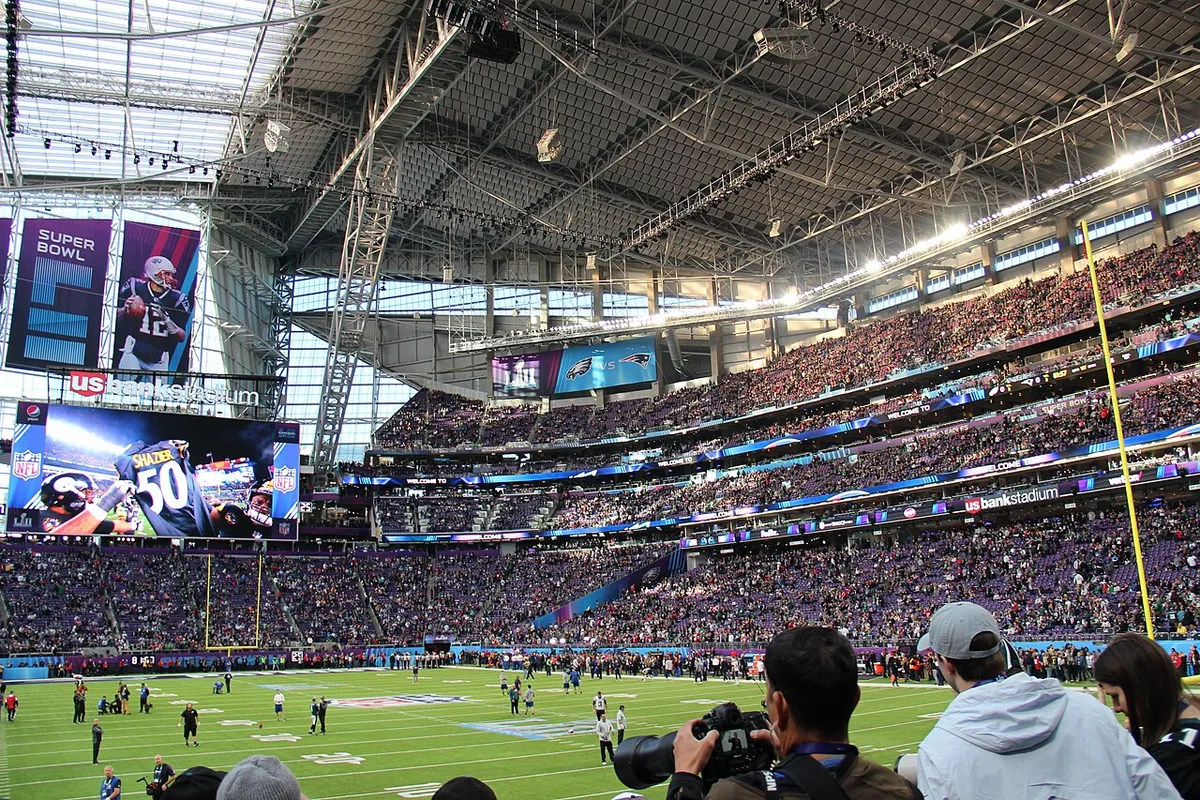
The Minnesota Vikings are the sole full-time football tenant, having played at U.S. Bank Stadium since the 2016 NFL season. From the 2016 season through November 27, 2026, the venue has hosted 88 NFL games, comprising 85 regular season contests and 3 playoff games. The most significant football event held at the stadium was Super Bowl LII on February 4, 2018, where the Philadelphia Eagles defeated the New England Patriots 41-33. The highest-scoring NFL game at the stadium occurred on September 13, 2020, when the Green Bay Packers beat the Vikings 43-34 for a combined 77 points. While designed primarily for football, the stadium's flexible seating allows it to host early-season college baseball games for the University of Minnesota Golden Gophers.
Management and Economic Impact
The stadium is owned by the Minnesota Sports Facilities Authority (MSFA), a public authority created in 2012. The MSFA's five-member board includes three appointees from the Governor of Minnesota and two from the Mayor of Minneapolis. Day-to-day operations are managed by the global firm ASM Global. The construction of U.S. Bank Stadium acted as a major catalyst for economic development in the surrounding Downtown East neighborhood. The project is credited with spurring approximately $1 billion in private investment in the area. This development included 1.2 million square feet of new office space, 28,000 square feet of retail space, around 400 residential units, and the creation of a 4.2-acre public park. The stadium's ability to host year-round events, from NFL games and the Super Bowl to the NCAA Final Four, concerts, and conventions, makes it a major event venue. The venue's first three years of operation alone saw 4.64 million visitors attend over 1,156 events.
Historical Context and Predecessor
U.S. Bank Stadium was built to replace the Hubert H. Humphrey Metrodome, which served as the Vikings' home from 1982 through 2013. The Vikings' lease at the Metrodome was considered one of the least lucrative in the NFL, with the team ranking 30th out of 32 teams in local revenue in 2005. The Metrodome was owned and operated by the Metropolitan Sports Facilities Commission (MSFC), which controlled most revenue streams like advertising, concessions, and parking. The infamous deflation and collapse of the Metrodome's roof under heavy snow on December 12, 2010, forced the relocation of the Vikings' final two home games of that season and intensified calls for a new, modern facility. During the two-year construction period for U.S. Bank Stadium (2014 and 2015 seasons), the Vikings played their home games at the University of Minnesota's open-air Huntington Bank Stadium. The MSFC was formally abolished by the state legislature in 2012, and its assets and responsibilities were transferred to the newly created Minnesota Sports Facilities Authority.
- Previous Vikings home: Hubert H. Humphrey Metrodome (1982 to 2013).
- Interim home during construction: Huntington Bank Stadium (2014 to 2015 seasons).
- Metrodome roof collapsed on December 12, 2010.
- Vikings ranked 30th in NFL local revenue in 2005 while at the Metrodome.
- Metropolitan Sports Facilities Commission abolished in 2012.
Recent games
| Date | Game | Week |
|---|---|---|
| Jan 10, 2027 | Chicago Bears at Minnesota Vikings | Week 18 |
| Dec 27, 2026 | Washington Commanders at Minnesota Vikings | Week 16 |
| Dec 20, 2026 | Detroit Lions at Minnesota Vikings | Week 15 |
| Dec 6, 2026 | Carolina Panthers at Minnesota Vikings | Week 13 |
| Nov 29, 2026 | Atlanta Falcons at Minnesota Vikings | Week 12 |
| Nov 9, 2026 | Buffalo Bills 23 at Minnesota Vikings 6 | Week 9 |
| Oct 25, 2026 | Indianapolis Colts 10 at Minnesota Vikings 16 | Week 7 |
| Oct 4, 2026 | Miami Dolphins 10 at Minnesota Vikings 15 | Week 4 |
| Sep 13, 2026 | Green Bay Packers 22 at Minnesota Vikings 39 | Week 1 |
| Jan 4, 2026 | Green Bay Packers 3 at Minnesota Vikings 16 | Week 18 |
| Dec 25, 2025 | Detroit Lions 10 at Minnesota Vikings 23 | Week 17 |
| Dec 7, 2025 | Washington Commanders 0 at Minnesota Vikings 31 | Week 14 |
Video
FAQ
When did U.S. Bank Stadium open and how long did construction take?
U.S. Bank Stadium officially opened to the public on July 22, 2016. Construction began with a groundbreaking ceremony on December 3, 2013. The project was completed in two and a half years, which was six weeks ahead of the original schedule. This accelerated timeline was notably faster than the construction periods for many other modern NFL stadiums. The Minnesota Vikings played their first preseason and regular season games in the new building during the 2016 NFL season.
How much did U.S. Bank Stadium cost and who paid for it?
The total project cost for U.S. Bank Stadium was $1.061 billion. The funding was a combination of public and private money. The state of Minnesota contributed $348 million, and the city of Minneapolis provided $150 million. The remaining $551 million came from the Minnesota Vikings organization and private sources, which included the revenue from the naming rights agreement with U.S. Bank. This financial structure was approved by the state legislature and the Minneapolis City Council in 2012.
Has U.S. Bank Stadium hosted a Super Bowl?
Yes, U.S. Bank Stadium hosted Super Bowl LII on February 4, 2018. In that game, the Philadelphia Eagles defeated the New England Patriots by a score of 41-33. The stadium's fixed, weather-proof roof guaranteed no weather-related disruptions for the NFL's premier event. The successful hosting of this Super Bowl demonstrated the stadium's capability as a major national event venue.
What type of roof does U.S. Bank Stadium have and why was it chosen?
U.S. Bank Stadium has a fixed, translucent roof made primarily of ETFE (ethylene tetrafluoroethylene). A retractable roof was seriously considered in early designs but was ultimately rejected due to its high cost and the engineering difficulty of reliably operating it in Minnesota's freezing winter temperatures. The ETFE roof panels form a massive skylight that allows natural light to fill the stadium. The slanted design helps the roof shed snow efficiently, with meltwater directed into a heated gutter system.
What other major events has U.S. Bank Stadium hosted besides Vikings games?
Beyond NFL football, U.S. Bank Stadium has hosted several high-profile national events. It was the site of the 2019 NCAA Men's Final Four, where a record crowd of 72,711 attended. The stadium also hosted the ESPN X Games in July 2018. Its design supports a wide range of events, including international soccer matches, major concerts, and conventions. The flexible seating system even allows it to be configured for early-season college baseball games for the University of Minnesota.
What is the address and public transit access for U.S. Bank Stadium?
U.S. Bank Stadium is located at 401 Chicago Avenue in Minneapolis, Minnesota. The stadium is directly served by the Blue Line and Green Line of the local light rail system at the U.S. Bank Stadium station. This convenient public transit access connects the venue to the broader Twin Cities area. The stadium's location on the former site of the Hubert H. Humphrey Metrodome places it within the growing downtown Minneapolis area, making it easily reachable for events.
Sources
- U.S. Bank Stadium (Wikipedia) Wikipedia
- U.S. Bank Stadium salasobrien.com
- U.S. Bank Stadium (Vikings Stadium) stadiumdb.com
- U.S. Bank Stadium Construction mortenson.com
- nflverse game, roster and draft data nflverse (CC BY 4.0)