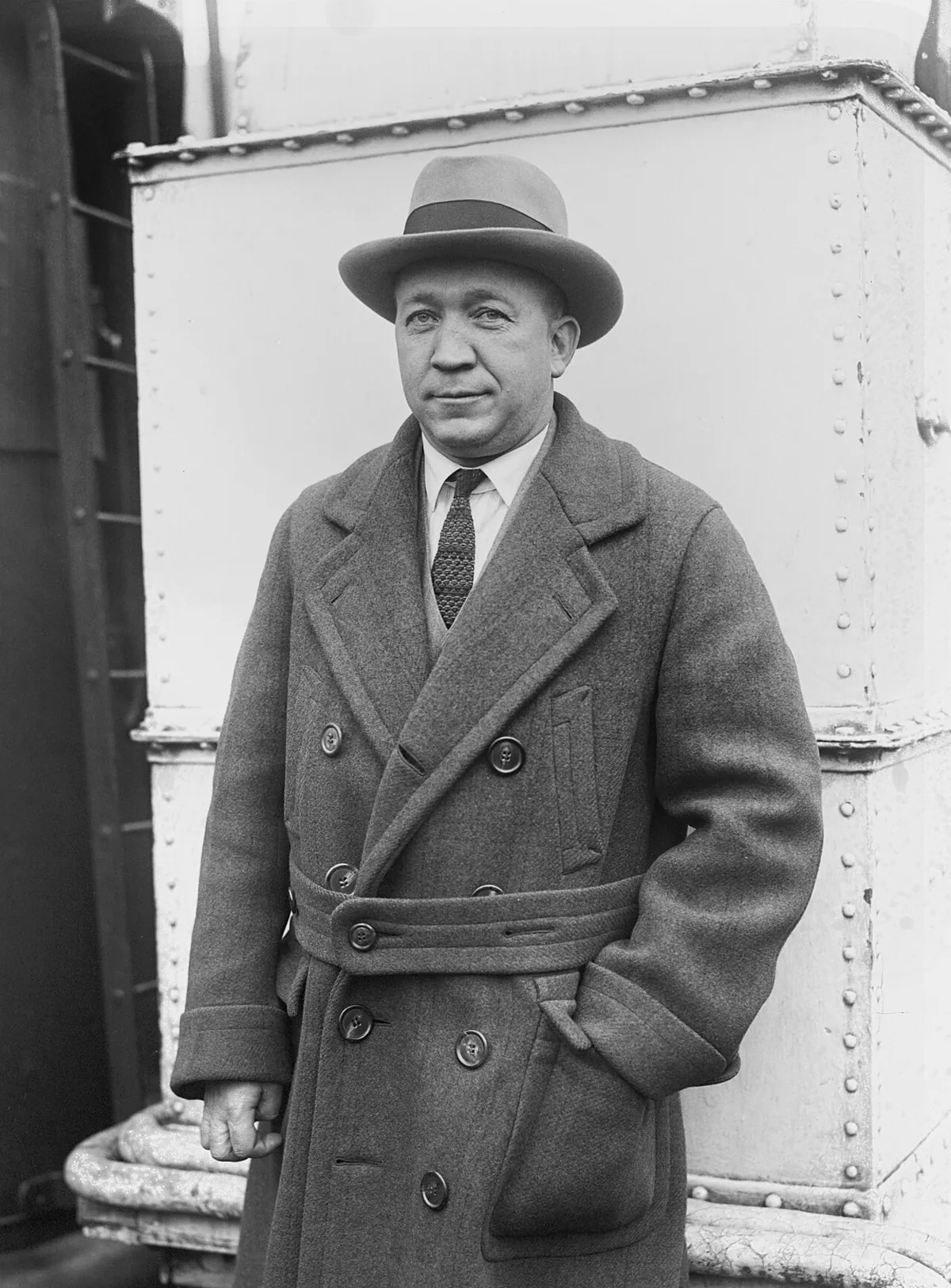
Knute Kenneth Rockne was a Norwegian-born American football player and coach at the University of Notre Dame. He served as the head coach of the Notre Dame Fighting Irish from 1918 until his death in 1931, taking over from Jesse Harper. During his 13-year tenure, Rockne compiled a record of 105 wins, 12 losses, and 5 ties, achieving a .881 winning percentage, the highest in major college football history. He led Notre Dame to three consensus national championships in 1924, 1929, and 1930, along with five undefeated seasons. Rockne died in a plane crash on March 31, 1931, at the age of 43, an event that prompted national mourning and aviation safety reforms.
Early Life and Playing Career
Knut Larsen Rokne was born in Voss Municipality, Norway, on March 4, 1888. He immigrated to the United States with his family at age five, settling in the Logan Square area of Chicago. Rockne played football for neighborhood teams and at North West Division High School. After graduating high school, he worked as a mail dispatcher for the Chicago Post Office for four years to save money for college. His clerk's salary was 600 dollars in 1907 and 900 dollars in 1909. Rockne enrolled at the University of Notre Dame in 1910 at the age of 22. He played end for the Notre Dame football team from 1910 to 1913, earning All-American honors in 1913. He also competed in track and field, setting a school record in the pole vault and competing in the long jump, shot put, and 880 yard run. He graduated magna cum laude in 1914 with a 90.52 grade average and a degree in pharmacy. Rockne worked as a laboratory assistant to chemist Julius Arthur Nieuwland after graduation. His most famous game as a player came on November 1, 1913, when Notre Dame upset Army 35-13 at West Point, utilizing a forward-pass attack from quarterback Gus Dorais to Rockne. That summer, while working as a lifeguard at Cedar Point in Sandusky, Ohio, Rockne and Dorais practiced their passing techniques extensively.
Professional Football and Early Coaching
After graduating in 1914, Rockne played professional football while beginning his coaching career. He was recruited by quarterback George Parratt to play for the Akron Indians in 1914. In 1915, he joined the Massillon Tigers alongside Gus Dorais, and the team won a championship that year. Rockne played for the Tigers through the 1917 season, bringing the forward pass to the professional game. Concurrently, he began his coaching career at Notre Dame as an assistant under head coach Jesse Harper from 1914 to 1917. Rockne also coached the amateur South Bend Jolly Fellows Club in 1916 and 1917. His worst loss in this period was a 40-0 defeat to the Toledo Maroons in 1917. Rockne's initial coaching record in Notre Dame's interhall sports league, where he coached Corby and Sorin Hall teams as a student in 1912 and 1913, was 2 wins, 5 losses, and 4 ties.
Notre Dame Head Coaching Tenure (1918 to 1930)
Knute Rockne was named head football coach and athletic director at the University of Notre Dame in 1918 following the retirement of Jesse Harper. He made his head coaching debut on September 28, 1918, with a 26-6 victory over Case Tech in Cleveland. His first season concluded with a 3-1-2 record, with the only loss coming to the MAC Aggies. Rockne coached Notre Dame for 13 seasons, from 1918 through the 1930 campaign. His overall record was 105 wins, 12 losses, and 5 ties, for a .881 winning percentage. This included five undefeated seasons in 1919, 1920, 1924, 1929, and 1930. Rockne's teams won three consensus national championships in 1924, 1929, and 1930. Notre Dame's only postseason bowl appearance under Rockne was a 27-10 victory over Stanford in the 1925 Rose Bowl, capping the 1924 national championship season. Rockne's final 19 games as head coach were all victories.
| Season | Record | Notable Achievement |
|---|---|---|
| 1918 | 3-1-2 | First season as head coach |
| 1919 | 9-0-0 | Undefeated season, national champion (not recognized by ND) |
| 1920 | 9-0-0 | Undefeated season, George Gipp's final year |
| 1924 | 10-0-0 | National champion, Rose Bowl win, Four Horsemen |
| 1926 | 9-1-0 | Loss to Carnegie Tech in Rockne's absence |
| 1929 | 9-0-0 | National champion, Rockne considered it his strongest team |
| 1930 | 10-0-0 | National champion, Rockne's final season |
The 1924 national championship team is famous for its Four Horsemen backfield, consisting of Harry Stuhldreher, Don Miller, Jim Crowley, and Elmer Layden. The line was known as the Seven Mules. Rockne's 1926 team suffered a 19-0 upset loss to Carnegie Tech while he was in Chicago covering the Army, Navy game for a newspaper and selecting an All-America team. The 1928 team lost to national champion Georgia Tech, and Rockne cited the play of Georgia Tech's Peter Pund as decisive. Rockne gave his famous Win one for the Gipper speech at halftime of a tied game against Army on November 10, 1928, and Notre Dame went on to win 12-6. He was occasionally absent due to illness, with assistant Tom Lieb acting as de facto head coach for parts of the 1929 season. Rockne said his 1930 team was his best offensively before the departure of player Jumping Joe Savoldi.
Key Players and the Gipper Story
Several noted players defined the Rockne era at Notre Dame. George Gipp, Notre Dame's first All-American as selected by Walter Camp, played for Notre Dame until 1920. Gipp died from strep throat and pneumonia on December 14, 1920. Rockne used this story eight years later to motivate his team against Army. The 1921 team was led by John Mohardt, who passed for 995 yards and 9 touchdowns, with ends Eddie Anderson and Roger Kiley as his primary targets. Grantland Rice noted that the 1921 squad was the first to build its attack around the forward pass. The 1924 backfield of the Four Horsemen became the most famous in college football history. Rockne's all-time All-America backfield consisted of Jim Thorpe, Red Grange, George Gipp, and George Pfann. Other notable players included Marchy Schwartz, Frank Carideo, and Curly Lambeau, who was a back on Rockne's 1918 team before founding the Green Bay Packers.
Coaching Schemes and Innovations
Rockne was an innovative coach who helped popularize and refine the forward pass in college football. He and Gus Dorais practiced passing extensively in the summer of 1913, developing an overhand throwing technique and having receivers catch the ball in stride. As a coach, Rockne installed an offensive system known as the Notre Dame Box, which was a shift formation. The backfield would line up in a T-formation and then shift into a box to the left or right just before the snap. This shift offense relied on speed, timing, and deception. Rockne also utilized a 7-2-2 defensive scheme. He was among the first coaches to use a full second team, which he called shock troops, at the start of games. Rockne redesigned football equipment and uniforms to be lighter and more protective, introducing gold satin and silk pants to reduce wind resistance. He promoted intersectional rivalries by scheduling games across the country, which helped build Notre Dame's national following. The shift was so effective that rules were later enacted to limit backfield motion before the snap.
Coaching Tree and Legacy
Rockne's influence extended beyond his immediate successors. He helped transform college football into a national spectacle during the 1920s, using media relations to promote Notre Dame. He worked as a promoter for the Studebaker company in South Bend. Through his coaching salary, promotional work, and other jobs, Rockne earned a combined income of 75,000 dollars.
- Charlie Bachman: Head coach at Kansas State (1920 to 1927), Florida (1928 to 1932), Michigan State (1933 to 1942, 1944 to 1946).
- Curly Lambeau: Founder and head coach of the Green Bay Packers (1920 to 1949), Chicago Cardinals (1950 to 1951), Washington Redskins (1952 to 1953).
- Buck Shaw: Head coach of the San Francisco 49ers (1946 to 1954), Philadelphia Eagles (1958 to 1960).
- Elmer Layden: Head coach at Duquesne (1927 to 1933) and Notre Dame (1934 to 1940).
- Harry Stuhldreher: Head coach at Villanova (1925 to 1935) and Wisconsin (1936 to 1948).
- Frank Thomas: Head coach at Chattanooga (1925 to 1928) and Alabama (1931 to 1946).
- Jim Crowley: Head coach at Michigan State (1928 to 1932) and Fordham (1933 to 1941).
- Hunk Anderson: Head coach at Notre Dame (1931 to 1933) and the Chicago Bears (1942 to 1945).
Personal Life and Activities
Knute Rockne married Bonnie Gwendoline Skiles on July 14, 1914, in Sandusky, Ohio. Gus Dorais served as best man at the wedding. The couple had four children: Knute Lars Jr., William Dorias, Mary Jeane, and John Vincent. The family lived in South Bend, Indiana. Rockne was born Lutheran but converted to Catholicism on November 20, 1925. He was baptized by Rev. Vincent Mooney in the Log Chapel on the Notre Dame campus. Beyond football, Rockne was involved in many campus activities as a student. He wrote articles for the student newspaper and yearbook, played the flute in the school orchestra, performed in student plays, and reached the finals of the Notre Dame marbles tournament. His grandson, Paul Michael Rockne, was killed in the 1986 Edmond post office shooting.
Plane Crash and National Reaction
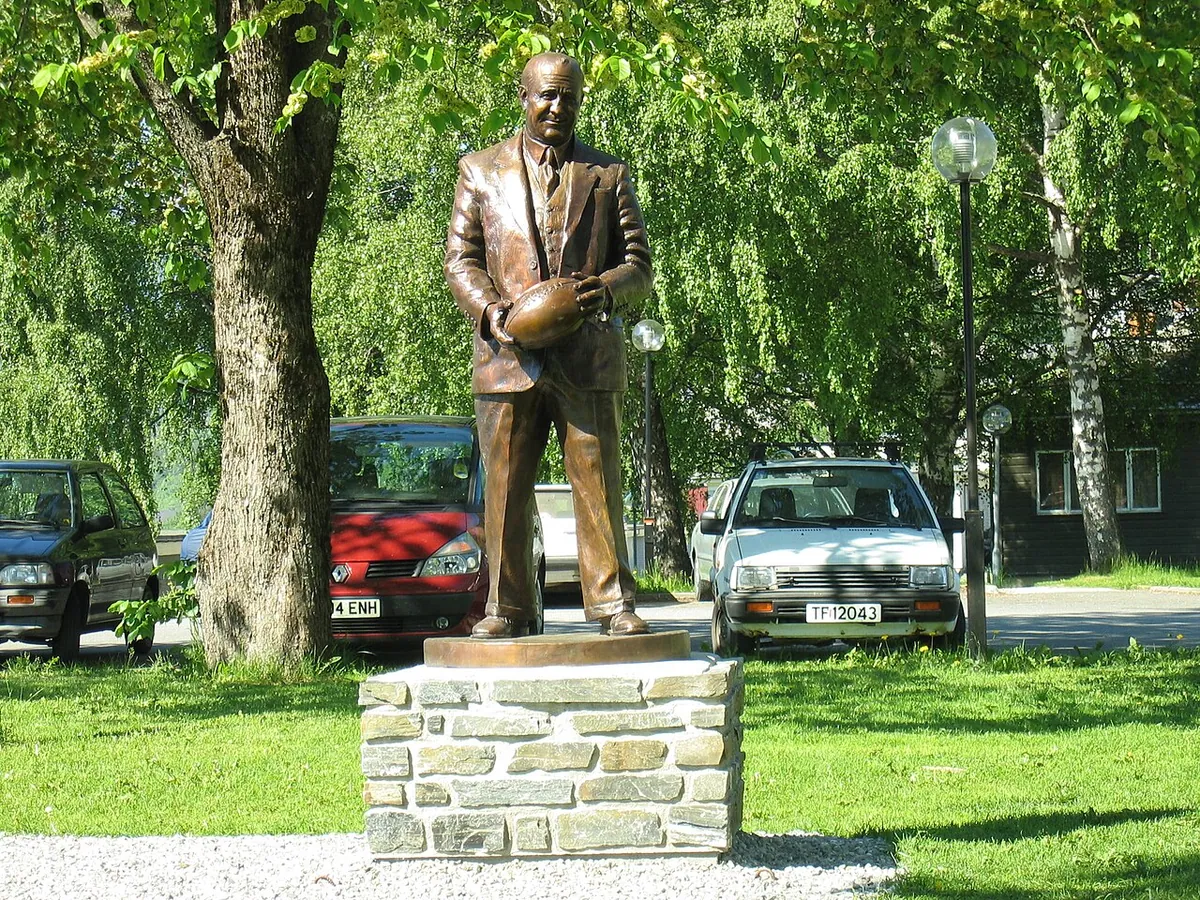
Knute Rockne died on March 31, 1931, in the crash of a Transcontinental & Western Air Fokker Trimotor airplane near Bazaar, Kansas. He was 43 years old. Rockne was traveling to Los Angeles to take part in making the film The Spirit of Notre Dame. He had stopped in Kansas City to visit his sons at the Pembroke-Country Day School before the flight. The crash, which killed seven others, was caused by the failure of a wing due to deteriorated water-based glue bonding the plywood skin to the frame. His former coach and friend, Jess Harper, who lived about 100 miles from the crash site, was called to identify the body. The national outcry led to major reforms in aircraft safety, design, manufacturing, inspection, and regulation. President Herbert Hoover called his death a national loss. King Haakon VII of Norway posthumously knighted Rockne. His funeral at the Basilica of the Sacred Heart at Notre Dame was broadcast live on network radio in the United States, Europe, and parts of South America and Asia. Over 100,000 people lined the route of his funeral procession. He was originally buried in Highland Cemetery in South Bend, with six of his 1930 players serving as pallbearers, and was reinterred on the Notre Dame campus in 2024.
Honors and Lasting Impact
Knute Rockne was inducted into the College Football Hall of Fame in its inaugural class of 1951. His .881 winning percentage remains the highest in major college football history. Rockne's teams produced 20 first-team All-Americans during his 13-year tenure. He was the subject of the 1940 biographical film Knute Rockne, All American, starring Pat O'Brien and Ronald Reagan. A memorial stands at the site of the plane crash in Kansas, maintained for years by James Heathman, who was 13 when he witnessed the crash. There is a Knute Rockne Street in San Antonio, Texas. Humorist Will Rogers said that while Notre Dame was Knute Rockne's address, every gridiron in America was his home. His most enduring tactical legacy was demonstrating the strategic power of the forward pass, moving it from a novelty to a standard offensive weapon. His motivational techniques, particularly the Gipper story, became embedded in American sports culture.
Video
FAQ
What was Knute Rockne's coaching record at Notre Dame?
Knute Rockne's overall record as head coach of the Notre Dame Fighting Irish from 1918 to 1930 was 105 wins, 12 losses, and 5 ties. This gave him a .881 winning percentage, which is the highest in major college football history. Rockne won three consensus national championships in 1924, 1929, and 1930. His only bowl game was a 27-10 victory over Stanford in the 1925 Rose Bowl. His final 19 games were all wins.
How did Knute Rockne die?
Knute Rockne died in a plane crash on March 31, 1931. The Transcontinental & Western Air Fokker Trimotor he was traveling in crashed into a wheat field near Bazaar, Kansas, killing all eight people on board. Rockne was en route from Kansas City to Los Angeles. The crash investigation determined that water-based glue bonding the plane's wooden wing structure had deteriorated, causing a wing to fail in flight. His death triggered national grief and led to significant reforms in aviation safety standards and aircraft manufacturing.
What was Knute Rockne's famous quote?
Knute Rockne is most associated with the phrase Win one for the Gipper. He said the words came from his dying player, George Gipp. Rockne used this story as a motivational speech at halftime of a tied game against Army on November 10, 1928, and Notre Dame went on to win 12-6. The phrase was later popularized by the 1940 film Knute Rockne, All American.
What was Knute Rockne's ethnicity?
Knute Rockne was Norwegian. He was born Knut Larsen Rokne in Voss Municipality, Norway, on March 4, 1888. He immigrated to the United States with his parents when he was five years old, and the family settled in Chicago. After his death, King Haakon VII of Norway posthumously knighted him in recognition of his achievements.
What offensive scheme did Knute Rockne use?
Knute Rockne's primary offensive scheme was the Notre Dame Box, a shift formation. In this offense, the backfield would line up in a T-formation and then quickly shift into a box formation to the left or right just as the ball was snapped. This was designed to create confusion and leverage speed and deception. Rockne also helped revolutionize the use of the forward pass, making it a key component of his offensive strategy. He practiced precise passing techniques with quarterback Gus Dorais, emphasizing overhand throws and receivers catching the ball in stride.
How many national championships did Knute Rockne win?
Knute Rockne won three consensus national championships as head coach at Notre Dame. These championships were awarded for the 1924, 1929, and 1930 seasons. The 1924 team finished with a 10-0 record and defeated Stanford in the Rose Bowl. The 1929 and 1930 teams also had perfect 9-0 and 10-0 records, respectively. In addition to these three titles, Rockne's teams had two other undefeated seasons in 1919 and 1920.
Sources
- Knute Rockne (Wikipedia) Wikipedia
- Knute Rockne | History | Research Starters | EBSCOhost ebsco.com
- Notre Dame Football Memories: Knute Rockne fightingirish.com
- Inductee | Knute Kenneth Rockne 1951 College Football Hall of Fame
- The Postman who Became one of the Greatest Coaches in Football History. passiton.com
- Knute K. Rockne (2014) - Rose Bowl Hall of Fame rosebowlgame.com