San Diego Stadium was a multi-purpose stadium located at 9449 Friars Road in San Diego, California. It opened in 1967 as San Diego Stadium and served as the home field for the San Diego Chargers of the NFL from 1967 through the 2016 season and the San Diego State Aztecs college football team from 1967 through 2019. The stadium hosted three Super Bowls, the annual Holiday Bowl from 1978 to 2019, and the Poinsettia Bowl from 2005 to 2016. After closing in March 2020, the stadium was demolished between December 2020 and March 22, 2021, with the site redeveloped as part of San Diego State University's Mission Valley campus. The stadium's naming rights were held by Qualcomm Corporation from 1997 to 2017, leading to its most commonly recognized name.
Construction and Design
Local sportswriter Jack Murphy began building support for a multi-purpose stadium in San Diego in the early 1960s. A $27 million bond referendum passed in November 1965, and construction began one month later on December 18, 1965. The stadium was designed by Frank L. Hope and Associates in the Brutalist architectural style. The general contractor for the project was Robertson/Larsen/Donovan, and the total construction cost was $27.75 million, equivalent to $268 million in 2025 dollars. The facility was the first example of the 'octorad' square-circle design, intended as an improvement for hosting both football and baseball compared to other multi-purpose venues of the era. The second and last stadium of this style was Veterans Stadium in Philadelphia, which was later imploded.
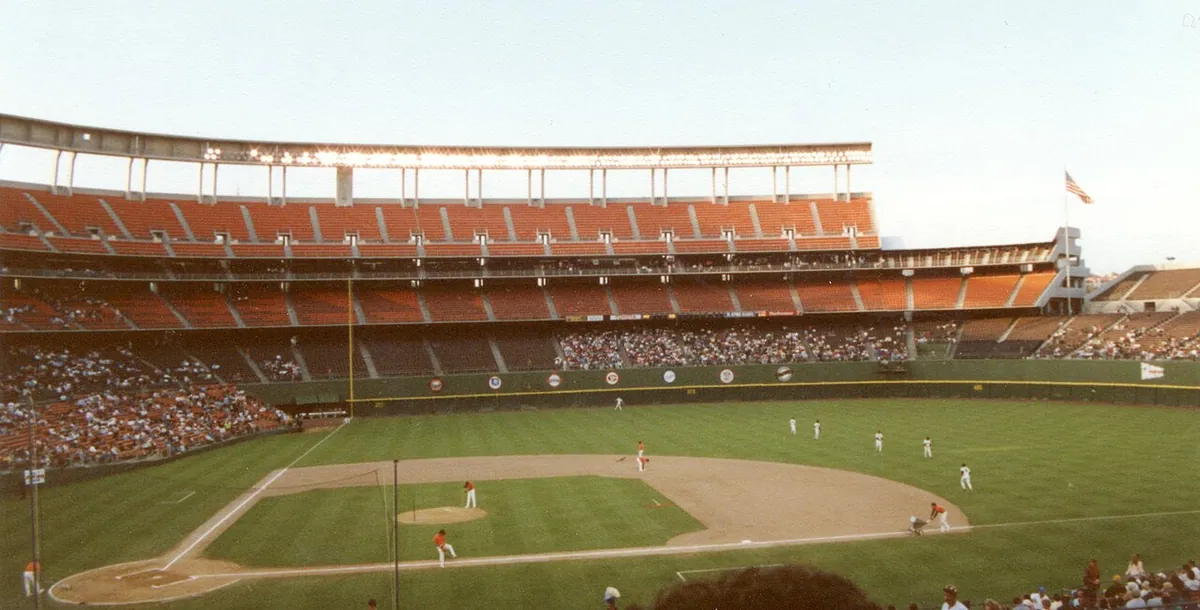
The original structure featured a three-tier grandstand in a horseshoe shape with an open east end topped by a large scoreboard. The initial seating capacity was approximately 50,000 with multicolored seats. The field used natural Bandera Bermuda grass and the venue was entirely outdoors. A unique design feature involved half of the lower level seating being permanent concrete and the other half being portable modular sections to allow reconfiguration between football and baseball layouts.
Expansions and Renovations
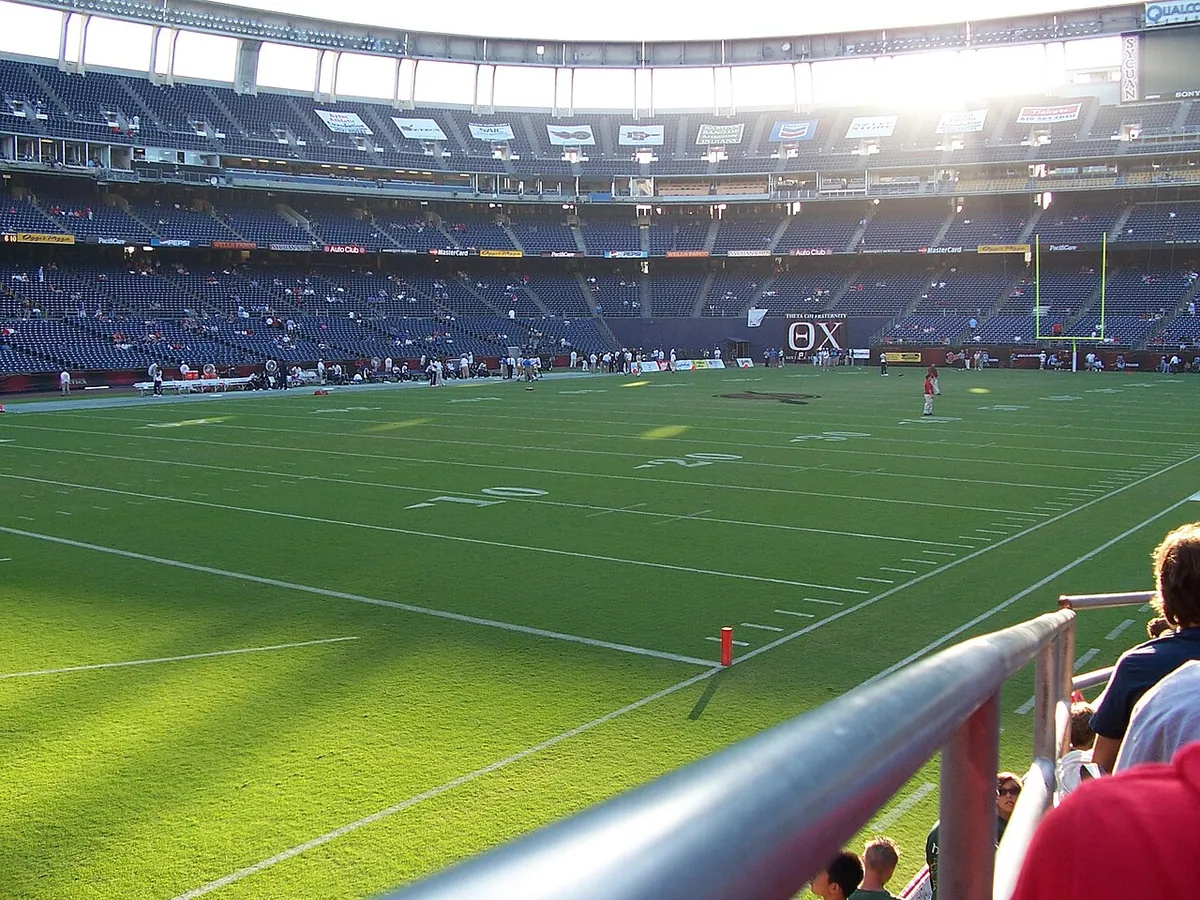
The stadium underwent two major expansions that significantly increased its capacity. The first expansion occurred in 1983 when over 9,000 bleacher seats were added to the lower deck on the open east end. This addition fully enclosed the field for the first time and raised the capacity. The most substantial renovation was completed in 1997 in preparation for hosting Super Bowl XXXII the following year. This project added nearly 11,000 seats, fully enclosing the stadium except for the scoreboard area, and brought the official Chargers football capacity to 70,561. The baseball capacity was set at 67,544 after this work.
The 1997 renovation also included the replacement of all the original multicolored seats with new blue seats. It added over 100 luxury suites and more than 7,000 club seats. Amenities for Chargers season ticket holders included the Chargers Gold Club, which provided service at their seats and access to air-conditioned lounges. The renovation gave the stadium a more football-oriented appearance, which was a point of contention for the San Diego Padres baseball team. The city granted the Chargers full financial control of the 113 luxury suites as part of this renovation, a move that affected the Padres' standing in their own ballpark.
Naming History and Rights
The stadium operated under four different names during its existence. From its 1967 opening until 1980, it was known as San Diego Stadium. Following the death of sportswriter Jack Murphy, the San Diego City Council voted 6-2 to rename it San Diego Jack Murphy Stadium on January 6, 1981. In 1997, Qualcomm Corporation paid $18 million for the naming rights, and the facility became Qualcomm Stadium. This agreement lasted until 2017. After those rights expired, San Diego County Credit Union purchased them, and the stadium was renamed SDCCU Stadium on September 19, 2017. Those naming rights expired in December 2020. The city maintained the name Jack Murphy Field for the stadium site itself, though this could not be used alongside the corporate stadium name. In December 2011, the venue was rebranded as Snapdragon Stadium for a 10-day promotional period for Qualcomm's mobile processor brand, a move that was legally challenged as it was not approved by the city council.
NFL Tenancy and Super Bowls
The team compiled an overall record of 209 wins, 173 losses, and 3 ties during their tenure at the venue. The Chargers hosted 11 playoff games at the stadium, posting a record of 5 wins and 6 losses in those contests. Notable hosted playoff games included the 1980 AFC Championship Game, a 34-27 loss to the Oakland Raiders, and the 1994 AFC Divisional Round, a 22-21 victory over the Miami Dolphins. From the 1999 season through November 27, 2026, the Chargers played 149 NFL games at the stadium, consisting of 143 regular season games and 6 playoff games. The highest combined score in an NFL game at the stadium from 1999 onward was 83 points, occurring on November 6, 2011, when the Green Bay Packers defeated the Chargers 45-38.
Qualcomm Stadium hosted three Super Bowls, making it the most recent multi-purpose stadium to host the NFL's championship game. The stadium achieved the unique distinction of being the only venue to host both a Super Bowl and a World Series in the same calendar year, accomplishing this in 1998. It was also one of only three stadiums to have hosted a Super Bowl, a World Series, and an MLB All-Star Game, alongside the Hubert H. Humphrey Metrodome and the Los Angeles Memorial Coliseum. The Chargers had perfect home records against certain opponents, including a 5-0 record against the Detroit Lions and a 4-0 record against the Jacksonville Jaguars. Conversely, they had winless records against others, such as 0-6 against the Atlanta Falcons and 0-6 against the Green Bay Packers during their time at the venue.
| Date | Super Bowl | Winner | Points | Loser | Points | Attendance |
|---|---|---|---|---|---|---|
| January 31, 1988 | XXII | Washington Redskins | 42 | Denver Broncos | 10 | 73,302 |
| January 25, 1998 | XXXII | Denver Broncos | 31 | Green Bay Packers | 24 | 68,912 |
| January 26, 2003 | XXXVII | Tampa Bay Buccaneers | 48 | Oakland Raiders | 21 | 67,603 |
College Football and Bowl Games
San Diego State University's Aztecs football team called the stadium home from its opening in 1967 through the 2019 season. The team played approximately five miles from its main campus, having previously used Balboa Stadium and the on-campus Aztec Bowl. A tradition started under coach Don Coryell was for the Aztecs to wear all-black uniforms for night games, known as 'The Look.' Attempts to change this uniform tradition were associated with poor team performance and were always reversed. The stadium hosted two major college football bowl games for many years, establishing itself as a December destination for the sport. The Holiday Bowl was held every December at the stadium from 1978 through 2019, and the Poinsettia Bowl ran from 2005 until its end after the 2016 game.
- The Holiday Bowl traditionally featured high-scoring contests. For a decade from 1995 through 2004, the team that lost each game still managed to score 20 or more points.
- The 1984 Holiday Bowl is particularly famous as it capped Brigham Young University's national championship season, the last Division I-A title not won by a team from a Power Five conference or a major independent.
- The Poinsettia Bowl was organized by the same committee as the Holiday Bowl, but the committee decided to host only one game beginning with the 2017 season, leading to the Poinsettia Bowl's discontinuation.
- On October 27, 2018, the stadium hosted a regular-season college game where the Navy Midshipmen served as the home team against the Notre Dame Fighting Irish.
- The stadium was the home field for the San Diego Fleet of the Alliance of American Football during its brief inaugural season in 2019, where the Fleet posted a 3-1 home record before the league folded.
- CIF San Diego Section high school football championship games for four divisions were routinely held at the stadium on a Friday in early December.
- The final sporting event at the stadium was the 2019 Holiday Bowl on December 27, where the Iowa Hawkeyes defeated the USC Trojans.
Other Sports and Events
Beyond football, the stadium served as the home of Major League Baseball's San Diego Padres from their inception in 1969 through the 2003 season. The Padres' move to Petco Park after the 2003 season left the Chargers as the sole major professional tenant. The stadium hosted the 1984 and 1998 World Series, the 1978 and 1992 MLB All-Star Games, and National League playoff series in 1984, 1996, and 1998. Notable baseball moments at the stadium included Orel Hershiser breaking Don Drysdale's scoreless innings streak on September 28, 1988, and Rickey Henderson collecting his 3,000th hit on October 7, 2001. The stadium also witnessed Tony Gwynn's final major league game on that same date in 2001.
The stadium also had a significant soccer history. It was home to the San Diego Sockers of the North American Soccer League from 1978 to 1984 and hosted Soccer Bowl '82. It was the venue for the 1999 MLS All-Star Game. The stadium hosted numerous international matches, including a 2008 friendly between Mexico and Argentina that drew 68,498 spectators, setting a regional attendance record for the sport. It was included in the United States' bids for the 2018 and 2022 FIFA World Cups. Other events included a Sports Car Club of America event in the parking lot in October 1967 and various concerts and gatherings throughout its history. The stadium also saw the infamous rendition of the national anthem by comedian Roseanne Barr before a Padres game in 1990.
Closure and Legacy
Discussions about replacing the aging stadium began in earnest after the Padres departed in 2003. The NFL stated that San Diego would need a new stadium to host another Super Bowl. The Chargers' efforts to secure a new venue were unsuccessful, leading to their announcement on January 12, 2017, that they would relocate to Los Angeles. The team played its final season at the stadium in 2016 before moving to Dignity Health Sports Park and later SoFi Stadium. In 2018, San Diego State University announced plans to build a new stadium on the site as part of a campus expansion. The stadium closed in March 2020 and demolition commenced in December 2020, concluding on March 22, 2021. San Diego State University purchased the site and developed it into the SDSU Mission Valley campus. The venue's evolution from a multi-purpose facility to a football-only concern and its eventual demolition reflected broader trends in stadium design and fan experience in professional and collegiate athletics.
Recent games
| Date | Game | Week |
|---|---|---|
| Jan 1, 2017 | Kansas City Chiefs 37 at San Diego Chargers 27 | Week 17 |
| Dec 18, 2016 | Oakland Raiders 19 at San Diego Chargers 16 | Week 15 |
| Dec 4, 2016 | Tampa Bay Buccaneers 28 at San Diego Chargers 21 | Week 13 |
| Nov 13, 2016 | Miami Dolphins 31 at San Diego Chargers 24 | Week 10 |
| Nov 6, 2016 | Tennessee Titans 35 at San Diego Chargers 43 | Week 9 |
| Oct 13, 2016 | Denver Broncos 13 at San Diego Chargers 21 | Week 6 |
| Oct 2, 2016 | New Orleans Saints 35 at San Diego Chargers 34 | Week 4 |
| Sep 18, 2016 | Jacksonville Jaguars 14 at San Diego Chargers 38 | Week 2 |
| Dec 20, 2015 | Miami Dolphins 14 at San Diego Chargers 30 | Week 15 |
| Dec 6, 2015 | Denver Broncos 17 at San Diego Chargers 3 | Week 13 |
| Nov 22, 2015 | Kansas City Chiefs 33 at San Diego Chargers 3 | Week 11 |
| Nov 9, 2015 | Chicago Bears 22 at San Diego Chargers 19 | Week 9 |
Video
FAQ
What was Qualcomm Stadium's capacity for football games?
Qualcomm Stadium's football capacity changed after major renovations. Following the 1997 expansion for Super Bowl XXXII, the official capacity for San Diego Chargers NFL games was 70,561. For San Diego State Aztecs college football games, the capacity was listed at 54,000. The original capacity when the stadium opened in 1967 was approximately 50,000. An earlier expansion in 1983 added over 9,000 seats, bringing the football capacity to 59,022 before the final 1997 enlargement.
When was Qualcomm Stadium demolished and what replaced it?
Demolition of Qualcomm Stadium began in December 2020 after the venue closed in March of that year. The demolition process was completed on March 22, 2021. San Diego State University purchased the stadium site and developed it into the SDSU Mission Valley campus. This new stadium serves as the home for the San Diego State Aztecs football team and is part of a larger campus expansion including parkland and other facilities.
How many Super Bowls were hosted at Qualcomm Stadium and which ones?
Qualcomm Stadium hosted three Super Bowls during its history. Super Bowl XXII was played on January 31, 1988, with the Washington Redskins defeating the Denver Broncos 42-10 before 73,302 fans. Super Bowl XXXII took place on January 25, 1998, where the Denver Broncos beat the Green Bay Packers 31-24 with an attendance of 68,912. Super Bowl XXXVII was held on January 26, 2003, featuring the Tampa Bay Buccaneers' 48-21 victory over the Oakland Raiders with 67,603 in attendance. The stadium was the most recent multi-purpose stadium to host the NFL's championship game.
What were the different names of the stadium over the years?
The stadium operated under four primary names. From its 1967 opening until 1980, it was called San Diego Stadium. After sportswriter Jack Murphy's death, it was renamed San Diego Jack Murphy Stadium in 1981. In 1997, Qualcomm Corporation purchased naming rights for $18 million, leading to the name Qualcomm Stadium until 2017. After that agreement expired, San Diego County Credit Union bought the rights, and from September 2017 until demolition it was called SDCCU Stadium. The city also designated the site itself as Jack Murphy Field, though this could not be used alongside the corporate stadium names.
What college football events were held at Qualcomm Stadium?
Qualcomm Stadium was the home field for the San Diego State Aztecs from 1967 through the 2019 season. It hosted the Holiday Bowl annually every December from 1978 through 2019. The stadium also hosted the Poinsettia Bowl from its first game in 2005 until its final edition in 2016. On October 27, 2018, the stadium held a regular-season college game where Navy served as the home team against Notre Dame. Additionally, the venue hosted CIF San Diego Section high school football championship games for multiple divisions each December.
What other professional sports teams played at Qualcomm Stadium?
Beyond the NFL's Chargers, Qualcomm Stadium was home to Major League Baseball's San Diego Padres from 1969 through the 2003 season. The stadium also hosted the San Diego Sockers of the North American Soccer League from 1978 to 1984. In 2019, it served as the home field for the San Diego Fleet of the Alliance of American Football during that league's only season. The stadium additionally hosted international soccer matches, including the 1999 MLS All-Star Game and a 2008 friendly between Mexico and Argentina that set a regional attendance record of 68,498 spectators.
Sources
- San Diego Stadium (Wikipedia) Wikipedia
- Jack Murphy Stadium, history, photos and more of the San Diego Padres former ballparkallpark ballparksofbaseball.com
- Qualcomm Stadium pro-football-history.com
- Qualcomm Stadium, history, photos and more of the site of Super Bowl XXII, XXXII & XXXVI Stadiums of Pro Football
- nflverse game, roster and draft data nflverse (CC BY 4.0)