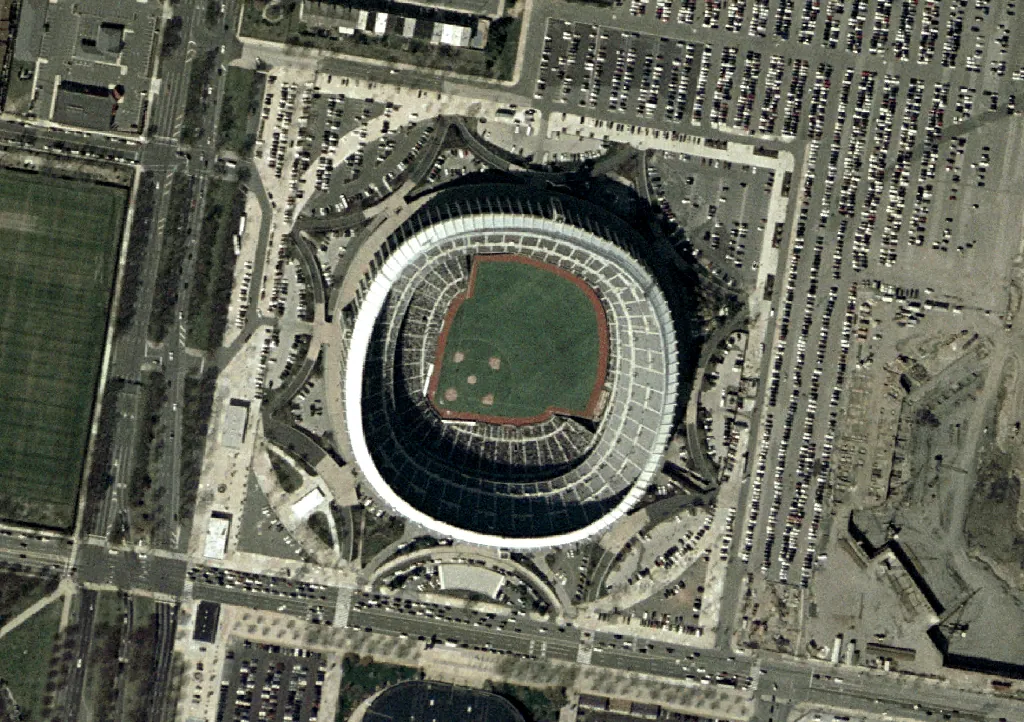
Veterans Stadium was a multi-purpose stadium located in the South Philadelphia Sports Complex at the corner of Broad Street and Pattison Avenue. It served as the home of the NFL's Philadelphia Eagles from 1971 through the 2002 season, hosting regular season and playoff games. The stadium also hosted the Army-Navy football game between 1980 and 2001. Known for its harsh artificial turf and notoriously rowdy fans, particularly in the upper 700 Level, the facility closed in 2003 and was imploded on March 21, 2004, replaced by Lincoln Financial Field and Citizens Bank Park.
Construction, Opening and Financing
Voters approved a $25 million bond issue in 1964 to fund construction. Ground was broken on October 2, 1967, and the stadium was named Veterans Stadium in 1968 to honor military veterans. Due to labor strikes, bad weather, and construction delays, the opening was pushed from 1970 to 1971. The final construction cost was $63 million, with an additional $13 million approved by voters in 1967 to cover overruns. The stadium was designed by Hugh Stubbins & Associates with an octorad shape intended to accommodate both baseball and football, a common but often problematic design for dual-use facilities of that era.
The stadium opened with a $3 million scoreboard complex that was the most expensive ever installed at the time. Before the first game, a blessing was performed by Marine Corps chaplain and veteran Francis Kelly. The first professional event held at the stadium was a baseball game on April 10, 1971, where the Philadelphia Phillies defeated the Montreal Expos 4-1 before an audience of 55,352. The ceremonial first ball was dropped by helicopter to Phillies catcher Mike Ryan. Entertainer Mike Douglas sang The Star-Spangled Banner before the game, and Phillies announcer Harry Kalas served as emcee. The Philadelphia Eagles played their first football game at the venue on September 26, 1971, hosting the Dallas Cowboys.
Stadium Design and Seating Configuration
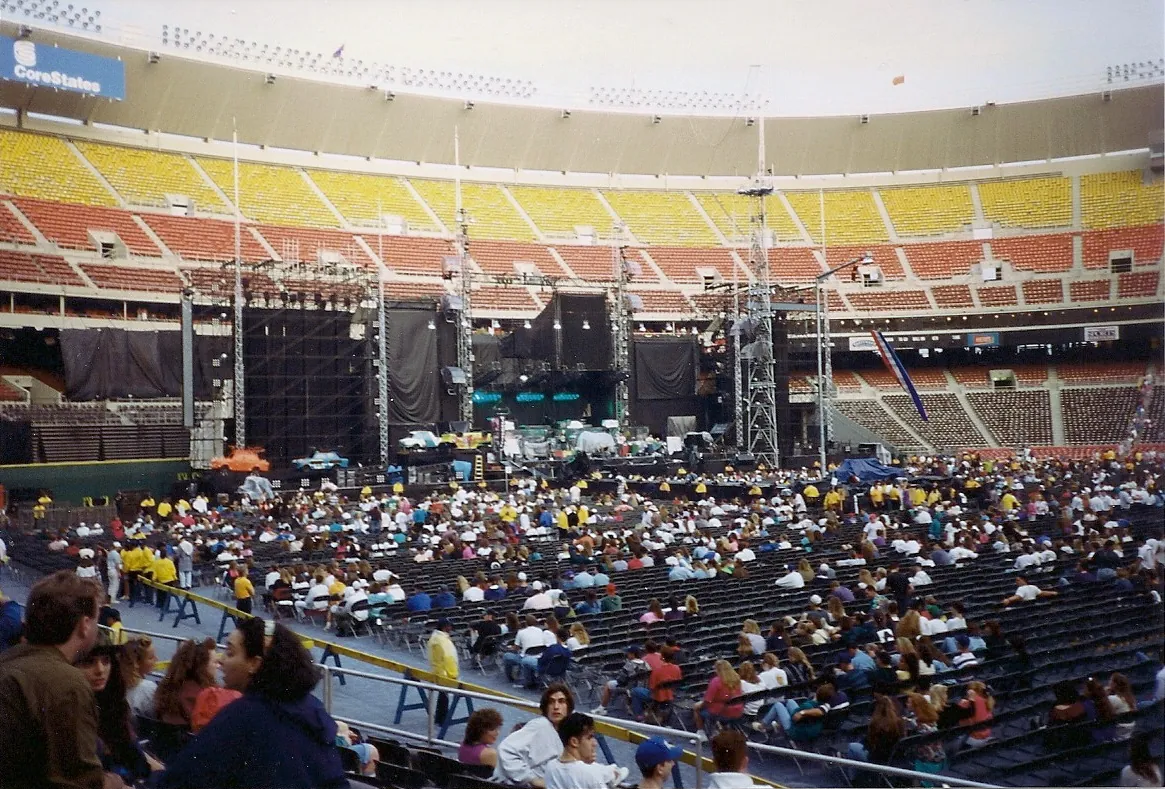
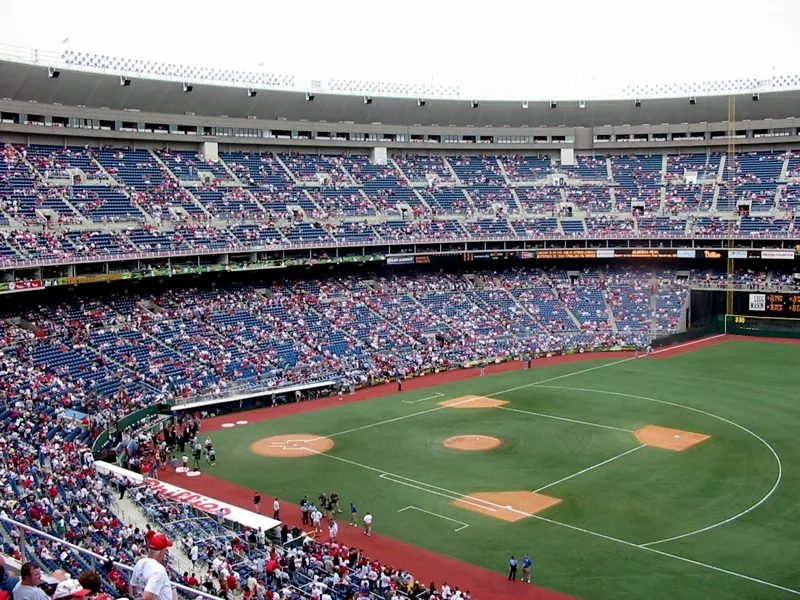
Veterans Stadium was a massive, nearly circular structure with seating arranged across seven distinct levels. The 200 Level comprised field-level boxes, and the 300 Level housed terrace boxes. The upper level began with the 500 Level, then the 600 Level, and finally the highest 700 Level. Originally, seats were in shades of brown, terra cotta, orange, and yellow, but they were replaced with blue seats prior to the start of the 1996 baseball season. For football, the official seating capacity was 65,352.
The stadium's acoustics were known for amplifying crowd noise, creating a significant home-field advantage for the Eagles. A replica of the Liberty Bell was mounted on the stadium roof in center field. The stadium was harshly criticized for its design compromises, with the upper deck exceptionally high and many seats far from the action. Approximately 70 percent of the seats were in fair territory for baseball, adding to a cavernous feel. The configuration for football was achieved using rollaway seats that were stored when the stadium was in baseball configuration. In the 1990s new video boards replaced the original scoreboard system.
- The 700 Level was the highest and cheapest seats, known for hostile fan behavior.
- The 400 Level was reserved for the press and dignitaries.
- In the late 1980s, several rows of the 700 Level were removed to accommodate construction.
- The original multi-colored seats were replaced with blue seats prior to the 1996 season.
- The original scoreboard featured a home run with a figure named Philadelphia Phil.
Philadelphia Eagles Tenancy and NFL Era
The Philadelphia Eagles played their first game at Veterans Stadium on September 26, 1971, a 42-7 loss to the Dallas Cowboys. The Eagles' only touchdown that day came on a 102-yard return of a missed field goal by Al Nelson. The team called the Vet home from 1971 to 2002. The final Eagles game at the stadium was the NFC Championship Game for the 2002 season, played on January 19, 2003, where the Tampa Bay Buccaneers defeated the Eagles 27-10. From the 1999 season through the 2002 season, the stadium hosted 36 NFL games, including 32 regular season contests and 4 playoff games. The highest combined score in an NFL game at Veterans Stadium was 69 points, occurring on January 2, 2000, when the Philadelphia Eagles beat the St. Louis Rams 38-31.
The Eagles moved into Lincoln Financial Field in August 2003. The stadium's condition deteriorated over the years, with issues like a hole in a wall that allowed visiting players to peek into the Eagles Cheerleaders' dressing room and infestations of mice that required cats to be employed as mousers. The Eagles had played at the University of Pennsylvania's Franklin Field from 1958 to 1970. The stadium's design was similar to other multi-purpose venues like San Diego Stadium, RFK Stadium, and Three Rivers Stadium, which also struggled to adequately serve both baseball and football.
Notable Injuries and Turf Problems
The playing field at Veterans Stadium was infamous throughout its existence, consistently ranked as the worst in the NFL in player surveys. The original surface was AstroTurf, installed in 1971 and known for being exceptionally hard, causing back pain and injuries. It was replaced in 1977 with a slightly softer variety of AstroTurf, but the field remained hazardous with visible seams and uneven patches, earning the nickname Field of Seams. Two career-altering injuries highlighted the dangers. On October 10, 1993, Chicago Bears receiver Wendell Davis tore both patellar tendons when his cleats caught in a seam. Exactly six years later, on October 10, 1999, Dallas Cowboys receiver Michael Irvin suffered a neck injury on the turf that ended his career.
In 2001, the original AstroTurf was replaced by a new surface called NexTurf. The first football game on the new turf was scheduled to be a preseason game, but it was canceled when the coach of the opposing team refused to let his players on the field after discovering a trench around an area where third base was covered. The problem was caused by heavy rain making the dirt in the baseball cutouts soft and uneven. The problem was solved by using asphalt hot mix to create a solid, level surface.
- In 1979, Cleveland Browns defensive tackle Jerry Sherk contracted a near-fatal staph infection from the turf.
- The NFL Players Association reportedly threatened to sue the city over the field conditions.
- The city crew that installed the NexTurf in 2001 did not install it properly.
- The solution for the mushy baseball cutouts required a jackhammer for removal when converting back to baseball.
- The players who died from glioblastoma include Tug McGraw, Darren Daulton, and John Vukovich.
College Football and Major Events
Beyond the NFL, Veterans Stadium was a major venue for college football. The stadium also hosted other entertainment and civic events throughout its lifespan. It was featured in films such as Stealing Home (1988) and Invincible (2006). The venue also hosted the 1976 and 1996 Major League Baseball All-Star Games during the Phillies' tenure. The stadium was part of the larger South Philadelphia Sports Complex, surrounded by highways and parking lots. Fans accessed the stadium by walking up ramps to the entrance gates. By the 1980s a new $4 million video and scoreboard system was added. In 1998, a metal railing broke during the Army-Navy college football game.
Closure and Demolition Timeline
By the late 1990s, both the Eagles and Phillies were pushing for new, sport-specific stadiums. The Eagles played their final game there in January 2003, and the Phillies played their last baseball game on September 28, 2003, a 5-2 loss to the Atlanta Braves. The stadium was imploded at 7:00 a.m. on March 21, 2004, in a demolition that took 62 seconds. The site was converted into a parking lot for the adjacent sports complex. On September 28, 2005, a historical marker commemorating where the ballpark once stood was dedicated. The stadium's Liberty Bell replica was removed before demolition and placed in storage. It was later installed outside the third base entrance of Citizens Bank Park in 2019. While remembered fondly by some for its intense atmosphere, Veterans Stadium is largely recalled for its terrible playing surface and the end of the multi-purpose stadium era in Philadelphia.
| Event | Date |
|---|---|
| Final Eagles Game (NFC Championship) | January 19, 2003 |
| Final Phillies Game | September 28, 2003 |
| Stadium Implosion | March 21, 2004 |
| Historical Marker Dedication | September 28, 2005 |
| Veterans Memorial Dedication | June 6, 2005 |
| Granite Markers Added | April 2006 |
Recent games
| Date | Game | Week |
|---|---|---|
| Jan 19, 2003 | Tampa Bay Buccaneers 27 at Philadelphia Eagles 10 | NFC Championship |
| Jan 11, 2003 | Atlanta Falcons 6 at Philadelphia Eagles 20 | Divisional |
| Dec 15, 2002 | Washington Redskins 21 at Philadelphia Eagles 34 | Week 15 |
| Dec 1, 2002 | St. Louis Rams 3 at Philadelphia Eagles 10 | Week 13 |
| Nov 17, 2002 | Arizona Cardinals 14 at Philadelphia Eagles 38 | Week 11 |
| Nov 10, 2002 | Indianapolis Colts 35 at Philadelphia Eagles 13 | Week 10 |
| Oct 28, 2002 | New York Giants 3 at Philadelphia Eagles 17 | Week 8 |
| Oct 20, 2002 | Tampa Bay Buccaneers 10 at Philadelphia Eagles 20 | Week 7 |
| Sep 29, 2002 | Houston Texans 17 at Philadelphia Eagles 35 | Week 4 |
| Sep 22, 2002 | Dallas Cowboys 13 at Philadelphia Eagles 44 | Week 3 |
| Jan 12, 2002 | Tampa Bay Buccaneers 9 at Philadelphia Eagles 31 | Wild Card |
| Dec 30, 2001 | New York Giants 21 at Philadelphia Eagles 24 | Week 16 |
Video
FAQ
When was Veterans Stadium demolished?
Veterans Stadium was demolished by implosion on March 21, 2004. The demolition process took 62 seconds and occurred early in the morning. The site was later converted into a parking lot for the South Philadelphia Sports Complex. A historical marker was placed at the site on September 28, 2005.
What was the playing surface like at Veterans Stadium?
The stadium had an artificial turf surface for its entire existence. It featured AstroTurf from 1971 to 2001, which was notoriously hard and poorly maintained with visible seams. It was replaced with NexTurf in 2001, but installation problems led to further issues. The field was perennially ranked the worst in the NFL by players.
What was the seating capacity of Veterans Stadium for football and baseball?
Veterans Stadium had a seating capacity of 65,352 for football and 56,371 for baseball. These capacities are noted in the official records, though other sources list slight variations such as 65,358 for football. The stadium was a multi-purpose facility designed to host both the Philadelphia Eagles and the Philadelphia Phillies. Its nearly circular, octorad design attempted to accommodate both sports, though the different field shapes made it imperfect for either. Over time, capacity fluctuated with modifications, such as the removal of rows in the late 1980s to add luxury suites.
When did Veterans Stadium open and what was its first event?
Veterans Stadium opened on April 10, 1971. The first event was a Philadelphia Phillies baseball game where they defeated the Montreal Expos 4-1 before a crowd of 55,352 fans. The stadium's opening had been delayed from a planned 1970 debut due to labor strikes, bad weather, and construction delays. The ceremonial first ball was dropped by helicopter to Phillies catcher Mike Ryan, and entertainer Mike Douglas sang the national anthem. This marked the beginning of over three decades as the home for the Phillies and the Philadelphia Eagles.
What was the address and location of Veterans Stadium?
Veterans Stadium was located at 3501 South Broad Street in Philadelphia, Pennsylvania, at the northeast corner of Broad Street and Pattison Avenue. This location was part of the South Philadelphia Sports Complex. The stadium was situated outside downtown Philadelphia, surrounded by highways and parking lots. Fans accessed the massive structure by walking up ramps to the entrance gates, leading into a facility known for its artificial turf and multi-colored seating sections.
Which Major League Baseball All-Star Games were held at Veterans Stadium?
Veterans Stadium hosted the Major League Baseball All-Star Games in 1976 and 1996. These events were among the premier baseball gatherings held at the multi-purpose facility during its operational years from 1971 to 2003. The stadium was a central venue for Philadelphia sports, also hosting the Philadelphia Phillies and Philadelphia Eagles. These All-Star Games added to the stadium's legacy of major sporting and entertainment events before its closure and demolition.
Sources
- Veterans Stadium (Wikipedia) Wikipedia
- Veterans Stadium, history, photos and more of the Philadelphia Phillies former ballpark ballparksofbaseball.com
- Clem's Baseball ~ Veterans Stadium andrewclem.com
- Veterans Stadium, History, Photos & More of the former NFL stadium of the Philadelphia Eagles Stadiums of Pro Football
- nflverse game, roster and draft data nflverse (CC BY 4.0)