The Michigan Wolverines football program represents the University of Michigan in NCAA Division I FBS competition. The team played its first season in 1879 and has compiled an all-time record of 1,027-367-36. The program claims 12 national championships and has won or shared 45 Big Ten Conference titles. The Wolverines play their home games at Michigan Stadium in Ann Arbor and maintain historic rivalries with Ohio State and Michigan State.
Program Founding and Early History
The University of Michigan played its first intercollegiate football game on May 30, 1879, against Racine College in Chicago. This contest is recognized as the first rugby-football game played west of the Allegheny Mountains. The program's early years included significant intersectional matchups, such as a game against Harvard in Boston in 1881. In 1887, Michigan players introduced the game to students at the University of Notre Dame , sparking the Notre Dame football program and a future rivalry. Michigan was a founding member of the Intercollegiate Conference of Faculty Representatives, known as the Western Conference and later the Big Ten , in 1896. The Wolverines won their first conference championship in 1898 with a 12-11 victory over the University of Chicago, a game that inspired the school's fight song, The Victors. The team posted records of 8-2 and 7-2-1 in 1899 and 1900, which were considered unsatisfactory following the 10-0 season of 1898.
The Fielding H. Yost Era
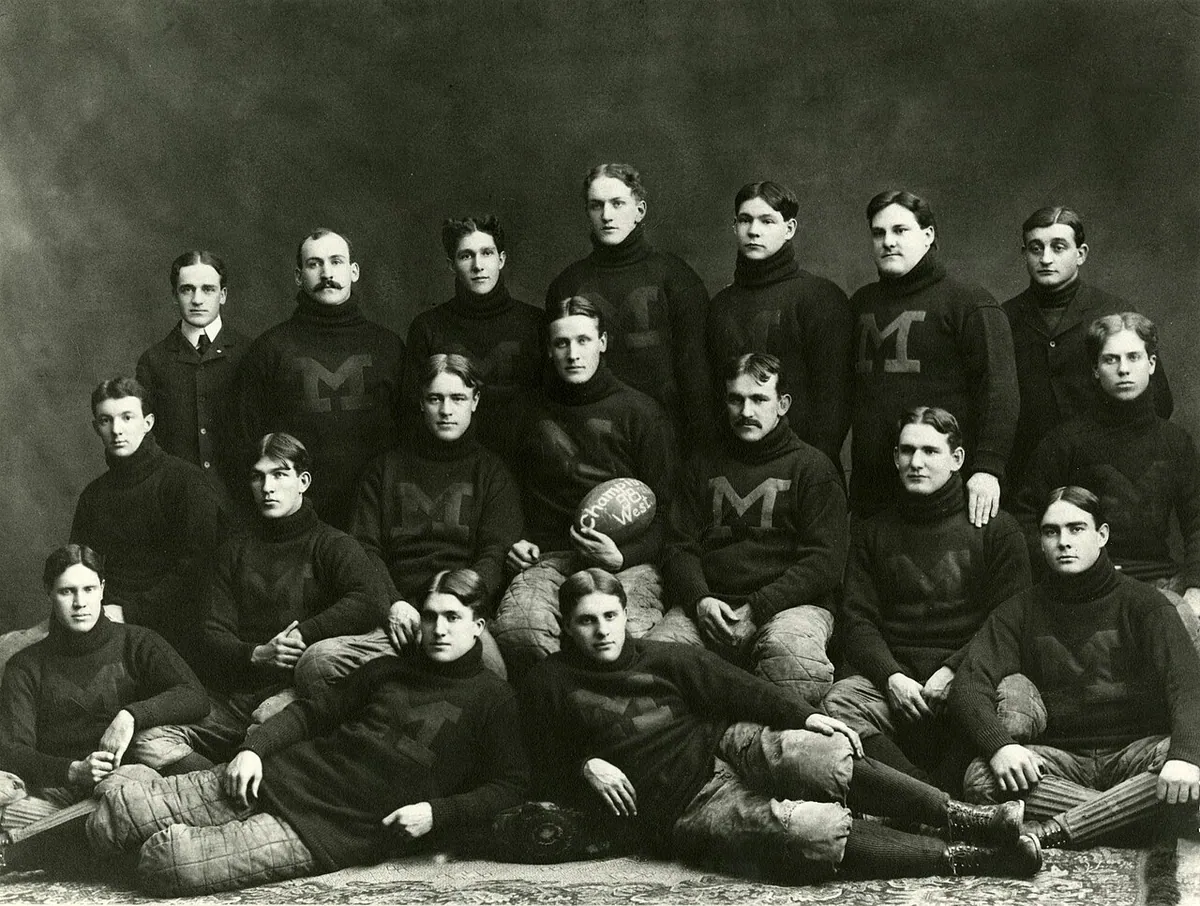
Fielding H. Yost became head coach in 1901 and immediately transformed the program. From 1901 through 1904, Michigan did not lose a game. The streak of 56 games without a loss spanned from Yost's arrival in 1901 until the season finale in 1905. The 1902 team outscored opponents 644-12. The 1903 season featured the first game for the Little Brown Jug trophy against Minnesota, resulting in a tie. In 1904, Michigan defeated West Virginia 130-0, one of the most lopsided scores in college football history. Yost's teams won ten conference championships during his tenure. Michigan left the conference from 1907 to 1916, posting one undefeated season in 1910 with a 3-0-3 record. Yost returned the team to the Big Ten in 1917. He coached through 1926, compiling a 165-29-10 record. Michigan claims national championships for the 1901, 1902, 1903, 1904, 1918, and 1923 seasons, which occurred during his tenure. As athletic director, he oversaw the construction of Michigan Stadium .
Coaching Succession from Kipke to Oosterbaan
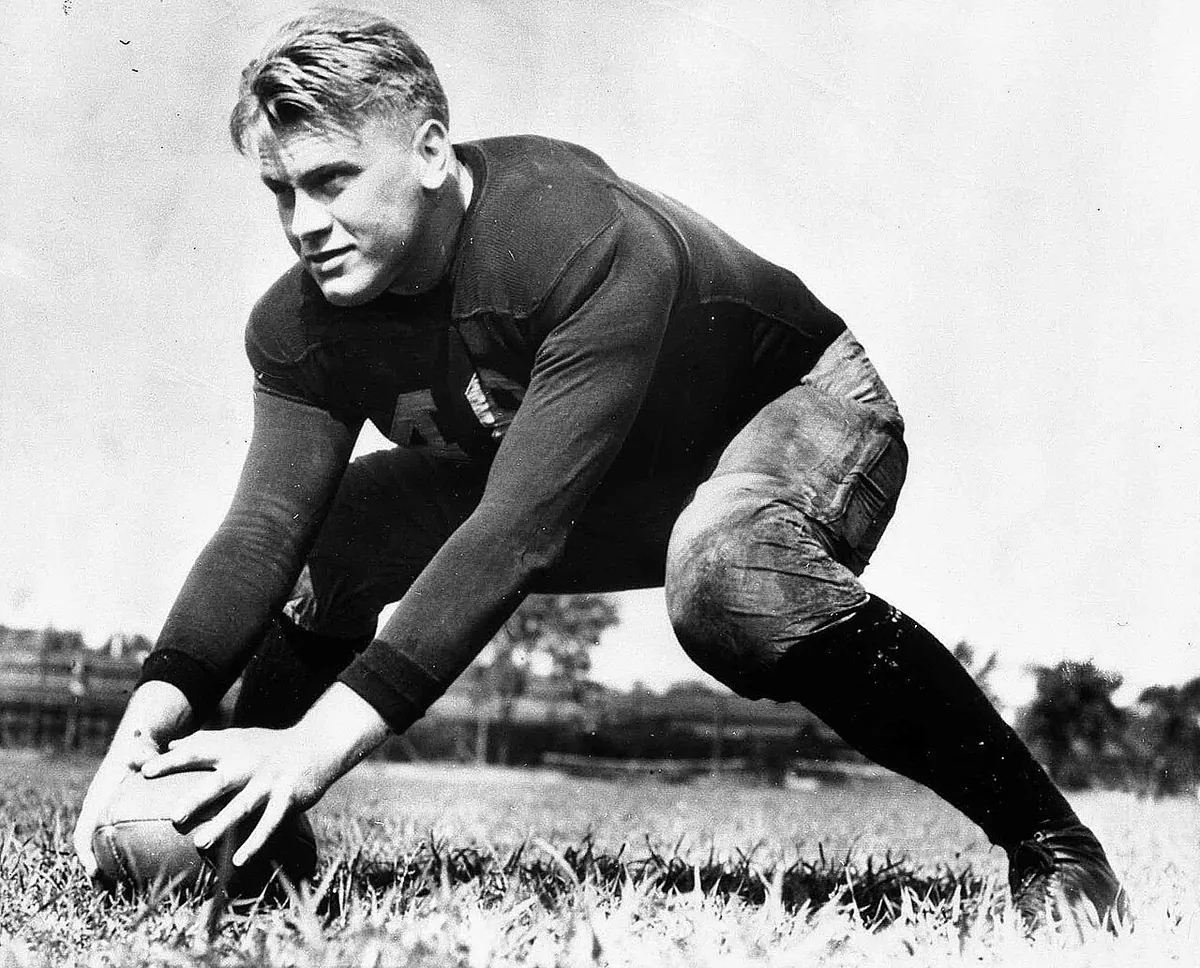
Harry Kipke took over as head coach in 1929 and led Michigan to four consecutive Big Ten titles from 1930 to 1933. The program declined after 1933, and Kipke's tenure ended after the 1937 season with a 49-26-4 record. Fritz Crisler replaced him in 1938 and introduced the winged football helmet. Crisler's tenure included Tom Harmon 's Heisman season in 1940 and a Big Ten title in 1943. In 1945, he pioneered two-platoon football. His final team in 1947, nicknamed the Mad Magicians, won the national championship. Crisler finished with a 116-32-9 record. Bennie Oosterbaan succeeded Crisler and led the 1948 team to a 9-0 record and a national championship. He won Big Ten titles from 1948 to 1950, but the team's performance declined later in his tenure.
The Schembechler Era and Beyond
Bo Schembechler was hired as head coach in 1969 and coached for 21 seasons. He won 194 games, a program record, and captured 13 Big Ten championships. Schembechler retired after the 1989 season. Two of his former assistants, Gary Moeller and then Lloyd Carr, followed him, and Carr led the team to the 1997 national championship. The program then entered a period of decline under coaches Rich Rodriguez and Brady Hoke. Jim Harbaugh, a former Michigan quarterback, then led the team to three consecutive Big Ten titles and three College Football Playoff appearances from 2021 to 2023.
Conference Membership and Championship History
Michigan has been a member of the Big Ten Conference since its founding in 1896, with a hiatus from 1907 to 1916. The program has won or shared 45 conference championships. Michigan's 12 claimed national championships are spread across more than a century. The titles from 1901 to 1923 were awarded by retroactive selectors. The 1932 and 1933 titles came during the Kipke era. The 1947 and 1948 championships were won under Crisler and Oosterbaan. The 1997 title was awarded by the Associated Press. The 2023 championship is the program's first from the College Football Playoff era.
| Claimed National Championship Year | Head Coach |
|---|---|
| 1901 | Fielding H. Yost |
| 1902 | Fielding H. Yost |
| 1903 | Fielding H. Yost |
| 1904 | Fielding H. Yost |
| 1918 | Fielding H. Yost |
| 1923 | Fielding H. Yost |
| 1932 | Harry Kipke |
| 1933 | Harry Kipke |
| 1947 | Fritz Crisler |
| 1948 | Bennie Oosterbaan |
| 1997 | Lloyd Carr |
| 2023 | Jim Harbaugh |
Bowl Game Participation and Record
Michigan has participated in 54 bowl games throughout its history, compiling a record of 24 wins and 30 losses. The program's first bowl appearance was in the inaugural Rose Bowl game in 1902, a victory over Stanford. The 1948 Rose Bowl win over USC capped the 1947 national championship season. In the College Football Playoff era, Michigan has a record of 2-2. The team lost in the semifinals in 2021 and 2022. Michigan's 2023 national championship run included a Rose Bowl victory and a win in the College Football Playoff National Championship game. The Wolverines have appeared in the Rose Bowl multiple times, from the 1902 game to a 27-20 overtime win over Alabama in the 2024 playoff semifinal. Michigan also reached the 1951 Rose Bowl after beating Ohio State 9-3 in the 1950 game known as the Snow Bowl.
Michigan Stadium: The Big House
Michigan Stadium has been the home of Wolverines football since the fall of 1927. The stadium was built under the direction of athletic director Fielding H. Yost, who envisioned a venue that could eventually hold over 100,000 spectators. Its original capacity was approximately 72,000. Through multiple expansions, the stadium's capacity grew to its current official figure of 107,601. Michigan Stadium was formally dedicated during a 21-0 win over Ohio State in 1927. It is renowned for its record-breaking attendance figures and is a central feature of game day in Ann Arbor. The stadium is widely known by its nickname, The Big House.
Heisman Trophy Winners and NFL Production
Three Michigan Wolverines have won the Heisman Trophy, awarded to the nation's most outstanding college football player. Halfback Tom Harmon won the award in 1940, and Desmond Howard won it in 1991. Cornerback Charles Woodson won the award in 1997, the same season Michigan claimed a national title. Michigan has a long and prolific history of sending players to the National Football League. Since 1974, 404 Michigan players have appeared on NFL rosters, with 257 being drafted. The program has produced 43 first-round NFL draft picks and one number one overall selection. Notable recent first-round picks include Aidan Hutchinson in 2022, J.J. McCarthy in 2024, and Mason Graham in 2025. As of the 2026 NFL season, 71 Michigan alumni are on active rosters. The program's draft output since 2016 has varied, with a high of 15 selections in 2024 and a low of 2 selections in 2018.
In 2016, three players were drafted. The 2017 draft saw 11 Michigan players selected. Only two players were drafted in 2018, followed by five in 2019. The 2020 draft included 10 Wolverines, and 2021 had eight. In 2022, five players were drafted, and 2023 saw 10 selections. The 2024 draft was a high point with 15 players selected, while seven were chosen in 2025 and eight in 2026. Michigan alumni on 2026 NFL rosters include Rashan Gary, Aidan Hutchinson, and Nico Collins.
Primary Football Rivalries
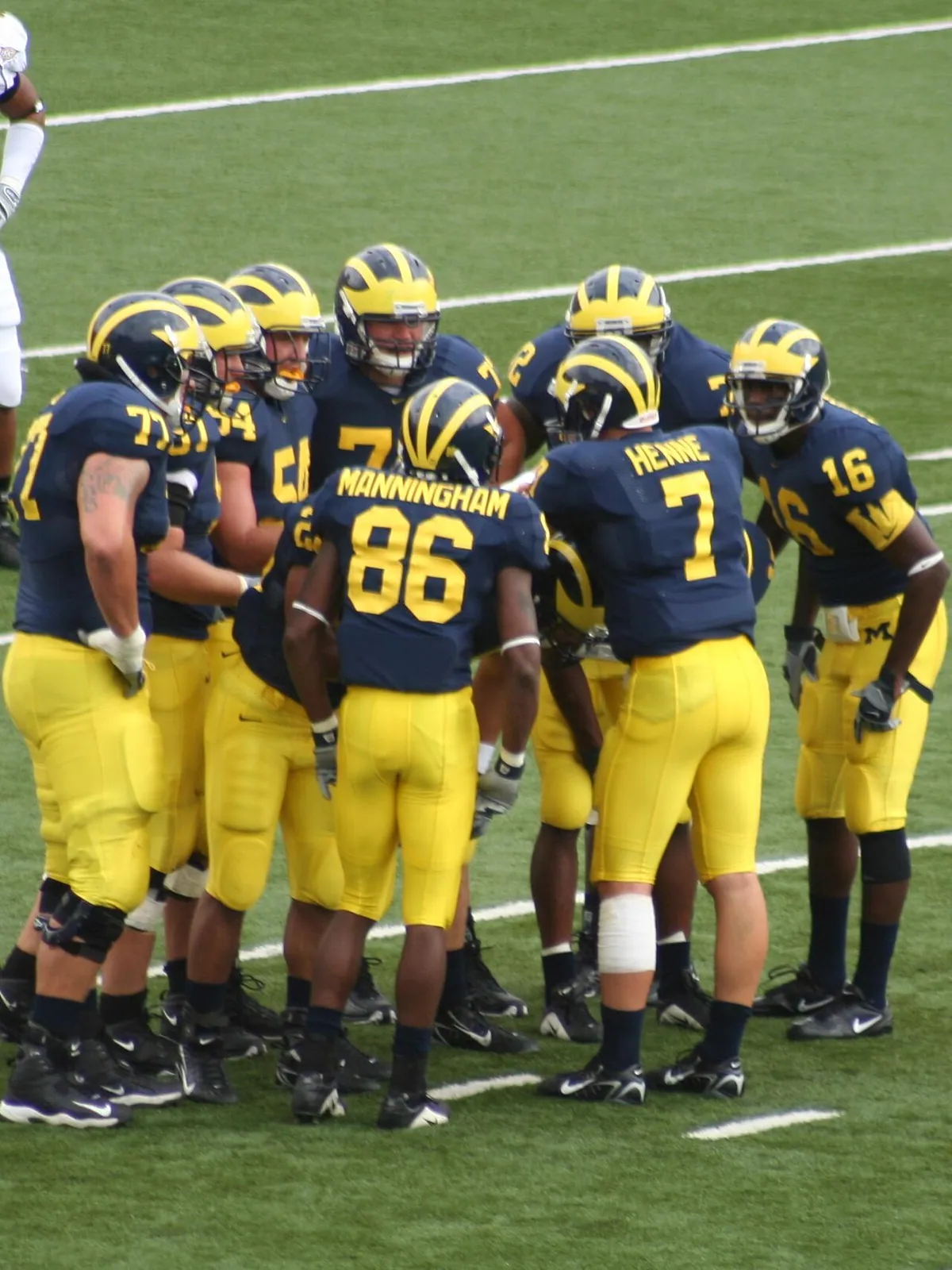
The annual regular season-ending game against Ohio State, known simply as The Game, was once voted ESPN's best sports rivalry. The matchup with the Michigan State Spartans is another major in-state rivalry. Other historic rivalries include Notre Dame, though the series has been intermittent, and Minnesota, with whom Michigan contests the Little Brown Jug. The Little Brown Jug is the oldest trophy game in college football, first played for in 1903.
In the first decade of the Schembechler era, his teams faced his former mentor Woody Hayes and Ohio State in a stretch dubbed the Ten Year War. Under Oosterbaan from 1951 to 1958, Michigan went 2-5-1 against Michigan State and 3-5 against Ohio State. The Notre Dame series included a No. 1 vs. No. 2 matchup in 1943, which Michigan lost 35-12. The Minnesota rivalry for the Little Brown Jug dates back to the early Yost era.
Recent Seasons and Current Status
After several seasons of rebuilding, the Wolverines broke through with a Big Ten championship and College Football Playoff appearance in 2021. They repeated as Big Ten champions in 2022 and 2023. The 2023 season ended with a 34-13 win over Washington in the national championship game. Following the championship, Harbaugh departed for the NFL, and offensive coordinator Sherrone Moore was promoted to head coach. After the 2025 regular season, Moore was fired. The university hired longtime Utah head coach Kyle Whittingham to lead the program. Whittingham is in his first season at Michigan in 2026. The team's all-time record stands at 1,027 wins, 367 losses, and 36 ties.
NFL players from Michigan
| Player | Pos | Years | Main team |
|---|---|---|---|
| Charles Woodson | FS | 1998–2015 | Oakland Raiders |
| Steve Hutchinson | G | 2001–2012 | Minnesota Vikings |
| Ty Law | CB | 1995–2009 | New England Patriots |
| Tom Brady | QB | 2000–2022 | New England Patriots |
| Trevor Pryce | DE | 1997–2010 | Denver Broncos |
| Jake Long | OT | 2008–2016 | Miami Dolphins |
| Anthony Carter | WR | 1985–1995 | Minnesota Vikings |
| Brandon Graham | DE | 2010–2025 | Philadelphia Eagles |
| Frank Clark | LB | 2015–2023 | Seattle Seahawks |
| Jim Harbaugh | QB | 1987–2001 | Chicago Bears |
| Taylor Lewan | OT | 2014–2022 | Tennessee Titans |
| Jumbo Elliott | OT | 1988–2002 | New York Giants |
| Mike Kenn | OT | 1978–1994 | Atlanta Falcons |
| Jon Runyan | OT | 1996–2009 | Philadelphia Eagles |
| Todd Collins | QB | 1995–2010 | Kansas City Chiefs |
Video
FAQ
What conference do the Michigan Wolverines football team play in?
The Michigan Wolverines compete in the Big Ten Conference. They were a founding member of the conference, originally known as the Western Conference, in 1896. The program has been a continuous member since 1917, following a brief hiatus from 1907 to 1916. Michigan has won or shared 45 Big Ten football championships. Its annual regular season-ending game against Ohio State, known as The Game, was once voted ESPN's best sports rivalry.
Who is the current head coach of Michigan football?
As of the 2026 season, the head coach of the Michigan Wolverines is Kyle Whittingham. Whittingham is in his first season with the program after a long and successful tenure as the head coach at the University of Utah. He took over following the dismissal of Sherrone Moore after the 2025 regular season. Moore had been promoted from offensive coordinator after Jim Harbaugh left for the NFL following the 2023 national title.
What is the name and capacity of Michigan's football stadium?
Michigan plays its home games at Michigan Stadium, commonly called The Big House, located in Ann Arbor. The stadium opened in 1927 with an initial capacity of roughly 72,000. It has been expanded several times and currently has an official seating capacity of 107,601. The massive venue is a defining feature of the game day experience for Michigan football and was built under the direction of athletic director Fielding H. Yost. Michigan Stadium is known for its record-breaking attendance at college football games.
How many national championships has Michigan football won?
The University of Michigan football program claims 12 national championships. These claimed titles were awarded in the seasons of 1901, 1902, 1903, 1904, 1918, 1923, 1932, 1933, 1947, 1948, 1997, and 2023. The 2023 title is the program's most recent national championship. The 1948 championship is considered the program's last undisputed title prior to 2023.
Which Michigan players have won the Heisman Trophy?
Three Michigan Wolverines have won the Heisman Trophy. Tom Harmon, a halfback, won the award in 1940. Desmond Howard, a wide receiver and return specialist, won in 1991. Charles Woodson, a cornerback who also played on offense, won in 1997. Charles Woodson's 1997 Heisman victory coincided with Michigan's national championship that season.
How many Michigan players are in the NFL and who are some notable ones?
Since 1974, 404 Michigan players have appeared on NFL rosters, with 257 being drafted. As of the 2026 NFL season, 71 Michigan alumni are on active rosters. The program has produced 43 first-round NFL draft picks. Notable recent first-round selections include defensive end Aidan Hutchinson, quarterback J.J. McCarthy, and defensive tackle Mason Graham. Current NFL players from Michigan include defensive stars like Hutchinson and Rashan Gary, as well as offensive players like wide receiver Nico Collins and offensive lineman Cesar Ruiz. The 2024 NFL Draft saw 15 Michigan players selected, the most in any draft since 2016.
Sources
- Michigan Wolverines football (Wikipedia) Wikipedia
- How many national titles have the Wolverines won? | Sporting News Sporting News
- nflverse game, roster and draft data nflverse (CC BY 4.0)