Each year, various organizations designate the best team in NCAA Division I Football Bowl Subdivision football as the national champion. The NCAA does not organize a championship tournament for this top level of college football, unlike most other sports it governs. This absence of an official playoff has frequently caused debate over which team truly deserves the title, a situation that gives rise to the term mythical national championship. For decades, the most influential bodies naming the champion have been the Associated Press Poll, voted on by sportswriters, and the Coaches Poll, voted on by active football coaches. The current method for settling the championship is the College Football Playoff, a multi-team tournament that began in 2014.
The Evolution of National Championship Selection
The method for determining a college football national champion has evolved dramatically from the sport's early days. In the late 19th and early 20th centuries, championships were largely retroactive selections made by historians and early pollsters like Caspar Whitney. The first semblance of order arrived in 1936 with the creation of the Associated Press Poll, which allowed a body of sportswriters to decide a champion at the end of the regular season. The AP Poll was the sole recognized selector until 1950, when the United Press formed the first coaches' poll. This created the potential for split national championships, which first occurred in 1954 when the AP chose Ohio State and the United Press (coaches') poll chose UCLA. For many years, these major polls conducted their final rankings before bowl games, which sometimes led to champions losing their bowl game and other teams claiming titles based on post-bowl awards like the FWAA Grantland Rice Award. The AP moved permanently to a post-bowl poll in 1968, and the Coaches Poll followed in 1974, allowing bowl games to more directly influence the championship outcome. The desire for a definitive on-field title game led to the creation of the Bowl Coalition in 1992, followed by the Bowl Alliance and finally the Bowl Championship Series in 1998, which used a combination of polls and computer rankings to match the top two teams. The BCS was replaced by the four-team College Football Playoff in 2014, which expanded to a 12-team format beginning in the 2024 season.
Major Selectors Recognized by the NCAA
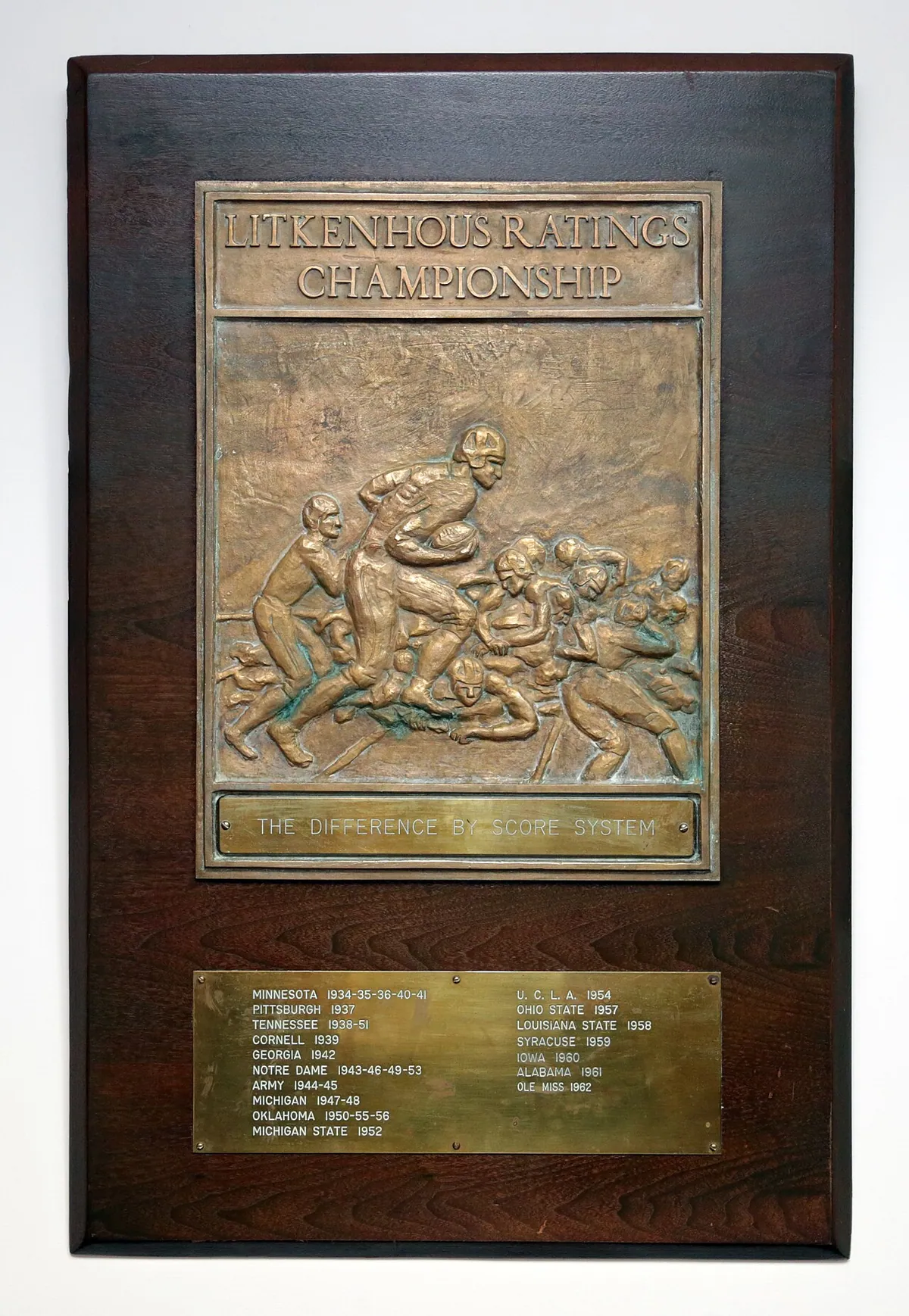
Although the NCAA does not crown an official champion at the FBS level, it maintains an official records book that documents the choices of designated major selectors. These selectors are categorized by their methodology: mathematical formulas, human polls, historical research, hybrids, and playoff systems. The criterion for being listed as a major selector is that the poll or system must be national in scope through distribution in media. Mathematical selectors include many systems created in the 1920s and 1930s, such as the Dickinson System which awarded the Rissman Trophy, as well as modern computer rankings used in the BCS era like the Colley Matrix and Sagarin Ratings. The human poll category is dominated by the Associated Press Poll and the AFCA Coaches Poll, which have been the most influential selectors for decades. Other notable poll-based selectors include the Football Writers Association of America (FWAA) and the National Football Foundation (NFF). The only selector primarily based on historical research is Parke H. Davis, who published retroactive national champions from 1869 to 1933 in Spalding's Foot Ball Guide. The Bowl Championship Series is categorized as a hybrid system, combining polls and computer rankings. The College Football Playoff is listed as a playoff system, the first selector to use a bracket competition to determine its champion.
- Mathematical Selectors: Dickinson System (1924 to 1940), Houlgate System (1885 to 1958), Colley Matrix (1992-present), Sagarin Ratings (1978-present).
- Human Poll Selectors: Associated Press Poll (1936-present), AFCA Coaches Poll (1950-present), FWAA Grantland Rice Award (1954 to 2013), National Football Foundation (1959-present).
- Research Selector: Parke H. Davis (1869 to 1933).
- Hybrid Selector: Bowl Championship Series (1998 to 2013).
- Playoff Selector: College Football Playoff (2014-present).
Eras of Championship Determination
The history of crowning champions can be divided into distinct eras defined by the primary selection methods. The pre-1936 period is known as the retroactive era, where all titles were assigned later by historian polls like the National Championship Foundation, Helms Athletic Foundation, and College Football Researchers Association. The AP poll era from 1936 to 1949 introduced contemporaneous voting but still named its champion at the end of the regular season, prior to bowl games. The split poll era began in 1950 with the advent of the coaches' poll and lasted until 1992. This era was marked by frequent disagreements between selectors, including the first three-team split in 1964 between Alabama, Arkansas, and Notre Dame. The Bowl Championship Series era from 1998 to 2013 aimed to create a single national championship game by combining human polls with computer rankings. The College Football Playoff era began in 2014, initially with a four-team bracket selected by a committee, which expanded to 12 teams in 2024 to provide more access and reduce controversy.
| Era | Years | Primary Method | Key Feature |
|---|---|---|---|
| Retroactive Era | Pre-1936 | Historian Polls | Titles assigned decades later |
| AP Poll Era | 1936 to 1949 | AP Sportswriters Poll | Single selector, pre-bowl vote |
| Split Poll Era | 1950 to 1992 | Multiple Human Polls | Frequent split championships |
| BCS Era | 1998 to 2013 | Hybrid Formula | Mandated No. 1 vs. No. 2 game |
| CFP Era | 2014-present | Playoff Tournament | Bracket competition, committee selection |
Notable Controversies and Split Championships
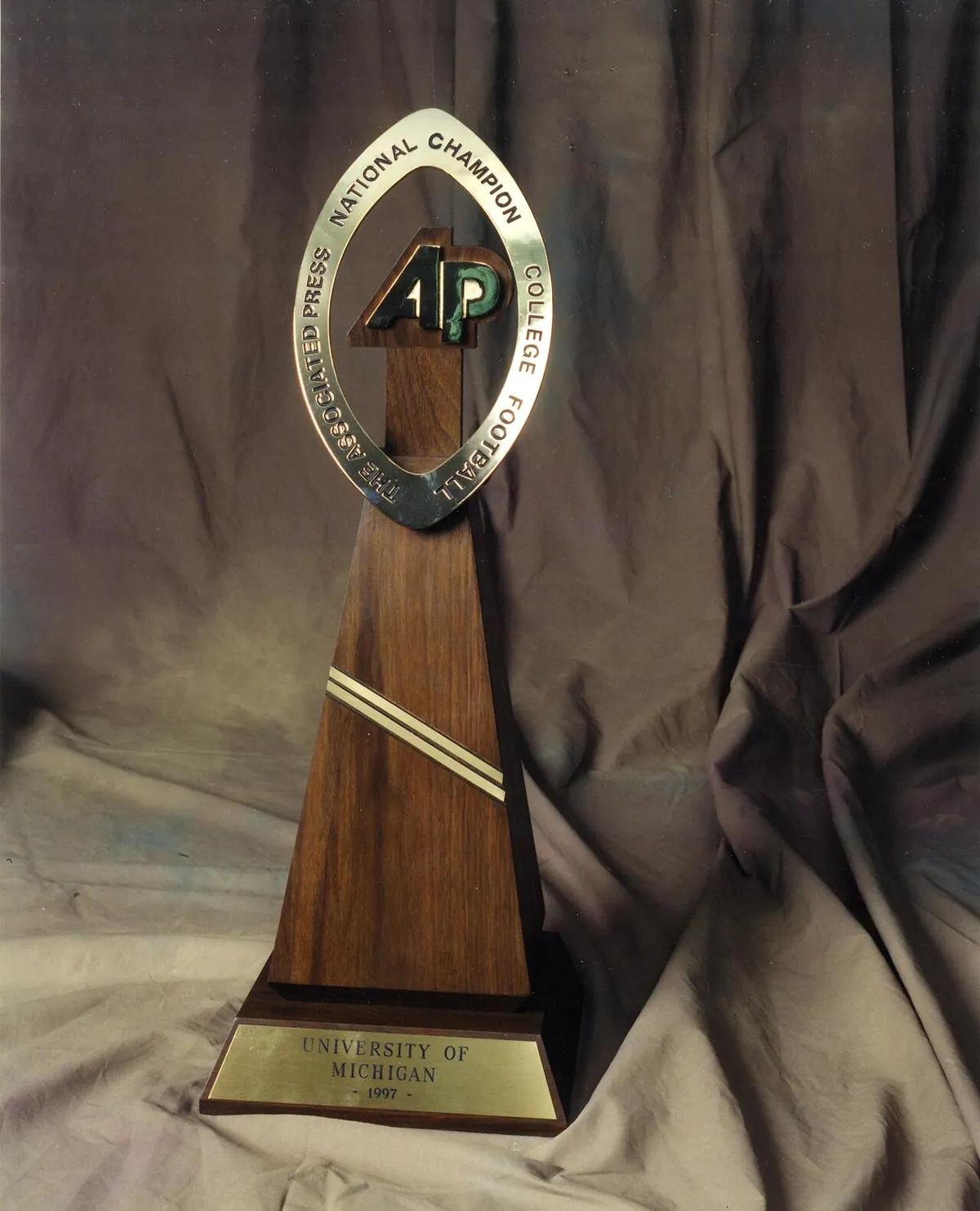
Controversy has been a constant companion to the process of naming a national champion, largely due to the lack of a unified playoff system for most of the sport's history. Split national championships occurred when different major selectors chose different teams as the best in the country. The first split between the AP and coaches' polls happened in 1954 with Ohio State and UCLA. One of the most famous splits occurred in 1997, when the AP Poll crowned Michigan and the Coaches Poll crowned Nebraska, both undefeated teams that did not meet on the field. That conflict is often cited as a key catalyst for the creation of the BCS. The 1964 season saw a three-way split where Alabama won the AP title, Arkansas won the FWAA title, and Notre Dame was named champion by the National Football Foundation. Controversies also arose from the timing of polls, particularly when selectors voted before bowl games. Even the BCS system, designed to prevent splits, created controversy by its exclusion of highly ranked teams. In 2003, the BCS rankings placed Oklahoma and LSU in the title game, leaving out USC, which was No. 1 in both the AP and Coaches polls. USC won the Rose Bowl and was awarded the AP national championship, creating a split title. These repeated controversies drove the eventual adoption of a playoff system.
The College Football Playoff System
The College Football Playoff represents the most recent and structured effort to determine a national champion on the field. It was established in 2014 to replace the Bowl Championship Series in response to past controversies. The inaugural playoff culminated with Ohio State winning the first title in January 2015. Unlike previous systems that relied on polls or formulas, the CFP uses a 13-member selection committee to choose and seed the participating teams. The committee prioritizes criteria such as strength of schedule, conference championships, head-to-head results, and common opponents. The original format from 2014 to 2023 featured a four-team bracket, with the semifinal games rotated among the New Year's Six bowl games. The two semifinal winners advance to the College Football Playoff National Championship, which is held at a neutral site different each year. This expansion was designed to provide more opportunities for schools to compete for the national title and to reduce controversy by including more teams with legitimate championship claims. The playoff awards its own national championship trophy, distinct from the trophies awarded by previous selectors like the Coaches' Trophy crystal football from the BCS era.
Claimed Titles and Program Comparisons
Because national championships have been awarded by many different selectors, universities often claim titles based on the recognition of one or more of these organizations. The NCAA records book lists Princeton with the most national championship selections at 28, reflecting its dominance in the sport's early retroactive era. Comparing championship counts across programs requires an understanding of the era and the selector. For example, Alabama's claimed titles span the poll, BCS, and CFP eras, demonstrating sustained success across different selection systems. Other programs, like Indiana which won the CFP title in 2025, have championships concentrated in the modern playoff era. Schools sometimes claim titles from selectors that were the only organization to choose them in a given year, such as the 17 singular selections by historian Parke H. Davis that are claimed by 12 schools. When evaluating program success, it is useful to distinguish between consensus championships, where multiple major selectors agreed, and championships claimed from a single selector. The modern CFP championship is generally the least ambiguous, as it is decided by a playoff bracket. The expansion to a 12-team playoff is likely to further centralize the championship designation, though the history of multiple selectors means that historical title counts will always vary by source.
Video
FAQ
How is the college football national champion determined?
Since 2014, the national champion has been determined by the College Football Playoff, a single-elimination tournament. A selection committee chooses and seeds the teams, which originally was four teams and expanded to 12 teams in 2024. The two semifinal winners advance to the College Football Playoff National Championship game. Before the CFP, champions were selected by polls like the AP and Coaches Polls, or by the Bowl Championship Series which matched the top two ranked teams in a title game.
What is a split national championship?
A split national championship occurs when two or more major selectors choose different teams as the national champion in the same season. This was common in the poll era, especially before the creation of a unified title game. The first split between the AP and coaches' polls happened in 1954 with Ohio State and UCLA. A famous example is 1997, when the AP crowned Michigan and the Coaches Poll crowned Nebraska. Split titles were a primary reason for creating the Bowl Championship Series and later the College Football Playoff to force a single on-field decisive game.
Who has won the most college football national championships?
According to the NCAA records book which compiles selections from all major selectors, Princeton has been chosen as national champion 28 times, the most of any program. These titles are largely from the sport's early retroactive era in the late 19th and early 20th centuries. In the modern era, programs like Alabama, Notre Dame, and Oklahoma have high counts across various selectors. The most recent champion as of 2025 is the Indiana Hoosiers, who won the College Football Playoff.
How did the national championship work before the playoff?
Before the College Football Playoff, the national champion was primarily determined by human polls or hybrid systems. From 1936, the Associated Press Poll of sportswriters was a key authority. The Coaches Poll began in 1950. These polls often voted at the end of the regular season, sometimes before bowl games. From 1998 to 2013, the Bowl Championship Series used a combination of polls and computer rankings to select the top two teams to play in a designated national championship game. Before 1998, bowl tie-ins often prevented the top two teams from meeting, leading to split titles.
What is the College Football Playoff National Championship game?
The College Football Playoff National Championship is the annual postseason game that determines the champion of NCAA Division I FBS. It features the two winners of the College Football Playoff semifinal games. The game replaced the BCS National Championship Game after the 2014 season. The location rotates each year among neutral-site stadiums across the country. The winner is awarded the CFP National Championship Trophy.
Why does the NCAA not crown an official FBS champion?
The NCAA does not host a championship event for the Football Bowl Subdivision, making it the only NCAA sport without an NCAA-sanctioned title. Historically, the bowl system and the financial interests of conferences and schools prevented the creation of an NCAA-run tournament. Therefore, national championships have been designated by independent organizations like polls, historical foundations, and later consortiums like the BCS and CFP. This has led to the unofficial designation of a mythical national championship, as multiple teams can claim a title in the same year based on different selectors.
Further reading
- College Football Playoff College Football Playoff. The official site of the playoff that decides the national champion of the top college division.
Sources
- College football national championships in NCAA Division I FBS (Wikipedia) Wikipedia
- How the college football national championship has changed through the decades, from polls and bowls to the playoff NCAA
- College Football Playoff National Championship | Sports and Leisure | Research Starters ebsco.com
- College Football: How Do You Define a "National Champion?" Bleacher Report
- College Football National Championship History Explained blog.rallyfuel.com
- College Football National Championships Explained cfbtrack.com