American football rules govern a game where two teams of 11 players compete to score points by advancing an oval ball into the opponent's end zone. The fundamental objective is to outscore the opponent within four 15-minute quarters by executing a series of plays called downs. The team on offense has four downs to advance the ball at least 10 yards to earn a new set of downs, while the defense aims to stop this progress and gain possession. Points are primarily scored via touchdowns worth six points and field goals worth three points, with additional conversion attempts following touchdowns.
Basic Gameplay and Scoring
The core of American football is the system of downs. The offensive team has four attempts, or downs, to move the ball forward at least 10 yards from the line of scrimmage. If they succeed, they are awarded a new first down and another set of four downs. Failure to gain 10 yards in four downs results in a turnover, giving the ball to the opposing team. Teams advance the ball by running with it or throwing a forward pass. The primary methods of scoring are touchdowns and field goals. A touchdown, worth six points, is scored when a player carries the ball into the opponent's end zone or catches a pass there. After a touchdown, the scoring team gets an untimed play called a conversion attempt to add extra points. They can kick the ball through the goalposts for one point or run or pass it into the end zone again for two points. A field goal, worth three points, is scored by kicking the ball through the opponent's goalposts from anywhere on the field during a scrimmage down. The defense scores two points for a safety, which occurs when they tackle an offensive player in possession of the ball in his own end zone. During a conversion attempt, if the defense gains possession and returns the ball to the opposite end zone, they score two points in the NFL, NCAA, and Texas high school football.
Player Positions and Team Structure
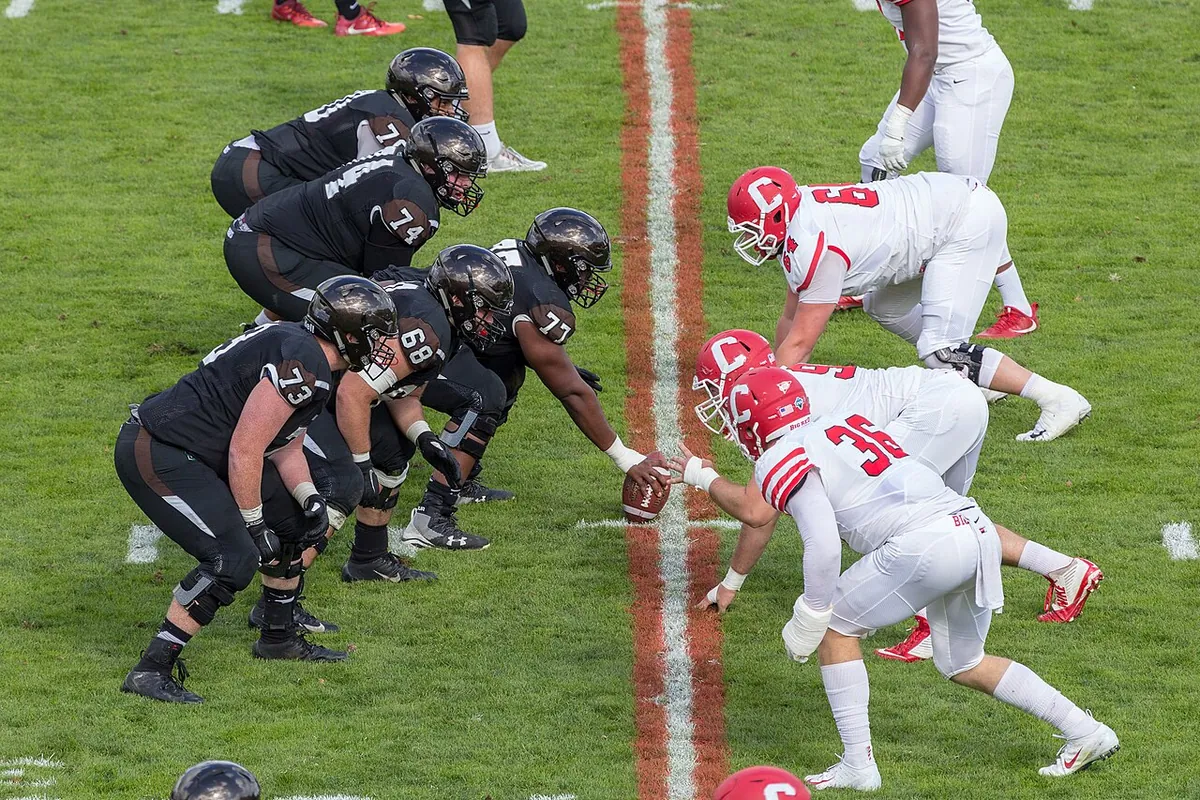
Each team fields 11 players at a time, but a full roster typically includes 45 players specialized for offense, defense, and special teams. The offensive unit's leader is the quarterback, who directs plays and throws or hands off the ball. The offensive line, consisting of the center, two guards, and two tackles, blocks for the quarterback and ball carriers. Skill positions include wide receivers and tight ends who catch passes, and running backs who carry the ball. The defensive team's objective is to stop the offense from advancing. The defensive line battles the offensive line, linebackers defend against runs and passes, and cornerbacks and safeties cover receivers. Substitutions are unlimited between plays, allowing coaches to deploy specialized personnel for specific situations. This specialization is a key strategic element, with entirely different units often taking the field for kicking plays like punts, field goals, and kickoffs.
Field Dimensions and Markings
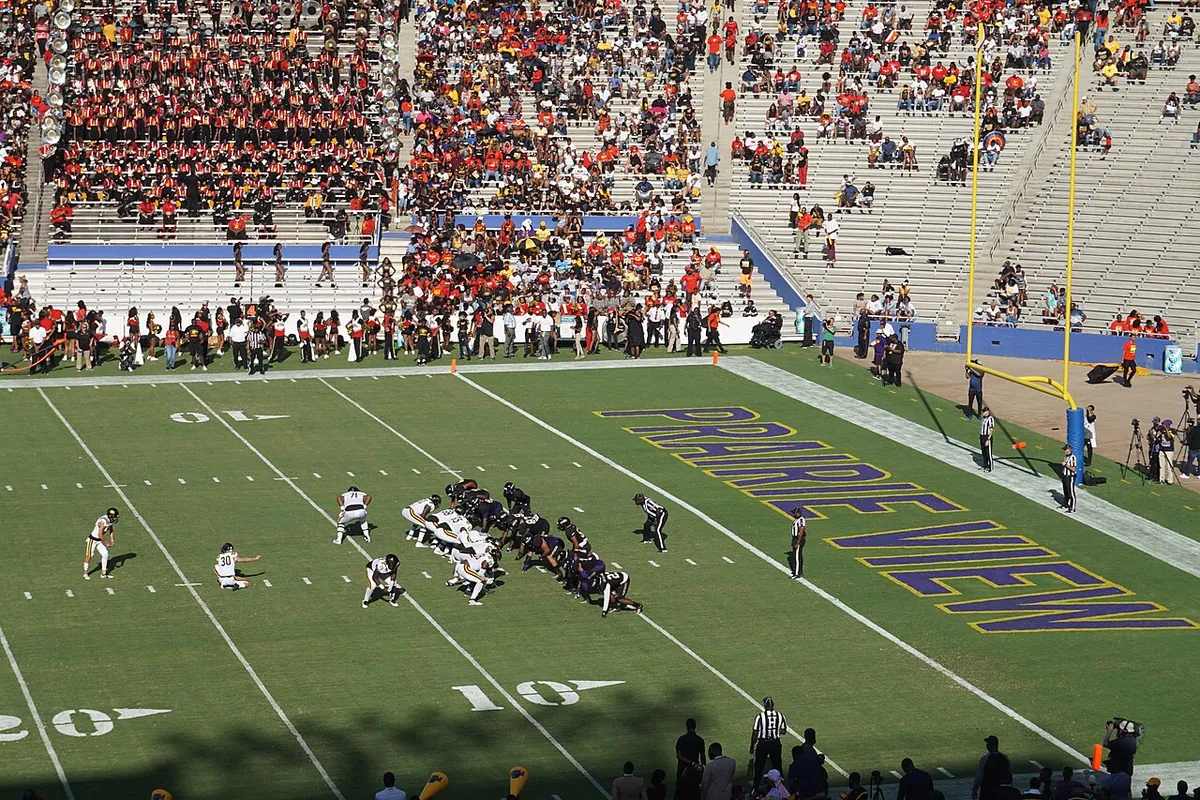
The standard football field is 100 yards long from goal line to goal line, with a 10-yard deep end zone at each end. Parallel yard lines cross the field at 5-yard intervals, numbered every 10 yards. Inbound hash marks indicate where the ball is spotted after a play ends near a sideline. NFL hash marks are located 70 feet 9 inches from the sideline, measured to their inbound edge. The goal posts are located at the back of each end zone. NFL goal posts are 18 feet 6 inches wide, while college goal posts are 23 feet 4 inches wide. All field lines are four inches wide, except for the eight-inch-wide goal line and yellow lines. Pylons mark the inside corners of the end zones at the intersection of the goal line and sideline.
Game Timing and Clock Management
NFL and college games consist of four 15-minute quarters, while high school quarters are typically 12 minutes. A 12-minute halftime separates the two halves. The game clock stops after incomplete passes, when a player with the ball goes out of bounds, following certain penalties, and after scores. Each team also has three timeouts per half to stop the clock strategically. In the NFL, an automatic timeout called the two-minute warning occurs when two minutes or less remain in the second quarter, fourth quarter, and overtime. A separate play clock governs the time the offense has to start a play. For the NFL and NCAA, the standard play clock is 40 seconds and begins immediately after the previous play concludes. Following specific delays like penalty enforcement, the offense has 25 seconds from when the referee marks the ball ready. A delay of game penalty is called if the offense fails to snap the ball before this clock expires. Teams change which end of the field they are defending at the end of the first and third quarters. Effective clock management, such as using kneeldowns to run out time, is a critical late-game strategy.
NFL Overtime Rules
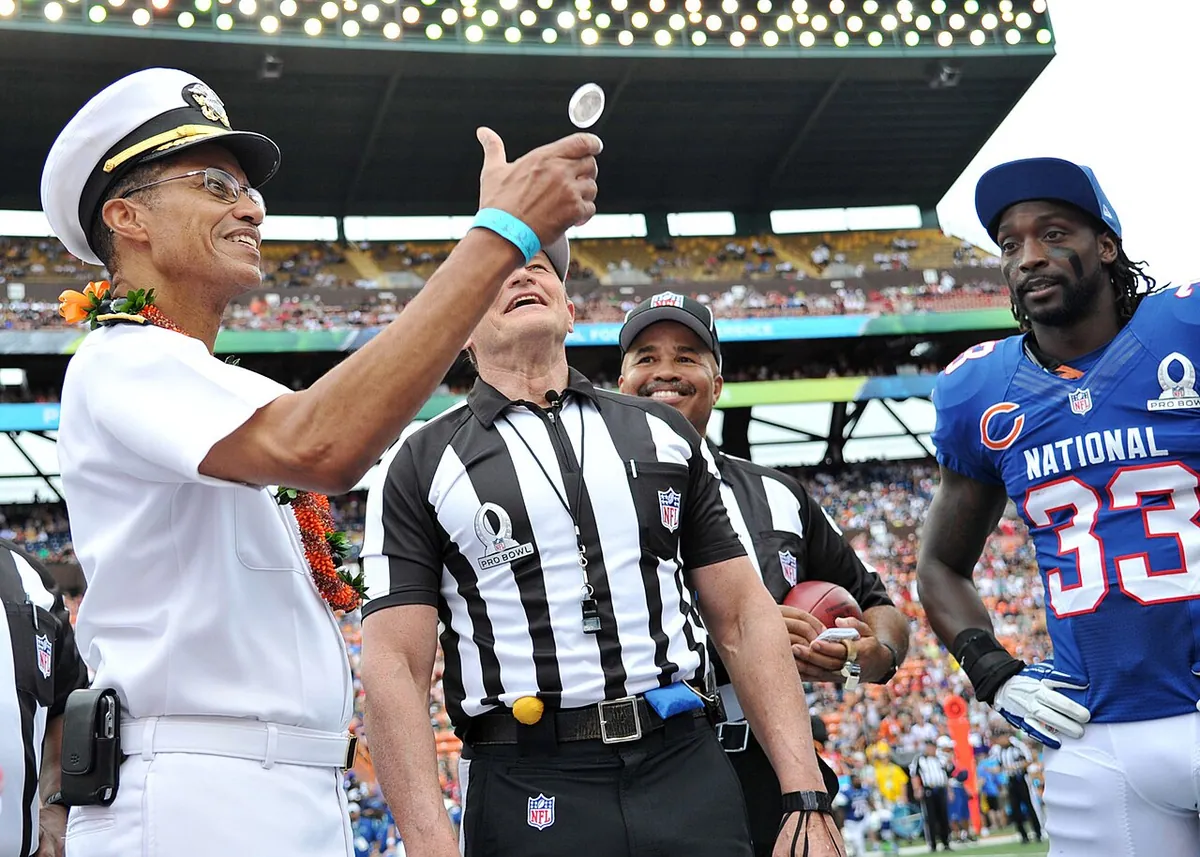
In the NFL regular season, tied games proceed to a 10-minute overtime period. A coin toss decides which team gets the first possession. Since the 2025 season, both teams are guaranteed at least one possession unless the defense scores a touchdown on a turnover or a safety on the receiving team's initial possession. If the score remains tied after each team has had one possession, the game becomes sudden death, where the next score wins. If the game is still tied after the 10-minute period, it ends in a draw. In the playoffs, overtime periods are 15 minutes long and continue until a winner is determined, with both teams getting a possession opportunity. The most recent NFL tie occurred on October 11, 2026, between the New York Giants and Washington Commanders with a 27-27 score. The first Super Bowl to go to overtime was Super Bowl LI, where the New England Patriots defeated the Atlanta Falcons.
College and High School Overtime Formats
College football does not allow ties. Its overtime system starts with each team getting one possession from the opponent's 25-yard line. The order is decided by coin toss. Teams attempt to score a touchdown or field goal. If the defense returns a fumble or interception for a touchdown on the first possession, they win immediately. If the game remains tied after both possessions, the procedure repeats for a second overtime. Starting in the third overtime, teams attempt alternating two-point conversion plays. High school overtime rules vary by state association. Many use a version of the Kansas Plan, where each team gets a possession starting at the 10-yard line, and first downs are not possible except by defensive penalty. In Texas, high schools follow modified NCAA rules. Some states end the play immediately on a defensive turnover, preventing a return for a score.
- College OT: Starts at opponent's 25-yard line.
- High School (Kansas Plan): Often starts at the 10-yard line.
- Third OT (NCAA): Two-point conversion shootout.
- Texas HS: Uses modified NCAA rules.
Special Teams and Kicking Plays
Special teams units handle all kicking plays, which are crucial for changing field position and scoring. A kickoff starts each half and follows every score, with one team kicking to the other. A fair catch can be called by the receiving team. Punts occur on fourth down when a team chooses to kick the ball away to pin the opponent deep rather than risk a turnover on downs. The punting team cannot recover or advance a punt unless it is touched first by a member of the receiving team. Field goal attempts are place kicks or drop kicks from scrimmage. The now-defunct XFL and the current UFL have used alternative overtime formats involving shootouts of two-point conversion attempts from short yardage, similar to a soccer penalty shootout.
Rule Evolution and Variations
American football rules have evolved significantly, particularly regarding overtime and player safety. The NFL's overtime rules have changed multiple times to reduce the advantage of winning the coin toss. Before 2010, the first team to score any points in overtime won, leading to the coin toss winner winning about 60% of games. The rules were adjusted for the 2010 playoffs to guarantee both teams a possession chance, a format adopted for the regular season in 2025. The World Football League in 1974 used a full 15-minute overtime period divided into halves. NFL Europa used a system where each team was guaranteed a possession before sudden death. The XFL's original incarnation used a modified Kansas Plan overtime starting at the 20-yard line, while its second version pioneered the two-point conversion shootout later adopted by the NCAA for multiple overtimes. These changes reflect an ongoing effort to balance fairness, excitement, and player workload in resolving tied games.
| League/Level | Overtime Format Key Feature |
|---|---|
| NFL (Post-2025) | Both teams get a possession, sudden death after. |
| NCAA | Possessions from 25-yard line, 2-pt shootout in 3OT+. |
| High School (Common) | Kansas Plan from 10-yard line. |
| XFL | Five-round 2-point conversion shootout. |
Video
FAQ
What are the most basic rules of American football?
The most basic rules involve scoring and advancing the ball. Two teams of 11 players try to score points by getting the ball into the opponent's end zone for a touchdown (6 points) or kicking it through the goalposts for a field goal (3 points). The offense has four downs, or plays, to move the ball 10 yards forward. If they succeed, they get a new set of four downs. If they fail, they turn the ball over to the other team. The game is played in four 15-minute quarters with a halftime break.
How does overtime work in the NFL?
In the NFL regular season, overtime is a 10-minute period. A coin toss decides who gets the ball first. If the score is still tied after each team has had one possession, the game becomes sudden death where the next score wins. If no one scores in the 10 minutes, the game ends in a tie. In the playoffs, overtime is 15 minutes and continues until a winner is found, with both teams getting a possession opportunity in each new period.
What is the difference between NFL and college football overtime?
NFL overtime is a timed period where play continues from where the regulation game ended. College overtime is untimed and uses a specific scoring format. In college, each team gets a possession starting at the opponent's 25-yard line. They attempt to score, and the team with more points after both possessions wins. If tied, they repeat the process. College games cannot end in a tie, while NFL regular season games can.
How many players are on the field for each team?
Each team has 11 players on the field during a play. A full team roster is much larger, typically 45 players in the NFL, allowing for specialized units for offense, defense, and special teams. Players substitute freely between plays, which is why you see completely different groups of players for kicking plays like punts and field goals. The offensive unit includes the quarterback, running backs, receivers, and an offensive line. The defensive unit includes linemen, linebackers, and defensive backs.
What is a down in football?
A down is one play or attempt to advance the ball. The offense has four downs to move the ball at least 10 yards from the original line of scrimmage. Each down is counted sequentially: first down, second down, third down, fourth down. If they gain the required 10 yards, they achieve a first down and the down count resets to one. The distance needed for a first down is often referred to as 'first and 10.' If they fail to gain 10 yards in four downs, they lose possession of the ball to the other team, usually by punting on fourth down or turning it over on downs.
How do you score points in American football?
Points are scored in four main ways. A touchdown is worth six points and is scored by carrying the ball into the opponent's end zone or catching a pass there. After a touchdown, a team can attempt a one-point conversion kick or a two-point conversion run or pass. A field goal is worth three points and is scored by kicking the ball through the goalposts during a scrimmage down. A safety is worth two points and occurs when the defense tackles an offensive player with the ball in his own end zone. The defense can also score two points by returning a turnover on a conversion attempt to the opposite end zone.
Further reading
- 2026 NFL Rulebook NFL Football Operations. The full official playing rules of the National Football League.
- NFHS football rules National Federation of State High School Associations. The rules body that writes the playing rules used in most high school football in the United States.
Sources
- American football rules (Wikipedia) Wikipedia
- Official 2026 NFL Rulebook, Rule 4: Game Timing NFL
- NFL Rules | The Football Girl thefootballgirl.com
- Complete Football Rules Guide for Every Player cscsports.com
- American Football Rules rulesofsport.com