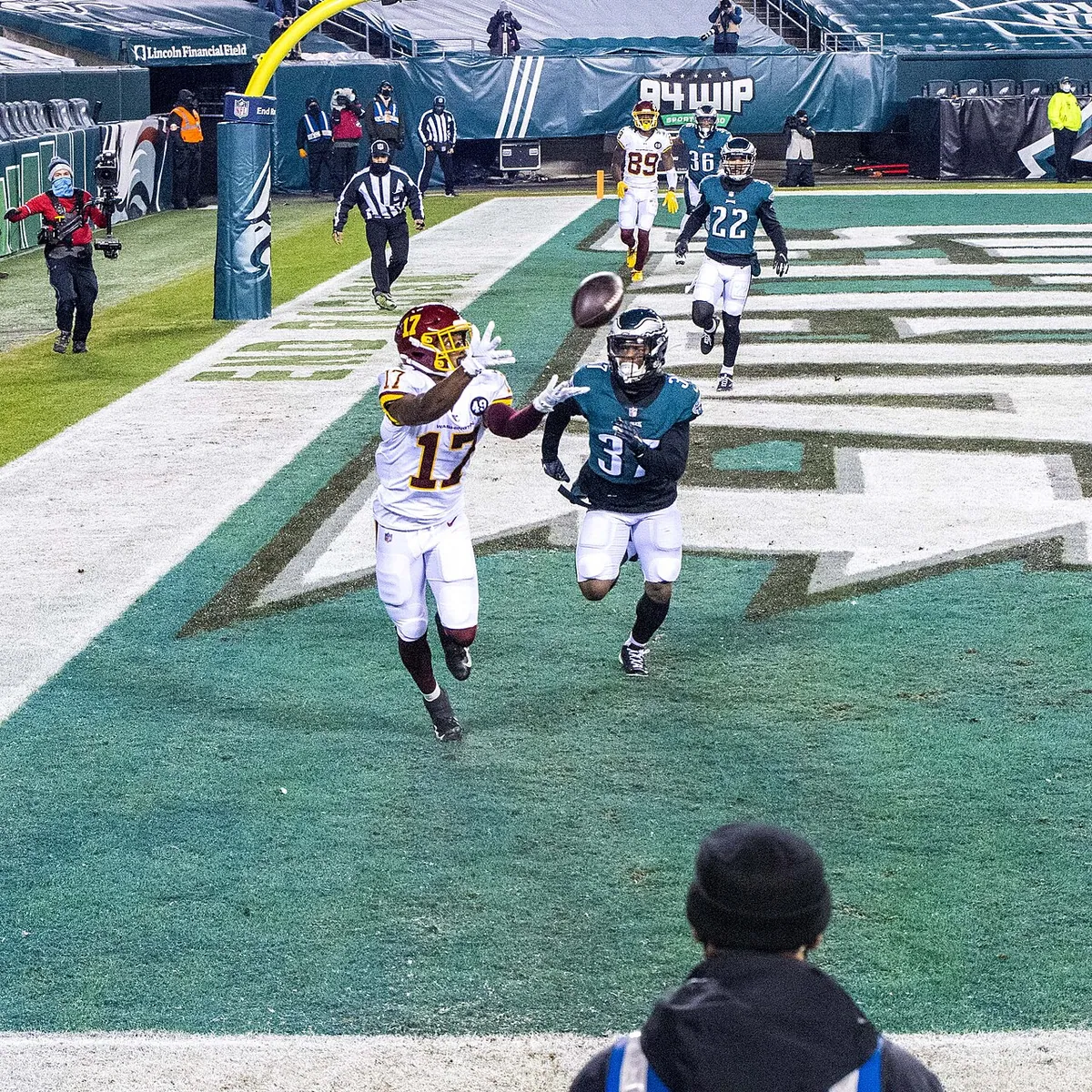
Additional scoring plays include the extra point (1 point) or two-point conversion (2 points) after a touchdown, and the safety, where the defense scores two points by tackling the offense in its own end zone. A team that scores four touchdowns with four extra points ends on 28 points, while a team that scores three touchdowns and three field goals ends on 27. A touchdown is the primary scoring method in football, awarding a team six points. It is scored when a player in possession of the ball has any part of the ball break the plane of the opponent's goal line while they are legally in bounds. The ball does not need to touch the ground, a rule change from the sport's rugby origins that was implemented in 1889. Touchdowns can be scored by the offense via a run or a pass, and by the defense or special teams via an interception return, fumble return, or a return of a kick or blocked kick. The scoring team is then granted an untimed down, known as a try or conversion attempt, to add one or two additional points. Officials signal a touchdown by raising both arms vertically above the head.
Scoring After a Touchdown
Following a touchdown, the scoring team attempts a conversion play to add extra points. The team has two options for this single, untimed play from scrimmage. The first is the extra point, also called the Point After Touchdown (PAT), which is a placekick through the goalposts. The second option is the two-point conversion, where the offense runs one play from the opponent's two-yard line in the NFL and high school, or the three-yard line in college, attempting to cross the goal line again via run or pass, which is worth two points. The choice between these options is a strategic decision, often influenced by the game score and time remaining. If a touchdown ends the game and the conversion cannot affect the outcome, the attempt is usually not made. Defenses can also score on conversion attempts under specific rules. Furthermore, a rare one-point safety can be awarded to the offense if the defense gains possession, retreats into its own end zone, and is tackled there during a conversion try. The defensive two-point conversion exists in the NFL, the NCAA, and Texas high school football.
- The extra point kick is attempted from the 15-yard line in the NFL.
- A defensive two-point conversion awards 2 points to the defense.
- A one-point safety awards 1 point to the offense during a conversion try.
Field Goals and Safeties
A field goal scores three points and is achieved by placekicking or dropkicking the ball through the opponent's goalposts during a play from scrimmage. Teams typically attempt a field goal on fourth down when they are within kicking range but unlikely to gain a first down or score a touchdown. A successful field goal ends the offensive possession, and the scoring team then kicks off to the opponent. If a field goal attempt misses, the kicking team scores no points and the other team takes possession of the ball. The fair catch kick is an obscure three-point scoring play allowed after a fair catch on a punt, where the receiving team can attempt an uncontested kick from the spot of the catch with the defense lined up ten yards away. A safety scores two points for the defensive team and occurs when the offensive team is responsible for the ball becoming dead in its own end zone. This most commonly happens when a ball carrier is tackled in his own end zone, after which the offense must kick the ball to the other team. Safeties are relatively rare and represent a significant momentum shift.
- A field goal is worth 3 points.
- A safety is worth 2 points for the defense.
- The fair catch kick is a legal but rare 3-point scoring play.
- A conversion safety during a try is worth 1 point.

Evolution of Scoring Values
When the first uniform rules were enacted by the Intercollegiate Football Association after the 1876 season, a touchdown required touching the ball to the ground past the goal line. A touchdown also gave the offense the chance to kick for goal, and one goal was equal to four touchdowns. In 1883, a numerical points system was introduced, with a touchdown counting for two points and a goal after a touchdown counting for four points. The values were reversed in 1884, making a touchdown worth four points and the subsequent goal worth two points. Today a touchdown is worth six points, which makes it the game's most valuable scoring play.
Overtime Scoring Rules
When an NFL regular season or playoff game is tied at the end of four quarters, an overtime period is played to determine a winner. Since the 2025 regular season, both teams are guaranteed an opportunity to possess the ball in overtime unless the defense scores a touchdown on a turnover or a safety on the first possession, which ends the game immediately. If the first possession results in a field goal, the other team gets a chance to possess the ball and can win with a touchdown or, if it kicks a field goal, tie the game, after which the game proceeds to sudden death. If the score remains tied after each team has had one possession, the game proceeds to sudden death, where the next team to score any points wins.
In the NFL regular season, overtime is a single 10-minute period, and if the score remains tied afterward, the game ends in a draw. The most recent NFL tie was a 27-27 game between the New York Giants and the Washington Commanders on October 11, 2026. In the playoffs, overtime periods are 15 minutes each and continue consecutively until a winner is determined, with no ties allowed. The current overtime rules, which guarantee both teams a possession opportunity, were developed to reduce the advantage gained from winning the overtime coin toss. The first overtime game played under a trial of earlier modified rules was a 2012 AFC wild card game, which the Denver Broncos won over the Pittsburgh Steelers on the first play of overtime with an 80-yard touchdown pass from Tim Tebow to Demaryius Thomas.
Differences Across Competition Levels
While the fundamental point values are identical, the rules governing scoring plays and game timing vary between the NFL, college football, and high school football. The most notable differences involve the placement for conversion attempts. For a two-point conversion, the ball is placed at the 2-yard line in the NFL and high school, but at the 3-yard line in college football. For the one-point kick, the ball is placed at the 3-yard line in high school, the 2-yard line in college, and the 15-yard line in the NFL. College and NFL games are divided into four 15-minute quarters, while high school games typically use 12-minute quarters. The NFL and NCAA employ a 40-second play clock that starts at the end of the previous play, with a 25-second clock used in specific situations. Some high schools also employ a mercy rule, where the clock runs continuously after a team achieves a large lead, stopping only for injuries and timeouts called by a team or a referee.
Rare and Unusual Scoring Plays
Beyond the common touchdowns, field goals, and safeties, the rulebook includes several obscure methods of scoring. The defensive two-point conversion occurs when the defense gains possession during a conversion attempt (extra point or two-point try) and returns the ball to the opponent's end zone, earning two points for its team. The one-point safety is an even rarer event that can only happen during a conversion attempt. It is awarded to the offense when the defense recovers the ball, runs backward into its own end zone, and is tackled there.
The fair catch kick rule allows a team that makes a fair catch on a punt to attempt a free kick for a field goal on the next play from the spot of the catch. The defense must line up ten yards away, and the kick is uncontested. A successful kick is worth three points. The play is so rare that even longtime fans might not know it, but it remains a legal scoring option. In the NFL, the referee may also award a touchdown as a penalty when a player comes off the bench during a play and tackles a runner who would otherwise have scored.
Scoring and Game Strategy
Teams usually go for two points when they need to close a specific points gap quickly. Coaches must constantly evaluate whether to attempt a field goal for three points or go for a touchdown on fourth down. The choice between a one-point extra point and a riskier two-point conversion after a touchdown is a mathematical decision often based on the current score differential and time remaining. For example, a team trailing by eight points late in a game will often score a touchdown and attempt a two-point conversion to tie the game.
Clock management becomes a critical scoring strategy, especially near the end of halves. A team leading toward the end of the game will often run out the clock with kneeldowns, while a trailing team relies on timeouts, incomplete passes, and plays that end out of bounds to stop the clock. In the NFL, college and Texas high school football, officials call an automatic timeout, the two-minute warning, once the ball is dead with two minutes or less left in the second quarter, fourth quarter, and overtime. In overtime, the decision to kick off or receive after winning the coin toss is a major strategic choice influenced by the current rules guaranteeing both teams a possession.
Video
FAQ
How many points is a touchdown worth?
A touchdown is worth six points. It is scored when a player advances the ball into the opponent's end zone or catches a pass while in the end zone. The touchdown itself is always six points, but it is followed by an extra point or two-point conversion attempt, which can add one or two more points to the play's total value. Many fans assume a touchdown is worth 7 points, but the 7th point comes from the separate extra point kick that follows.
What are all the ways to score points in football?
There are five primary ways to score points in American football. After a touchdown, a team can attempt an extra point kick for one point or a two-point conversion from scrimmage for two points. A field goal, kicked through the goalposts during play from scrimmage, scores three points. A safety, where the offense is tackled in its own end zone, scores two points for the defense. Rare scoring plays include the defensive two-point conversion and the fair catch kick.
What is the difference between an extra point and a two-point conversion?
Both are conversion attempts made after a touchdown, but they differ in execution and point value. The extra point (PAT) is a placekick through the goalposts. In the NFL, it is attempted from the 15-yard line and is worth one point. The two-point conversion is a single offensive play from the opponent's two-yard line in the NFL and high school, or the three-yard line in college, where the team tries to cross the goal line again via a run or pass. It is worth two points. The extra point is statistically more reliable, while the two-point conversion is riskier but offers a higher reward.
How does overtime scoring work in the NFL?
In the NFL regular season, if a game is tied after four quarters, a 10-minute overtime period is played. Under rules effective for the 2025 season, both teams are guaranteed a possession opportunity unless the defense scores a touchdown or a safety on the first possession, which ends the game. If the first team scores a field goal, the other team gets a chance to score. If the game remains tied after both teams have had a possession, it becomes sudden death. If still tied after 10 minutes, the game ends in a tie. Playoff overtime uses 15-minute periods and continues until a winner is determined.
Can the defense score on an extra point try?
Yes, the defense can score on an extra point or two-point conversion attempt. If the defense gains possession during the try and returns the ball to the opponent's end zone, it is awarded a defensive two-point conversion. Furthermore, if the defense gains possession, retreats into its own end zone, and is tackled there, the offense is awarded a rare one-point safety. These rules make conversion attempts live ball situations, adding a layer of strategic risk beyond simply missing the kick or failing to convert.
How does a team earn a first down in football?
A team earns a first down by advancing the ball at least 10 yards during their four downs. The offense has four plays, called downs, to gain those 10 yards. If they succeed, the down count resets to first down and they get four new plays to try and gain another 10 yards from the new line of scrimmage. If the offense fails to gain 10 yards in four downs, the defense regains control of the ball in a turnover on downs.
Sources
- American football rules (Wikipedia) Wikipedia
- Touchdown (Wikipedia) Wikipedia
- How scoring works in American football aflepro.com
- Football Scoring Guide: Touchdowns, Safeties & Rules prosportista.com