An NFL football game lasts 60 minutes of regulation time, divided into four 15-minute quarters, with a standard halftime break of 12 minutes. The total elapsed time for a typical NFL game, including stoppages, commercials, and halftime, usually exceeds three hours. If the score is tied after regulation, a 10-minute overtime period is played in the regular season, while playoff games continue with 15-minute overtime periods until a winner is determined. College football also uses 15-minute quarters, and high school football typically features 12-minute quarters.
Regulation Game Structure and Timing
The official playing time for an NFL or college football game is 60 minutes, structured as four 15-minute quarters. High school football games typically use four 12-minute quarters instead. The game clock is frequently stopped, which extends the real-world duration far beyond one hour. Stoppages occur for incomplete passes, plays that end out of bounds, changes of possession, scores, timeouts, and official measurements. Each team receives three timeouts per half, which they can use strategically. The frequent clock stoppages, combined with television commercial breaks, are why a typical NFL broadcast lasts over three hours from kickoff to final whistle.
A separate play clock ensures the pace of the game, counting down the time the offense has to start the next play. In specific situations, such as after a penalty is enforced, the offense is given 25 seconds from when the ball is marked ready for play. Failure to snap the ball before this clock expires results in a delay of game penalty. Teams also switch ends of the field at the end of the first and third quarters, though down, distance, and possession remain unchanged. This structure is consistent across professional and college levels, with the primary variation being the length of quarters at the high school level.
The Halftime Intermission
The halftime break occurs after the second quarter and serves as the major intermission in a football game. In the NFL, the standard halftime duration is 12 minutes for regular season and most playoff games. During this period, teams retreat to their locker rooms for rest, medical treatment, and strategic adjustments by the coaching staff. Stadium operations crews perform field maintenance, while broadcasters air analysis segments and commercials. For fans in attendance, halftime often includes entertainment like music, fan contests, and highlights on the video board.
The Super Bowl is a major exception to the standard halftime length. To accommodate its elaborate halftime show, the intermission is extended to between 25 and 30 minutes, roughly twice as long as a normal game. This allows time for complex stage setup and breakdown, as well as the 12 to 14 minute performance itself. The extended break requires competing teams to adjust their routines, with some simulating the longer intermission during practice week.
- Super Bowl halftime is extended to 25-30 minutes for the halftime show.
- College football halftimes are typically about 20 minutes long.
- High school football halftimes commonly range from 10 to 15 minutes.
- During halftime, teams make strategic adjustments and players receive medical attention.
- Broadcasters use the break for studio analysis, commercials, and feature packages.
NFL Overtime Rules and Evolution
If an NFL game is tied at the end of regulation, it proceeds to an overtime period. For the regular season, this is a single 10-minute period preceded by a three-minute intermission. A critical rule implemented for the 2025 regular season guarantees both teams an opportunity to possess the ball, unless the team that kicks off to start overtime scores a safety on the receiving team's initial possession. If the first team to possess the ball scores a touchdown, the opposing team gets a chance to match with a possession of its own. If the score remains tied after both teams have had a possession, the game becomes sudden death, where the next score wins. If neither team scores in the 10-minute period, the game ends in a tie. NFL overtime rules have changed several times to promote fairness. The rule was further modified after the 2021 AFC divisional playoff game, where the Kansas City Chiefs won without the Buffalo Bills' offense touching the ball. Ties in the NFL are rare, with one occurring as recently as October 11, 2026, between the New York Giants and Washington Commanders.
- Overtime was adopted for NFL regular season games in 1974.
- The regular season overtime period was shortened from 15 to 10 minutes in 2017.
- The first playoff game under trial modified rules was the 2012 AFC Wild Card (Broncos vs. Steelers).
- The first Super Bowl to go to overtime was Super Bowl LI in 2017 (Patriots vs. Falcons).
- Both the 2019 NFC and AFC Championship games went to overtime.
- The rule guaranteeing both teams a possession in playoff overtime was approved by a 29-3 owner vote.
Playoff and Super Bowl Overtime
Overtime rules for NFL playoff games, including the Super Bowl, differ significantly from the regular season because a winner must be determined. Playoff overtime consists of 15-minute periods, and play continues with additional periods until a winner emerges. There is a two-minute intermission between overtime periods, but no halftime break. The rule guaranteeing each team at least one possession applies here as well. Strategic decisions become paramount in overtime. Only one Super Bowl has ever gone to overtime. Super Bowl LI in 2017 saw the New England Patriots and Atlanta Falcons tied 28-28 at the end of regulation. The first playoff game played under a trial of the modified possession rules was the 2012 AFC Wild Card game, where the Denver Broncos won on the first play of overtime with an 80-yard touchdown pass from Tim Tebow to Demaryius Thomas.
College Football Game Length and Overtime
College football games also consist of four 15-minute quarters, totaling 60 minutes of regulation time. The halftime intermission in college is typically longer than in the NFL, often lasting around 20 minutes. The game clock operates under similar stoppage rules, leading to an average game duration of three to four hours. The most distinct difference between college and professional football is the overtime format, as NCAA games cannot end in a tie. Overtime begins with a coin toss, where the winning team chooses to take the ball first or select the end of the field where the series will be played.
In college overtime, each team gets one possession starting at the opponent's 25-yard line. The game clock is not used during overtime periods. Teams alternate attempts to score, and if the game is tied after the first overtime, it proceeds to a second overtime. This system ensures both teams have an equal opportunity and produces a definitive winner.
High School and Alternative League Rules
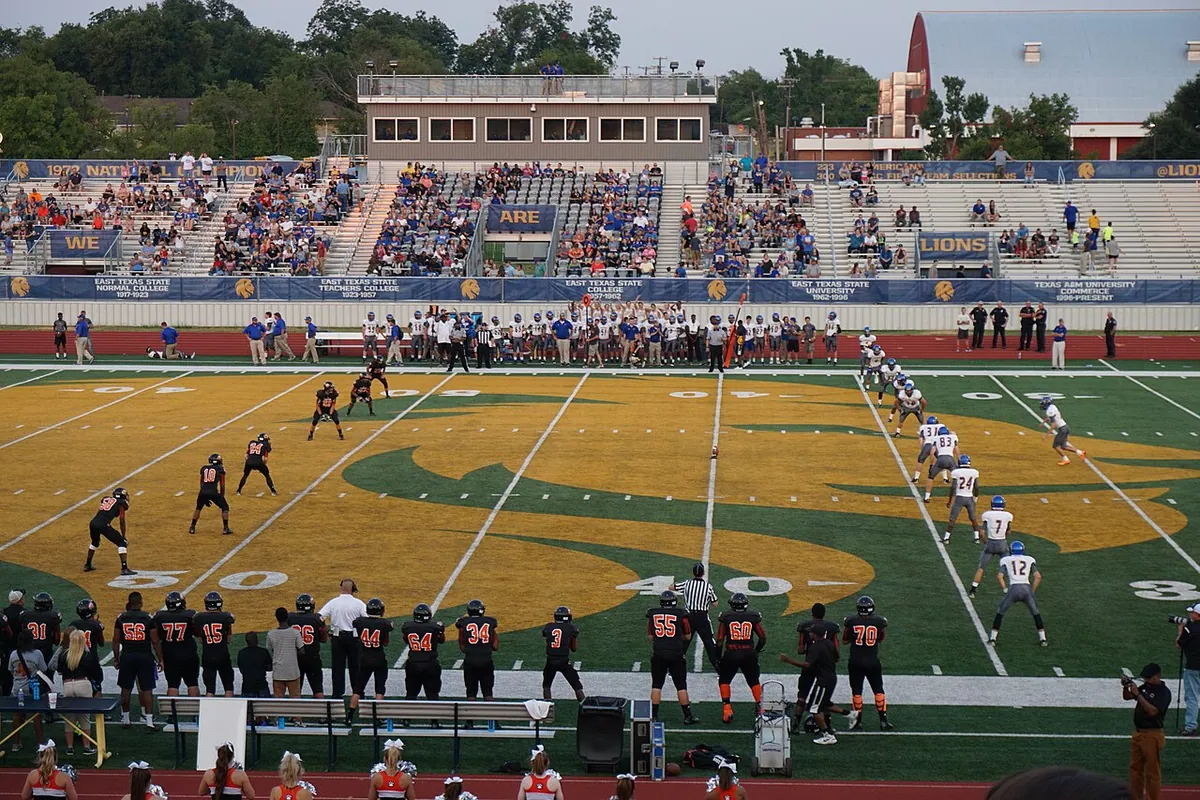
High school football games are generally shorter than their college and professional counterparts. Most states use four 12-minute quarters, though the specific rules are set by individual state athletic associations. Halftime lengths vary but commonly range from 10 to 15 minutes. Overtime formats also vary by state, with many adopting a version of the Kansas Plan. In this common format, each team is granted a possession starting at the opponent's 10-yard line, and teams alternate attempts to score.
Alternative professional leagues have experimented with different overtime systems. The original XFL used a modified Kansas Plan starting at the 20-yard line, where the second team had to match the first team's score in the same or fewer downs. The second incarnation of the XFL and the current UFL use a shootout of two-point conversion attempts, similar to a soccer penalty shootout. The defunct World Football League in 1974 used a full 15-minute overtime period divided into two halves. NFL Europa used a 10-minute overtime where each team was guaranteed a possession before sudden death, similar to later NFL rules. These variations highlight the ongoing effort to create a fair and exciting conclusion to tied games.
- The Kansas Plan is a common high school overtime format starting at the 10-yard line.
- Texas high schools use NCAA-style overtime rules starting at the 25-yard line.
- The original XFL used an overtime system starting at the 20-yard line.
- The current UFL uses a best-of-three two-point conversion shootout in overtime.
Key Timing Rules and Game Management
Several specific timing rules significantly impact the flow and duration of a football game. In other high school games without a visible stadium clock, officials may give a four-minute warning instead. Media timeouts are another major factor, scheduled by broadcasters to allow for commercial breaks, often after scoring plays, changes of possession, or extended injury stoppages. Clock management is a critical strategic element, especially late in close games. A team leading near the end of the game will often use plays like kneeldowns to run out the clock without risking a turnover. Conversely, a trailing team will use timeouts strategically to stop the clock and preserve time for their own offensive possessions. Officials can also stop the clock for their own timeouts to administer penalties, measure for a first down, or attend to injured players. The interplay of these rules and strategies ensures that while the official game time is fixed, the actual experience of a football game is a dynamic and often lengthy event.
FAQ
How long is halftime in an NFL game?
The standard halftime in an NFL regular season or playoff game is 12 minutes. This break occurs after the second quarter and allows teams to rest, make adjustments, and for broadcasters to air commercials and analysis. The Super Bowl is the major exception, where halftime is extended to between 25 and 30 minutes to accommodate the elaborate halftime show performance and stage setup. The longer break requires teams to adjust their routines, sometimes simulating the extended intermission during practice.
How does NFL overtime work in the regular season?
In the NFL regular season, a tied game goes to a single 10-minute overtime period. A rule change for the 2025 season guarantees both teams an opportunity to possess the ball, unless the kicking team scores a safety on the opening possession. If the first team scores a touchdown, the other team gets a chance to match it. If the score remains tied after both possessions, the game becomes sudden death. If neither team scores in the 10 minutes, the game ends in a tie, which is a rare occurrence in the league.
What are the overtime rules for the NFL playoffs and Super Bowl?
NFL playoff games, including the Super Bowl, use 15-minute overtime periods and continue until a winner is determined. Both teams are guaranteed at least one possession. If the score is still tied after each team has had a possession, the game proceeds in a sudden-death format. There is a two-minute intermission between overtime periods but no halftime. This rule was adopted for the playoffs starting in 2022, ensuring both offenses touch the ball in overtime, a change prompted by a high-profile playoff game the previous year.
How long are quarters in college and high school football?
College football games use four 15-minute quarters, identical to the NFL. The halftime break in college is usually around 20 minutes, which is longer than the NFL's 12 minutes. High school halftimes commonly range from 10 to 15 minutes, depending on state association rules. The actual elapsed time for both levels is much longer than the regulation clock due to frequent stoppages.
How does college football overtime work?
College football uses a unique overtime system where each team gets a possession starting at the opponent's 25-yard line. The game clock is not used during overtime. Teams alternate attempts to score, and if tied after one overtime, a second overtime is played. Starting with the third overtime, teams no longer get possessions from the 25-yard line. Instead, each team attempts a two-point conversion from the three-yard line in an alternating shootout format until a winner is determined. This system was adjusted in 2019 to start the shootout format in the third overtime instead of the fifth.
What is the standard length of an NFL halftime break?
The standard halftime break for an NFL regular-season or playoff game is 12 minutes. This intermission occurs after the second quarter and is a scheduled stoppage distinct from timeouts. During this time, teams rest, coaches make strategic adjustments, and broadcasters air programming and commercials. The 12-minute duration is set by league rules and is applied by the officiating crew on game day, though it can be shortened in rare cases due to weather or scheduling delays.
Sources
- American football rules (Wikipedia) Wikipedia
- How long does an NFL game last? How long is halftime? dazn.com
- Duration of NFL Halftime Breaks Explained southernpigskin.com
- Super Bowl Halftime Length Explained: Timing, Setup & Why It's Longer Than Normal Sports Illustrated
- NFL Overtime Rules Explained: How Regular Season and Playoff Overtime Works Yahoo Sports
- NFL's Super Bowl overtime rules, explained sbnation.com