NFL referees are the on-field officials responsible for supervising professional football games and ensuring conformity with the rules. Each NFL game is supervised by a crew of seven officials. The referee serves as the lead member of the officiating team and has the final authority on all rulings, including the score and down number. Officials are commonly referred to collectively as referees, but each position has a specific name and duties.
Positions and Responsibilities of the Officiating Crew
An NFL officiating crew consists of seven officials, each with a specific title and area of responsibility on the field. The referee counts offensive players and focuses on the quarterback and approaching defenders on passing plays. On running plays, the referee observes the quarterback during and after a handoff before checking the running back. The other officials have prescribed mechanics to watch specific player positions and watch for specific fouls, ensuring all 22 players are observed.
The officiating crew uses prescribed mechanics prior to the snap and during the play. Each official has separate administrative duties such as counting players, timing the play clock, monitoring the game clock, and spotting the ball as ready for the next down. The referee signals all infractions and is the final authority on any disputed calls. This structure is designed to provide comprehensive coverage of the field and all player actions from multiple angles throughout the game.
Uniforms and Equipment
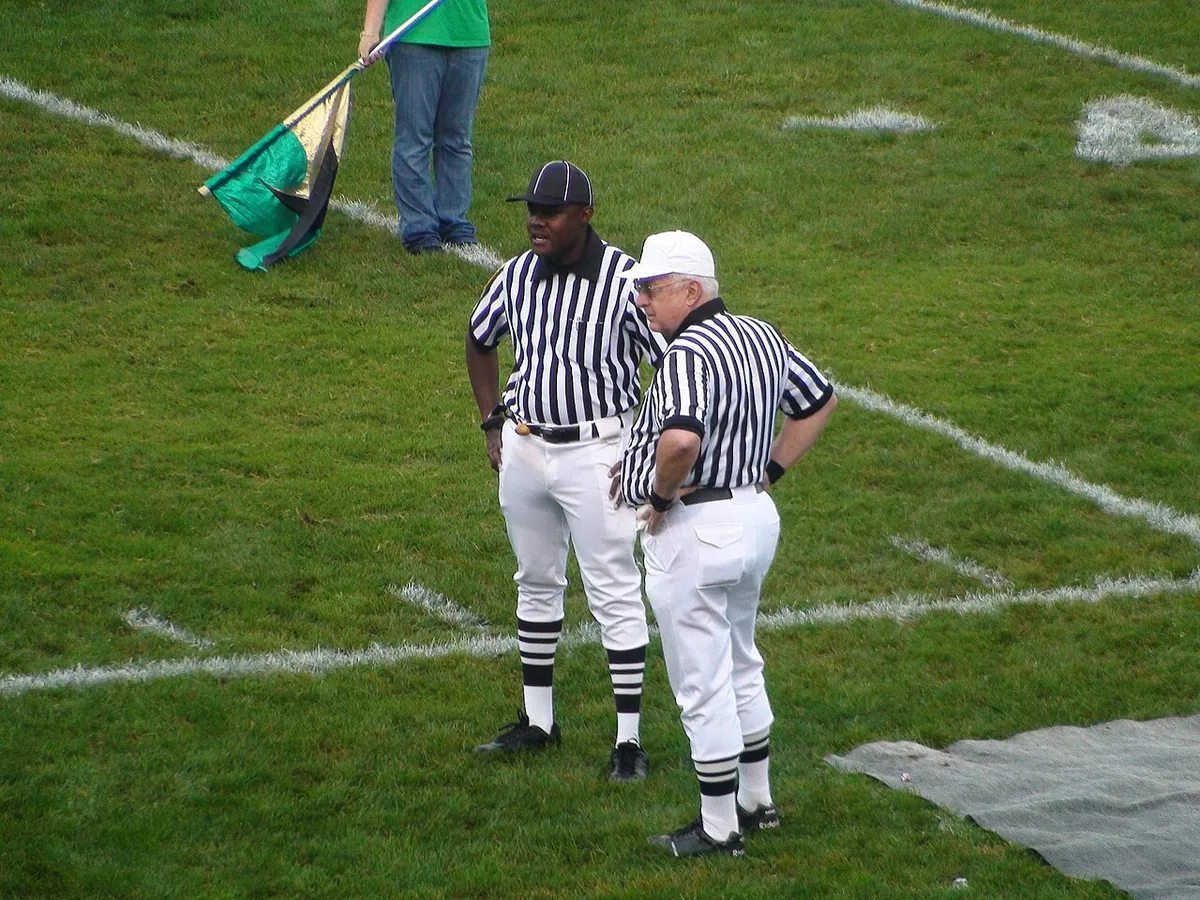
This striped design was introduced in the 1920s, replacing plain white shirts after an incident where a quarterback mistakenly handed the ball to an official. The distinctive pattern led to officials being colloquially called zebras. Since 2006, the NFL has used a redesigned, sleeker uniform that no longer identifies an official's position from the front. For cold weather, NFL officials wear black pants with a white stripe, which became mandatory in 2012. The stripes on NFL officials' shirts feature an uneven striping pattern, differing from the two-inch stripes used in college and one-inch stripes common in high school.
Officials carry specific equipment to manage the game. They use a weighted yellow flag to mark the spot of a foul when it is thrown onto the field. A bean bag is used as a marker, for instance to mark the spot where a player stepped out of bounds. The referee wears a microphone connected to the stadium public address system to announce penalties to the crowd and television audience. Officials' hats are occasionally used as markers. An official will drop a hat to mark the spot of where a player went out of bounds, or to signal a second foul called on a play.
- Striped Shirt: Black-and-white, introduced in the 1920s.
- Hats: Referee wears white. Other officials wear black with white stripes.
- Cold-Weather Pants: Black pants became mandatory in 2012.
- Flag: Weighted yellow flag thrown to mark a foul.
- Bean Bag: Used as a marker for various game situations.
- Microphone: Worn by the referee to announce calls.
The NFL Referees Association and Labor History
The NFL Referees Association (NFLRA) is the labor union representing all NFL game officials. It was established in 1972 as the Professional Football Referees Association and serves as the collective bargaining agency with the league. At its formation, officials were paid between $250 and $500 per game for a 14-game season. The union successfully campaigned for pension benefits, with officials retiring after the 1974 season receiving an annual pension of $200 per month. The NFLRA has been involved in two major work stoppages, with lockouts occurring in 2001 and 2012.
The union's formation process began in July 1966 when referee Stan Javie announced an effort to organize for higher game fees. After a vote of 34 to 17, officials decided to establish a collective bargaining unit financed by $50 annual dues per member. In 1968, 53 NFL officials were joined by 34 American Football League officials at a clinic in Denver ahead of the leagues' merger. The organization was formally incorporated in March 1972 in St. Louis. Early pension benefits were a major achievement. After a presentation to owners in 1974, officials retiring after that season received a pension. The union also retroactively self-funded a similar benefit for the ten officials who had retired between 1968 and 1974, assessing fees from members until the last recipient died in 2009. The union's members are currently operating under a collective bargaining agreement signed in September 2019, which runs through May 2026.
How Officiating Differs Across Football Levels
The number of officials and some rules vary significantly between the NFL, college football, and high school football. The NFL uses a standard crew of seven officials for every game. Since 2015, Division I college football conferences have used eight game officials. College games outside the Division I level use six or seven officials. High school football played under National Federation of State High School Associations rules typically use five officials for varsity games, with 3, 4, or 5 used for non-varsity contests. Other leagues have experimented with different numbers. The Alliance of American Football in its only season in 2019 and the 2020 version of the XFL have used eight game officials.
Arena football and other levels use officiating systems with fewer than seven officials. The Canadian Football League used an eighth official only during the 2018 playoffs, with that official's sole responsibility being to watch for head contact with the quarterback. Uniform details also differ, with stripe widths on shirts varying between one inch in high school and two inches in college, while the NFL uses an uneven striping pattern. At the sub-varsity and youth level, officials are usually permitted to wear shorts as weather and comfort permit. When working as an off-field or auxiliary official, individuals usually wear the same uniform as on-field officials but with a polo shirt or jacket replacing the striped shirt.
| Level of Play | Typical Number of Officials | Notes |
|---|---|---|
| NCAA Division I | 8 | Used eight officials since 2015. |
| NCAA Non-Division I | 6 or 7 | Varies by conference and level. |
| NFHS High School (Varsity) | 5 | Common standard across states. |
| High School (Non-Varsity) | 3, 4, or 5 | Determined by local associations. |
| Arena Football | Fewer than 7 | Uses other officiating systems. |
| Alliance of American Football (2019) | 8 | Used in its only season. |
| XFL (2020) | 8 | Used eight game officials. |
Penalty Signals and Game Administration
When an official sees a rule violation, he throws a weighted yellow flag onto the field to mark the spot. The play is allowed to conclude before the referee, who is wired with a microphone, announces the penalty. The referee uses a series of standardized hand signals to visually communicate the foul to players, coaches, and spectators, a practice dating to the early days of American Football when radio microphones were not available. The referee then talks to an on-field captain of the team offended against to explain his options.
The process for signaling a penalty involves multiple steps and the use of specific equipment. In professional games, the referee's announcement is broadcast through the stadium and television audio because he wears a microphone. At grassroots games without microphone systems, the visual signals become the primary means of communication. Officials also use other items for game administration. A bean bag will be used instead of a hat to mark a spot in some conferences and high school associations that discourage hat use. The hat is also used to signal a second foul called by an official on a play, or to indicate unsportsmanlike conduct committed against the official himself. This system of signals and markers allows for clear communication of complex rulings during the fast-paced game.
Historical Evolution of NFL Officiating
NFL officiating has evolved significantly in terms of uniforms, technology, and crew composition. Officials wore plain white shirts until the 1920s, when stripes were adopted. In the 1940s, the NFL officials wore color-striped shirts that represented their positions. During most of the American Football League's existence from 1960 to 1967, officials wore red-orange striped jerseys before switching to the standard black and white stripes for their last two seasons. The referee's hat color scheme changed in the NFL.
Postseason compensation has also evolved since the early days of the NFLRA. The union's name was originally the Professional Football Referees Association due to an error by the lawyer drawing up the articles of incorporation. This imprecise moniker remained unchanged until 2000. The union was registered as a non-profit organization in 1975. The use of the microphone for the referee to announce penalties is a technological advancement from the early days of the sport. Other leagues have had unique uniform styles. The United Football League in 2009 featured officials wearing solid red polo shirts without stripes before switching to a customized version of the traditional stripes in 2010. The CFL mirrored the white hat for referees convention in 2019, having previously used a different system.
Officiating Crews and Performance
The NFL's officiating department is responsible for continuously evaluating performance, training personnel, and reviewing hours of film. Becoming an official in the NFL requires hard work and typically begins at the high school level, where officials maintain the integrity of the game through honesty, objectivity and consistency. The league maintains resources such as a historical officiating coverage directory and analytics for officials. For the 2026 season, veteran referees include Carl Cheffers in his 19th season as a referee, Clete Blakeman in his 17th, and Brad Allen in his 13th.
Officiating mechanics are regularly updated based on rule changes and observed trends. The NFL's officiating boss instructed officials to slow down before throwing flags to ensure accuracy. New kickoff mechanics were designed to help officials catch illegal blocks more effectively. These adjustments are part of the league's effort to ensure officials are in optimal position to make correct calls. The performance evaluation process includes detailed film review and feedback from the coordinator coaches. This system aims to maintain a high standard of officiating across all NFL games throughout the season and into the playoffs, as the officiating department continuously works to train and mentor personnel.
Video
FAQ
How many referees are in an NFL game?
There is one referee per NFL game, who serves as the crew chief and lead official. However, each game features a full crew of seven on-field officials, as specified in the 2026 NFL rulebook. The other six officials hold specific positions such as umpire, down judge, line judge, field judge, side judge, and back judge. The referee is distinguished by a white hat, while the other officials wear black hats with white stripes. All seven individuals are collectively responsible for supervising the game.
Are NFL referees full-time employees?
The NFL Referees Association is the sole and exclusive bargaining representative of all employees employed by the NFL to officiate games. The NFLRA, established in 1972, negotiates collective bargaining agreements that govern the employment terms for officials. The current collective bargaining agreement between the NFLRA and the league was signed in September 2019 and runs through May 2026. The union has been involved in work stoppages in 2001 and 2012.
What is the difference between a referee and an official in football?
In football terminology, 'official' is the correct collective term for the entire on-field crew supervising the game and ensuring conformity with the rules. The 'referee' is one specific position within that crew, the lead member who wears the white hat and has final authority on rulings. While all officials are commonly referred to as referees, each of the seven officials has a specific name and duties, such as umpire, head linesman, or line judge. The referee is sometimes referred to as the head referee or crew chief.
What is the role of the referee in an NFL game?
The referee is the lead official who has the final authority on all rulings and is responsible for the general supervision of the game. In the NFL, the referee also has final say on the score and the down number in case of any disagreement. This position is sometimes called the head referee or crew chief and can be identified by a white cap while other officials wear black hats. During plays, the referee is positioned behind the offensive team, focusing on the quarterback and defenders on passing plays and observing the quarterback and running back on running plays.
How can you identify the referee on the field during an NFL game?
The referee can be identified by wearing a white cap, while all other officials on the crew wear black hats with white stripes. This convention has been used in the NFL since 1988, after a period from 1979 to 1987 where referees wore black hats and other officials wore white. The referee's shirt, like those of other officials, is black-and-white vertically striped, but since a 2006 redesign, the front no longer identifies the official's position. The referee is also the official who communicates penalties and decisions to team captains and the press box.
What is the history behind the striped uniforms worn by NFL officials?
The black and white striped shirts worn by NFL officials were introduced in the 1920s. Prior to this, officials wore plain white shirts. The stripes were adopted to make officials more easily distinguishable from players on the field. This distinctive look has led officials to be colloquially called 'zebras' due to their appearance.
Sources
- Official (gridiron football) (Wikipedia) Wikipedia
- NFL Referees Association (Wikipedia) Wikipedia
- Referees Signals bafra.info