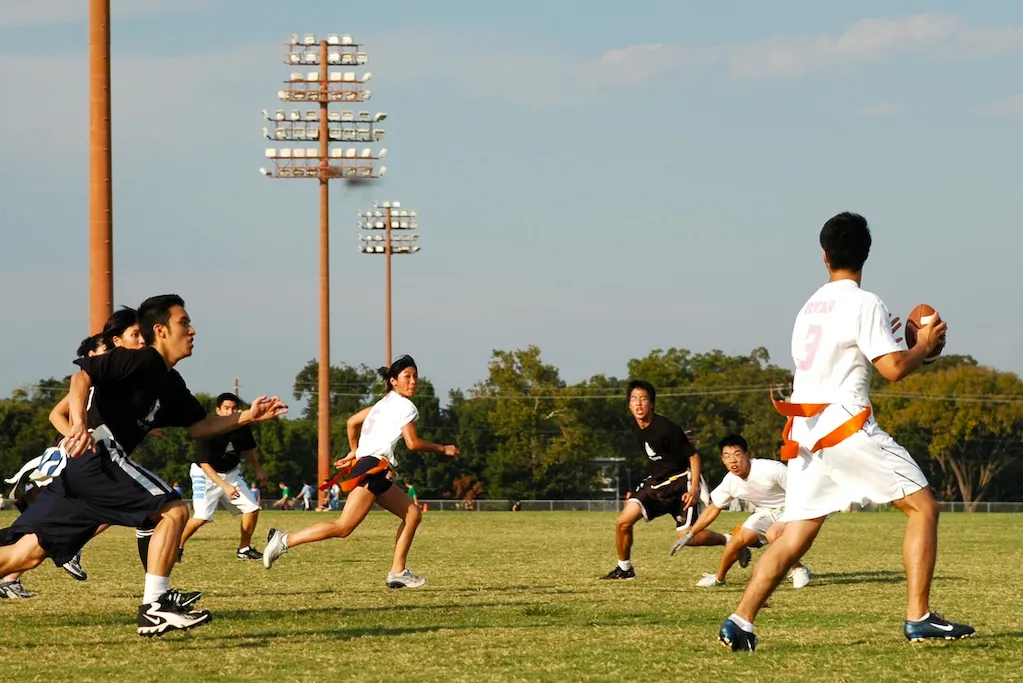
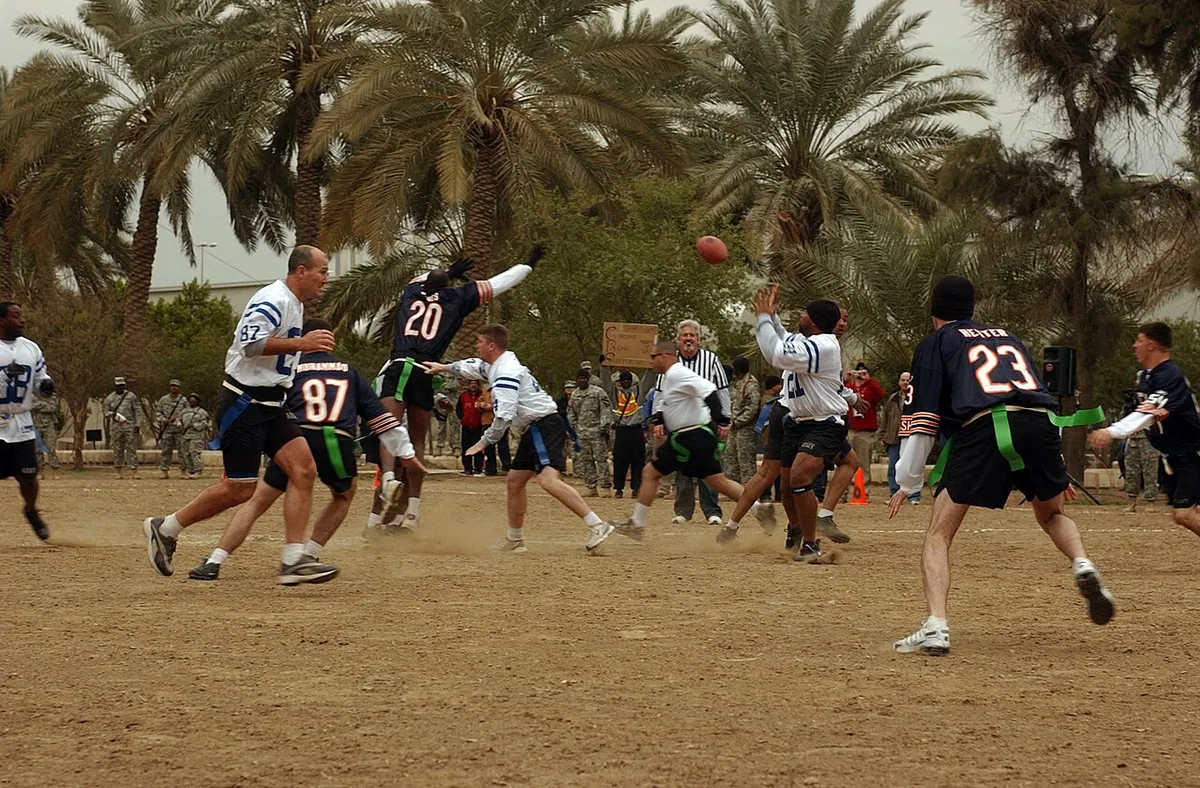
Flag football is a non-contact variant of American football where players wear flags attached to a belt and defenders must pull a flag from the ball carrier to end a play instead of making a tackle. The sport originated in the United States around 1940 as a recreational activity for military personnel and has since grown into a global sport with organized youth, collegiate, and international competitions. The sport of flag football traces its origins to the early 1940s during World War II, created as a recreational activity for American military personnel. The first known games were played around 1940 at Fort Meade, Maryland, which is widely considered the birthplace of the sport. Soldiers developed the game, initially called "Touch and Tail football," to maintain fitness while minimizing the risk of injury associated with traditional tackle football. After the war, veterans brought the game to civilian life, where it gained popularity in community parks and on college campuses. The sport formalized in the 1960s with the establishment of the National Touch Football League (NTFL) in St. Louis, Missouri, which began hosting a national championship game in 1971. A key innovation came when Arizona teachers Porter Wilson and Norman Adams invented the quick-release flag-a-tag belt and flag system, which became the template for the equipment used in the game today.
Basic Rules and Gameplay
Flag football replicates the fundamental structure of American football but replaces tackling with the act of pulling a flag from the ball carrier's belt, known as deflagging. Specific rules vary widely by league and organization, but all versions share the core principle of limited contact. A standard game is played in two halves, typically 15 to 25 minutes each, with the clock stopping only for injuries, timeouts, and halftime. There is no kickoff. Play begins with a coin toss to determine which team starts with the ball. Formats feature 5 players per side on the field at once, though variations exist with 4, 6, 7, 8, 9, or 10 players. Key common rules include prohibitions on tackling, blocking, and screening, with the defense relying on speed and positioning to pull flags. Many leagues implement "no-run zones" near the end zones to encourage passing, and rules often eliminate fumbles and punts to maintain a fast-paced, continuous flow of play. Notable rule variations across different leagues include.
- Eligibility of linemen to catch forward passes.
- Allowance or restriction of blocking, which if permitted is usually limited to contact on the chest.
- Rules governing whether the quarterback can advance the ball past the line of scrimmage by running.
- Inclusion or exclusion of kicking plays for punts and point-after-touchdown attempts.
- Field sizes that range from full NFL or CFL dimensions to much smaller fields, often adapted from soccer pitches or parks.
Growth and Organization in the United States
Flag football has experienced significant growth in the United States, driven by concerns over injuries in tackle football and concerted efforts by major organizations. USA Football, the national governing body and U.S. member of the IFAF, organizes the men's and women's national teams for international competition. The largest tournament operator is USA Flag, which hosted a club World Championships in January 2023 with over 980 teams, the largest single-weekend flag football tournament ever recorded. At the collegiate level, NIRSA governs intramural and club flag football and published its 22nd edition rulebook for the 2025 to 2026 season. The NFL expanded its commitment to the sport in 2020 when Denver Broncos quarterback Russell Wilson took on a leadership role as chairman and co-owner of NFL Flag. The league has integrated flag football into its Pro Bowl Games since the event's reformatting in 2023, featuring AFC and NFC all-stars playing flag football. In a major development for the sport's future, the NFL is actively working to launch professional flag football leagues. NFL Commissioner Roger Goodell said the league plans to start separate women's and men's professional flag football leagues in the near future. This initiative represents a substantial financial and organizational commitment from the NFL to establish flag football as a professional spectator sport.
Varsity and Collegiate Expansion
The popularity of flag football among female student-athletes has surged since the 2000s, making it one of the fastest-growing high school sports in the nation. The state of Florida pioneered this movement in 2002 by sanctioning varsity girls' flag football, an inaugural season that saw participation from 103 high schools. The number of states with fully sanctioned championships reached 20 by the 2025-26 school year, and two more states, Louisiana and North Carolina, planned to add the sport for the 2026-27 season. An additional 19 states had recognized emerging or pilot programs for the sport by that time. The National Federation of State High School Associations (NFHS) published its first national rule book for the sport in 2025, based on a 7-on-7 format. Collegiate governing bodies have also embraced the sport, with the National Association of Intercollegiate Athletics (NAIA) becoming the first to add women's flag football as a varsity emerging sport for the 2020-21 season.
The NCAA's adoption of flag football represents a major milestone. In February 2025, the NCAA Committee on Women's Athletics recommended adding flag football as an Emerging Sport for Women. By January 2026, all three NCAA divisions approved this addition, with the first emerging sport season held in spring 2026. Over 100 NCAA members planned to field women's flag football teams for the spring 2027 season. However, the Mid-Eastern Athletic Conference became the first D-I conference to officially sponsor the sport, announcing a championship for the 2026-27 school year in June 2026. Other early adopters include the Atlantic East Conference (NCAA Division III) in spring 2025 and Conference Carolinas (NCAA Division II) starting in spring 2026.
International Competition and the Olympic Movement
Flag football has established a robust schedule of international competitions under the governance of the International Federation of American Football (IFAF). The premier event is the biannual IFAF Flag Football World Championship, first held in 2002. The most recent championship in 2026 saw the United States successfully defend the men's title, while Canada won the women's title. That same tournament determined the first teams to qualify for the 2028 Olympics, with spots going to the women's team from Mexico and the men's team from Canada. Flag football has also been featured at the World Games, a multi-sport event for non-Olympic sports, since the 2022 edition in Birmingham, Alabama. The United States won the men's tournament and Mexico won the women's tournament in 2022, with only a women's tournament held at the 2025 World Games in Chengdu, China.
The sport's inclusion in the Olympic program marked a significant achievement for its global development. In July 2022, the NFL and IFAF partnered on a bid for flag football to be included in the 2028 Summer Olympics in Los Angeles. The NFL has also gained approval for its players to participate in the 2028 Games. Other notable international tournaments include the World Cup of Flag Football organized by the International Flag Football Festival (IFFF) and the women's Kelly McGillis Classic, an 8-on-8 tournament held each February in Key West, Florida, with over 90 teams.
Development in Canada and Europe
Flag football has seen substantial growth in Canada, with organized structures at multiple levels. The Canadian Flag Football League (CFFL), established in 2019 and affiliated with Football Canada, runs a national championship where winners earn the opportunity to represent Canada internationally. The league features male, female, and mixed divisions, with regional championships feeding into the national event. Collegiate play in Canada is strong in Quebec, where the Réseau du sport étudiant du Québec (RSEQ) has run college women's flag football since 2009, added a men's division in 2017, and launched a separate university women's competition in 2021. The Canadian version often uses a hybrid of American and Canadian football rules, played on Canadian-sized fields but with the four-down system of the American game. Canada's national teams have found success, with the women's team winning the IFAF World Flag Football Championships in 2026.
In Europe, the IFAF European Flag Football Championship has been held since 2003. The 2025 European Championship in Paris, France, was won by the Italian men's national team and the British women's national team. In the United Kingdom, competition is mostly 5-a-side, organized by the adult Outlaw Flag League and the National Flag Football League (NFFL) run by the British American Football Association (BAFA). The sport's international footprint continues to expand, with development clinics held in locations like Ghana and youth programs launched worldwide through initiatives like NFL Flag Around the World.

Equipment and Safety
The essential equipment for flag football is designed for safety and accessibility, requiring a minimal investment compared to tackle football. Every player wears an official flag belt with two or three flags attached by Velcro or a quick-release mechanism. Players typically receive a team jersey and the flag belt upon registration with a league. Critical to safety rules, players must wear shorts without pockets to ensure flags are always visible and to prevent fingers from getting caught during flag pulls. The only protective gear commonly used is a mouthguard, which is often optional but recommended. Football cleats are permitted, but metal cleats are prohibited. Some players choose to wear football gloves for better grip, but they are not required. The sport uses a standard football. The simplicity of the required gear, combined with the non-contact nature of the sport, creates a low barrier to entry that has fueled its rapid growth among youth and recreational athletes.
Video
FAQ
Where did flag football originate?
Flag football originated in the United States around 1940 at Fort Meade, Maryland. It was developed by American military personnel during World War II as a recreational sport that would allow them to stay fit while minimizing the risk of injury associated with traditional tackle football. The game was initially called "Touch and Tail football" before becoming known as flag football after the war. Veterans brought the sport to civilian life, leading to its spread across communities and the establishment of organized leagues in the following decades.
What are the basic rules of flag football?
The basic rules of flag football center on replacing tackles with flag pulls. Defenders must remove one or both flags from the ball carrier's belt to end a down. Contact such as tackling, blocking, and screening is not allowed. Games are typically played with 5 players per side on a smaller field, often 50 yards long by 25 yards wide for 5-on-5. There are no kickoffs. Play starts with a coin toss. Many leagues implement "no-run zones" near the end zones to encourage passing, and rules often eliminate fumbles and punts to keep the game fast-paced. Specific rules on quarterback runs, lineman eligibility, and point-after attempts vary by league.
Is the NFL making a professional flag football league?
Yes, the NFL is actively working to launch professional flag football leagues. In December 2025, NFL team owners voted to support the creation of a league through the league's investment fund, 32 Equity, which can invest up to $32 million. Commissioner Roger Goodell stated the plan is to launch separate women's and men's professional flag football leagues in the near future. By April 2025, ten investor groups had already submitted bids to be part of the new league. This initiative is part of the NFL's broader strategy to promote flag football globally, which also includes its youth NFL Flag program and support for the sport's Olympic inclusion.
When will flag football be in the Olympics?
Flag football is scheduled to make its Olympic debut as a discretionary event at the 2028 Summer Olympics in Los Angeles. The sport was officially approved for inclusion by the International Olympic Committee in October 2023, following a bid partnership between the NFL and the International Federation of American Football (IFAF). This will mark the first time any form of gridiron football is included as a full medal sport in the Olympic program. The NFL has also received approval for its players to participate in the 2028 Games. Qualification tournaments, such as the IFAF World Flag Football Championships, are awarding spots to national teams like Mexico's women and Canada's men.
How is flag football growing in schools and colleges?
Flag football is experiencing rapid growth as a varsity sport for female student-athletes. By the 2025-26 school year, 20 U.S. states fully sanctioned a high school state championship, with more states adding it each year. At the collegiate level, the NAIA was the first to add women's flag football as a varsity emerging sport in 2020-21. The NCAA approved flag football as an Emerging Sport for Women across all three divisions in January 2026, with the first season held in spring 2026.
What is NFL Flag?
NFL Flag is the official flag football league of the National Football League and the largest youth flag football organization in the United States. It operates a non-contact program for girls and boys from ages 5 to 17, supported by the NFL and focused on teaching football fundamentals and fostering community. The program provides jerseys, flag belts, and organizes leagues and tournaments nationwide. NFL Flag also hosts a national championships event that brings together top youth athletes. Denver Broncos quarterback Russell Wilson became a chairman and co-owner of NFL Flag in 2020 as part of the league's efforts to expand the sport globally. The program has a particular focus on expanding opportunities for girls and women in the sport.
Further reading
- Flag football at the LA28 Olympic Games LA28 Organizing Committee. The organizers' page for flag football's debut on the Olympic program in Los Angeles in 2028.
Sources
- Flag football (Wikipedia) Wikipedia
- NFL FLAG Football nflflag.com
- Flag Football NFL
- FLAG FOOTBALL 101 - Everything About the Sport of Flag Football uaflag.ca
- When Was Flag Football Invented? bigleagueshirts.com