The Pro Bowl was the National Football League's annual all-star event, recognizing the league's top performers from each season. From 1951 to 2022, it was primarily a tackle football game, but it evolved into the Pro Bowl Games featuring flag football and skills competitions from 2023 to 2026. Players were selected through a vote split equally among fans, coaches, and fellow players. In August 2026, the NFL announced the end of the Pro Bowl as an in-person event, though the league will continue to name an annual Pro Bowl class of 88 players to honor their achievements.
Origins and Early History (1939 to 1949)
The NFL's first all-star contest, called the Pro All-Star Game, took place on January 15, 1939, at Wrigley Field. This early series, which ran from 1939 through 1942, featured the league champion facing a team of all-stars from the rest of the NFL. The league champion won the first four of these matchups before the all-star team secured a victory in the final 1942 game. These games were discontinued after 1942 due to travel restrictions imposed during World War II. The concept lay dormant until June 1950, when the league approved a new all-star game under the name Pro Bowl. This revival was sponsored by the Los Angeles Publishers Association. It was decided the new game would feature all-star teams from each conference to avoid confusion with the Chicago College All-Star Game, which pitted the NFL champion against a college all-star team.
The Modern Pro Bowl Era (1951 to 1979)
The first official Pro Bowl under the new conference format was played on January 14, 1951, at the Los Angeles Memorial Coliseum. This game matched the American Conference against the National Conference, a structure that would define the event for decades. The American Conference won that inaugural game 28-27, and Cleveland Browns quarterback Otto Graham was named the first Player of the Game. The game remained in Los Angeles for its first 21 editions through 1972. Following the AFL-NFL merger in 1970, the conferences were renamed the American Football Conference and National Football Conference, and the game was officially called the AFC-NFC Pro Bowl. Player selection was initially done only by coaches and players until 1995, when fan voting was added as a third component.
The Hawaiian Era and Scheduling Shifts (1980 to 2009)
In 1980, the Pro Bowl found a long-term home at Aloha Stadium in Halawa, Hawaii, where it would be held for 30 consecutive seasons through 2009. During this era, the game was traditionally played the weekend after the Super Bowl. The 2010 Pro Bowl marked a significant break from tradition, as it was moved to Sun Life Stadium in Miami and scheduled before Super Bowl XLIV. This change was made to address declining television ratings, as the post-Super Bowl slot was seen as an anti-climax. The new timing also introduced a rule that players from the two Super Bowl teams would not participate. The game returned to Hawaii in 2011 but maintained its pre-Super Bowl scheduling.
Criticism, Fantasy Draft, and the Skills Showdown (2010 to 2016)
The 2012 Pro Bowl game was met with widespread criticism from fans and media for a perceived lack of effort and quality play. In October 2012, NFL Commissioner Roger Goodell stated that if player competitiveness did not improve, he was inclined to discontinue the event. In response, the NFL Players Association negotiated several changes, leading to a radical unconferenced format from 2014 to 2016. During these years, team captains selected players in a televised fantasy draft, disregarding conference affiliation. For the 2014 game, Pro Football Hall of Famers Jerry Rice and Deion Sanders served as alumni captains, with active players like Drew Brees and J.J. Watt serving as captains. The 2015 Pro Bowl was held at University of Phoenix Stadium in Glendale, Arizona, before the format returned to Hawaii in 2016. The league also introduced the Pro Bowl Skills Showdown during this period, featuring events like passing contests and dodgeball.
Return to Conferences and Pandemic Cancellation (2017 to 2022)
The traditional AFC-NFC conference format was restored in 2017 when the game moved to Camping World Stadium in Orlando, Florida. Orlando had won the hosting rights over bids from Brazil, Honolulu, Houston, and Sydney, Australia. The Skills Showdown continued as a companion event. The 2019 Pro Bowl saw winners earn $67,000 and losers $39,000. The 2021 Pro Bowl was canceled due to the COVID-19 pandemic, though the full roster was still voted on and announced. Alternative events were held that week, including a Madden NFL 21 video game tournament using the Pro Bowl rosters. The new Allegiant Stadium in Las Vegas, originally slated to host the 2021 game, held over its hosting duties to the 2022 Pro Bowl. The 2022 game, a 41-35 AFC victory, was a traditional tackle football Pro Bowl.
The Pro Bowl Games Era (2023 to 2026)
In September 2022, the NFL announced a complete overhaul, rebranding the event as the Pro Bowl Games starting in 2023. This new format, developed in partnership with Peyton Manning's Omaha Productions, replaced tackle football with a series of skills competitions and flag football games. Points earned in skills events carried into the flag football contests to determine an overall winner. The NFC won the inaugural Pro Bowl Games 35-33. The 2024 edition used a single flag football game with challenges interspersed between quarters, and the NFC won 64-59. For the 2026 Pro Bowl Games, the event was downsized and integrated directly into Super Bowl week festivities, held at the Moscone Center in San Francisco on February 3, 2026. Pro Football Hall of Famers Jerry Rice and Steve Young served as the head coaches for the NFC and AFC, respectively, in that final event.
Selection Process and Eligibility Rules
The Pro Bowl selection process was a three-part vote divided equally among fans, players, and coaches, with each group accounting for 33.3 percent of the total. Fans cast their ballots on the NFL's official website. A player was officially credited with a Pro Bowl selection if they were an initial selection or an alternate who accepted the invitation and attended. Invited alternates who declined were not considered Pro Bowlers. Starting in 2010, a key rule stated that players from the two Super Bowl teams would not play in the Pro Bowl, though they were still credited with the selection if originally chosen. These players were replaced by alternates from other teams. The new system announced for the 2026 season ends the use of alternates completely, meaning only the originally selected 88 players will receive the Pro Bowl honor. This change was made to ensure the distinction carries greater meaning and is not diluted by replacement selections.
Coaching Staff Selection History
The method for choosing Pro Bowl coaches changed several times alongside the game's scheduling. When the game was held after the Super Bowl, the head coaches were typically the losing coaches from the AFC and NFC Championship Games. This method was used from 1978 to 1982 and again from 2010 to 2013 and from 2017 onward after the game moved before the Super Bowl. If two losing teams had the same record, the higher-seeded team's staff received the honor. During the unconferenced draft years from 2014 to 2016, alumni captains selected the teams, so no active NFL coaches were involved. For the final Pro Bowl Games in 2026, the NFL appointed Hall of Fame players Jerry Rice and Steve Young as the ceremonial head coaches, with Rice leading the NFC and Young the AFC.
Player Compensation Through the Years
Players received payment for participating in the Pro Bowl, with the winning team members earning a larger sum than the losers. This financial incentive grew substantially over the decades. From 1951 through 2010, winners earned $23,000 and losers $17,000. The amounts saw significant jumps in the 2010s, with winners getting $50,000 in 2011 and 2013, $65,000 in 2012, and $53,000 in 2014. For the 2017 game, winners earned $61,000. By 2020, the winner's share had risen to $74,000. For the final 2026 Pro Bowl Games, winners were paid $96,000 each, while losers received $48,000. This steady increase reflected the league's efforts to maintain player interest in the event despite its exhibition nature.
| Years | Winners' Pay | Losers' Pay |
|---|---|---|
| 1951 to 2010 | $23,000 | $17,000 |
| 2012 | $65,000 | $40,000 |
| 2017 | $61,000 | $30,000 |
| 2020 | $74,000 | $37,000 |
| 2024 | $88,000 | $44,000 |
| 2026 | $96,000 | $48,000 |
Game Honors and MVP Awards
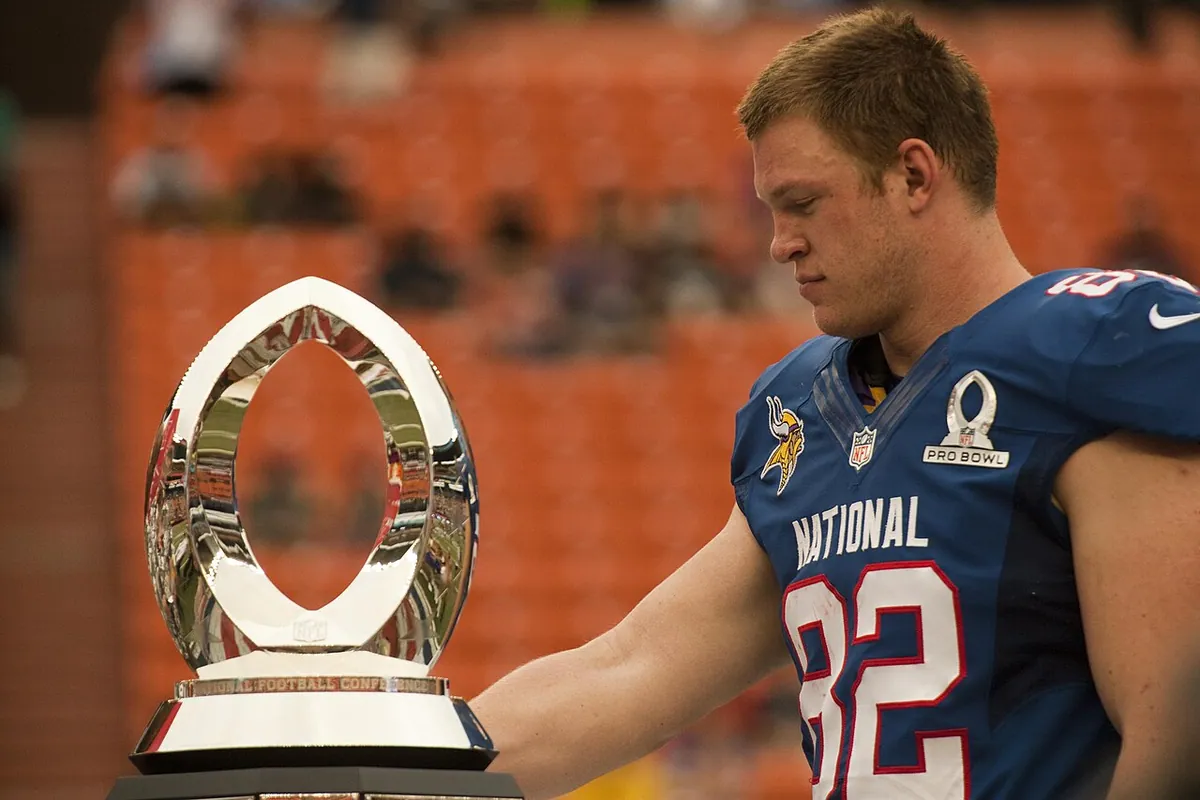
The Pro Bowl presented individual awards, though the name and structure changed over time. From 1951 to 1956, a single Player of the Game was honored, with Otto Graham winning the first award in 1951. From 1957 to 1971, awards were given for both an Outstanding Back and an Outstanding Lineman. In 1972 and again since 2014, the game has recognized both an Outstanding Offensive Player and an Outstanding Defensive Player. From 1973 through 2007, only one Player of the Game award was given, though it was presented to multiple players on three occasions. In 2008 the award was renamed the Most Valuable Player. Notable early MVPs include Jim Brown, who won the Outstanding Back award in 1962, 1963, and 1966, and Johnny Unitas, who won it in 1960, 1961, and 1964.
Conference Results and Recent Winners
The historical record between the AFC and NFC in Pro Bowl tackle games was very close. The final traditional AFC-NFC Pro Bowl was played in 2022, resulting in a 41-35 victory for the AFC. Under the new Pro Bowl Games format from 2023 to 2026, the NFC won all four editions. The 2023 event was a close 35-33 win for the NFC. The 2024 event was a high-scoring affair, with the NFC winning 64-59. The 2025 Games saw the NFC winning 76-63. The NFC also claimed the final 2026 Pro Bowl Games with a score of 66-52. The competition between conferences in the Pro Bowl has been relatively balanced over the years.
Detailed Rule Modifications for Safety
Pro Bowl tackle games operated under a specialized set of rules designed to minimize injury risk and encourage offensive play. These rules created a game that was essentially a form of two-hand touch football, as players adhered to a gentlemen's agreement to avoid hard tackles. Defensive schemes were heavily restricted. Teams were required to use a 4-3 alignment at all times, and blitzing was prohibited. Defensive ends and tackles could only rush the passer if they were on the same side of the ball. On offense, intentional grounding was legal, and more than one forward pass per play was allowed. The offense was also required to have a running back and tight end in all formations. Special teams play was also neutered, with no kickoffs, no punt returns, and no rushing the punter, kicker, or holder. If a team wanted to attempt an onside kick scenario, they could run one play from their own 25-yard line, needing to gain 15 yards to retain possession. The game used a 35-second play clock and could not end in a tie, employing overtime rules where the first team to score after each side had one possession would win.
The End of the Event and New Honor System
This made the NFL the first of the major North American professional sports leagues to end its all-star game. The decision followed years of format changes aimed at revitalizing fan and player interest. League officials stated that the purpose of the Pro Bowl was to honor the best players, and that repeated replacement selections had diluted the distinction. Beginning with the 2026 season, the NFL will select an official Pro Bowl class of 88 players each year using the same voting process split among fans, coaches, and players. The key change is that no alternates will be named. Only the original 88 selections will carry the Pro Bowl honor. These selected players will be invited to an in-person celebration held at the Super Bowl host city the week before the championship game. NFL executive vice president Peter O'Reilly stated the change would return the Pro Bowl selection to its original purpose of honoring the absolute best players of the season.
Notable Records and Snubs
Quarterback Tom Brady holds the record for the most Pro Bowl invitations with 15 selections over his career. Other players with numerous invitations include offensive lineman Trent Williams. The record for most touchdown receptions in a single Pro Bowl game is four, set by wide receiver Brandon Marshall in 2012. In the final years of the event, fan voting remained a key component, with Kansas City Chiefs tight end Travis Kelce leading all players in fan balloting for the 2026 Pro Bowl Games. The Pro Bowl has also seen its share of notable snubs, where high-performing players were overlooked by voters, a topic frequently analyzed after roster announcements. Each season, media outlets would highlight players like the NFL's tackles leader or promising young quarterbacks who were omitted from the rosters despite strong statistical seasons.
Video
FAQ
What was the Pro Bowl?
The Pro Bowl was the NFL's annual all-star event that honored the league's top players from each season. From 1951 to 2022, it was primarily a tackle football game between the American and National Football Conferences. From 2023 to 2026, it was reformatted as the Pro Bowl Games, featuring flag football and skills competitions. The NFL ended the in-person event in August 2026, though it continues to name an annual Pro Bowl class of 88 players.
When was the Pro Bowl game played?
Initially, it was played after the NFL championship game. From 1967 to 2009, it was typically held the weekend after the Super Bowl. A major change came in 2010 when the league scheduled the game for the Sunday preceding the Super Bowl. Under the Pro Bowl Games format from 2023 to 2026, the flag football game was held on the first Sunday of February during the week before the Super Bowl. The final 2026 event was held on February 3 at the Moscone Center in San Francisco.
Who votes for the Pro Bowl and how does it work?
Pro Bowl rosters were determined by a vote split equally among three groups: fans, players, and coaches. Each group's ballot counted for one-third of the total. Fans voted online at NFL.com. Starting with the 2026 season, the NFL will still use this voting method to select an 88-player Pro Bowl class, but no alternates will be named. Players from the Super Bowl teams were still selected but did not participate in the event when it was active.
Do players get paid for the Pro Bowl?
Yes, players were paid for participating in the Pro Bowl. The winning team always received a larger payout than the losing team. For the final 2026 Pro Bowl Games, winners earned $96,000 each while losers earned $48,000. This represented a steady increase over the years from the $23,000 and $17,000 amounts paid in the early decades.
What is the future of the Pro Bowl honor?
The NFL has discontinued the Pro Bowl Games event. However, beginning with the 2026 season, the league will select an annual Pro Bowl class of 88 players through the same voting process. These selected players will be invited to an in-person ceremony held during the week leading up to the Super Bowl. No game or skills competitions will be held, and the system of naming alternate players has been eliminated.
How did the format of the Pro Bowl change over the years?
The Pro Bowl format changed significantly throughout its history. From 1939 to 1942, the NFL champion played against a team of all-stars. The first official Pro Bowl in 1951 matched conference all-stars, and after the 1970 merger, it became the AFC versus NFC Pro Bowl. From 2014 to 2016, the NFL experimented with a non-conferenced format where teams were selected by honorary captains in a televised draft. In 2023, the event was revamped as the Pro Bowl Games, featuring skills competitions and flag football. The event was ultimately discontinued after 2026, though a Pro Bowl team is still selected annually.
Sources
- Pro Bowl (Wikipedia) Wikipedia
- NFL Pro Bowl Games Home NFL
- NFL ends Pro Bowl, selection of 'best of the best' to continue fieldlevelmedia.com
- NFL Pro Bowl Winners List: Who has won more pro bowls, AFC or NFC? marca.com
- Winners of the Pro Bowl onthisday.com