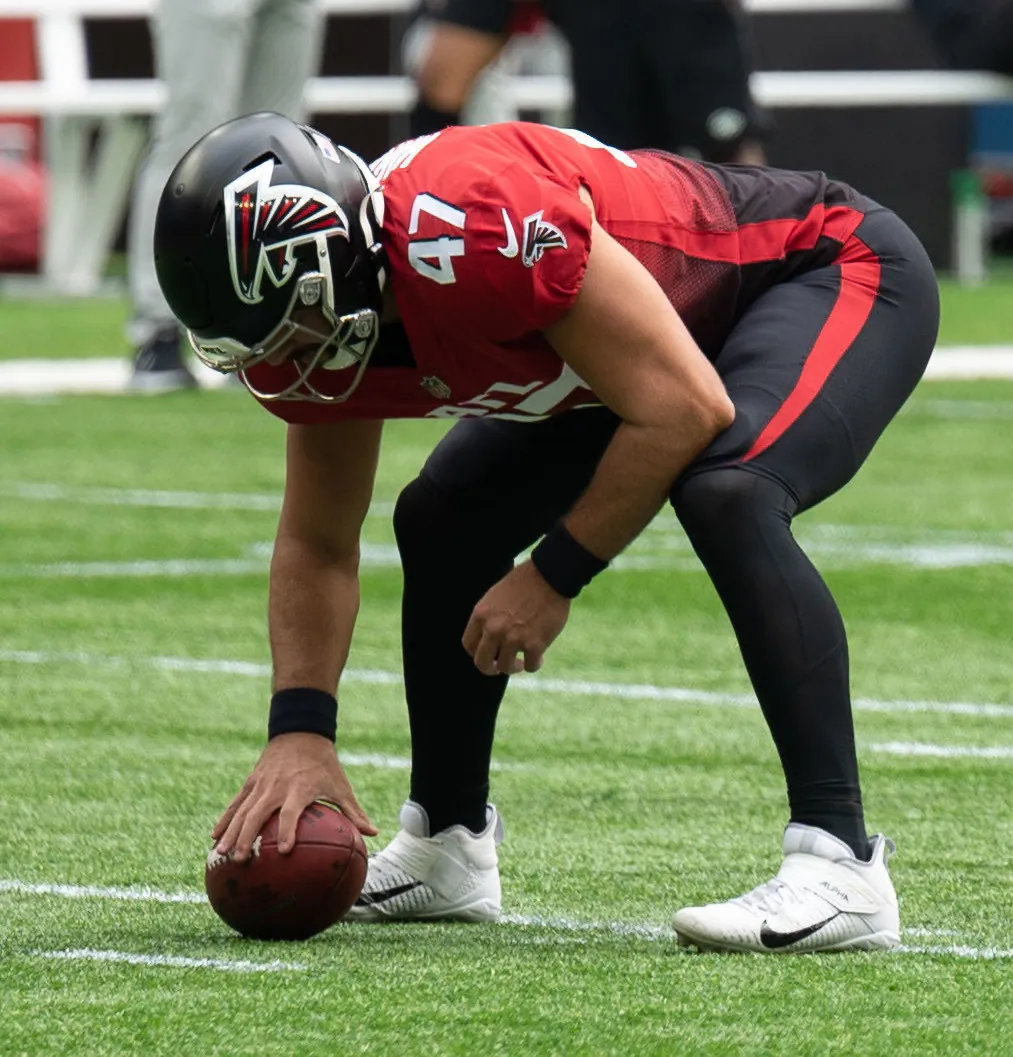
A long snapper is a specialized American football player on special teams whose primary duty is to snap the football over longer distances for punts, field goals, and point-after-touchdown attempts. On punts, the snap travels 13 to 15 yards to the punter, while on field goals and extra points, it goes 7 to 8 yards to the holder. Following the snap, the long snapper often has blocking responsibilities and, on punts, must cover the kick downfield. The position has evolved into a dedicated roster spot in the NFL, with players who train specifically for its unique demands of accuracy, speed, and consistency under pressure.
What Does a Long Snapper Do?
The long snapper's core function is to deliver an accurate, timely snap to either the punter or the holder. On field goal and extra point attempts, the holder positions himself 7 to 8 yards behind the line of scrimmage. The snap must arrive at a precise, repeatable spot to allow for a clean placement and kick. During punts, the punter stands 13 to 15 yards deep, and the snap must travel this greater distance with a tight spiral and consistent velocity. After the snap on a punt, the long snapper typically executes a blocking assignment to protect against an interior rush before releasing downfield to cover the kick and tackle the returner. If a punt is not caught, the snapper is responsible for preventing the ball from bouncing into the end zone for a touchback or backward for a loss of yardage.
NFL Rules for the Long Snapper
The NFL rulebook contains specific provisions regarding the long snapper, primarily focused on alignment and protection. When the offense is in a formation for a punt, field goal, or extra point, defensive players are prohibited from aligning directly opposite the long snapper. Officials typically enforce this rule through verbal warnings before the snap. Unlike in college football, the NFL does not mandate a set period of time after the snap before a defender can make contact with the snapper. However, the league's general rules against dangerous contact still apply. Every NFL team currently employs a dedicated long snapper, a practice that began with the Washington Redskins in 1971 when coach George Allen designated George Burman for the role. The specialization means these players rarely appear on offense or defense, and their roster spot is secured almost exclusively by their snapping ability.
The path to the NFL for long snappers is unique. They are rarely drafted, and when they are, it is usually in the later rounds. The first known player drafted primarily for his long-snapping ability was Todd Thomas, selected by the Kansas City Chiefs in the fifth round in 1981. The first pure long snapper drafted was Tyler Schmitt, taken by the Seattle Seahawks in the sixth round in 2008. Since the Seattle Seahawks drafted Tyler Schmitt in 2008, several long snappers have been selected in the NFL draft. Recent examples include Julian Ashby, drafted by the New England Patriots in the seventh round in 2025. The following list shows a selection of long snappers drafted since 2008.
| Player | Team | Year | Round (Overall Pick) |
|---|---|---|---|
| Tyler Schmitt | Seattle Seahawks | 2008 | 6 (189) |
| Joe Cardona | New England Patriots | 2015 | 5 (166) |
| Jimmy Landes | Detroit Lions | 2016 | 6 (210) |
| Colin Holba | Pittsburgh Steelers | 2017 | 6 (213) |
| Hunter Bradley | Green Bay Packers | 2018 | 7 (239) |
| Austin Cutting | Minnesota Vikings | 2019 | 7 (250) |
| Blake Ferguson | Miami Dolphins | 2020 | 6 (185) |
| Thomas Fletcher | Carolina Panthers | 2021 | 6 (222) |
| Camaron Cheeseman | Washington Football Team | 2021 | 6 (225) |
College and High School Football Rules
NCAA rules provide more explicit protection for the long snapper than NFL rules. Defensive players are prohibited from lining up within the shoulder-length frame of the long snapper. More significantly, defensive players are not allowed to initiate contact with the long snapper until one full second has elapsed after the ball is snapped. These rules are designed to protect the snapper, who is in a vulnerable position with his head down at the start of the play. Coverage rules also differ from the NFL. In college football, all 11 players on the punting team are allowed to proceed downfield as soon as the play begins. This contrasts with the NFL, where only the two outside gunners may release before the kick. The college rule leads many teams to employ spread or rugby-style punt schemes to maximize downfield coverage and limit return yardage. At the youth and high school levels, rules often emphasize protection for the snapper. The specialization trend has trickled down from the professional ranks, with an increasing number of young athletes training exclusively as long snappers in hopes of earning college scholarships.
The skill set required, precision, consistency, and mental toughness, does not demand the same size or speed as other positions, making it an accessible path to collegiate athletics for dedicated players. College programs now actively recruit and offer scholarships to true long snappers, recognizing their importance to special teams success. The number of young men training for the position has increased as families learn that athletic scholarships are attainable through this specialized skill. Boys can begin training as early as elementary school, focusing on the techniques of snapping a football accurately over long distances.
History and Evolution of the Position
For much of football's history, the long snapper was not a dedicated position. The duty typically fell to a backup center, tight end, or linebacker who practiced the skill in addition to their primary role. This began to change in 1971 when Washington Redskins head coach George Allen made George Burman the first modern, specialized long snapper, keeping him on the roster solely for that purpose. The trend toward specialization grew slowly but steadily through the late 20th century. As the speed of the game increased and special teams became more strategically important, the margin for error on snaps decreased. Teams realized that consistent snapping was a skill that required year-round dedication and practice, leading to the full-time specialist model seen today. Key milestones in the position's evolution include the drafting of specialists and the establishment of protective rules.
The NFL draft history shows the league's growing recognition of the role. Before the 2000s, players like Kendall Gammon, drafted in 1992, and Jeff Robinson, drafted in 1993, were selected with their snapping ability as a noted asset, though they were listed at other positions. The pure specialist era was cemented when the Seattle Seahawks used a sixth-round pick in 2008 on long snapper Tyler Schmitt, who had no other designated position. Rule changes, particularly in the NCAA, have also shaped the position by adding protections that acknowledge the snapper's vulnerability during the snap motion. The increased specialization has also created a cottage industry of coaching and training for aspiring long snappers from youth football through the professional ranks.
- 1971: George Burman becomes the first dedicated NFL long snapper for the Washington Redskins.
- 1992: Kendall Gammon is drafted by the Pittsburgh Steelers in the 11th round as a long snapper/offensive lineman.
- 2004: Gammon is named to the Pro Bowl.
- 2015 onward: At least one long snapper is drafted in almost every NFL draft.
Famous Plays and Game Impact
The critical importance of a reliable long snapper is most starkly revealed when the operation fails. Several high-profile games have turned on botched snaps, demonstrating that the position, while often invisible, carries enormous pressure. In the 2008 regular season, the Pittsburgh Steelers lost long snapper Greg Warren to a torn ACL during a game against the New York Giants. Linebacker James Harrison, who had snapping experience in NFL Europe, took over. His snap in the fourth quarter went over the head of punter Mitch Berger and out of the end zone for a safety, which tied the game. The Giants received the ensuing free kick and scored a go-ahead touchdown, winning the game. Another notable incident occurred in 2012 when Oakland Raiders long snapper Jon Condo was injured. Backup linebacker Travis Goethel struggled, delivering snaps that bounced to punter Shane Lechler and contributing to a blocked punt in a loss to the San Diego Chargers. More recently, in the 2022 season opener, Cincinnati Bengals long snapper Clark Harris suffered a biceps injury.
Backup tight end Mitchell Wilcox was forced into duty. With the game tied and time expired in regulation, a potential game-winning extra point was blocked due in part to the altered operation. In overtime, a high snap on a subsequent field goal attempt led to a miss, and the Bengals ultimately lost to the Pittsburgh Steelers. These examples show that a single errant snap can directly alter the outcome of a game, making consistency the paramount virtue for any professional long snapper. Other examples include Brad St. Louis of the Cincinnati Bengals, who delivered five bad snaps in the first five games of the 2009 season, leading to his release.
Skills and Techniques of the Position
Playing long snapper requires a highly specialized and repeatable skill set. The fundamental technique involves a swift, fluid motion to propel the ball backward over the required distance. The snap must combine accuracy, pace, and a tight spiral. For a field goal, the target is a stationary spot where the holder's hands will be. For a punt, the target is the punter's frame, and the ball must arrive with the correct tilt to facilitate the drop. Mental toughness is equally critical, as the snapper must perform with precision despite oncoming rushers and high-pressure situations, often without being able to see the full defensive alignment after the snap. After the snap, the long snapper must immediately transition to his next assignment.
On field goals, he pops up into a stable blocking position to help protect the interior of the line. On punts, he may have a quick protection responsibility before releasing downfield as a coverage player. This requires functional athleticism, agility, and tackling ability. The best long snappers make the complex operation look routine, delivering countless flawless snaps that allow the holder, kicker, and punter to execute their jobs without adjustment. Coaches evaluate long snappers on this repeatability, the ability to provide a consistent, catchable ball play after play, season after season, under all conditions. The position is evaluated through target accuracy, pace and rotation of the ball, recovery balance after the snap, and the transition into coverage.
Related Football Positions and Terms
Several other football positions and terms are closely associated with the work of the long snapper. The holder is the player who receives the snap on field goal and extra point attempts, places the ball on the tee or ground, and positions it for the kicker. The punter is the player who receives the long snap on fourth down and kicks the ball to the opposing team. The kicker is the specialist who scores points by kicking field goals and extra points. A gunner is a player on the punt coverage team, typically lined up wide near the sideline, whose primary job is to sprint downfield and tackle the returner. In the NFL, only the two gunners are allowed to cross the line of scrimmage before the punt is kicked. A bad snap refers to any off-target snap that disrupts the timing of a punt or placekick, potentially causing a fumble, block, or missed kick.
The shotgun formation is an offensive alignment where the quarterback lines up several yards behind the center to receive the snap. While the snap distance is shorter than a punt, some of the technical principles overlap with long snapping. Special teams is the unit that handles all kicking plays, including punts, kickoffs, field goals, and extra points. Finally, a dedicated long snapper is a player whose roster spot is secured almost exclusively by his ability to perform the long snap, as opposed to a positional player who snaps as a secondary duty. Before specialization, players like Allen Aldridge, a linebacker for the Detroit Lions, and Buccaneers tight end Dave Moore also served as their team's long snapper.
Video
FAQ
What is a long snapper in football?
A long snapper is a special teams specialist whose primary job is to snap the football for punts, field goals, and extra point attempts. On punts, they snap the ball 13 to 15 yards to the punter. On field goals and extra points, they snap it 7 to 8 yards to the holder. Following the snap, they have blocking and coverage responsibilities. The position requires extreme accuracy and consistency, and in the modern NFL, it is almost always a dedicated role filled by a player who does not regularly play on offense or defense.
What does a long snapper do in the NFL?
In the NFL, a long snapper's duties are highly specialized. They execute the long snap for all punt, field goal, and extra point attempts. After snapping on punts, they typically block for a moment before releasing downfield to cover the kick and attempt to tackle the returner. On field goals, they snap and then immediately rise to block, helping protect the interior of the line. NFL rules prohibit defensive players from lining up directly in front of the long snapper in a kick formation. Every NFL team employs a dedicated long snapper, a practice that began in 1971.
Are you allowed to hit the long snapper in football?
The rules for contacting the long snapper differ between the NFL and NCAA. In college football, defensive players are not allowed to initiate contact with the long snapper until one full second has elapsed after the ball is snapped. In the NFL, there is no specified waiting period, but defenders cannot line up directly in front of the snapper in a kick formation. Both leagues have rules against dangerous contact that endangers the player, especially given his vulnerable, head-down position at the start of the play.
Do long snappers ever get drafted into the NFL?
Yes, long snappers are drafted, though typically in the later rounds. The first pure long snapper drafted was Tyler Schmitt, selected by the Seattle Seahawks in the sixth round in 2008. Since then, at least one long snapper has been chosen in nearly every NFL draft. Recent examples include Blake Ferguson (2020, 6th round), Thomas Fletcher (2021, 6th round), Camaron Cheeseman (2021, 6th round), and Julian Ashby (2025, 7th round). Before the 2000s, players like Kendall Gammon (1992) and Jeff Robinson (1993) were drafted with snapping as a noted skill, though they were listed at other positions.
What is the difference between a long snapper and a center?
A center is an offensive lineman who snaps the ball to the quarterback on every offensive play from scrimmage, usually over a distance of a few inches to a few yards in the shotgun. A long snapper is a special teams specialist who snaps only for punts, field goals, and extra points over distances of 7 to 15 yards. While a center must then engage in complex pass or run blocking, a long snapper's post-snap duties involve protection and coverage on kicking plays. The techniques, distances, and timing requirements are distinct, which is why most teams carry a dedicated long snapper separate from their offensive center.
How far does a long snapper have to snap the football during punts and field goals?
A long snapper must snap the football approximately 15 yards to the punter during punts, and 7 to 8 yards to the holder during field goals and point after touchdown attempts. These longer distances differentiate the role from a regular offensive center. Following a punt snap, the snapper often has a blocking assignment and then must cover the kick by running downfield to tackle the returner. The precision required for these distances makes it a specialized skill.
Sources
- Long snapper (Wikipedia) Wikipedia
- Colts Football 101: Long Snapping w/ Matt Overton colts.com
- Long Snapper learn-any-sport.webflow.io
- Tale of the Long Snapper cornellbrsn.com
- What Is a Long Snapper in Football? LS Position Explained | PFM profootballmania.com