Allianz Arena is a major football stadium located in Munich, Germany. Opened in 2005, it is the home ground of FC Bayern Munich and is renowned for its illuminated, color-changing exterior facade. The stadium has a seating capacity of 75,024 for domestic matches and 70,000 for international fixtures. Since 2022, Allianz Arena has also hosted regular-season National Football League games as part of the NFL International Series in Germany. The venue has been a site for major events including the 2006 FIFA World Cup, the 2012 and 2025 UEFA Champions League finals, and UEFA Euro 2024 matches. The stadium's construction cost totaled €340 million and it was designed by the architectural firm Herzog & de Meuron.
American Football at Allianz Arena
The Allianz Arena has been a venue for the NFL International Series, hosting regular-season American football games in Germany. The stadium has hosted two NFL regular-season games. The first NFL game at the arena was played on November 13, 2022, featuring the Tampa Bay Buccaneers against the Seattle Seahawks. The Buccaneers won that contest by a score of 21 to 16. The second game occurred on November 10, 2024, with the Carolina Panthers defeating the New York Giants 20 to 17 in overtime. The highest combined score in an NFL game at the venue is 37 points, set during the 2022 game. The stadium is listed as an outdoor venue for these football contests. These games are part of the NFL's effort to grow the sport internationally, with Allianz Arena being selected as one of the first German stadiums to host such events.
Location and Construction History
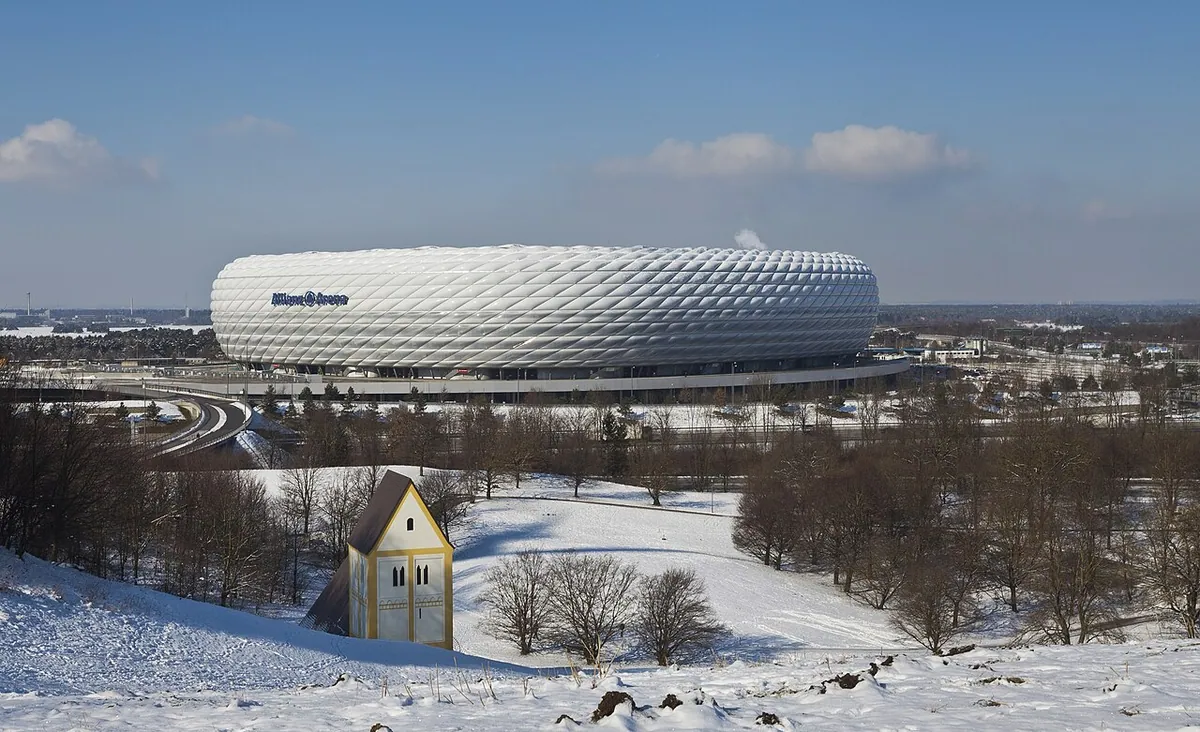
The Allianz Arena is situated at Franz-Beckenbauer-Platz 5 in the Schwabing-Freimann borough on the Fröttmaning Heath in northern Munich. The stadium's construction began on October 21, 2002, after a public vote approved the project. The primary architects were the Swiss firm Herzog & de Meuron, with Arup serving as the structural engineer. The arena was officially opened on May 30, 2005. The total construction cost was €340 million, which included financing expenses, with an additional €210 million spent by the city and state on area development and infrastructure. Key construction materials included 120,000 cubic meters of concrete and 22,000 tonnes of steel for the stadium itself, plus 85,000 cubic meters of concrete and 14,000 tonnes of steel for the attached parking garage. The project replaced the option of a major reconstruction of the Munich Olympic Stadium, an idea refused by its original architect. The surrounding transport infrastructure was significantly upgraded, including the expansion of the A9 Autobahn and the Fröttmaning U-Bahn station. The stadium's opening was marked by a series of inaugural matches and events. Key firsts in the stadium's history include.
- May 30, 2005: Opening exhibition, 1860 Munich beats 1. FC Nürnberg 3-2.
- June 2, 2005: First 'arena derby' between tenants, won by TSV 1860 Munich.
- July 26, 2005: First competitive goal scored by Roy Makaay (Bayern Munich) in the DFL-Ligapokal.
- August 5, 2005: First Bundesliga goal scored by Owen Hargreaves (Bayern Munich).
- September 9, 2005: First visiting team to win a league game was Dynamo Dresden against 1860 Munich.
Capacity Evolution and Seating Design
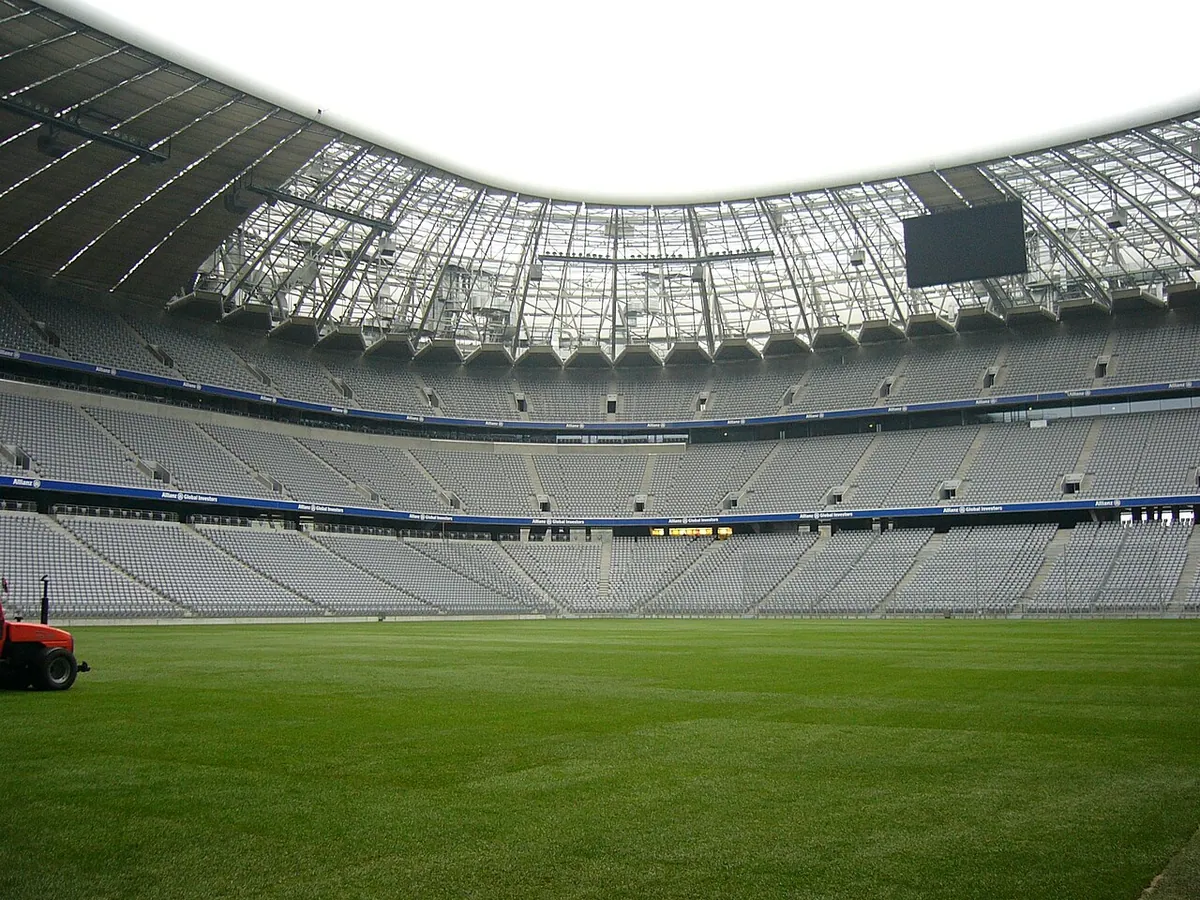
The Allianz Arena's capacity has evolved through several planned expansions since its opening. Its initial legal capacity upon opening in 2005 was approximately 66,000 for UEFA matches. For the second half of the 2005-06 Bundesliga season, the capacity for domestic games was increased to 69,901. A city approval granted on January 16, 2006, increased the legal capacity to 71,000 spectators. Before the 2012-13 season, Bayern Munich announced an increase in domestic capacity to 71,000 and UEFA capacity to 68,000. A further expansion was completed in August 2014, which involved installing about 2,000 new seats in the upper tier and optimizing standing areas. This work brought the maximum Bundesliga capacity to 75,024, with approval finalized in January 2015. The current international match capacity is set at 70,000 to comply with UEFA regulations which prohibit standing room.
The seating structure is divided into three main levels. The lower tier has a maximum of 20,000 seats, the middle tier holds up to 24,000, and the upper tier can accommodate 22,000 people. In the corners of the lower tier, 10,400 seats are designed to be converted into standing areas, which adds space for 3,120 more spectators. The total capacity figure includes 2,000 business seats, 400 seats for the press, and 106 luxury boxes that can accommodate up to 174 people. The stadium also provides 165 spaces for wheelchairs and accompanying persons. The partial roof covers all seats, although it is an open-air stadium where wind can blow rain onto some sections.
Ownership, Tenancy, and Naming Rights
The stadium was originally commissioned and owned by Allianz Arena München Stadion GmbH, a company founded in 2001 and owned equally by FC Bayern Munich and TSV 1860 Munich. This ownership structure changed in April 2006 when 1860 Munich, facing a serious financial crisis, sold its 50 percent share to Bayern Munich for €11 million. The sale prevented insolvency for 1860 Munich, who then became tenants with a right to buy back their share before June 2010, a right they resigned in November 2007. An agreement initially allowed 1860 Munich to play at the stadium as a tenant. However, following 1860 Munich's relegation to the 3. Liga in 2017, Bayern Munich terminated the rental contract. Liga in 2017, Bayern Munich terminated the rental contract in July 2017, making themselves the sole tenants and 100 percent owners of the arena. The financial services company Allianz secured the naming rights for a period of 30 years. Due to sponsorship conflicts with FIFA and UEFA policies, the corporate name cannot be used during their events.
- For the 2006 FIFA World Cup, the stadium was called "FIFA WM-Stadion München" (FIFA World Cup Stadium, Munich).
- For UEFA club competitions, Nations League, and international matches, it is known as "Fußball Arena München" (Football Arena Munich).
- The naming rights deal was a significant source of financing for the stadium project.
- The address was changed to Franz Beckenbauer Platz 5 on May 1, 2025, in honor of the late Bayern Munich legend.
Architectural Features and Technology
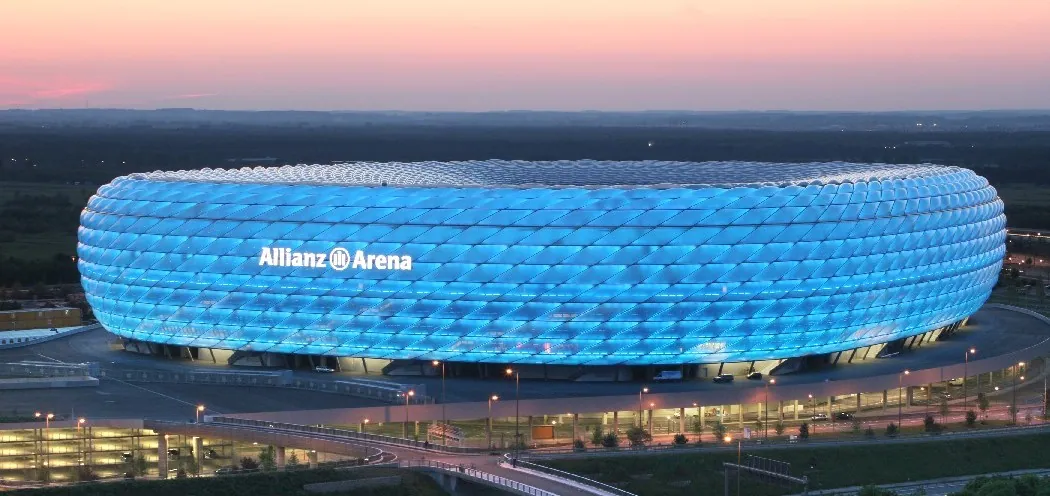
The Allianz Arena is widely known for its innovative and striking architectural design. The most distinctive feature is its luminous exterior, constructed from 2,760 ETFE-foil air panels that are kept inflated with dry air. Each panel can be independently illuminated with white, red, or blue light, creating the first stadium in the world with a full color-changing exterior. The lighting scheme is team-specific: red for Bayern Munich, blue for TSV 1860 Munich, and white for the Germany national team or neutral venues. The Munich police mandate a single-color scheme to prevent driver distraction on the nearby A9 Autobahn. The facade's innovative concept has influenced other venues like MetLife Stadium in New Jersey. The stadium's roof incorporates built-in roller blinds that can be drawn during games to provide protection from the sun for spectators. The architects Herzog & de Meuron designed the stadium with a pure football focus, featuring steep, three-tier stands that create an intense atmosphere and bring fans close to the pitch.
The stadium complex includes extensive ancillary facilities. It houses the FC Bayern Erlebniswelt museum, which opened on May 25, 2012. There are four team locker rooms, four coaches' locker rooms, and two referees' locker rooms, plus two 110-square-meter warm-up areas for athletes. The stadium contains 550 toilets and 190 monitors throughout the concourses. It is served by Europe's largest underground parking structure, comprising four four-storey garages with 9,800 parking spaces, plus an additional 1,200 spaces within the arena's first two tiers. For public transport, the Fröttmaning U-Bahn station on the U6 line is located directly next to the stadium, with the line connecting to Marienplatz in central Munich in about 15 minutes.
Major Tournament Matches and Events
The Allianz Arena has been selected to host some of the world's most prestigious football tournaments since its opening. It served as a venue for the 2006 FIFA World Cup, staging six matches. These included the tournament's opening match where Germany beat Costa Rica 4-2, and a semi-final where France defeated Portugal 1-0, all before crowds of 66,000. The stadium has hosted two UEFA Champions League finals. The 2012 final saw Chelsea defeat home team Bayern Munich on penalties after a 1-1 draw, with an attendance of 62,500. The 2025 final featured Paris Saint-Germain beating Inter Milan 5-0 before 64,327 spectators. The arena was also a host venue for UEFA Euro 2024. Beyond football, the stadium's scheduling includes NFL games and it has been used for occasional concerts, though these are not regular events. The stadium's design and capacity make it a premier choice for neutral-site finals and international competitions.
| Date | Event | Match/Result |
|---|---|---|
| June 9, 2006 | 2006 FIFA World Cup | Germany 4-2 Costa Rica (Group A opener) |
| June 24, 2006 | 2006 FIFA World Cup | Germany 2-0 Sweden (Round of 16) |
| July 5, 2006 | 2006 FIFA World Cup | Portugal 0-1 France (Semi-final) |
| May 19, 2012 | UEFA Champions League Final | Chelsea 1-1 (4-3 p) Bayern Munich |
| November 13, 2022 | NFL International Series | Tampa Bay Buccaneers 21-16 Seattle Seahawks |
Renovations and Stadium Corruption Affair
Beyond capacity expansions, the Allianz Arena underwent a significant visual renovation in 2017 after TSV 1860 Munich's departure. Bayern Munich replaced the old grey seats with new ones in red and white, the club's colors. This redesign created a large FC Bayern crest on the stands, with "FC Bayern München" lettering on one side and the club motto "Mia San Mia" on the other. Walls were decorated with images from the club's history, and the overall quantity of red within the stadium was increased. The stadium's history is also marked by a corruption scandal between 2004 and 2006. Karl-Heinz Wildmoser Jr., the CEO of the stadium operating company, and his father Karl-Heinz Wildmoser Sr., president of TSV 1860 Munich, were charged with corruption related to the award of construction contracts. The younger Wildmoser was convicted in May 2005 for fraud, corruption, and tax evasion, receiving a four-and-a-half-year prison sentence for inflating a contract price and receiving €2.8 million in return. This affair led to significant leadership changes at both the stadium company and 1860 Munich.
Visitor Experience and Tours
The Allianz Arena offers a comprehensive experience for visitors beyond match days. The FC Bayern Erlebniswelt museum, located inside the stadium, details the history of the club and is a major attraction. Guided stadium tours are available almost daily, combining a visit to the museum with access to behind-the-scenes areas. The 60-minute combi-tour includes stops at the stands, the home and away changing rooms, the players' tunnel, the sponsor lounge, and the press club. Tours operate from 10 a.m. to 6 p.m. and cost €19, though they are not available on event days. The stadium features numerous food and beverage outlets and the FC Bayern Munich Megastore for merchandise. For American football fans attending NFL games, the experience utilizes the same facilities and access routes. The stadium's esplanade entrance, which rises from the U-Bahn station, is designed to smoothly guide large crowds. The nearby Fröttmaning Hill offers a notable view of the stadium and its illuminated facade, which can be seen from up to 50 miles away on clear nights.
Recent games
| Date | Game | Week |
|---|---|---|
| Nov 10, 2024 | New York Giants 17 at Carolina Panthers 20 | Week 10 |
| Nov 13, 2022 | Seattle Seahawks 16 at Tampa Bay Buccaneers 21 | Week 10 |
Video
FAQ
What is the capacity of the Allianz Arena?
The Allianz Arena has a maximum capacity of 75,024 spectators for domestic football matches like Bundesliga games. For international matches governed by UEFA and FIFA regulations, the capacity is reduced to 70,000. The capacity has been increased several times since the stadium's opening in 2005, when it was approximately 66,000. The current figures include seating across three tiers, with the ability to convert some lower-tier seats to standing room for domestic matches. The stadium also contains 106 luxury boxes, 2,000 business seats, and 400 press seats within its total count.
Which team plays at the Allianz Arena?
FC Bayern Munich is the primary and sole tenant of the Allianz Arena, having played there since the 2005-06 season. TSV 1860 Munich was a co-tenant from 2005 until 2017, when their rental agreement was terminated following relegation. The Germany national football team also plays select matches at the stadium. Bayern Munich owns 100 percent of the stadium after buying out 1860 Munich's share in 2006. The stadium's exterior lights up red for Bayern Munich home games, reflecting their primary tenancy.
When was the Allianz Arena built and opened?
Construction on the Allianz Arena began on October 21, 2002, after a public vote approved the project. The stadium was officially opened on May 30, 2005, with an exhibition match between TSV 1860 Munich and 1. FC Nürnberg. The total investment for the project, including financing costs, was €340 million. An additional €210 million was spent by the city and state on area development and infrastructure improvements like road and subway expansions. The stadium was designed by the renowned architectural firm Herzog & de Meuron and built in under three years.
Has the Allianz Arena hosted NFL games?
Yes, the Allianz Arena has hosted regular-season National Football League games as part of the NFL International Series. The first game was on November 13, 2022, when the Tampa Bay Buccaneers beat the Seattle Seahawks 21-16. A second game was played on November 10, 2024, with the Carolina Panthers defeating the New York Giants 20-17 in overtime. These events mark the stadium's use for major American football events alongside its primary soccer schedule.
Why does the Allianz Arena change colors?
The stadium's exterior is made of 2,760 ETFE-foil panels that can be illuminated from within. The color corresponds to the home team playing: it lights up red for FC Bayern Munich, blue for TSV 1860 Munich, and white for the Germany national team or for neutral events like the Champions League final. The innovative lighting system makes it the first stadium in the world with a full color-changing exterior. The Munich police require a single, steady color during events to prevent driver distraction on the nearby autobahn. The electricity cost for the lighting is approximately €50 per hour.
What major soccer events has the Allianz Arena hosted?
The Allianz Arena has hosted several major soccer tournaments and finals. It was a venue for the 2006 FIFA World Cup, staging six matches including the opening game and a semi-final. It has hosted two UEFA Champions League finals, in 2012 and 2025. The stadium also hosted matches during UEFA Euro 2020 and was a venue for UEFA Euro 2024 in Germany. For these FIFA and UEFA events, the stadium operates under a different name due to sponsorship rules, such as 'Fußball Arena München' or 'FIFA World Cup Stadium Munich'. Its design and capacity make it a frequent choice for top-level neutral-site finals.
Sources
- Allianz Arena (Wikipedia) Wikipedia
- Allianz Arena: Bayern Munich stadium capacity, location, facts & video tour goal.com
- nflverse game, roster and draft data nflverse (CC BY 4.0)