The Bernabéu is a major retractable roof football stadium located in the Chamartín district of Madrid, Spain. It has been the home of Real Madrid soccer club since its opening in 1947. Following extensive renovations completed in late 2024, the stadium has a modern seating capacity of 83,186. The stadium is one of the world's most famous football venues, having hosted four European Cup/UEFA Champions League finals and the 1982 FIFA World Cup final.
American Football at the Bernabéu
The Bernabéu has a limited but notable history with American football, including an NFL regular season game in 2026. The stadium's first American football game occurred long before the NFL's arrival, on November 16, 1958. That game featured teams from two US Air Force bases in Europe, the Tigers from Toul, France and the Tacooners from Giebelstadt, Germany, who played following a La Liga match between Real Madrid and Valencia. The NFL played a regular season game in Spain at the Bernabéu during the 2026 season. On November 8, 2026, the stadium hosted a neutral-site regular season game between the Cincinnati Bengals and the Atlanta Falcons. That game, with a combined score of 51 points, is the highest-scoring NFL game at the venue from the 1999 season through November 27, 2026. The event required stadium modifications, including the removal of some seating at both ends to accommodate the longer American football field. The atmosphere was distinctly different from a typical Real Madrid soccer match, with fans wearing NFL jerseys and a focus on the event experience over competitive tension for local supporters. The initial batch of tickets for this historic game sold out in hours, with nearly 700,000 people attempting to purchase seats.
Location and Construction
The Bernabéu is situated in the Chamartín district north of Madrid's city center, at Avenida de Concha Espina. The area blends metropolitan skyscrapers and shops with residential plazas and parks, with the Chamartín train station providing high-speed and airport links nearby. The need for a new stadium arose in the early 1940s as Madrid's population grew and the old Campo de Chamartín became too small. After acquiring land from the Villa Ulpiana and Entrecanales estates for 3,000,000 pesetas, a design competition was held. The winning design was submitted by architects Manuel Muñoz Monasterio and Luis Alemany Soler. Construction, handled by Huarte y Compañía, S.A., began in October 1944 and was completed in December 1947. Financing was a significant challenge, overcome through an innovative plan of mortgage-backed bonds issued in three stages between 1944 and 1947, which were fully subscribed by club members. The total construction cost was approximately 38,300,000 pesetas (about 230,183 euros). It was initially named Estadio Real Madrid Club de Fútbol but was commonly called Nuevo Estadio Chamartín.
The construction process faced numerous obstacles, including material shortages in post-war Spain and technical difficulties from a nearby railway link. Over 30 months of work involved moving about 150,000 cubic meters of earth, requiring 82,000 truckloads. An average of 150 workers labored each day, totaling about 315,000 workdays. The stadium's infrastructure included 4.5 kilometers of piping for sanitation, 90 porcelain sinks, 125 toilets, 365 urinals, and 46 showers. Facilities were built with football in mind, including four player dressing rooms with showers, a swimming pool, a massage room, an infirmary with six beds, and a gymnasium.
Capacity and Renovation History
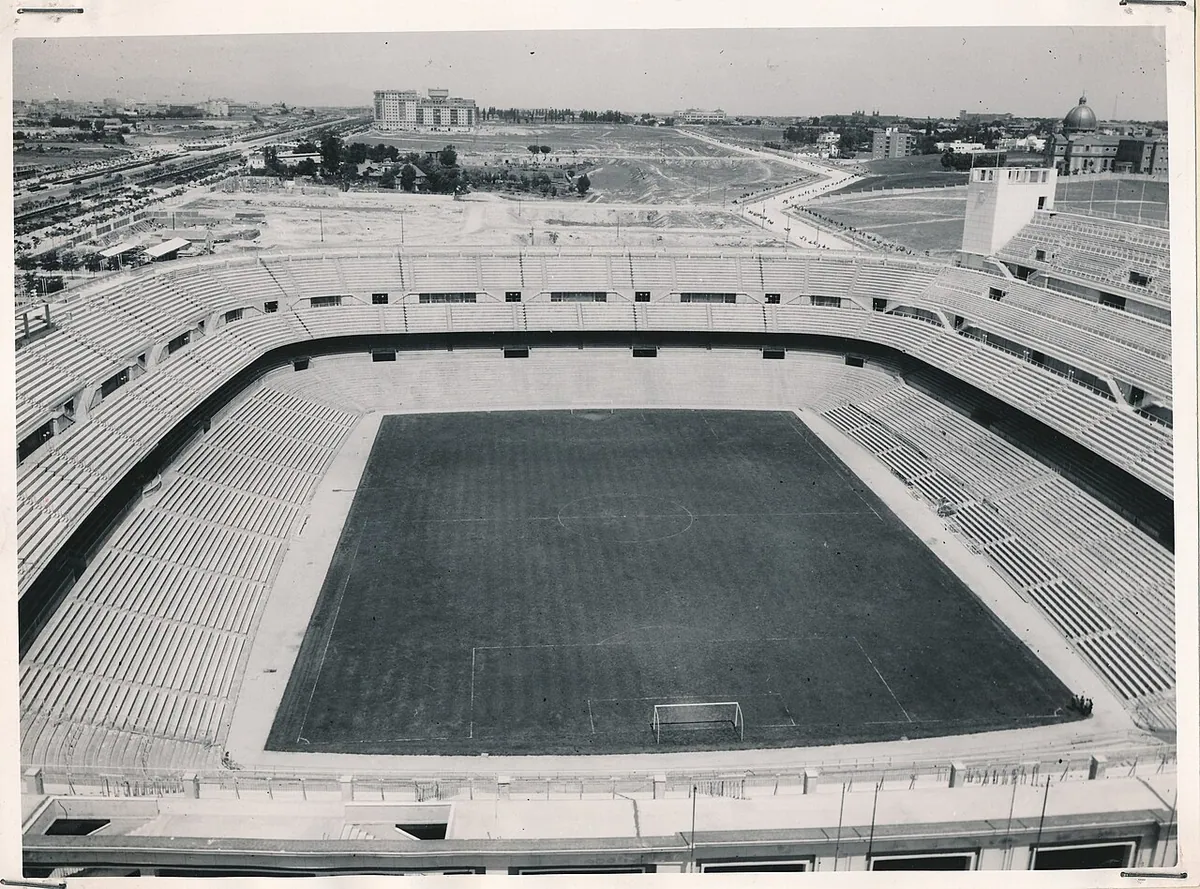
The Bernabéu's capacity has changed dramatically throughout its history due to expansions, safety regulations, and modernizations. Upon opening in 1947, it held 75,145 spectators, with only 27,645 seated and 47,500 standing. A major expansion in 1952 increased capacity to 125,000, and a record attendance of 129,690 was set for a European Cup match in 1956. Safety mandates and conversions to all-seater configurations led to reductions, with capacity falling to 90,000 by 1978, then rising to 110,000 after 1994 renovations, before being reduced to 81,044 by 1999. The most recent and comprehensive renovation began in 2019, with the stadium reopening on December 23, 2023. This project included the installation of a full retractable roof, extensive premium facilities, and technological upgrades. The current capacity is 83,186 all-seated, making it the third-largest stadium in Europe behind Barcelona's Camp Nou and London's Wembley Stadium. The stadium features 245 executive suites and a Mixto hybrid grass playing surface.
- 1982 Renovation: Cost $4.7 million (704 million pesetas) for the 1982 FIFA World Cup, adding a partial roof and reducing capacity to 90,000.
- 1992 to 1994 Expansion: Cost over 5 billion pesetas, adding a new tier on the west side and increasing height to 45 meters.
- 2001 to 2006 Master Plan: Cost 127 million euros, expanding the east side and adding VIP areas, raising capacity to 80,354.
- 2019 to 2024 Transformation: Adding the retractable roof and modernizing all facilities.
Architectural Features and Technology
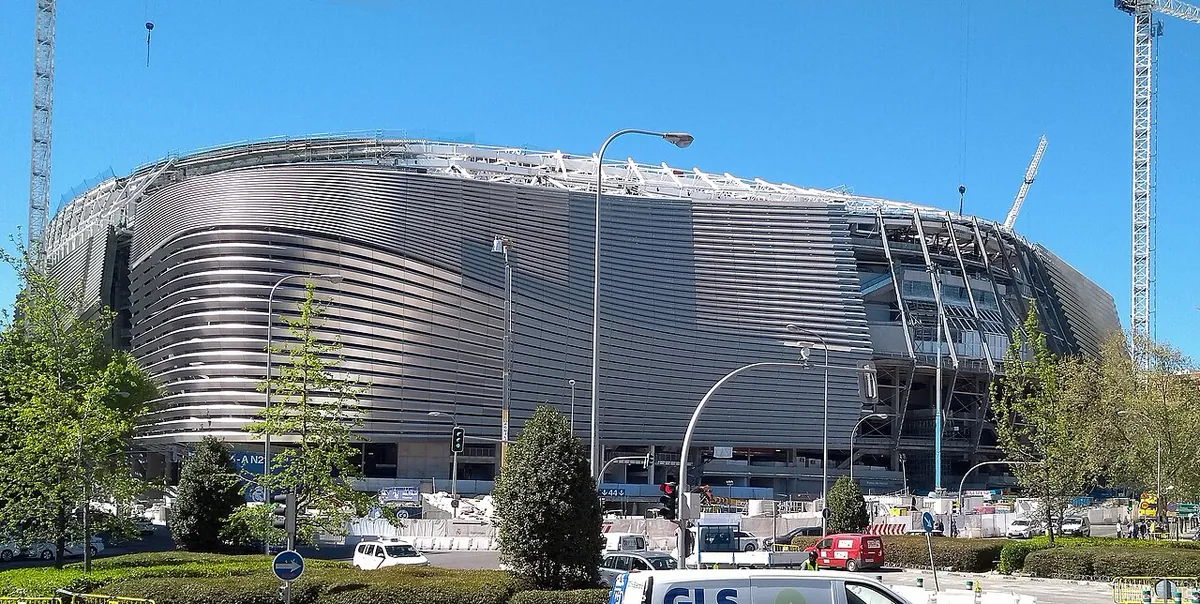
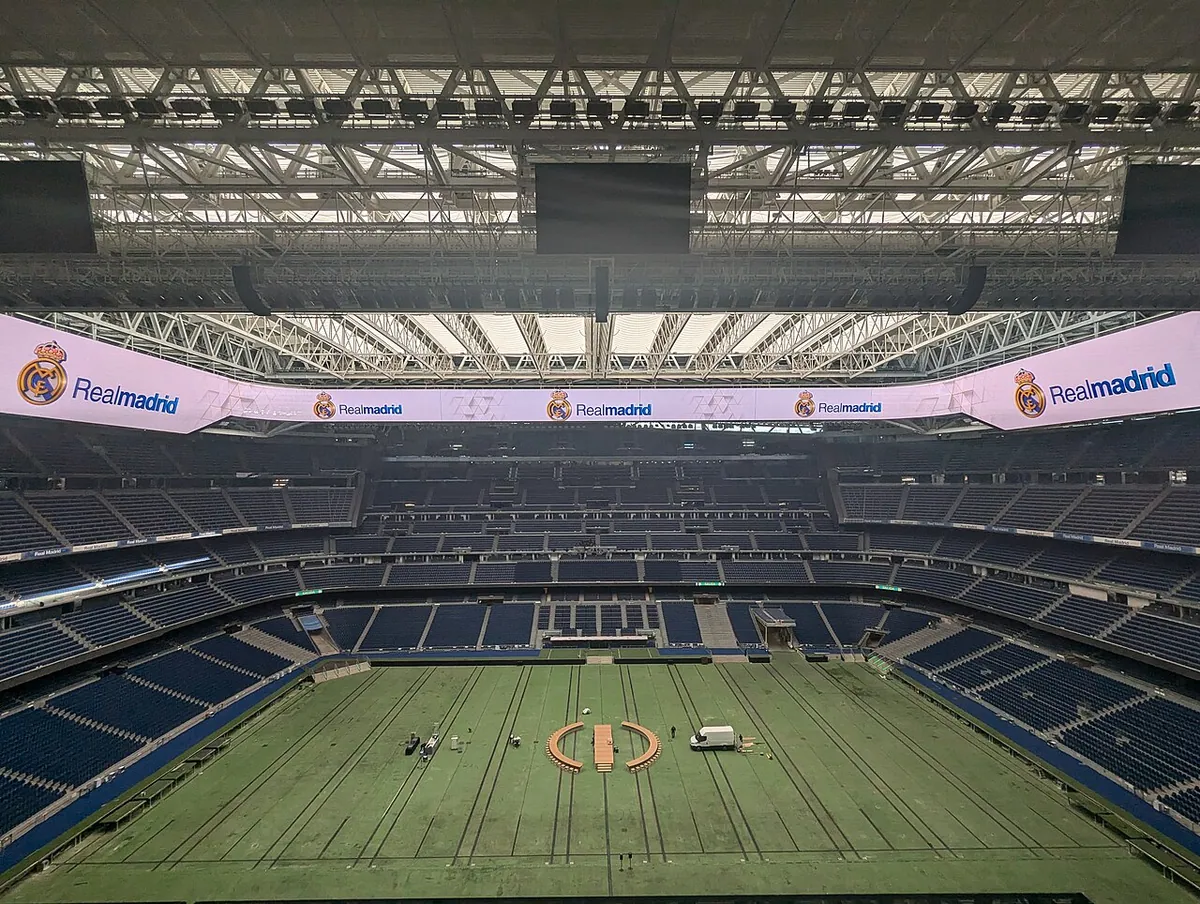
The Bernabéu is a technologically advanced venue, especially following its 2019 to 2024 transformation. Its most prominent feature is the full retractable roof, which allows the stadium to operate as an enclosed arena. For NFL games played at the Bernabéu, the roof is listed as closed. Due to the height of the stands casting shade, a subsurface heating system of polypropylene pipes was installed to maintain the turf. The stadium's lighting capability was significantly improved over the years, with floodlights first installed in 1957. The venue includes four entrance towers with staircases and spiral ramps for efficient fan access. Inside, the stadium houses a large commercial center known as La esquina del Bernabéu, six restaurants, a unique gastronomic area, panoramic lifts, and escalators. The press areas, locker rooms, and audio systems have all been modernized. The Bernabéu Tour and club museum, opened in 1999, allow visitors to experience the stadium from a player's perspective.
Football Tenants and Major Soccer Events
The primary and continuous tenant of the Bernabéu is Real Madrid, the noted soccer club that has called the stadium home since 1947. The club's success, including over 100 trophies and a record 35 international titles, is intrinsically linked to the venue. Beyond club soccer, the Bernabéu has hosted several of the world's most prestigious football finals. It staged the European Cup/UEFA Champions League final in 1957, 1969, 1980, and 2010. The stadium also hosted the second leg of the 2018 Copa Libertadores Finals. The stadium was also the site of the 1964 European Nations' Cup final and, most notably, the 1982 FIFA World Cup final. For that tournament, the stadium hosted three second-round matches and the final, where Italy defeated West Germany 3-1 in front of 90,000 fans. The Bernabéu has also been a venue for major non-sporting events, including a 1982 address by Pope John Paul II to a large crowd and concerts by artists like Taylor Swift, U2, and Bruce Springsteen. Notable milestones in the stadium's development include.
- 1955: Stadium renamed Santiago Bernabéu.
- 1957: Floodlights installed for nighttime games.
- 1972: First electronic scoreboard installed for the 25th anniversary.
- 1999: Bernabéu Tour and club museum opened.
- 2007: Awarded UEFA Elite Stadium status and designated for the 2010 Champions League final.
- 2023: Reopened after major renovation on December 23.
- The stadium's name was formerly Santiago Bernabéu Stadium and is now known as Bernabéu.
Naming History and Records
The stadium's naming history reflects the legacy of the club it houses. From its 1947 opening until 1955, it was officially the Estadio Real Madrid Club de Fútbol. On January 4, 1955, it was renamed the Santiago Bernabéu Stadium in honor of the club's president and former player, Santiago Bernabéu de Yeste, a key figure in the club's development. The stadium holds a significant record for the largest crowd ever assembled within its walls. On April 19, 1956, during the era when the stadium had a capacity of 125,000, a total of 129,690 fans attended a European Cup match between Real Madrid and AC Milan. This remains the all-time record attendance for the venue. In the modern era with a reduced, all-seater capacity, sellout crowds for major events reach the current maximum of 83,186. The highest combined score in an NFL game at the Bernabéu in that period is 51 points, achieved in the Cincinnati Bengals' 34-17 victory over the Atlanta Falcons on November 8, 2026.
Financing and Economic Impact
The construction and renovation of the Bernabéu have involved substantial financial investment and innovative funding models. Subsequent renovations have been funded by the club, sometimes increasing its debt, as with the 5 billion peseta project in the early 1990s. The 1982 renovation received 530 million pesetas from the City of Madrid. The most expensive project was the 2019 to 2024 transformation. The stadium is designed to maximize revenue through its 245 executive suites, VIP areas, restaurants, and commercial center. Hosting major international events like the NFL game, which saw nearly 700,000 ticket requests, and concerts by global artists contributes significantly to the club's brand and economic activity. The stadium's Elite status from UEFA and its modern facilities ensure it remains a premier venue capable of generating income from diverse events beyond soccer. The original construction costs were broken down into several major categories.
- Land acquisition and related expenses: 4,500,000 pesetas.
- Loan costs: 2,000,000 pesetas.
- Material execution of the stadium: 28,000,000 pesetas.
- Office construction: 1,500,000 pesetas.
- Architect and surveyor fees: 1,300,000 pesetas.
- Compensation for City Council expropriations: 1,000,000 pesetas.
Access, Transportation and Visitor Information
The Bernabéu is well-integrated into Madrid's public transportation network, making it accessible for local and visiting fans. The stadium's address is Avenida de Concha Espina, 1, in the 28036 Madrid postal district. The Santiago Bernabéu metro station on Line 10 provides direct access. Numerous bus lines, including 14, 27, 40, 43, 120, 147, and 150, have stops near the venue. For those traveling from further afield or the airport, the nearby Chamartín railway station is a major hub offering high-speed train services and direct airport links. The stadium is open for tours every day of the year except December 25 and January 1, with standard operating hours from 9:00 AM to 7:00 PM, and from 9:30 AM to 6:00 PM on Sundays and public holidays. The tour includes access to the museum, player tunnel, pitchside, and presidential box.
Recent games
| Date | Game | Week |
|---|---|---|
| Nov 8, 2026 | Cincinnati Bengals 34 at Atlanta Falcons 17 | Week 9 |
Video
FAQ
Where is the Bernabéu stadium located?
The Bernabéu stadium is located in the Chamartín district of Madrid, Spain. Its specific address is Avenida de Concha Espina, 1, 28036 Madrid. The area is north of the city center and is served by the Santiago Bernabéu metro station, multiple bus lines, and the nearby Chamartín railway station with high-speed and airport links. Chamartín blends metropolitan skyscrapers and upscale shops with residential plazas and family-friendly parks.
What is the capacity of the Bernabéu?
Following its major renovation completed in late 2024, the Bernabéu has a seating capacity of 83,186. This makes it one of the largest stadiums in Europe. Its capacity has changed throughout history, from an opening capacity of 75,145 in 1947, expanding to 125,000 in the 1950s, and undergoing several reductions and increases due to renovations and safety regulations before settling at the current figure. The record attendance of 129,690 was set in 1956 before the stadium became all-seater.
Has the Bernabéu hosted an NFL game?
Yes, the Bernabéu hosted its first NFL regular season game on November 8, 2026. The game was a neutral-site contest where the Cincinnati Bengals defeated the Atlanta Falcons 34-17. This was the first official NFL game in Spain. The stadium also hosted an American football game in 1958 between teams from two US Air Force bases in Europe. For the 2026 NFL game, some seating was removed to fit the longer field, and the roof was closed.
When was the Bernabéu built and opened?
Construction on the Bernabéu began in October 1944 and was completed in December 1947. The stadium was officially inaugurated on December 14, 1947, with a friendly match between Real Madrid and the Portuguese club Os Belenenses. The first official match took place on December 28, 1947, a 5-1 Real Madrid victory over Athletic Club. The construction took over 30 months and involved moving 150,000 cubic meters of earth using 82,000 truckloads.
What major soccer finals has the Bernabéu hosted?
The Bernabéu has hosted four European Cup/UEFA Champions League finals, in 1957, 1969, 1980, and 2010. It hosted the 1964 European Nations' Cup final and the 1982 FIFA World Cup final, where Italy beat West Germany 3-1. It is the only stadium to have hosted finals of both the UEFA Champions League and the Copa Libertadores, staging the second leg of the 2018 Copa Libertadores final. These events confirm its status as one of the world's most prestigious football venues.
What was the first event ever held at the Bernabéu stadium?
The first event held at the Bernabéu stadium was a football match between Real Madrid and the Portuguese side Os Belenenses on December 14, 1947. This match served as the stadium's inauguration. Real Madrid striker Sabino Barinaga scored the first goal in the 15th minute. The stadium was officially named Estadio Real Madrid Club de Fútbol at the time, though fans commonly referred to it as the Nuevo Estadio Chamartín.
Sources
- Bernabéu (stadium) (Wikipedia) Wikipedia
- Atmosphere at Santiago Bernabeu Stadium looking a lot different ahead of 1st NFL game in Spain Yahoo Sports
- 10 Things to Know About Madrid's Santiago Bernabéu Stadium commanders.com
- nflverse game, roster and draft data nflverse (CC BY 4.0)