Bryant-Denny Stadium, officially known as Saban Field at Bryant-Denny Stadium, is the home football stadium for the University of Alabama Crimson Tide. Located on the university's campus in Tuscaloosa, Alabama, the stadium opened in 1929 as Denny Stadium. It has been expanded numerous times, with its current seating capacity of 100,077 making it one of the largest on-campus football stadiums in the United States. The venue is named for former university president George H. Denny and noted coach Paul Bear Bryant, with the playing field named in 2024 for the program's second-winningest coach, Nick Saban. The stadium is the fourth-largest in the Southeastern Conference and the eighth-largest stadium in the United States.
Location and Construction
Bryant-Denny Stadium is situated on the southwestern edge of the University of Alabama campus in Tuscaloosa. Groundbreaking for the stadium occurred in December 1928, and it opened on September 28, 1929, with a 55-0 victory over Mississippi College. The original construction cost was $196,000, which is equivalent to approximately $3.68 million in 2025 dollars. The architects for the project were Atwood and Nash, Inc., Architects and Engineers. The stadium was originally named Denny Stadium in honor of George H. Denny, the university's president from 1912 to 1932. It was built to replace the older Denny Field and was initially a single grandstand on the west sideline with a capacity of 12,000 spectators. The stadium was officially dedicated the following week during homecoming ceremonies against Ole Miss, a game Alabama won 22-7. President Denny initially envisioned a full bowl stadium capable of seating 66,000 people, a vision that would be realized through decades of expansion.
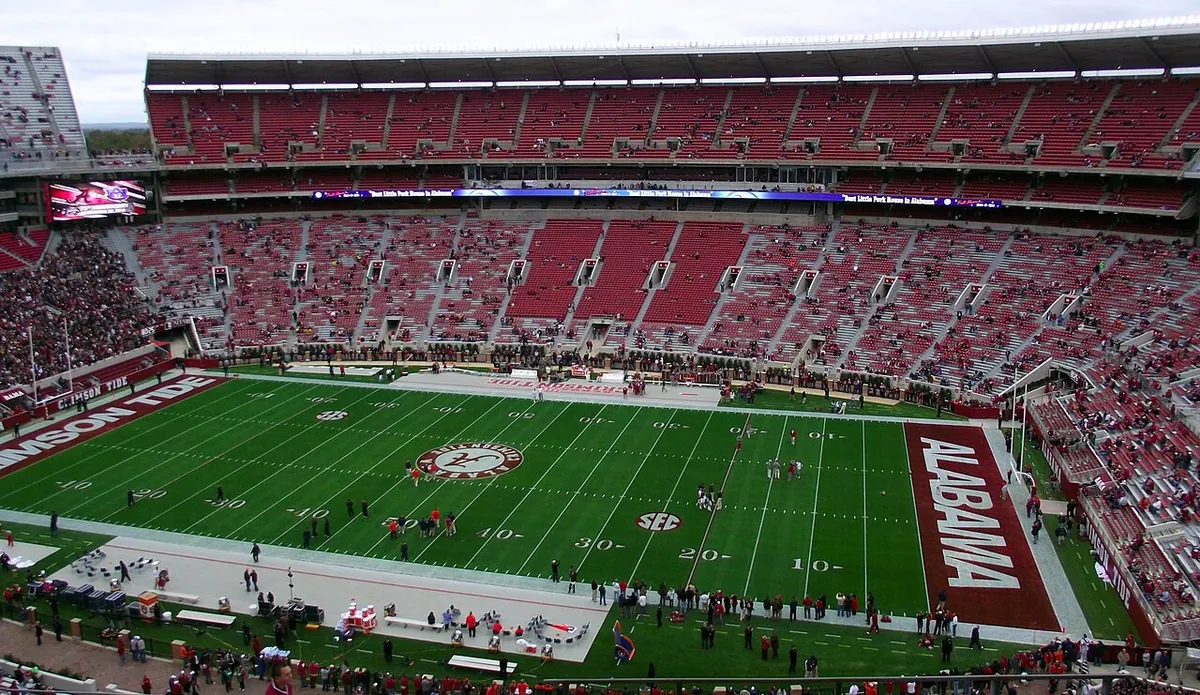
Expansion History and Capacity Timeline
Bryant-Denny Stadium has undergone eight major expansions since its opening, transforming it from a 12,000-seat venue into one of the largest stadiums in college football. The first expansion in 1937 added a permanent grandstand on the east sideline, raising capacity to 24,000. Bleachers were added to both end zones in 1946 for a total of 31,000 seats. New seats in the west grandstand in 1961 increased capacity to 43,000, and the enclosure of both end zones in 1966 brought the figure to 60,210. A west side upper deck was added in 1988, pushing capacity to 70,123. A significant east side upper deck expansion in 1998 added 10,000 seats and 81 skyboxes, bringing official capacity to 83,818. The north end zone was expanded in 2006, adding an upper deck and premium seating, which set a new record attendance of 92,138. The most substantial expansion was completed in 2010 with a south end zone upper deck and club area, which increased capacity to 101,821. Subsequent renovations from 2019 to 2024, which added premium seating and updated amenities, adjusted the current official capacity to 100,077.
| Year | Summary | Capacity |
|---|---|---|
| 1929 | Stadium opened | 12,000 |
| 1937 | East sideline grandstand | 24,000 |
| 1946 | Bleachers in end zones | 31,000 |
| 1961 | West grandstand seats | 43,000 |
| 1966 | End zones enclosed | 60,210 |
| 1988 | West side upper deck | 70,123 |
| 1998 | East side upper deck | 83,818 |
| 2006 | North end zone expansion | 92,138 |
| 2010 | South end zone expansion | 101,821 |
| 2020 | Premium seating renovation | 100,077 |
The 1998 expansion was financed by the university along with $4.65 million from the city of Tuscaloosa, the city of Northport, and Tuscaloosa County. In return, the university pledged to move all Crimson Tide home games to Bryant-Denny and cease playing games at Legion Field in Birmingham. The 2006 north end zone expansion cost approximately $47 million and included the creation of the Walk of Champions plaza. The 2010 south end zone expansion was initially budgeted at $80.6 million but was completed for about $65.6 million due to lower construction costs. The expansion added a two-level South Zone club with 1,700 seats and 36 skyboxes, bringing the total number of skyboxes in the stadium to 159.
Football Tenants and Home Record
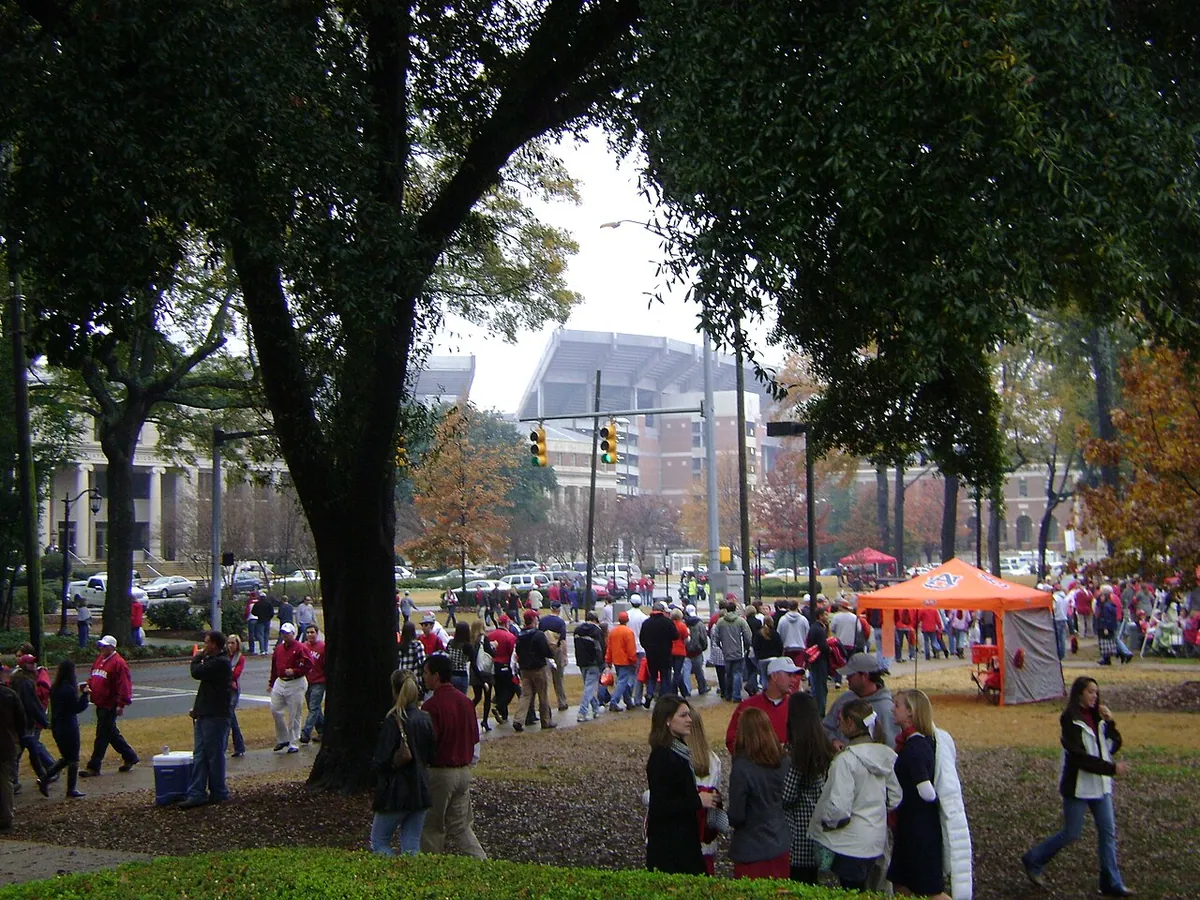
The Alabama Crimson Tide football team has been the primary football tenant of Bryant-Denny Stadium since its opening in 1929. The Iron Bowl rivalry game with Auburn was hosted at Legion Field in even-numbered years from 1988 through 1998. The move of all major home games to Tuscaloosa was finalized in 2003, and Bryant-Denny Stadium has since been the exclusive home for Alabama football. Through the 2023 season, the Crimson Tide owns an all-time record of 304 wins, 54 losses, and 3 ties at the stadium, for a winning percentage of .844 (not including vacated wins). Since the 2007 season, under head coach Nick Saban, Alabama compiled an 88-7 record at the venue (not including vacated wins). Dating back to the 1988 renovation, nearly 21 million fans have attended 253 home games over 37 seasons.
- 1998: The east upper deck expansion made Bryant-Denny's capacity exceed Legion Field's.
- 1999: The home game series against Tennessee moved permanently to Tuscaloosa.
- 2000: Alabama hosted the Iron Bowl at Bryant-Denny Stadium for the first time.
- 2003: Alabama played its final game at Legion Field, a contest against South Florida.
Major Renovations and Modern Features
A series of renovations from 2019 to 2024, part of a larger 10-year, $600 million campus athletic facilities plan, significantly upgraded Bryant-Denny Stadium. The $107 million project included the creation of three new club areas and the addition of 3,826 new premium seats, including loge boxes, a Terrace Club, a Champions Club, and Founders Suites on the west side. New skyboxes were added on the east U1 level, and existing skyboxes were renovated. Team areas were improved, with an expanded locker room and tunnel, and the recruiting room was nearly doubled in size. A student plaza was added on the south side, and the press box was relocated to the east side. The stadium's four corner video boards were enlarged, and an updated sound system was installed prior to the 2021 season. Previous major technological upgrades include.
- 2019: A state-of-the-art LED light system was installed, featuring instant on/off capabilities, full dimming, and the ability to display different colors and effects.
- 2006: The north end zone expansion added three levels of premium seating, 38 luxury skyboxes, two large video scoreboards, and wrap-around display boards on the upper deck facades.
- 1999: Four additional skyboxes were built, and a scoreboard with video replay capabilities was installed in the south end zone.
- 1998: The east side expansion added two spiral walkways and reception areas for Scholarship and A-Club level patrons above the center entrance.
Naming History and Honors
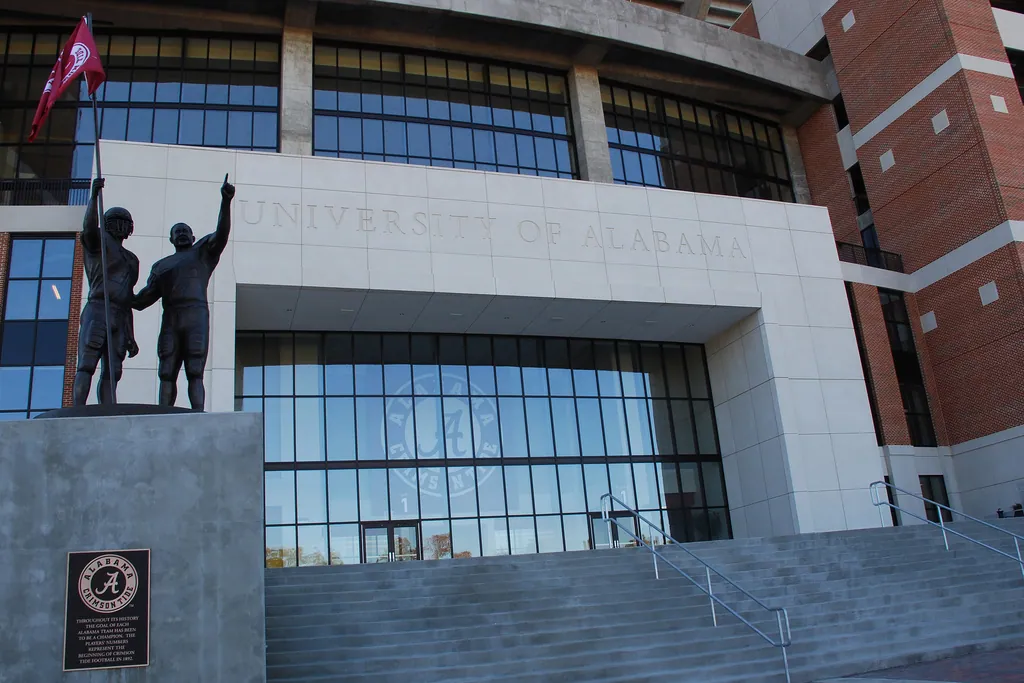
The stadium's naming history reflects the legacy of Alabama football. It opened as Denny Stadium in 1929, named for University President George H. Denny. In 1975, the Alabama state legislature added the name of noted head coach Paul Bear Bryant, creating Bryant-Denny Stadium. Bryant coached the team for seven more seasons at the venue bearing his name. On September 7, 2024, the playing field was named in honor of Nick Saban, following approval by the University of Alabama System Board of Trustees. The official name became Saban Field at Bryant-Denny Stadium. Saban coached the Crimson Tide from 2007 to 2023, winning six national championships during his tenure in Tuscaloosa. The stadium grounds feature the Walk of Champions, a brick plaza leading from University Boulevard to the north end zone entrances. This plaza honors Alabama's national championship coaches and commemorates the team's national and SEC titles. The Walk of Champions includes several specific features.
- 16 granite monuments set into the walkway commemorating Alabama's SEC and national championship teams.
- Five bronze statues, each approximately 9 feet tall and 2,000 pounds, honoring national championship coaches Wallace Wade, Frank Thomas, Paul Bear Bryant, Gene Stallings, and Nick Saban.
- A semicircular wall behind each statue bearing the coach's name and championship year(s).
- A bronze statuary group of two anonymous players at the north end zone entrance. One wears number 18 and holds a flag, the other wears number 92, together representing the year 1892, the first season of Alabama football.
Stadium Surface and Field Design Evolution
The playing surface at Bryant-Denny Stadium has changed several times over its history. From 1929 to 1967, the field featured natural grass. AstroTurf was installed in 1968 and remained until 1990, when the stadium returned to a natural grass surface, which has been used ever since. The field design has evolved from a purely functional layout to one incorporating team and conference branding. For many years, the field had only necessary markings and block-style ALABAMA lettering in the end zones. A script A was added at midfield in 2002. The current design, established in the 2004 season, features a crimson script A logo encircled by Alabama Crimson Tide at midfield. The end zones display ALABAMA in the north and CRIMSON TIDE in the south, in a white block font on a crimson background. SEC logos are displayed on the 25-yard lines, and in 2011, houndstooth awareness ribbons were added to the field to recognize tornado relief efforts. Special commemorative field logos have been used for specific seasons.
- 1992: A special midfield logo commemorated the centennial season of Alabama football.
- 2006: Logos on the 25-yard lines marked the 175th anniversary of the university.
- 2007: Logos on the 25-yard lines marked the 75th anniversary of the Southeastern Conference.
- 2008: SEC logos with Alabama crimson as the primary color were added to the 25-yard lines.
Notable Games and Events
While many historic Alabama games were played at Legion Field, Bryant-Denny Stadium has hosted numerous memorable contests. The 1999 game against LSU featured a goal-line stop by Marvin Constant as time expired to preserve a victory. In 2005, Tyrone Prothro made a notable reception over a Southern Miss defender, and the Tide defeated No. 5 Florida 31-3. The 2008 Iron Bowl marked Alabama's first victory over Auburn at Bryant-Denny, a 36-0 shutout that broke a six-game losing streak in the series. The 2009 game against Tennessee was decided by Terrence Cody's blocked field goal as time expired. The stadium also saw a notable loss in the 2010 Iron Bowl, commonly known as the Camback. Other significant games include a 1994 high-scoring contest between Alabama's Jay Barker and Georgia's Eric Zeier, and a Roman Harper-forced fumble against Tennessee in 2005 that helped secure a win. The newly expanded stadium debuted on September 5, 1998, with a 38-31 victory over BYU where running back Shaun Alexander set a single-game record with five touchdowns.
Bryant-Denny Stadium has also been the site for other football events beyond Crimson Tide games. Since 2009, it has been a regular host for the Alabama High School Athletic Association's Super 7 state championship games. The stadium has set its record attendance of 101,821 on multiple occasions. The venue's reputation for a challenging environment is noted in various rankings, with NCAA Football 11 ranking it as the fourth toughest place to play in the nation and third in the SEC in 2010. Sporting News has ranked it first, while Bleacher Report ranked it as the fifth toughest and second best stadium in the country.
Financial Aspects and Premium Seating
The financial evolution of Bryant-Denny Stadium mirrors its physical growth. The 1998 east upper deck expansion had a final cost of $35 million. The most recent 2019 to 2024 renovations cost $107 million. Premium seating has become a major component of the stadium's revenue and fan experience. The South Zone club, opened in 2015, offers 1,700 patrons climate-controlled club space with all-inclusive catering and dedicated entry at Gate 28. The 2024 renovations added the Terrace Club, Champions Club, and Founders Suites on the west side. Skyboxes have proliferated through expansions, starting with 81 added in 1998, growing to 123 after 2006, and reaching 159 after the 2010 expansion. Key financial and seating milestones include.
- 1929: Initial cost of $196,000 for 12,000 seats.
- 1998: $35 million expansion adding 10,000 seats and 81 skyboxes.
- 2006: $47 million expansion adding premium seating and 38 skyboxes.
- 2010: $65.6 million expansion adding 1,700 club seats and 36 skyboxes.
Video
FAQ
What is the capacity of Bryant-Denny Stadium?
The current official seating capacity of Bryant-Denny Stadium is 100,077. This figure resulted from renovations completed between 2019 and 2024 that added premium seating while adjusting overall capacity. The stadium's largest recorded attendance is 101,821, which was the official capacity following the 2010 south end zone expansion. It is the fourth-largest stadium in the Southeastern Conference and one of the largest on-campus football stadiums in the nation.
When was Bryant-Denny Stadium built and opened?
Construction on Bryant-Denny Stadium began with a groundbreaking in December 1928. The stadium opened on September 28, 1929, with the Alabama Crimson Tide defeating Mississippi College by a score of 55-0. The original construction cost was $196,000. It was dedicated the following week during homecoming ceremonies against Ole Miss, which Alabama won 22-7. The venue was originally named Denny Stadium after university president George H. Denny.
Why is it called Bryant-Denny Stadium?
The stadium is named for two key figures in University of Alabama history. It opened in 1929 as Denny Stadium, honoring President George H. Denny. In 1975, the Alabama state legislature added the name of Paul Bear Bryant, the noted head football coach, to the stadium's title, creating Bryant-Denny Stadium. In 2024, the playing field was named Saban Field in honor of coach Nick Saban, making the full official name Saban Field at Bryant-Denny Stadium.
What is the Walk of Champions at Bryant-Denny Stadium?
The Walk of Champions is a brick plaza leading from University Boulevard to the north end zone entrances of the stadium. It features 16 granite monuments set into the walkway that commemorate the Crimson Tide's SEC and national championship teams. The plaza also includes five bronze statues, each honoring an Alabama football coach who led the team to a national championship: Wallace Wade, Frank Thomas, Paul Bear Bryant, Gene Stallings, and Nick Saban. The statues were unveiled between 2006 and 2011.
What is the all-time football record for Alabama at Bryant-Denny Stadium?
Through the 2023 season, the Alabama Crimson Tide owns an all-time record of 304 wins, 54 losses, and 3 ties in games played at Bryant-Denny Stadium. This equates to a winning percentage of .844. The record includes all games since the stadium opened in 1929. From the 2007 season through 2023, under head coach Nick Saban, Alabama compiled a record of 88 wins and 7 losses at the venue, for a .926 winning percentage during that 17-season span.
What is the full name of the stadium and why was it changed in 2024?
The stadium's full name is Saban Field at Bryant-Denny Stadium. In 2024, the University of Alabama announced that the playing field would be named in honor of head coach Nick Saban, who led the Crimson Tide to six national championships between 2007 and 2023. The stadium itself has been known as Bryant-Denny Stadium since 1975, when the state legislature added longtime head coach Paul 'Bear' Bryant to the original name of Denny Stadium. The naming honor for Saban was formally approved by the University of Alabama System Board of Trustees in July and September of 2024.
Sources
- Bryant-Denny Stadium (Wikipedia) Wikipedia
- Saban Field at Bryant-Denny Stadium rolltide.com
- South Zone crimsontidefoundation.org