Highmark Stadium is an American football stadium located in Orchard Park, New York, a suburb of Buffalo. It opened on June 23, 2026, and serves as the home field of the Buffalo Bills of the National Football League. The stadium was designed by the architecture firm Populous with a focus on creating an intimate, football-first environment while embracing the region's winter weather. With a final construction cost reported to be $2.2 billion, the venue features a 360-degree canopy covering 65 percent of seats but leaves the natural grass playing field fully exposed to the elements. The stadium is owned by the state of New York and operated by Legends Hospitality.
Location and Construction
Highmark Stadium is situated at 10 Bills Plaza in Orchard Park, New York, directly adjacent to Erie Community College's south campus. The site is across the street from the location of the Buffalo Bills' previous stadium. Groundbreaking for the new facility took place on June 5, 2023, initiating a three-year construction process. The structural steel framework was topped out on April 4, 2025, with a ceremonial ribbon-cutting held on June 23, 2026, to officially open the venue. The stadium was built at an elevation of 770 feet above mean sea level.
The total cost for the stadium was $2.2 billion, a figure that increased from initial estimates due to rising labor and material costs. The state of New York contributed $600 million, with $418 million of that sum coming from funds seized from the Seneca Nation of New York related to casino compact disputes. Erie County contributed $250 million, the Buffalo Bills ownership contributed $350 million, and the NFL provided a $200 million loan. Under the 30-year lease agreement, the state of New York owns the stadium and is also responsible for $280 million in maintenance costs over the lease term, plus $6 million annually for capital improvements, with both figures adjusted for inflation.
Groundbreaking ceremony was held on June 5, 2023. Vandalism was discovered in the stadium on February 16, 2026, leading to a temporary work stoppage. The ribbon-cutting ceremony opened the stadium on June 23, 2026. PSL holders attended a scrimmage and practice on August 8, 2026. The project faced challenges like fan trespassing into the excavation site, nicknamed "The Pit," during the 2023 season.
Design and Capacity
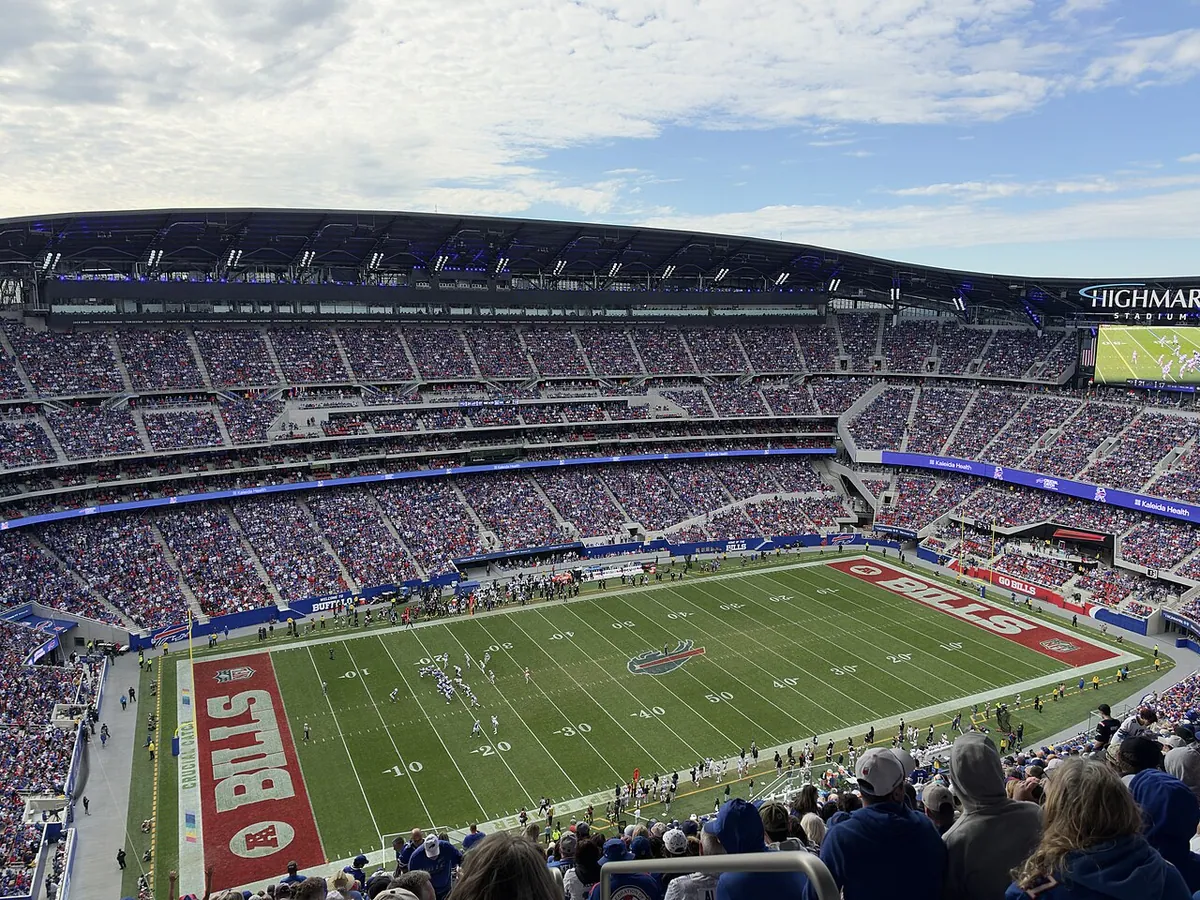
Populous designed Highmark Stadium as a football-focused, open-air venue intended to preserve the atmospheric conditions of Buffalo's climate while providing greater spectator comfort than the previous stadium. The exterior features a continuous colonnade of vertical fins and perforated metal panels that provide wind and precipitation protection while maintaining an open-air character. The lower portion uses iron-spot brick, and large openings at the north end zone and corners serve as main entrances. A defining feature is the 360-degree canopy that covers approximately 65 percent of the seating bowl, sheltering fans while leaving the entire playing field exposed to snow, wind, and cold.
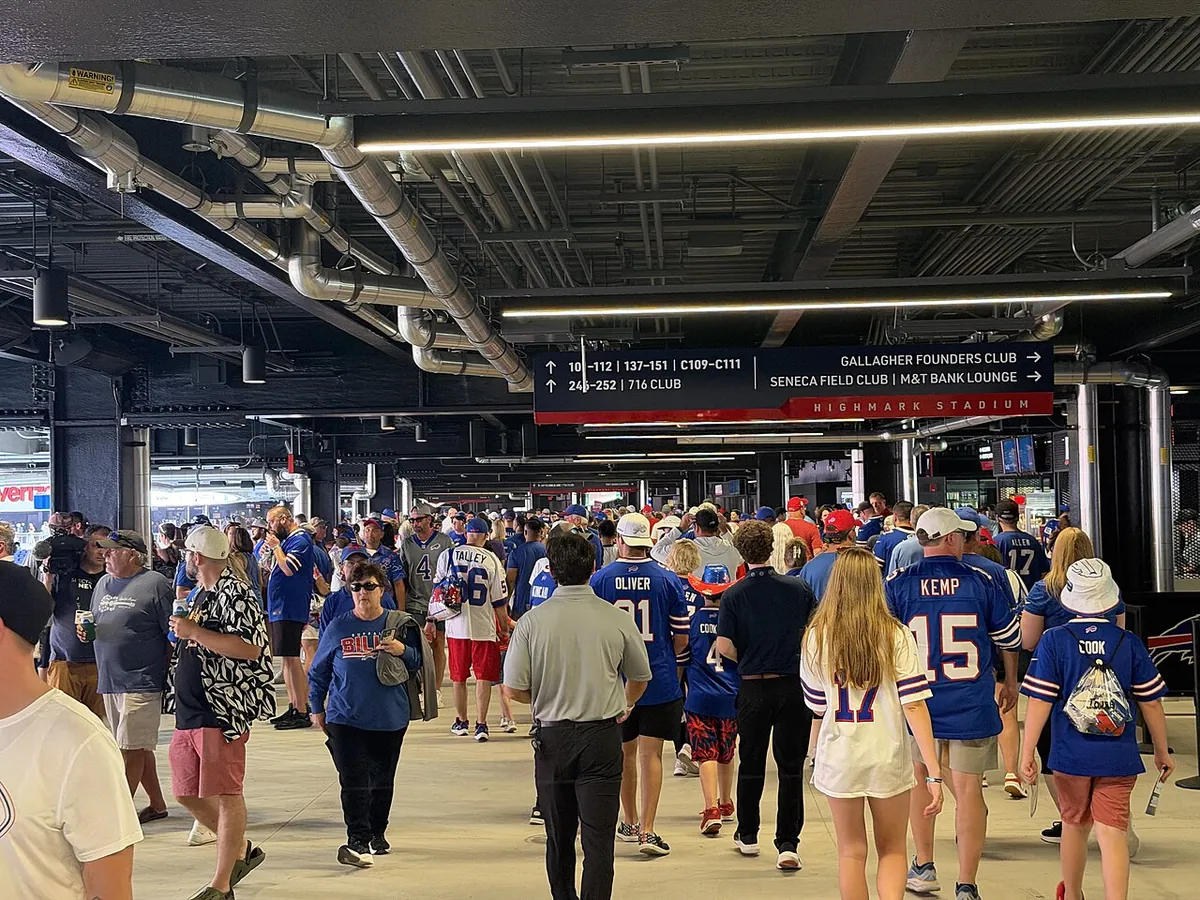
The seating bowl was designed with steep, stacked seating to bring spectators closer to the field, creating what the architects describe as an intimate and intimidating environment. The upper seating bowl is the closest in the NFL, with seats above the north end zone positioned just 12 feet vertically from the field. Interior circulation is organized around 360-degree concourses that allow fans to move around the stadium while retaining views of the field. The stadium includes seven sensory rooms, the most of any venue in the world, and a General Admission Plus concourse located only 12 feet above the field. The playing surface is a Kentucky bluegrass field equipped with an underground heating system, and the stadium features the world's largest stadium roof snow-melt system.
The official seating capacity is 60,108, which is the smallest among all NFL venues. With the addition of 2,892 standing room positions, the total capacity reaches 63,000, and it can be configured to hold up to 66,000 for certain events. This represents a significant reduction from the team's previous stadium, which held approximately 71,608 fans. The decision for a smaller capacity was driven by a focus on fan experience and the regional assessment that Buffalo lacked the infrastructure to host mega-events like the Super Bowl, making a massive stadium less necessary.
The stadium incorporates several innovative design features intended to set new standards for the NFL. A 360-degree canopy covers 65 percent of spectator seats. It contains seven sensory rooms, the most of any venue worldwide. The GA+ concourse is located only 12 feet above the playing field. The facade is custom-designed to mitigate wind. Over 35 brand activations throughout the venue celebrate Bills traditions and Buffalo's industrial heritage.
Football Tenants and Events
Highmark Stadium is the exclusive home of the Buffalo Bills. The team played its first games in the new venue during the 2026 NFL season. From the 1999 season through the 2026 season, the Bills played 225 NFL games at their Orchard Park home, comprising 216 regular season contests and 9 playoff games. Over those years, the stadium operated under the names Ralph Wilson Stadium (129 games), New Era Field (90 games), and Highmark Stadium (6 games). The highest-scoring NFL game at the venue from 1999 to 2026 was a 82-point affair on January 3, 2021, when the Bills defeated the Miami Dolphins 56 to 26.
The stadium's design and Buffalo's weather are integral to the team's home-field identity. The open-air configuration, wind-mitigating facade, and exposed field are intended to leverage the region's cold and snowy conditions. The venue has not hosted a Super Bowl, and civic leaders have stated that Buffalo's infrastructure is not suited for such an event. The stadium's primary use is for NFL football, and it is not designed to easily accommodate other sports like soccer or baseball. The Bills have a perfect home record against the Arizona Cardinals, Green Bay Packers, and Tampa Bay Buccaneers in games played at their Orchard Park stadium.
Beyond the NFL, the stadium has a history of hosting other football events. The previous stadium on the site hosted high school football playoffs annually. It also hosted a college football game in 2013 between the University at Buffalo Bulls and the Bowling Green Falcons. Syracuse University played two home games at the old stadium in 1979 while their own venue was being rebuilt. The old stadium also hosted the opening ceremony for the 1993 Summer Universiade.
The first NFL game was on September 30, 1973 (Bills vs. New York Jets). The first playoff game was in 1989 (Bills vs. Houston Oilers). High school football playoffs are held there annually. The last regular season game at the old stadium was scheduled for early 2026.
Naming Rights and Stadium History
The stadium's naming rights are held by Highmark Blue Cross Blue Shield under a 10-year agreement announced in 2021. This extended an existing partnership and led to the venue being named Highmark BlueCross BlueShield Stadium. The naming continues a long history of corporate sponsorship for the Bills' home. The original stadium opened in 1973 as Rich Stadium under a deal with Rich Products. After that 25-year deal expired in 1998, the venue was renamed Ralph Wilson Stadium to honor the team's founder. A subsequent agreement with New Era Cap Company led to the name New Era Field from 2016 to 2020, followed by a temporary name of Bills Stadium before the Highmark deal was finalized.
The new Highmark Stadium represents a complete replacement rather than a renovation of the previous venue. The old stadium, which opened in 1973, was located directly across the street. It was known for its large capacity, which peaked at 80,024 when it opened and was later reduced to about 71,608. That stadium hosted numerous memorable games and events, including the first-ever NHL Winter Classic on January 1, 2008. The decision to build a new, smaller, and more modern facility was driven by the age of the old structure and the desire for improved fan amenities and economic sustainability. The old stadium's field always used artificial turf, unlike the natural grass in the new building.
Notable Features and Incidents
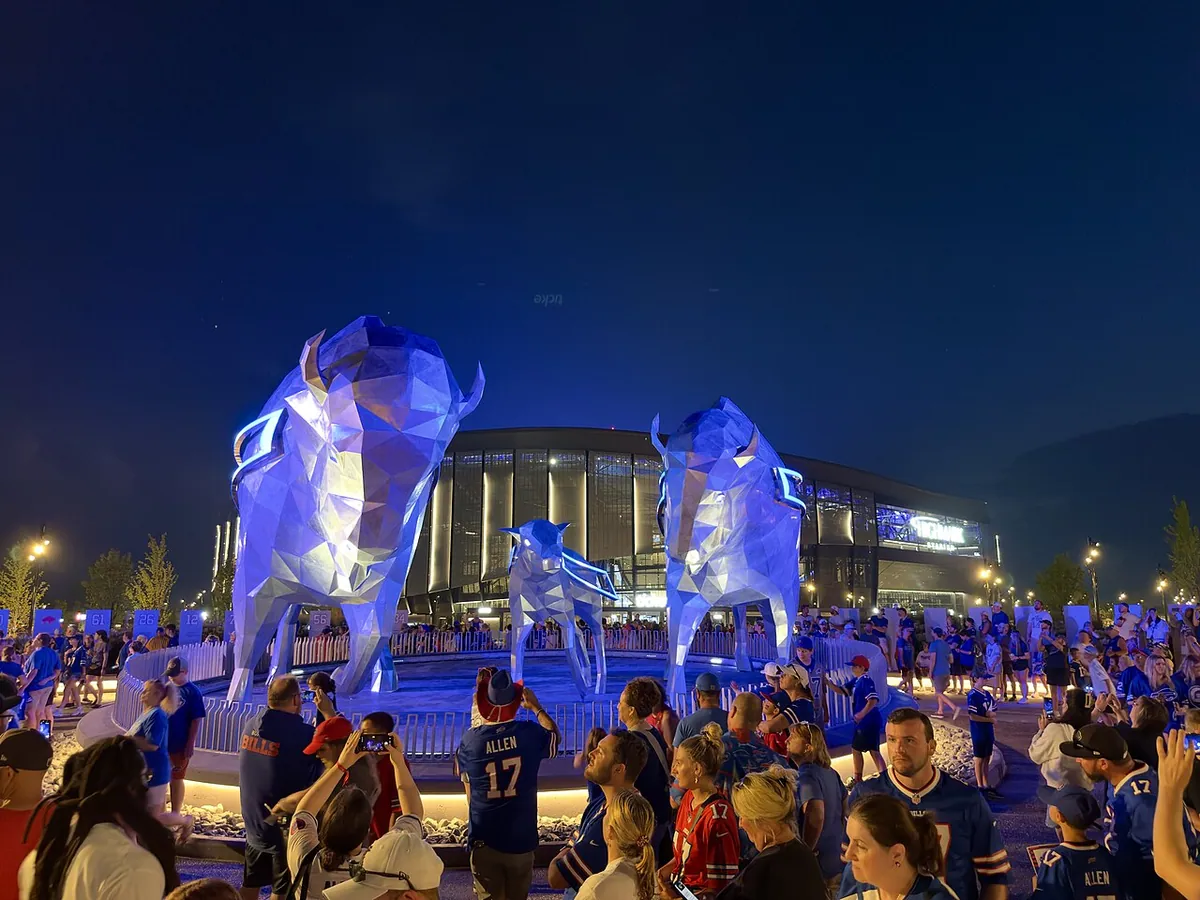
Several innovative features distinguish Highmark Stadium within the NFL. The canopy and perforated facade are specifically engineered to mitigate Buffalo's notorious wind and winter weather without eliminating the outdoor environment. During construction, the site gained the colloquial nickname "The Pit" among fans. A superstition emerged during the 2023 NFL season that 'feeding the pit' would lead to a Bills victory, coinciding with a six-game win streak. This led to increased security around the site after multiple fan incidents.
The construction process encountered a few notable incidents. A minor fire occurred on December 14, 2025, from sparks during welding work, but it caused no injuries or significant damage and did not delay the project. On February 16, 2026, construction was temporarily suspended after workers discovered graffiti in several secure locations, including four private luxury suites. The graffiti was reported to be pornographic and homophobic in nature. An investigation identified up to seven workers as alleged perpetrators, leading to two union workers being fired, though no criminal charges were filed by the Erie County District Attorney's Office. A specific design element, the metal panels for weatherproofing, was inspired by a similar design used at Kleinhans Music Hall in Buffalo.
Comparison to Previous Stadium
The new Highmark Stadium differs from its predecessor in several key aspects. The most obvious change is the reduced capacity. The old stadium opened with over 80,000 seats and settled at about 71,608, while the new venue has 60,108 seats. This reduction of approximately 11,500 seats reflects a modern trend toward more intimate, premium experiences over sheer volume. The design philosophy also shifted. The old stadium was a typical open-air bowl with limited fan protection, while the new stadium incorporates a extensive canopy covering 65 percent of seats, significantly improving spectator comfort in inclement weather.
The playing surface changed from perpetual artificial turf to a natural Kentucky bluegrass field with a sophisticated subsurface heating system. The architectural style moved from a utilitarian concrete oval to a design with curved forms, brick accents, and a perforated metal facade intended to reference Buffalo's historic architecture. Fan circulation was greatly improved with 360-degree open concourses that offer views of the field, a contrast to the more enclosed concourses of the old building. Finally, the ownership and funding model changed. The old stadium was owned by Erie County, while the new one is owned by the state of New York, which also bears long-term maintenance costs under the largest taxpayer contribution ever made for an NFL facility. The stadium's smaller size and open-air design align with a regional assessment that Buffalo lacks the infrastructure to host mega-events like the Super Bowl.
Recent games
| Date | Game | Week |
|---|---|---|
| Jan 10, 2027 | New York Jets at Buffalo Bills | Week 18 |
| Dec 19, 2026 | Chicago Bears at Buffalo Bills | Week 15 |
| Nov 26, 2026 | Kansas City Chiefs 10 at Buffalo Bills 13 | Week 12 |
| Nov 22, 2026 | Miami Dolphins 9 at Buffalo Bills 26 | Week 11 |
| Nov 1, 2026 | Baltimore Ravens 10 at Buffalo Bills 36 | Week 8 |
| Oct 4, 2026 | New England Patriots 29 at Buffalo Bills 26 | Week 4 |
| Sep 27, 2026 | Los Angeles Chargers 16 at Buffalo Bills 24 | Week 3 |
| Sep 17, 2026 | Detroit Lions 31 at Buffalo Bills 41 | Week 2 |
| Jan 4, 2026 | New York Jets 8 at Buffalo Bills 35 | Week 18 |
| Dec 28, 2025 | Philadelphia Eagles 13 at Buffalo Bills 12 | Week 17 |
| Dec 7, 2025 | Cincinnati Bengals 34 at Buffalo Bills 39 | Week 14 |
| Nov 16, 2025 | Tampa Bay Buccaneers 32 at Buffalo Bills 44 | Week 11 |
Video
FAQ
Where is Highmark Stadium located?
Highmark Stadium is located in Orchard Park, New York, which is a suburb of the city of Buffalo. The stadium's address is 10 Bills Plaza. It sits on land adjacent to the south campus of Erie Community College. The venue was constructed directly across the street from the site of the team's former home stadium.
When did Highmark Stadium open?
Highmark Stadium officially opened on June 23, 2026. This opening followed a construction period that began with a groundbreaking ceremony on June 5, 2023. The structural steel work was completed on April 4, 2025. The stadium officially opened with a ribbon-cutting ceremony on June 23, 2026, and PSL holders attended an event on August 8, 2026.
Which NFL team calls Highmark Stadium home?
Highmark Stadium is the home field for the Buffalo Bills of the National Football League. The Bills began playing their home games in the new stadium during the 2026 NFL season. The venue was specifically designed as a football-first facility for this franchise. The team has a 30-year lease to play at the stadium.
What is the seating capacity of Highmark Stadium?
Highmark Stadium has a seating capacity of 60,108 permanent seats, which is the smallest in the NFL. Including 2,892 standing room positions, the total capacity reaches 63,000 people. For special events, the configuration can be adjusted to accommodate up to 66,000 attendees. This is a reduction of roughly 11,500 seats compared to the old Bills stadium.
Does Highmark Stadium have a roof or dome?
Highmark Stadium does not have a full roof or dome enclosure. It is an open-air stadium that features a 360-degree canopy covering about 65 percent of the spectator seats. This canopy provides protection from wind and precipitation for most fans. The entire playing field, however, remains uncovered and exposed to Buffalo's outdoor weather conditions.
How much taxpayer money was used to build Highmark Stadium?
The construction of Highmark Stadium involved a taxpayer contribution of $850 million. The state of New York provided $600 million, and Erie County contributed $250 million towards the $2.2 billion total cost. This public funding represents the largest taxpayer contribution ever made for an NFL facility. The state is also responsible for hundreds of millions in future maintenance costs over the 30-year lease.
Sources
- Highmark Stadium (Wikipedia) Wikipedia
- Highmark Stadium Makes Regular Season Debut populous.com
- Highmark Stadium (New York) Facts for Kids kids.kiddle.co
- nflverse game, roster and draft data nflverse (CC BY 4.0)