Husky Stadium is an outdoor football stadium located on the campus of the University of Washington in Seattle, Washington. It has served as the home field for the Washington Huskies college football team since its opening on November 27, 1920. The stadium, known for its loud atmosphere and scenic views of Lake Washington and the Cascade Mountains, has also served as a temporary home for the NFL's Seattle Seahawks. Following a major $280 million renovation completed in 2013, the stadium's seating capacity was reduced to 70,138. In November 2026, it was announced that the venue will be renamed Columbia Bank Stadium starting January 1, 2027.
Construction, Renovations and Capacity History
Husky Stadium was built by the Puget Sound Bridge and Dredging Company, with groundbreaking on May 17, 1920. The original stadium opened later that year on November 27 with a capacity of 30,000 spectators and a dirt playing surface. The first major expansion came in 1936 with the addition of 10,000 seats around the rim of the lower bowl. In 1950, the stadium's first covered grandstand was constructed on the south side, adding 15,000 seats. Further expansions occurred in 1968, adding seats, and a major $13 million renovation in 1987 added a north grandstand with a cantilevered roof, increasing capacity to 72,500. That 1987 project made headlines when the north grandstand collapsed during construction on February 25, 1987, causing significant property damage but no casualties. It was still completed in time for the 1987 football season.
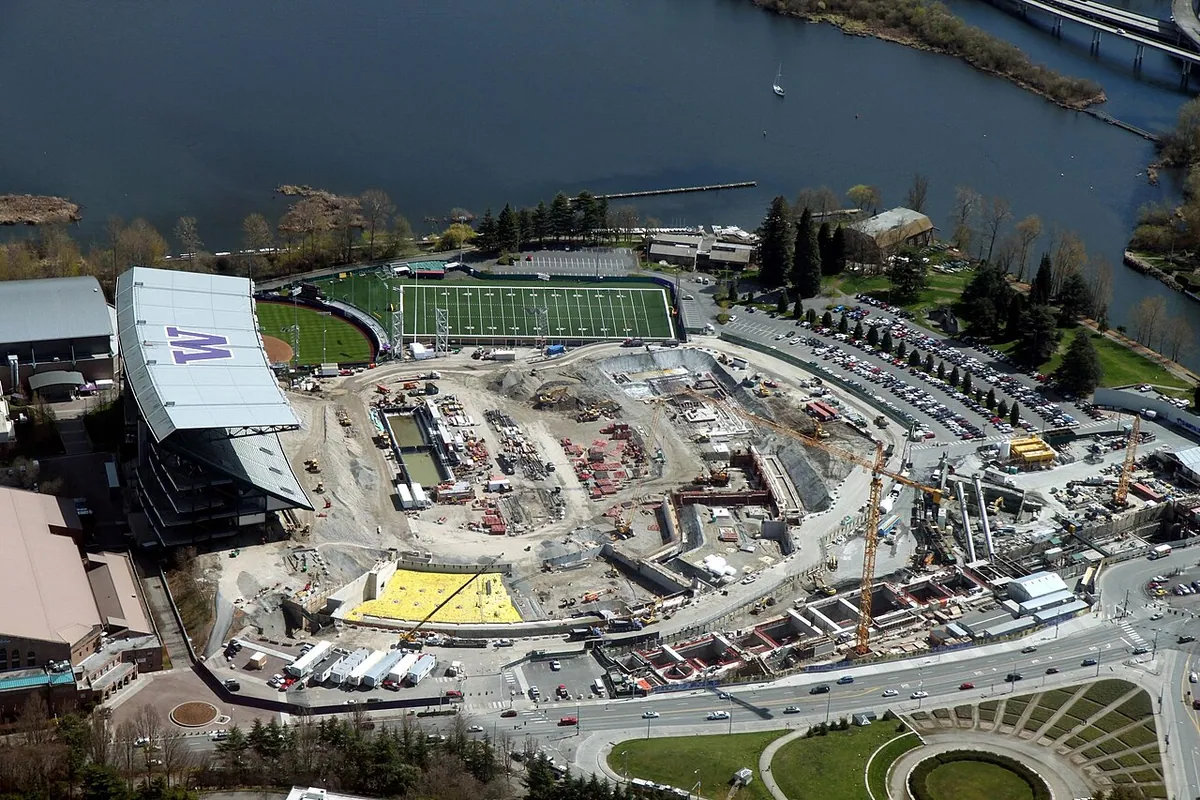
The most comprehensive renovation in the stadium's history began after the 2011 season. This $280 million project, which was privately funded, required the Huskies to play their 2012 home games at CenturyLink Field. The renovation involved demolishing and rebuilding most of the stadium except for the north upper deck. Key changes included lowering the playing field by four feet to bring seats closer to the action, removing the surrounding track, constructing a new lower bowl and south upper deck, and adding premium seating and suites. These changes reduced the official capacity from 72,500 to 70,138 upon reopening in 2013. The stadium's current seating capacity is 72,132. The project also incorporated extensive environmental measures, recycling over 95% of construction waste and using Salmon Safe practices to protect Lake Washington.
- 1920: Original opening with 30,000 seats on dirt.
- 1936: First expansion adds 10,000 seats.
- 1950: South grandstand built, capacity reaches ~55,000.
- 1968: Additional seats added.
- 1987: North grandstand built, capacity peaks at 72,500.
- 2013: Major renovation reopens stadium with 70,138 seats.
Football Tenants and Notable Games
The primary tenant of Husky Stadium since its inception has been the University of Washington Huskies football team. The stadium hosted its first game on November 27, 1920, a 28-7 loss for Washington against Dartmouth. The Huskies have played all their home games there since, through their move to the Big Ten Conference. The stadium has also hosted significant NFL action. The Seattle Seahawks used Husky Stadium as a temporary home for five games (two preseason, three regular season) in 1994 while the Kingdome was closed for roof repairs.
The highest-scoring NFL game at the venue during that span was on September 10, 2000, when the St. Louis Rams defeated the Seattle Seahawks 37-34 for a combined 71 points. The stadium has been selected to host the Washington state high school football championship games, known as the Gridiron Classic, on a trial basis starting in December 2023. Prior to the Seahawks' arrival in 1976, Husky Stadium also hosted 12 NFL preseason exhibition games between 1955 and 1975, with the San Francisco 49ers making the most appearances. The stadium was the site of a notable historical moment on July 27, 1923, when President Warren G. Harding delivered his last public speech there. He died in San Francisco six days later. During World War II in 1943, the stadium hosted a large public demonstration where 35,000 people watched a mock bombing raid and emergency response exercise involving the Seattle fire department and P-38 aircraft. The stadium also served as a venue for the 1990 Goodwill Games, hosting the opening and closing ceremonies as well as the track and field competition.
Playing Surface Evolution and Field Features
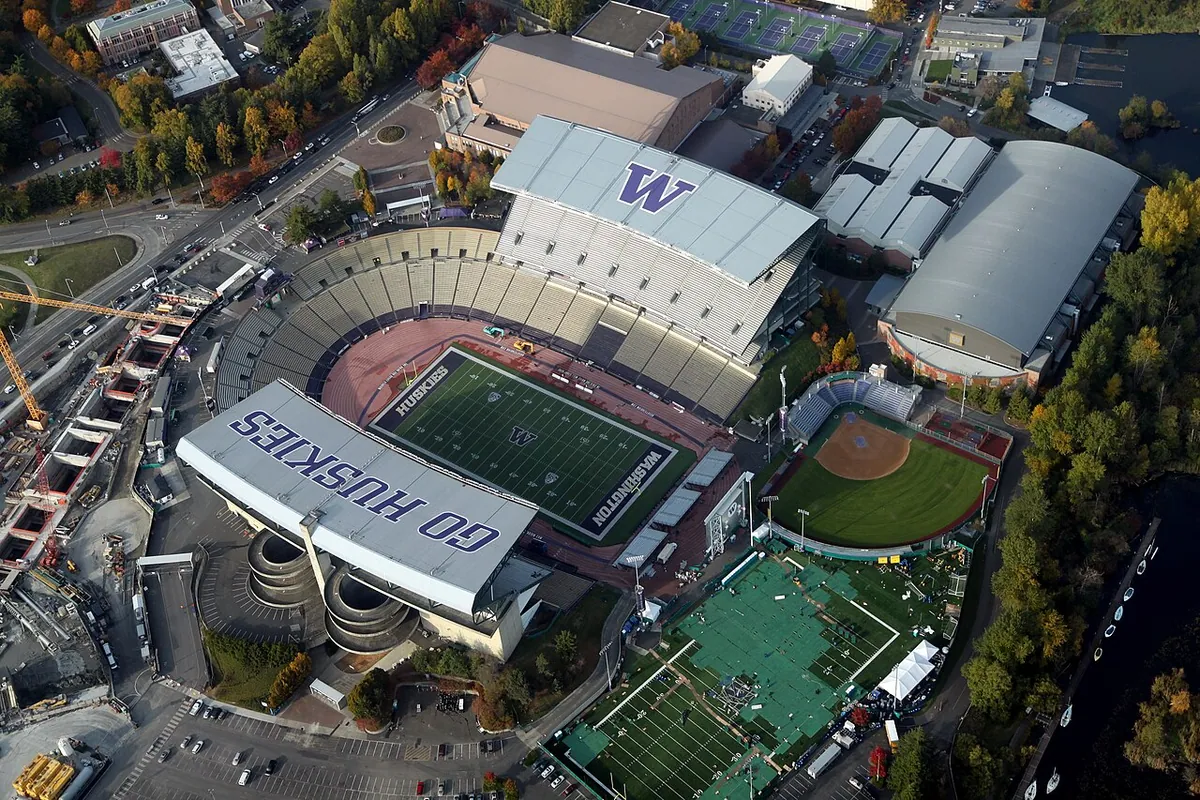
The playing surface at Husky Stadium has evolved significantly over its century of use. The original dirt field was replaced with natural grass in 1938. In 1968, Washington became one of the first major college football programs to install AstroTurf, replacing the grass. That original AstroTurf was replaced several times in 1972, 1977, 1987, and 1995. In 2000, a new type of synthetic turf called FieldTurf was installed, funded by Seattle Seahawks owner Paul Allen as part of the stadium's preparations for NFL use. The FieldTurf, featuring sand and rubber infill, proved so popular with players that the Seahawks installed it in their new permanent home as well.
The FieldTurf at Husky Stadium was replaced with newer versions in 2009 and again during the 2013 renovation. In 2021, the stadium returned to an AstroTurf system, specifically the AstroTurf 3D3 surface. This turf was replaced again in 2026. The appearance of the end zones has changed multiple times with the surface changes. They were painted gold during the 1980s and early 1990s, switched to purple with the 1995 AstroTurf, and became natural green with the 2000 FieldTurf installation. They reverted to gold for the 2009 season before returning to purple in 2010, and have been temporarily painted black for special "blackout" games. The open east end of the U-shaped stadium overlooks Lake Washington and provides views of the Cascade Mountains, including Mount Rainier. During the 2013 renovation, the field was lowered by four feet to bring spectators closer to the action, and the surrounding track was permanently removed to accommodate additional sideline seating.
Stadium Atmosphere and Cultural Phenomena
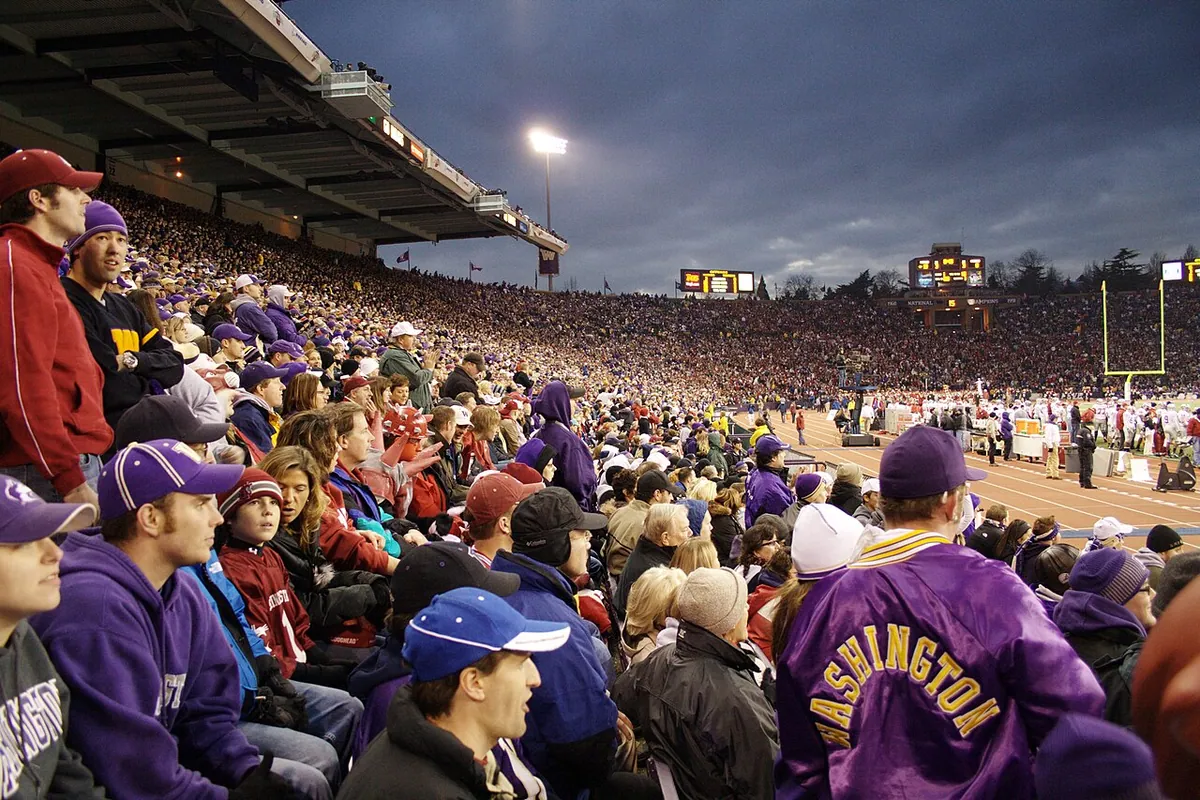
Husky Stadium is renowned for its exceptionally loud environment, a characteristic amplified by its architectural design. Nearly 70% of the seats are located between the end zones and are covered by cantilevered metal roofs that trap and reflect crowd noise. The stadium holds the record for the loudest noise level ever recorded at a college football stadium, measured at 133.6 decibels by ESPN during a game against Nebraska on September 19, 1992. Crowd noise routinely exceeds 100 decibels during games, and the intensity has been known to cause television cameras to shake. The stadium's setting is also famous, offering views of Lake Washington, the Downtown Seattle skyline, Mount Rainier, and the Cascade and Olympic mountain ranges.
The stadium is credited by many, though disputed, as the origin point of the "wave" or "Mexican wave" audience phenomenon. The event is said to have occurred on Halloween 1981, initiated by individuals including Husky band trumpeter Dave Hunter and former yell leader Robb Weller. The unique location also allows for "sailgating," where fans arrive by boat on Lake Washington and moor near the stadium. On game days, upwards of 12,000 people can be gathered on the water. The north and south parking lots are also hubs for traditional tailgating. The stadium serves as the site for the university's annual commencement ceremony each June.
Fans can also gather at the Dempsey Indoor Facility north of the stadium for pre-game Husky Huddles. After games, the Tyee Sports Council and UW Athletic Department host events with analysis from Washington coaches and former players. The Washington crew team offers shuttle services from boats on Lake Washington to the docks on game days. The stadium's first large video screen, a 23-by-42-foot "HuskyTron," debuted in 1998, and improved lighting for television broadcasts was added in 1999.
Naming Rights and Financial Agreements
For most of its history, the stadium was known simply as Husky Stadium, having been renamed from University of Washington Stadium after the 1970 football season. The first major corporate sponsorship agreement for the field itself began in 2015, when Alaska Airlines secured naming rights. The 10-year, $41 million deal named the playing surface "Alaska Airlines Field at Husky Stadium," making it the largest such agreement in college athletics at the time. Alaska Airlines declined to renew the agreement upon its expiration after the 2026 season, though it maintained other partnerships with UW athletics.
On November 12, 2026, the University of Washington announced a new, record-setting naming rights partnership with Columbia Bank. The 10-year agreement is worth $70 million, or $7 million annually. As a result, the entire stadium will be renamed Columbia Bank Stadium, effective January 1, 2027. This marks the first time the 'Husky Stadium' name will be replaced with a corporate sponsor's name for the venue itself. The $70 million deal represents the largest naming rights partnership in University of Washington history.
Other Sports and Event Considerations
Beyond football, Husky Stadium has been considered for other sporting events. In the mid-1990s, the University of Washington offered the stadium as a potential two-year home for a Major League Soccer team, including the Seattle Sounders, provided a plan for a permanent soccer stadium was in place. The stadium was also considered as a potential venue for the 1994 FIFA World Cup, but it lacked a suitable grass surface at the time. It was included as a candidate venue in the unsuccessful United States bid for the 2022 FIFA World Cup alongside what was then Qwest Field. The stadium was among several local venues evaluated for soccer use during that period. The university's offer to an MLS team included significantly discounted venue fees to facilitate the temporary arrangement. These considerations for soccer use occurred alongside the stadium's primary function as a football venue and its hosting of other major events like the Goodwill Games.
Transportation and Athletic District Integration
Husky Stadium is served by multiple transportation options, making it uniquely accessible. The University of Washington Link light rail station provides direct rail service to the venue. Several major bus routes also serve the stadium area. Fans can drive to the north and south parking lots for tailgating, and the 2013 renovation included construction of a 200-space parking garage beneath the south stands. The stadium's location on Union Bay allows for "sailgating," with fans arriving by boat on Lake Washington.
The stadium is integrated into a comprehensively remodeled athletic district at the University of Washington. This district includes a new $19 million Husky Ballpark, a new track and field stadium, a renovated soccer stadium, and a $50 million basketball operations and practice facility. Other recently completed projects include the Husky Legends Center, the Conibear Shellhouse, Alaska Airlines Arena renovations, and the Dempsey Indoor facility. The stadium renovation itself included an 80,000-square-foot football operations support building with a sports medicine clinic integrated into the west end zone. The athletic district remodel coincided with construction for the underground Link light rail station and the replacement of the Evergreen Point Floating Bridge. The stadium's design accounted for the constraints of the urban lakeside site while incorporating sustainable construction practices. During the 2013 renovation, concrete from the demolished lower bowl was crushed on site and reused as fill material under the new structure.
Stadium Records and Notable Features
Husky Stadium holds several notable records and features beyond its capacity. The venue's design with cantilevered roofs covering most seats between the end zones creates this acoustic phenomenon. The stadium was the first and primary income source for the University of Washington's remodeled athletic district, representing the largest single capital project in the university's history. The stadium has hosted significant non-sporting events, including presidential addresses and military demonstrations. Its use as a temporary NFL home required specific upgrades, including the installation of official NFL goalposts (optic yellow, 40 feet in height) in 2000. The venue's capacity of 72,132 makes it larger than any professional stadium in the Pacific Northwest region. The stadium's open end provides what many describe as the "Greatest Setting in College Football," with panoramic views of water and mountains.
| Feature | Detail |
|---|---|
| Record Loudness | 133.6 decibels (1992 vs. Nebraska) |
| Largest Renovation Cost | $280 million (2013) |
| Original Construction Cost | $600,000 (1920) |
| Field Lowering | 4 feet (2013 renovation) |
| Track Removal | 2013 renovation |
| First Artificial Turf | 1968 (AstroTurf) |
| NFL Goalposts Installed | 2000 |
| Video Screen Debut | 1998 (HuskyTron) |
Recent games
| Date | Game | Week |
|---|---|---|
| Jan 6, 2002 | Kansas City Chiefs 18 at Seattle Seahawks 21 | Week 17 |
| Dec 16, 2001 | Dallas Cowboys 3 at Seattle Seahawks 29 | Week 14 |
| Dec 2, 2001 | San Diego Chargers 10 at Seattle Seahawks 13 | Week 12 |
| Nov 11, 2001 | Oakland Raiders 27 at Seattle Seahawks 34 | Week 9 |
| Oct 28, 2001 | Miami Dolphins 24 at Seattle Seahawks 20 | Week 7 |
| Oct 14, 2001 | Denver Broncos 21 at Seattle Seahawks 34 | Week 5 |
| Oct 7, 2001 | Jacksonville Jaguars 15 at Seattle Seahawks 24 | Week 4 |
| Sep 23, 2001 | Philadelphia Eagles 27 at Seattle Seahawks 3 | Week 2 |
| Dec 23, 2000 | Buffalo Bills 42 at Seattle Seahawks 23 | Week 17 |
| Dec 16, 2000 | Oakland Raiders 24 at Seattle Seahawks 27 | Week 16 |
| Nov 26, 2000 | Denver Broncos 38 at Seattle Seahawks 31 | Week 13 |
| Nov 5, 2000 | San Diego Chargers 15 at Seattle Seahawks 17 | Week 10 |
FAQ
When was Husky Stadium built and opened?
Construction on Husky Stadium began with groundbreaking on May 17, 1920. The Puget Sound Bridge and Dredging Company built the venue, and it opened for its first game on November 27, 1920. That inaugural contest featured the Washington Huskies hosting Dartmouth College. The stadium has undergone several major renovations, most notably a $280 million project that was completed in 2013.
Did the Seattle Seahawks ever play at Husky Stadium?
Yes, the NFL's Seattle Seahawks used Husky Stadium as a temporary home on two separate occasions. The team played five total games there in 1994 while the Kingdome was closed for roof repairs. Later, after the Kingdome was demolished, the Seahawks played their full 2000 and 2001 NFL seasons at Husky Stadium. In total, the Seahawks played 16 regular season NFL games at the venue from 2000 to 2001.
Why is Husky Stadium considered so loud?
Husky Stadium's design is the primary reason for its loud reputation. Nearly 70% of the seats are located between the end zones and are covered by cantilevered metal roofs. These structures trap and reflect sound back toward the field. The stadium holds the verified record for the loudest noise level at a college football game, measured at 133.6 decibels during a 1992 contest. Crowd noise regularly surpasses 100 decibels during games.
What is the future name of Husky Stadium?
Husky Stadium will be renamed Columbia Bank Stadium starting January 1, 2027. This change results from a new 10-year naming rights agreement between the University of Washington and Columbia Bank, announced in November 2026. The deal is worth $70 million over its term. It replaces the previous field naming agreement with Alaska Airlines, which expired after the 2026 season.
What other notable events have happened at Husky Stadium?
The stadium has hosted events beyond football throughout its history. It was the site of President Warren G. Harding's final public address on July 27, 1923. It served as a primary venue for the 1990 Goodwill Games, holding the opening ceremonies and track events. The stadium was considered as a potential temporary home for a Major League Soccer team in the 1990s. It is also accessible by the University of Washington Link light rail station, as well as by bus, car, bicycle, and boat.
What is the current seating capacity of Husky Stadium?
The current seating capacity of Husky Stadium is 72,132. This makes it the largest stadium, college or professional, in the Pacific Northwest. The capacity was adjusted following a major renovation completed in 2013, which added premium seating but reduced the overall number from a previous high of 72,500. The stadium has undergone multiple expansions since its original opening with a capacity of 30,000 in 1920.
Sources
- Husky Stadium (Wikipedia) Wikipedia
- University of Washington Husky Stadium baike.baidu.com
- Husky Stadium worldofstadiums.com
- Husky Stadium, Facilities, University of Washington Athletics gohuskies.com
- At Husky Stadium, it's a whole new ballgame | UW Magazine magazine.washington.edu
- nflverse game, roster and draft data nflverse (CC BY 4.0)