Opened on October 1, 1927, it is the largest stadium in the United States and the Western Hemisphere, and the third-largest stadium in the world. The stadium's official capacity is 107,601. It was constructed at a cost of $950,000 and has undergone numerous expansions and a major $226 million renovation completed in 2010. Michigan Stadium is the home field for the University of Michigan Wolverines football team and has hosted crowds exceeding 115,000.
Construction and Financing
Fielding Yost, the University of Michigan's athletic director, recognized the need for a larger stadium after expansions to the previous venue, Ferry Field, proved insufficient. He persuaded the university's regents to approve a new stadium on April 22, 1926. Groundbreaking took place on September 12, 1926, on land with a high water table that created quicksand-like conditions, famously swallowing a crane that remains buried beneath the stadium today. The design was modeled after the Yale Bowl and utilized 440 tons of reinforcing steel and 31,000 square feet of wire mesh during construction. Financing came from the sale of 3,000 bonds at $500 each, not taxpayer dollars, for a total cost of $950,000. Yost originally wanted a capacity between 100,000 and 150,000 but settled on an initial 72,000 seats with footings installed to allow for future expansion beyond 100,000.
Opening and Early Years
Michigan Stadium opened on October 1, 1927, with the Wolverines defeating Ohio Wesleyan 33-0 before a crowd of 17,483. Before its completion, Yost requested an additional 10,000 temporary seats, increasing the capacity for the dedication game to 84,401. The stadium was formally dedicated three weeks later on October 22, 1927, in a game against Ohio State, which Michigan won 21-0 before a standing-room-only crowd of 84,401. In 1930, Michigan Stadium became the first stadium in the United States to use electronic scoreboards to keep the official game time. The stadium replaced Ferry Field, where the Wolverines had played previously, and with its initial temporary capacity of 84,401, it was the largest college-owned stadium in the nation at the time of its dedication.
Capacity History and Expansions
The original 72,000 seats in 1927 were quickly supplemented, reaching 85,752 in 1928. A major expansion in 1949 replaced wooden bleachers with permanent metal seating and raised capacity to 97,239. The 1956 expansion added a press box and brought the official count to 101,001, introducing the tradition of the one "extra seat" said to be reserved for athletic director Fritz Crisler. Since then, all official capacity figures have ended in "-01". Further increases followed: 101,701 in 1973, 102,501 in 1992, and 107,501 in 1998. A settlement under the Americans with Disabilities Act temporarily reduced capacity to 106,201 for the 2008 and 2009 seasons.
| Years | Official Capacity |
|---|---|
| 1927 | 72,000 |
| 1928 to 1948 | 85,752 |
| 1949 to 1955 | 97,239 |
| 1956 to 1972 | 101,001 |
| 1973 to 1991 | 101,701 |
| 1992 to 1997 | 102,501 |
| 1998 to 2007 | 107,501 |
| 2008 to 2009 | 106,201 |
| 2010 to 2015 | 109,901 |
| 2015 to present | 107,601 |
Playing Surface Evolution
The type of playing field at Michigan Stadium has changed four times since its opening. From 1927 to 1968, the stadium featured a natural grass surface. In 1969, the grass was replaced with 3M TartanTurf, an early generation of artificial turf installed to give players better traction. This surface was considered unforgiving on players' joints, leading to a return to natural grass in 1991. Maintaining a healthy grass field proved difficult due to the stadium's below-ground location and proximity to the water table. In 2003, the field was converted to FieldTurf, a modern artificial surface designed to mimic the characteristics of natural grass. The FieldTurf surface was upgraded in 2010 to a newer version called Duraspine.
Michigan Football and Attendance Records
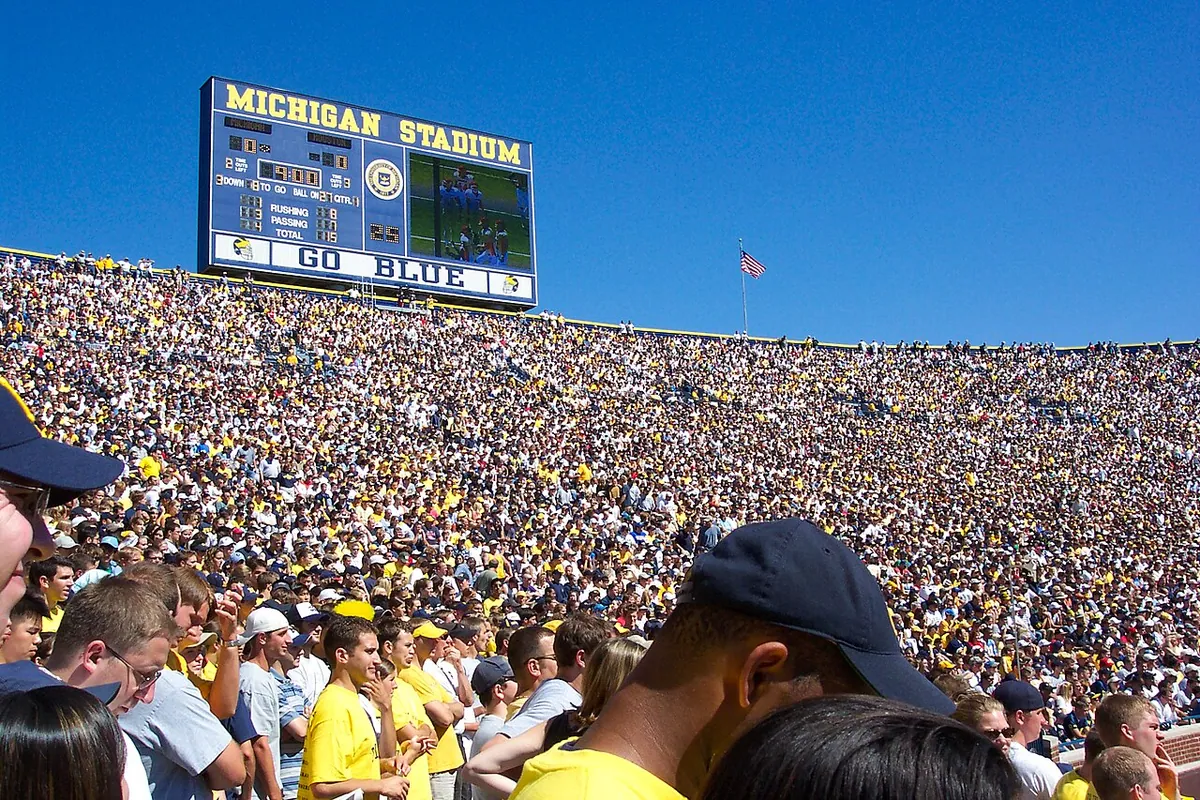
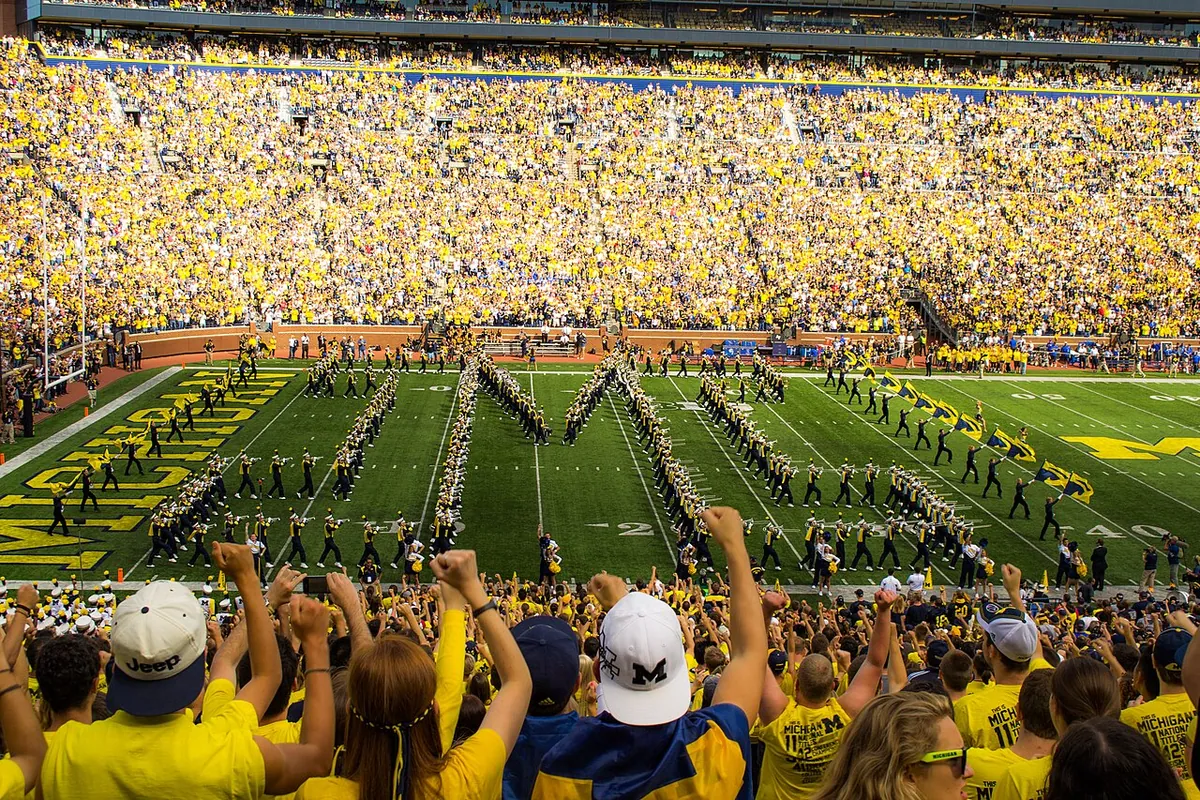
The game on November 4, 2006, against Ball State was the 200th consecutive crowd over 100,000. In 2023, Michigan Stadium again led the nation with the highest average attendance at 109,971 fans per game and the highest total attendance of 769,797 for the season. The largest crowd in stadium history was 115,109 for the Michigan versus Notre Dame game on September 7, 2013, a record for a college football game since 1948 at the time. Other notable record crowds include 114,804 for a 2011 Michigan-Notre Dame game and 114,132 for the 2011 Michigan-Ohio State game. The stadium's first night football game occurred on September 10, 2011, a 35-31 win over Notre Dame. Key attendance figures from the stadium's history include 84,401 for the stadium dedication game against Ohio State on October 22, 1927, and 101,001 for a game against Michigan State on October 6, 1956. The crowd for the Michigan-Notre Dame game on September 13, 2003, was 111,726. The 2013 Michigan-Ohio State game drew 113,511 spectators.
The 2010 Renovation and Modern Upgrades
On June 21, 2007, the University's Board of Regents approved a $226 million renovation and expansion project for Michigan Stadium. The stadium was rededicated on September 4, 2010, before a game against Connecticut, with a listed capacity of 109,901. Shortly after, the regents approved a $1.8 million plan to add permanent lights, which were first used for a hockey game on December 11, 2010, and for the first night football game on September 10, 2011. In August 2011, the stadium's scoreboards were replaced with new boards measuring 4,000 square feet each. The most recent major upgrade came in 2023 as part of a $41 million Michigan athletic department renovation. This project installed new high-definition video boards in the north and south end zones, each measuring 152 by 55 feet (8,360 square feet). The renovation also upgraded the Crisler Center control room for enhanced video production, introduced a new LED stadium lighting system, and improved the audio system. Additional improvements in 2024 expanded concourse space, upgraded Gate 2, and relocated the Wolverine statue to Gate 8 for improved game-day logistics.
Other Sports and Major Events
Beyond football, Michigan Stadium has hosted a diverse array of events that have set attendance records. The stadium is used for the University of Michigan's main graduation ceremonies, most notably the 1964 commencement where President Lyndon B. Johnson outlined his Great Society program. In ice hockey, "The Big Chill at the Big House" on December 11, 2010, set the record attendance for a hockey game with 104,173 fans watching Michigan play Michigan State. That record was broken on January 1, 2014, when 105,491 attended the NHL Winter Classic between the Detroit Red Wings and Toronto Maple Leafs. For soccer, an International Champions Cup match on August 2, 2014, between Manchester United and Real Madrid drew 109,318, a United States record at the time.
The stadium has also hosted lacrosse, with the varsity men's team debuting on March 17, 2012, and the women's team on March 20, 2014. A notable Division II football game occurred on September 29, 1979, when Slippery Rock played Shippensburg before 61,143 fans, setting an NCAA Division II attendance record. The stadium hosted its first dedicated concert on September 27, 2025, featuring Zach Bryan and special guest John Mayer, which set a U.S. record for a ticketed concert with a single headlining act with an announced crowd of 112,408. Other major soccer matches at the stadium include Real Madrid versus Chelsea in 2016 before 105,826 fans and Manchester United versus Liverpool in 2018 before 101,254 fans.
Stadium Features and Traditions
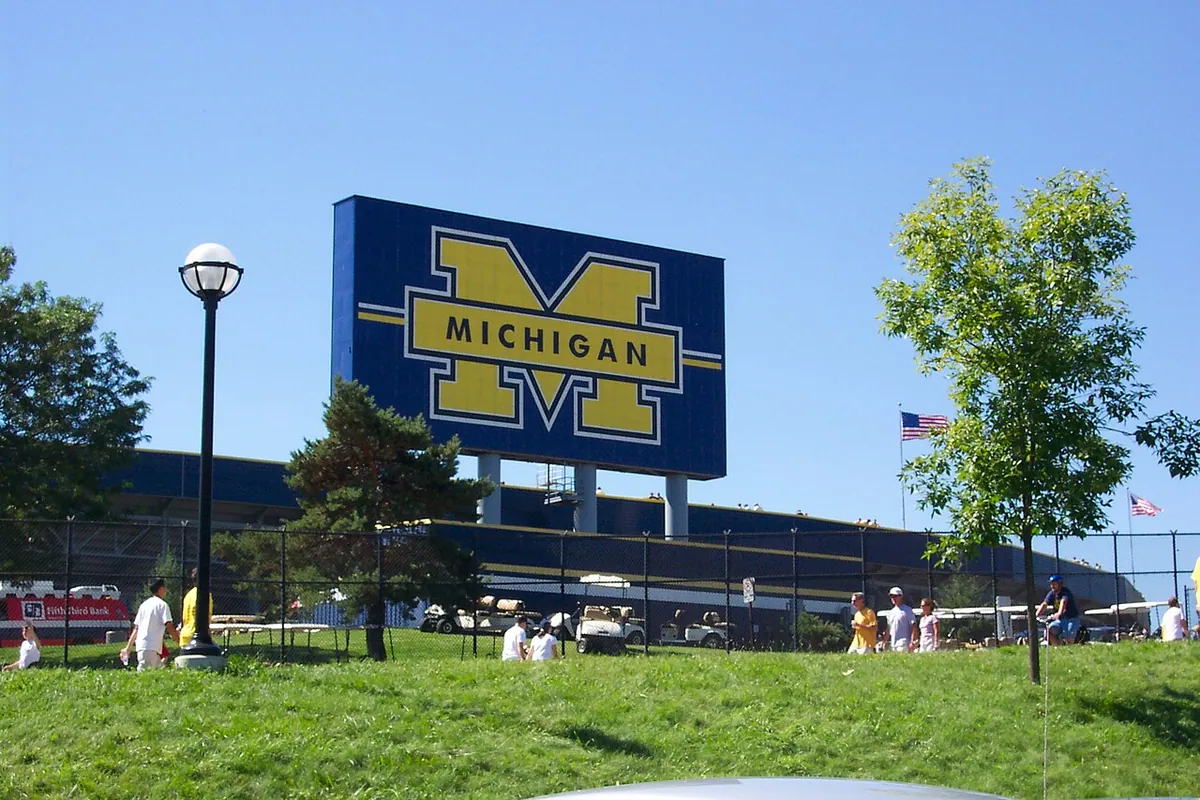
Michigan Stadium is known for several distinctive physical features and long-standing traditions. Its size is not wholly apparent from the outside because most of the seating bowl is built below ground level, a consequence of the high water table on the construction site. The stadium earned the nickname "The Big House" in the mid-1980s, a moniker popularized by broadcaster Keith Jackson. Before 1968, the stadium maintained a policy of "No women or children allowed on the field," with photojournalist Sara Krulwich noted as the first woman on the field. Longtime radio announcer Bob Ufer coined a famous description of the stadium as "The hole that Yost dug, Crisler paid for, Canham carpeted, and Schembechler fills every cotton-pickin' Saturday afternoon".
The stadium has experienced very few weather disruptions in its history. The first weather delay occurred on September 9, 2006, due to lightning. The first game called because of weather was on September 3, 2011, when Michigan and Western Michigan mutually agreed to end the game with 1:27 left in the third quarter due to an ongoing lightning delay. Guided tours of the stadium are available by arrangement through the university's Special Events Office but must be scheduled at least two weeks in advance, as the stadium is not open for public walk-ins. The stadium's varsity men's lacrosse team played its first game at the venue on March 17, 2012, a 13-9 loss to Bellarmine.
Video
FAQ
What is the capacity of Michigan Stadium?
The official capacity of Michigan Stadium is 107,601 seats. This number has changed over the decades due to various expansions and renovations. Prior to this, the capacity was 109,901 from 2010 to 2015 following a major $226 million renovation project. The stadium has consistently hosted crowds far exceeding its official capacity, with the record attendance set at 115,109 people for a football game in 2013.
When was Michigan Stadium built and what was the original cost?
Construction on Michigan Stadium began after a groundbreaking ceremony on September 12, 1926. The venue opened for its first game on October 1, 1927. The total cost for the original construction was $950,000, which is equivalent to approximately $14.1 million in 2025 dollars. The funding was secured by selling 3,000 bonds priced at $500 each to finance the project.
What is the largest crowd ever recorded at Michigan Stadium?
The largest crowd in the history of Michigan Stadium was 115,109 spectators, recorded on September 7, 2013. This attendance figure was set during a college football game where the University of Michigan defeated Notre Dame by a score of 41-30. This event established a post-1948 NCAA single-game attendance record at that time. The second-largest crowd of 114,804 was also for a Michigan-Notre Dame matchup on September 10, 2011.
Why is the stadium called The Big House and who gave it that nickname?
Michigan Stadium earned the nickname "The Big House" in the mid-1980s. The nickname gained national prominence and was widely popularized by the sports broadcaster Keith Jackson. The term references the stadium's immense physical size and massive seating capacity. By the mid-1980s, Michigan Stadium had become known by this nickname.
How many consecutive games have had over 100,000 fans?
Every University of Michigan football home game played at Michigan Stadium since November 8, 1975, has drawn a crowd exceeding 100,000 fans. This represents an active run of more than 300 consecutive contests. The game against Indiana University on October 25, 1975, was the last home game to attract fewer than 100,000 spectators. The 200th consecutive crowd over 100,000 was celebrated during a game against Ball State University on November 4, 2006.
What major renovations have been done recently?
The most significant recent renovation was a $226 million project completed before the 2010 season, which added luxury suites, club seats, and a new press box. In 2023, a separate $41 million athletic department renovation installed new video boards in the north and south end zones, each measuring 152 by 55 feet. This upgrade also included a new LED lighting system and enhanced audio and video production facilities. Further improvements in 2024 expanded concourse space and relocated stadium landmarks.
Sources
- Michigan Stadium (Wikipedia) Wikipedia
- Michigan Stadium, University of Michigan.. mgoblue.com
- Michigan Stadium: History, Capacity, Events & Significance sportsmatik.com