Mile High Stadium was an outdoor multi-purpose stadium located in Denver, Colorado, that operated from 1948 to 2002. Originally built as Bears Stadium for minor league baseball, it became the home of the Denver Broncos of the American Football League and later the NFL from 1960 through the 2000 season. The stadium was known for its innovative movable east stands, which allowed it to host both football and baseball, and for its atmosphere fueled by fans at an elevation of 5,280 feet. After the Broncos and the Colorado Rockies baseball team departed, the stadium was demolished in 2002 and replaced by a parking lot for its successor, Empower Field at Mile High.
Construction, Location and Early Years
Mile High Stadium was constructed on the site of a former landfill at 2755 West 17th Avenue in Denver. Groundbreaking occurred in 1947, and the venue opened on August 14, 1948, as Bears Stadium, built with private funds for the Denver Bears minor league baseball team. The original design by architect Stanley E. Morse featured a single 18,000-seat grandstand. The stadium's elevation of 5,280 feet above sea level, exactly one mile, would later inspire its famous name. Facing significant debt, Howsam sought to extend the stadium's use by adding football, which led to the arrival of the Denver Broncos in the new American Football League. The stadium was built by the Platt Rogers Construction Company and was initially owned by Rocky Mountain Sports, Inc., the entity that owned the Denver Bears.
Capacity and Expansions Through the 1970s
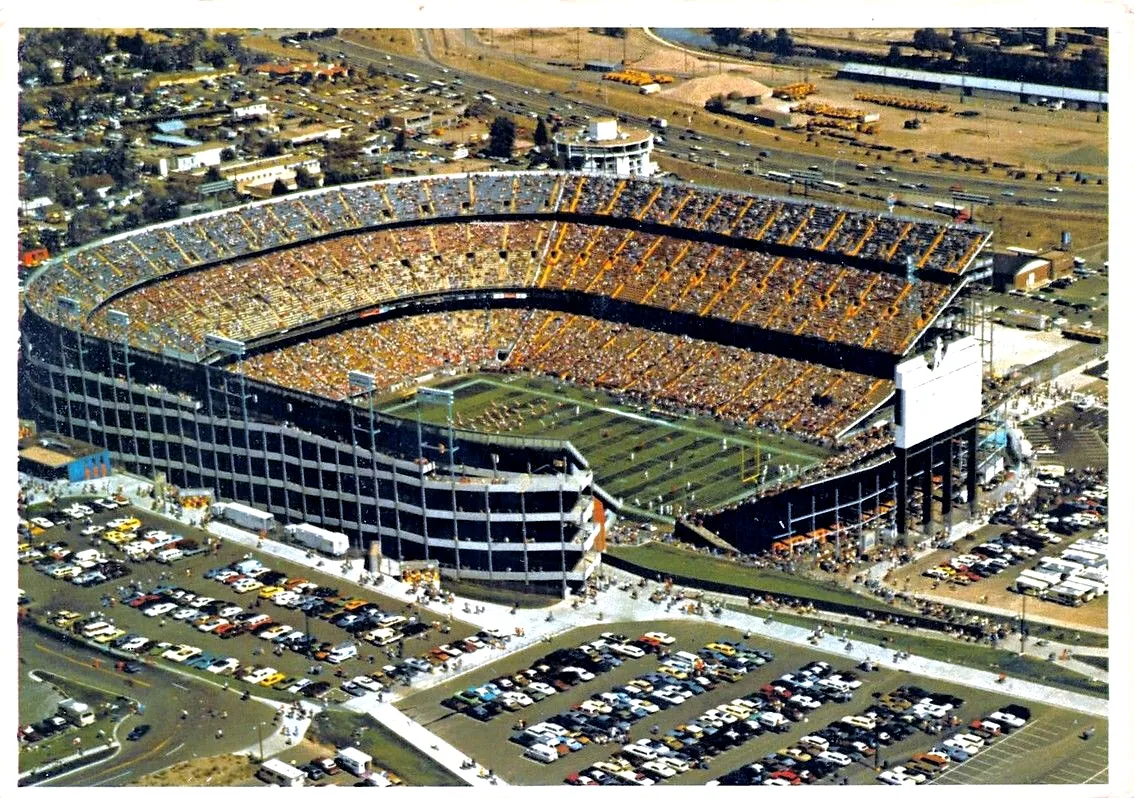
The stadium's seating capacity underwent numerous expansions throughout its history, evolving from its original 18,000 seats to a final configuration of 76,273. The first major football-driven expansion came in 1960, when temporary east stands and a south bleacher section raised capacity to 34,657 to accommodate the new Broncos. The stadium's seating capacity was listed as 34,264 from 1962 to 1965 and 34,643 from 1966 to 1967. The capacity continued to grow incrementally, reaching 51,706 by 1972 and 63,532 by 1976. The most significant expansion occurred between 1975 and 1977, when a 9-million-pound, triple-decked movable stand was built on the east side. This structure, designed by architect Jim Tolle, could be hydraulically moved 145 feet on a sheet of water, retracting to form a horseshoe for football or extending to fit a baseball field. This project raised the capacity to 75,103 by 1980.
| Year Range | Seating Capacity |
|---|---|
| 1948 to 1959 | 18,000 |
| 1960 to 1961 | 34,657 |
| 1962 to 1965 | 34,264 |
| 1966 to 1967 | 34,643 |
| 1968 to 1969 | 50,000 |
| 1970 | 50,705 |
| 1971 | 51,200 |
| 1972 | 51,656 |
| 1973 to 1975 | 51,706 |
| 1976 | 63,532 |
| 1977 to 1978 | 75,087 |
| 1979 | 75,092 |
| 1980 to 1981 | 75,103 |
Final Expansions and Stadium Features
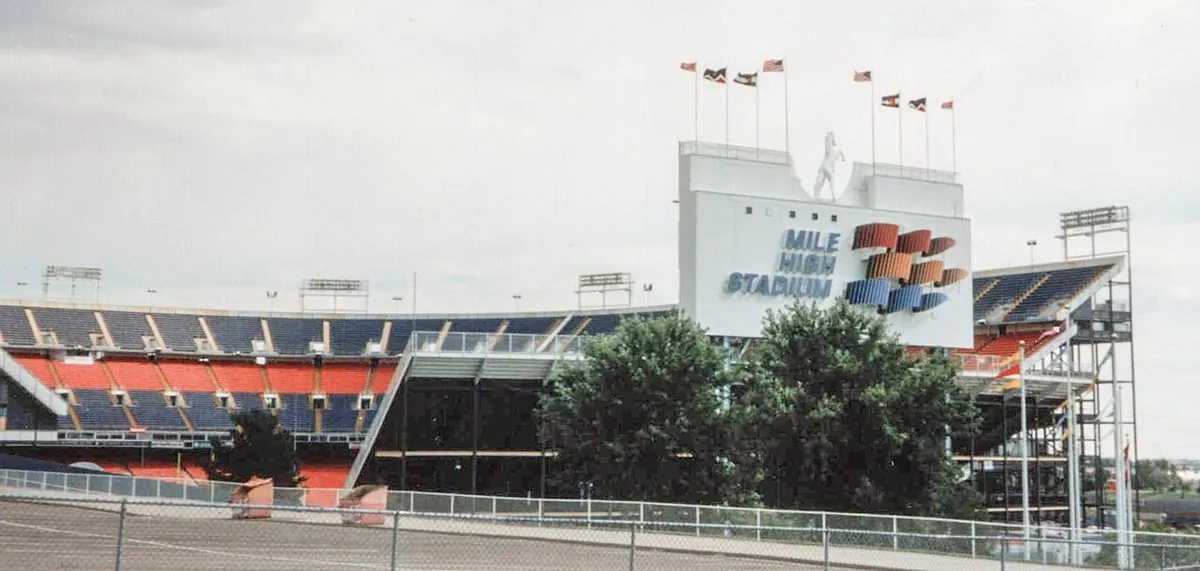
A final major renovation in 1986 added 77 luxury suites atop the west stands, increasing the official seating capacity. The stadium was an outdoor facility with a natural grass playing surface throughout its existence. Its most famous architectural feature was the massive movable east stand, a 9-million-pound structure that was 450 feet long, 200 feet wide, and traveled on a thin sheet of water pumped onto runways. Hydraulic rams would push the stands at a rate of two to three feet per minute, a process that took several hours to complete. The stadium was known for being exceptionally loud, a characteristic attributed to its steel grandstand construction and the passionate fans, particularly those in the south stands. Another feature was the 27-foot-tall, 1,600-pound fiberglass statue of a horse named Bucky, mounted atop the south scoreboard from 1975 onward. For much of the 1970s and 1980s, the stadium was also unique as the only professional-caliber baseball facility with an all-grass infield that included sliding pits around the bases.
Denver Broncos Tenancy and NFL Games
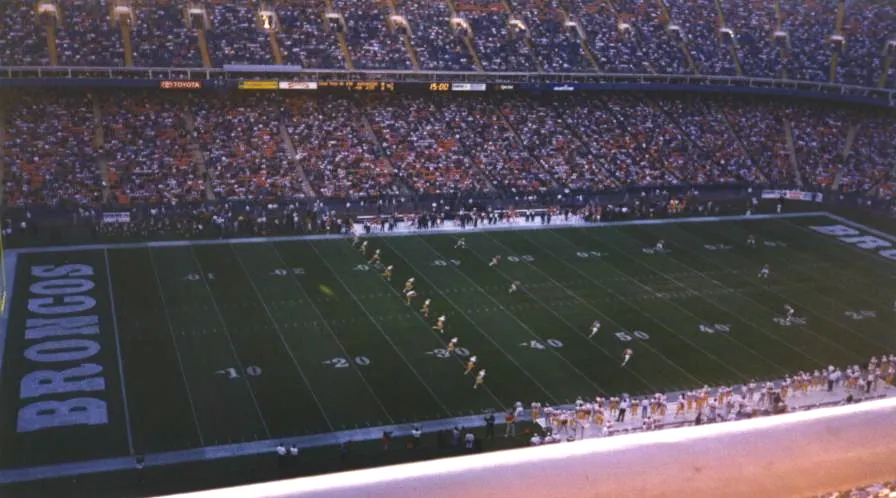
The Denver Broncos were the stadium's primary tenant, playing there from their AFL inception in 1960 through the 2000 NFL season. The Broncos' first game at the stadium was on October 2, 1960, against the Oakland Raiders. The team established a sellout streak that began with every game in their inaugural 1970 NFL season and continued uninterrupted through their tenure at Mile High and beyond. Records show 16 NFL games were played at Mile High Stadium during the 1999 and 2000 seasons, all involving the Denver Broncos as the home team. The highest combined score in those games was 75 points, occurring in a 38-37 Broncos victory over the San Diego Chargers on November 19, 2000. The stadium also hosted other professional football teams, including the Denver Gold of the United States Football League from 1983 to 1985. The USFL held its inaugural championship game at Mile High on July 17, 1983. The final NFL game at the stadium was played on December 23, 2000, a 38-9 Broncos victory over the San Francisco 49ers. The Broncos closed their history at Mile High with perfect home records against several franchises, including a 5-0 mark against the Green Bay Packers and Indianapolis Colts.
Baseball Tenants and Record Attendance
Although best known for football, Mile High Stadium had a long history with baseball. The Denver Bears, later renamed the Zephyrs, played there from 1948 until the franchise moved after the 1992 season. The stadium's most notable baseball period began in 1993 when the expansion Colorado Rockies of Major League Baseball used it as a temporary home while Coors Field was built. The Rockies drew record crowds, with 80,227 fans attending the home opener on April 9, 1993. The team was on pace to exceed that record during the strike-shortened 1994 season, having drawn 3,281,511 fans in 57 home dates for an average of 57,570. The unique movable east stands were crucial for converting the horseshoe football configuration into a viable baseball field. The last Rockies game at Mile High was on August 7, 1994. The large capacity and low ticket prices were key factors in the record attendance, which prompted officials to enlarge the planned Coors Field to a capacity over 50,000.
- Denver Bears/Zephyrs (Minor League Baseball): 1948 to 1992
- Colorado Rockies (MLB): 1993 to 1994
- Record Single Game Attendance: 80,227 (Rockies opener, April 9, 1993)
- 1993 Season Attendance: 4,483,350
- 1994 Season Attendance: 3,281,511 (57 games)
Soccer, Final Years and Demolition
Other sports tenants included several professional soccer teams. The Denver Dynamos of the North American Soccer League played from 1974 to 1975 before moving to Minnesota. The Colorado Caribous of the NASL played just the 1978 season. The Colorado Foxes of the American Professional Soccer League used the stadium for the 1994 and 1995 seasons, attracting an average crowd of 4,100 in their initial year. The most significant soccer tenant was the Colorado Rapids of Major League Soccer, who played at Mile High from 1996 until 2001, becoming the final professional team to use the stadium before its closure. On Independence Day 2000, Rapids captain John Spencer recorded the team's first hat-trick in a 3-1 win before 60,500 fans, a team attendance record. The final professional contest at the venue occurred on September 8, 2001, when the Rapids fell 2-0 to the Los Angeles Galaxy with 17,129 spectators present. The drive for a modern stadium with more luxury suites and club seats led voters to approve a new venue for the Broncos in 1998. Construction began on Empower Field at Mile High adjacent to the old stadium. Spirtas Wrecking Company performed a conventional demolition, which was completed by April 17, 2002. The land was cleared to become a parking area for the new stadium.
Major Concerts and Non-Sporting Events
Beyond sports, Mile High Stadium hosted a wide array of concerts and large-scale events. The Denver Pop Festival in June 1969 featured The Jimi Hendrix Experience, whose performance there on June 29 was the trio's final performance before bassist Noel Redding quit. Major concert tours by The Jacksons on September 7 and 8, 1984, during their Victory Tour, and Bruce Springsteen on September 23 and 24, 1985, played the stadium. It was also a stop for festival tours like the Monsters of Rock festival on July 30, 1988, featuring Van Halen and Metallica, and Ozzfest in 1997 and 2001. U2 performed there on October 21, 1992, as part of the Zoo TV Tour and again on May 1, 1997, on the PopMart Tour. The stadium served as a venue for religious gatherings, including Billy Graham's Rocky Mountain Crusade in 1987 and a massive Promise Keepers rally in June 1995 that drew over 70,000 men and boys. In August 1993, it hosted the Papal Welcoming Ceremony and the Way of the Cross for World Youth Day with Pope John Paul II. For decades, it was also the annual host of the Drums Along the Rockies drum corps competition, the single longest-running non-sporting event at the venue, and hosted the Drum Corps International World Championships in 1977 and 1978.
Legacy and the Stadium Site Today
The area where Mile High Stadium once stood now serves as a parking lot for Empower Field at Mile High. A small-scale model of the old stadium is placed in the parking lot as a memorial. The historical site is marked by the hills that formed the foundation of the west and north stands, which are still visible, and a staircase descends the corner between them much as the original stands did. A marker identifies the location of home plate from the stadium's baseball configuration. The statue of Bucky the horse was relocated to the new stadium after Mile High's demolition. The legacy of Mile High Stadium lives on in the name of its successor and in the memories of the fans who experienced its loud, passionate environment. The stadium hosted the Broncos' rise to prominence and the record-setting introduction of Major League Baseball to Denver.
Recent games
| Date | Game | Week |
|---|---|---|
| Dec 23, 2000 | San Francisco 49ers 9 at Denver Broncos 38 | Week 17 |
| Dec 10, 2000 | Seattle Seahawks 24 at Denver Broncos 31 | Week 15 |
| Nov 19, 2000 | San Diego Chargers 37 at Denver Broncos 38 | Week 12 |
| Nov 13, 2000 | Oakland Raiders 24 at Denver Broncos 27 | Week 11 |
| Oct 15, 2000 | Cleveland Browns 10 at Denver Broncos 44 | Week 7 |
| Oct 1, 2000 | New England Patriots 28 at Denver Broncos 19 | Week 5 |
| Sep 24, 2000 | Kansas City Chiefs 23 at Denver Broncos 22 | Week 4 |
| Sep 10, 2000 | Atlanta Falcons 14 at Denver Broncos 42 | Week 2 |
| Jan 2, 2000 | San Diego Chargers 12 at Denver Broncos 6 | Week 17 |
| Dec 19, 1999 | Seattle Seahawks 30 at Denver Broncos 36 | Week 15 |
| Dec 5, 1999 | Kansas City Chiefs 16 at Denver Broncos 10 | Week 13 |
| Nov 22, 1999 | Oakland Raiders 21 at Denver Broncos 27 | Week 11 |
Video
FAQ
When was Mile High Stadium torn down?
Demolition of Mile High Stadium began in January 2002 and was completed by April 17, 2002. The conventional demolition was performed by Spirtas Wrecking Company after the stadium closed following the 2001 Major League Soccer season. The old stadium was demolished to make way for a parking lot serving the new Empower Field at Mile High, which opened in 2001 directly adjacent to the original site. The process was covered extensively by local media and was broadcast live on television.
What was the capacity of Mile High Stadium?
Mile High Stadium's capacity changed frequently due to expansions. It opened in 1948 with 18,000 seats for baseball. When the Denver Broncos began playing in 1960, capacity was expanded to 34,657. Major expansions in 1968 raised it to 50,000, and the innovative movable stand addition in the late 1970s brought capacity to over 75,000. The final official seating capacity from 1986 until the stadium closed in 2001 followed the addition of 77 luxury suites atop the west stands.
Why was it called Mile High Stadium?
The stadium was named for Denver's elevation, which is exactly 5,280 feet above sea level, or one mile high. The original name was Bears Stadium, but after the City of Denver purchased it in 1968, it was renamed Mile High Stadium. The elevation was a defining geographical characteristic of the venue. This high-altitude location was often cited as a factor in the stadium's loud atmosphere and the challenge it presented to visiting athletic teams.
Did Mile High Stadium host any Super Bowls?
Mile High Stadium never hosted a Super Bowl. During its operational lifetime from 1960 to 2000, the NFL awarded Super Bowls to newer domed stadiums or warm-weather outdoor venues. The stadium did host other significant football events, including the inaugural United States Football League championship game on July 17, 1983. Its successor, Empower Field at Mile High, would later host Super Bowl 50, but the original stadium did not have that distinction.
What is on the site of Mile High Stadium today?
The land where Mile High Stadium stood is currently used as a parking lot for Empower Field at Mile High. A miniature replica of the old stadium is located in the parking lot as a memorial. The hills that formed the foundation of the original west and north stands are still visible on the site, and a marker indicates where home plate was located during baseball games. The statue of the horse Bucky that once topped the scoreboard was relocated to the new stadium complex after the demolition.
What was the highest-scoring NFL game played at Mile High Stadium?
The highest combined score in an NFL game at Mile High Stadium was 75 points, when the Denver Broncos defeated the San Diego Chargers 38-37 on November 19, 2000. This high-scoring affair was a regular season game during the stadium's final years of hosting the Broncos. The game is noted in the computed records from the 1999 and 2000 NFL seasons, which list 16 total games played there in that period. All those games featured the Denver Broncos as the home team and were played outdoors on a grass surface.
Sources
- Mile High Stadium (Wikipedia) Wikipedia
- Mile High Stadium, history, photos and more of the Colorado Rockies former ballpark ballparksofbaseball.com
- Mile High Stadium, History, Photos & More of the former NFL stadium of the Denver Broncos Stadiums of Pro Football
- nflverse game, roster and draft data nflverse (CC BY 4.0)