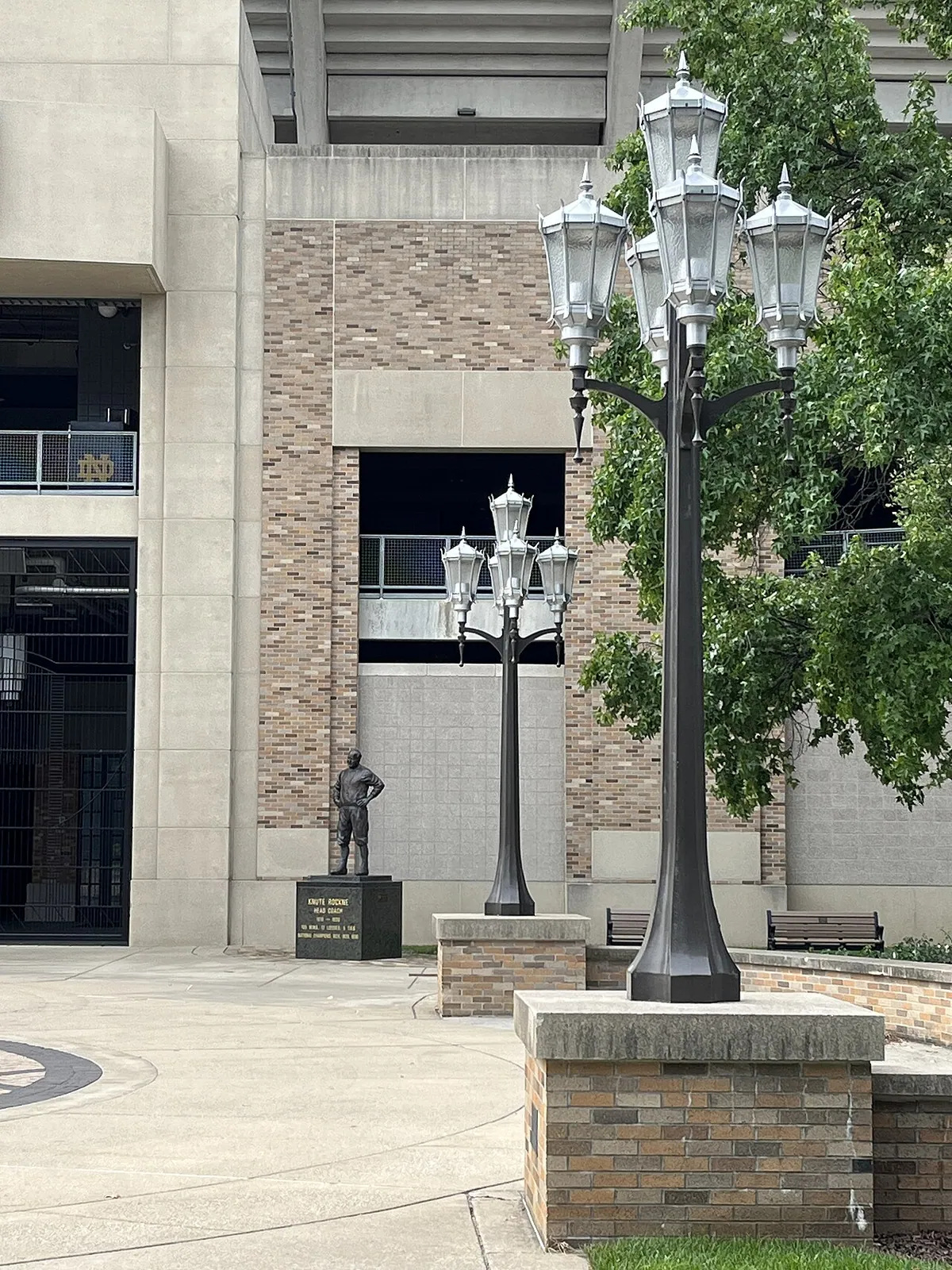
Notre Dame Stadium is the outdoor football home of the University of Notre Dame Fighting Irish in South Bend, Indiana. It opened on October 4, 1930, and was built under the direction of coach Knute Rockne, earning the nickname The House that Rockne Built. The original stadium seated 54,000, and after several major renovations, it now seats 77,622 fans. The stadium is famous for its view of the Touchdown Jesus mural on the nearby Hesburgh Library and for its simple, traditional design that has never included advertising.
Construction and Opening
Notre Dame Stadium was constructed in 1930 to replace the team's former home, Cartier Field. Head coach Knute Rockne was a driving force behind the project, pushing the university administration to act. University president Father Charles O'Donnell financed the build without debt by using football season profits and selling 240 six-person reserved box seats for terms of ten years, raising over $150,000. The total cost of construction was more than $750,000. The Osborn Engineering firm, which also designed Yankee Stadium, created the plans, and the Sollitt Construction Company of South Bend was the general contractor. The original stadium seated 59,075, measured a half-mile in circumference, stood 45 feet high, and included a glass-enclosed press box rising 60 feet above ground level. The Fighting Irish inaugurated their new home on October 4, 1930, with a 20-14 win over SMU. Joe Savoldi scored the first touchdown in the stadium on a 98-yard kickoff return. The formal dedication ceremony was held a week later during the October 11 game against Navy, where Savoldi scored three touchdowns.
Capacity History and Major Renovations
The number of seats in Notre Dame Stadium has evolved through multiple construction projects. A significant $53 million renovation took place between November 1994 and the summer of 1997. The renovated stadium was dedicated with a 17-13 victory over Georgia Tech on September 6, 1997. The largest and most complex upgrade was the $400 million Campus Crossroads project, announced in January 2014. This 33-month initiative attached three new academic and student life buildings to the stadium's exterior, adding more than 750,000 square feet of space. Completed in January 2018, the project also involved changes to the seating bowl. The first game played after this renovation was a 49-16 win against Temple on September 2, 2017, and the official capacity was listed at 77,622.
- 1930: Opened with a capacity of 54,000.
- 1997: Post-expansion capacity reaches 80,795.
- 2017: Current capacity set at 77,622 after the Campus Crossroads project.
- The stadium has been regularly sold out for home games since the 1964 season.
Playing Surface and Field Design
The stadium used a natural grass playing field from its opening in 1930 through the end of the 2013 season. On April 12, 2014, the university announced it would switch to an artificial turf surface, citing persistent maintenance challenges. The grass field had been replaced four separate times in 2013, including twice during the football season. Installation of the new FieldTurf began after graduation ceremonies in May 2014, and the university sold 2-by-5-foot sections of the old grass turf to the public for $150 each. The design of the field is intentionally simple and traditional. The end zones do not display the school name or mascot. Instead, each end zone features nine diagonal white lines set at a 42-degree angle, all pointing toward the campus Golden Dome. The total of 18 lines represents the year 1842, the founding year of the University of Notre Dame. A pattern of lines in the end zones has been used since 1930. The 2014 renovation also placed the ND monogram at midfield and added small green shamrocks at the 35-yard lines.
Stadium Features and Game Day Traditions
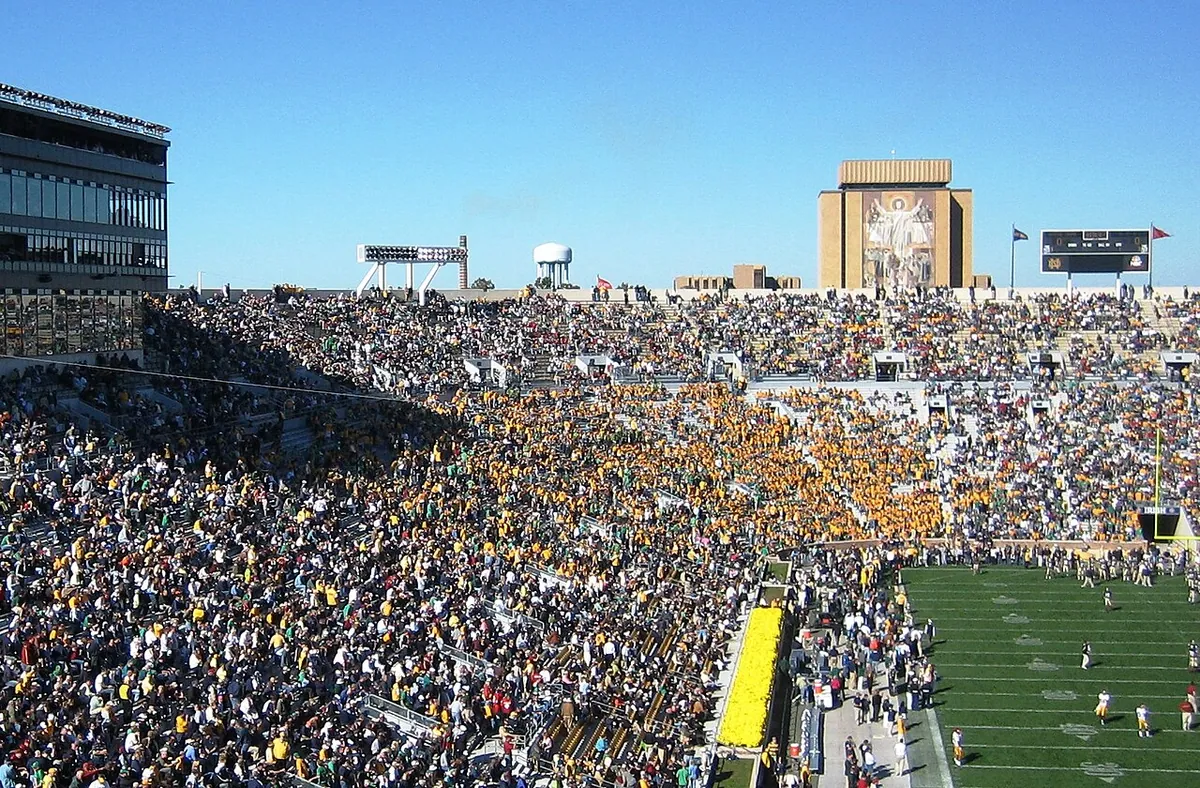
Notre Dame Stadium is defined by several distinctive physical features and long-running traditions. The view to the north includes the large mosaic on the Hesburgh Library known as Touchdown Jesus, officially titled The Word of Life. This mural was installed in 1964 as a gift from Mr. and Mrs. Howard V. Phalin. Inside the stadium, a yellow sign reading Play Like a Champion Today hangs in the passageway from the home locker room to the field. Players touch this sign as they exit for the game. The current version of the sign was painted in the fall of 1986 at the request of coach Lou Holtz. For 39 seasons from 1982 to 2020, public address announcer Michael Collins served in that role, and he announced 233 consecutive games. Another tradition featured Indiana State Police Sergeant Tim McCarthy, who delivered humorous driving safety messages over the public address system at the end of the third quarter starting in the 1960 season, a practice he continued for 55 years until his retirement in 2015. The stadium has maintained a policy of no advertising or corporate signage since its opening, preserving a clean, traditional appearance.
Notable Football Events and Records
Notre Dame Stadium has hosted many significant football games and milestones. Television broadcasts from the stadium began on November 8, 1952, with Notre Dame beating Oklahoma 27-21. The stadium reached its 100th consecutive sold-out game in 1991 against Tennessee, which was also the 300th game played in the venue. It was used as a filming location for the 1993 movie Rudy. The first evacuation in stadium history happened on September 3, 2011, due to severe weather during a game versus South Florida. A landmark modern event occurred on December 20, 2024, when Notre Dame hosted Indiana in the first College Football Playoff game ever staged at an on-campus stadium, winning 27-17. That contest was also the first Notre Dame home game not televised by NBC since November 17, 1990.
| Event | Date | Significance |
|---|---|---|
| First Game | October 4, 1930 | Notre Dame 20, SMU 14 |
| First Televised Game | November 8, 1952 | Notre Dame 27, Oklahoma 21 |
| First CFP On-Campus Game | December 20, 2024 | Notre Dame 27, Indiana 17 |
The Campus Crossroads Project Details
The Campus Crossroads Project was a $400 million transformation of Notre Dame Stadium that integrated academic facilities directly into the structure. Announced in January 2014 and finished in January 2018, the project added three new buildings anchored to the stadium walls. The Duncan Student Center on the west side houses student recreational facilities, dining options, and the Meruelo Family Career Center. O'Neill Hall on the south side is home to the university's music department. Corbett Family Hall on the east side contains the psychology and anthropology departments. These buildings collectively added more than 750,000 square feet of space and also contain premium stadium seating, new press boxes, and event venues like the Dahnke Ballroom. The project was designed by the SLAM collective with HOK as a consultant, and Barton Malow was the design-build contractor. This integration makes Notre Dame Stadium one of the few football venues in the country that directly supports daily academic and student life functions beyond game days.
Stadium Access and Transportation
The address of Notre Dame Stadium is 2010 Moose Krause Circle on the university campus. The location is in Notre Dame, Indiana, approximately four miles north of the city center of South Bend and about 95 miles east of Chicago. Visitors arriving by car can use Exit 77 from Interstate 80/90, the Indiana Toll Road. Paid parking for the general public is available in several campus areas including White Field, Burke Golf Course, Saint Mary’s College, and Holy Cross College, with costs between $20 and $40 per vehicle. These parking lots open at 8 AM on game days. The South Bend Transpo system provides a free Game Day Express shuttle from downtown hotels to McKenna Hall on campus. Train service from Chicago on the South Shore Line ends at the South Bend Airport station, requiring a rideshare for the final leg. Tailgating is common, with gas grills allowed but charcoal grills and deep fryers prohibited. Post-game rideshare pickups are organized at the Trader Joe's parking lot at 1140 Howard Street to ease traffic congestion.
Lighting and Broadcast History
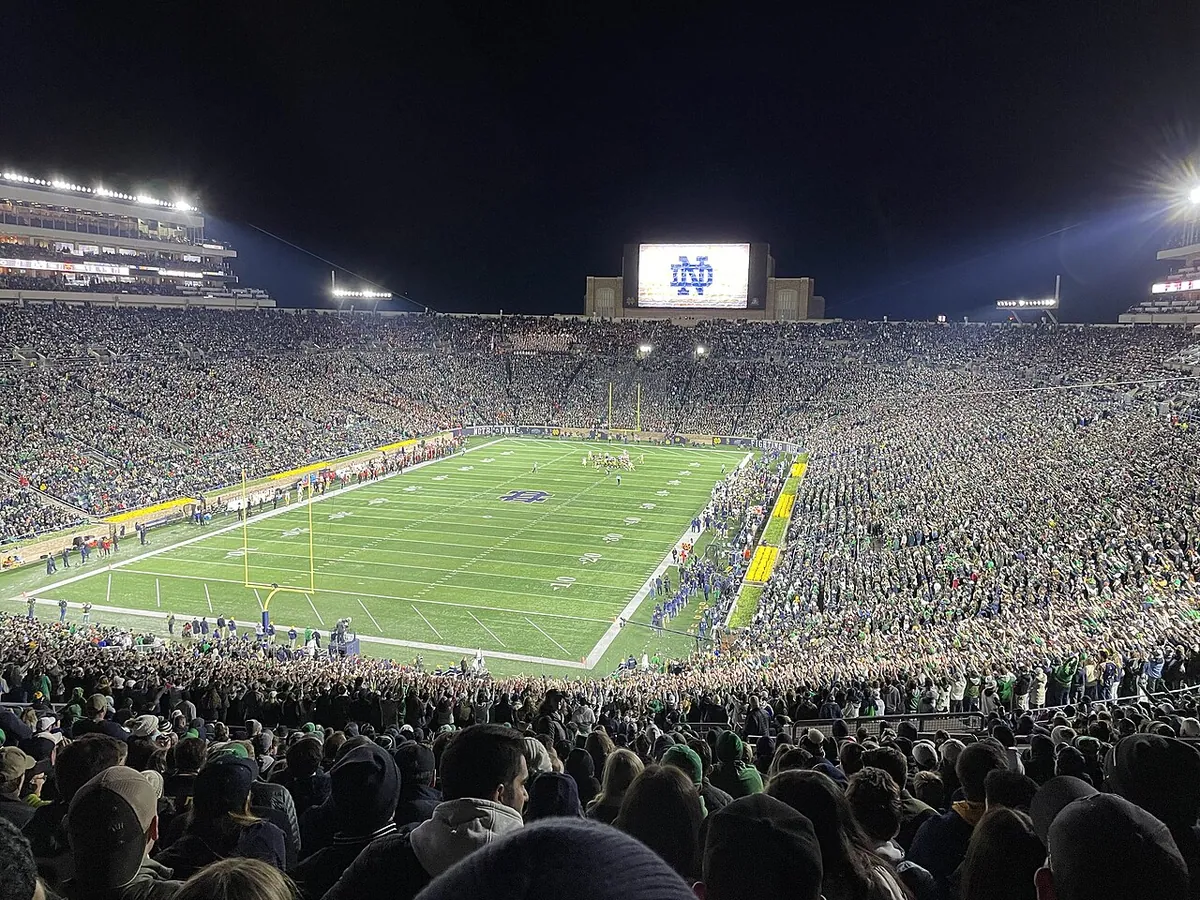
Notre Dame Stadium did not have permanent field lights until the 1997 expansion. The first night game in stadium history used temporary lighting provided by Musco Lighting on September 18, 1982, for a game against Michigan. The permanent lights installed in 1997 were funded by NBC, which has held exclusive television rights to Notre Dame home games since 1991. Initial contracts with NBC from 1991 to 2010 stipulated that there be no home night games, so the lights were primarily for late-afternoon November games. After a 21-year gap, the stadium held a night game again on October 22, 2011, when Notre Dame faced USC. As part of the 2014 to 2017 Campus Crossroads renovation, Musco installed a new LED field lighting system. The relationship with NBC has been central to the stadium's modern broadcast presence, with the network showing traditions like the Play Like a Champion Today sign starting in 1991.
Other Uses and Events
While primarily a football venue, Notre Dame Stadium hosts a variety of other events throughout the year. The university holds its annual commencement ceremonies in the stadium. It has also been used for concerts and special sporting events. The stadium was the site of the 2019 NHL Winter Classic hockey game. The facility has also hosted soccer and rugby matches. The switch to artificial turf in 2014 was partly to enable more non-football events and to allow the football team to practice in the stadium. The three buildings added during the Campus Crossroads project provide year-round academic and student activity spaces, ensuring the structure is utilized beyond the seven or eight home football Saturdays each fall. This multi-use approach represents a modern evolution for the historic venue while maintaining its primary identity as the home of Fighting Irish football.
Video
FAQ
What is the seating capacity of Notre Dame Stadium?
The current seating capacity of Notre Dame Stadium is 77,622. This figure was set after the completion of the Campus Crossroads renovation project in 2017. The stadium's capacity has changed throughout its history. A major expansion from 1994 to 1997 raised the capacity to over 80,000, peaking at 80,795. The 2014 to 2017 renovation integrated new buildings and adjusted the seating layout, resulting in the current capacity of 77,622.
Who designed and built Notre Dame Stadium?
Notre Dame Stadium was designed by the Osborn Engineering firm of Cleveland, which also designed Yankee Stadium. The general contractor was the Sollitt Construction Company of South Bend. The project was spearheaded by noted Notre Dame football coach Knute Rockne, who was heavily involved in its design and advocated for keeping fans close to the field. Construction above ground began on April 2, 1930, and the stadium was built in just six months, opening on October 4 of that year.
What was the Campus Crossroads project?
The Campus Crossroads project was a $400 million renovation and expansion of Notre Dame Stadium that took place from 2014 to 2017. It involved attaching three new buildings to the stadium's exterior: the Duncan Student Center, O'Neill Hall, and Corbett Family Hall. These buildings added over 750,000 square feet of academic, student life, and event space, while also housing premium seating and new press facilities. The project was completed in January 2018 and was designed by the SLAM collective with HOK as a consultant.
Has Notre Dame Stadium ever hosted a College Football Playoff game?
Yes, Notre Dame Stadium hosted its first College Football Playoff game on December 20, 2024. The Fighting Irish faced in-state rival Indiana in what was the first CFP game ever played in an on-campus stadium. Notre Dame won the game 27-17. This event was also notable because it was the first Notre Dame home game not televised by NBC since November 17, 1990, as the playoff game was broadcast by ESPN.
What was the first game ever played at Notre Dame Stadium and who scored its first touchdown?
The first game played at Notre Dame Stadium was on October 4, 1930, where the Fighting Irish defeated SMU 20-14. The first Notre Dame touchdown in the new stadium was scored by 'Jumping Joe' Savoldi on a 98-yard kickoff return. The official dedication occurred a week later on October 11 against Navy, where Savoldi scored three touchdowns and was cited as the first hero in the stadium's lore. The poet G.K. Chesterton was present for that game and wrote 'The Arena' to commemorate the occasion.
What is the nickname of Notre Dame Stadium and how did it get that name?
Notre Dame Stadium is nicknamed 'The House that Rockne Built.' This name originates from the fact that the stadium was built in 1930 under the guidance of noted head coach Knute Rockne. Rockne, regarded as one of the greatest coaches in college football history, played a key role in its design and construction. The stadium was built to replace the outdated Cartier Field and was financed in part by the profits from the football program. This enduring nickname honors Rockne's key influence in creating this famous football venue.
Sources
- Notre Dame Stadium (Wikipedia) Wikipedia
- Notre Dame Stadium: 77622 Capacity, Fan Stamp fan-stamp.com
- University of Notre Dame | Sports, Events & Traditions visitsouthbend.com
- Notre Dame Stadium, Notre Dame: Capacity & Visitor Guide, MeetStadium meetstadium.com