The Oakland Coliseum, officially the Oakland, Alameda County Coliseum, is a multi-purpose stadium in Oakland, California. It opened in 1966 and was the primary home of the NFL's Oakland Raiders from 1966 to 1981 and again from 1995 to 2019. Designed with a sunken playing field, it was the last stadium in the United States to be shared by professional baseball and football teams. Its football capacity varied over the years, reaching a peak of 63,132 seats. The venue hosted numerous significant football games before the Raiders' relocation to Las Vegas.
Construction and Opening
Planning for the Oakland Coliseum began in earnest in the early 1960s as city leaders sought to change Oakland's profile as a major metropolitan area distinct from San Francisco. A non-profit corporation led by real estate developer Robert T. Nahas was formed to finance the project without taxpayer-backed bonds. The site in East Oakland was chosen in December 1960. The Port of Oakland gave 157 acres to the East Bay Regional Park District in exchange for 105 acres of park land, which it then donated to the city for the stadium complex. Groundbreaking occurred on April 15, 1964, after legal issues and cost overruns delayed the start of construction. The architectural firm Skidmore, Owings & Merrill designed the stadium, with Myron Goldsmith as the principal design architect, and the Guy F. Atkinson Company served as the general contractor. The stadium opened on September 18, 1966, with an inaugural football game where the Kansas City Chiefs defeated the Oakland Raiders 32-10. It was built as a multi-purpose facility, with the playing surface situated 21 feet below sea level, creating a distinctive sunken bowl design where fans entered at the top of the first seating level.
Football Configuration and Capacity Evolution
The Oakland Coliseum was built more for baseball than football, which created unique challenges for football configurations. During the baseball season overlap, the gridiron was located between home plate and center field. Once the baseball season ended, the field was switched to run along the first and third base areas, with temporary bleachers placed in the outfield. This gave Raiders season ticket holders two season ticket locations in different parts of the stadium. This dual-configuration system ended after the 1996 expansion.
| Years | Football Capacity |
|---|---|
| 1966 to 1972 | 54,587 |
| 1973 to 1974 | 54,041 |
| 1975 to 1976 | 54,037 |
| 1977 to 1988 | 54,615 |
| 1989 to 1995 | 54,444 |
| 1996 to 1998 | 63,026 |
| 1999 to 2012 | 63,132 |
| 2013 | 53,286 |
| 2014 to 2017 | 56,057 |
| 2018 to 2019 | 55,997 |
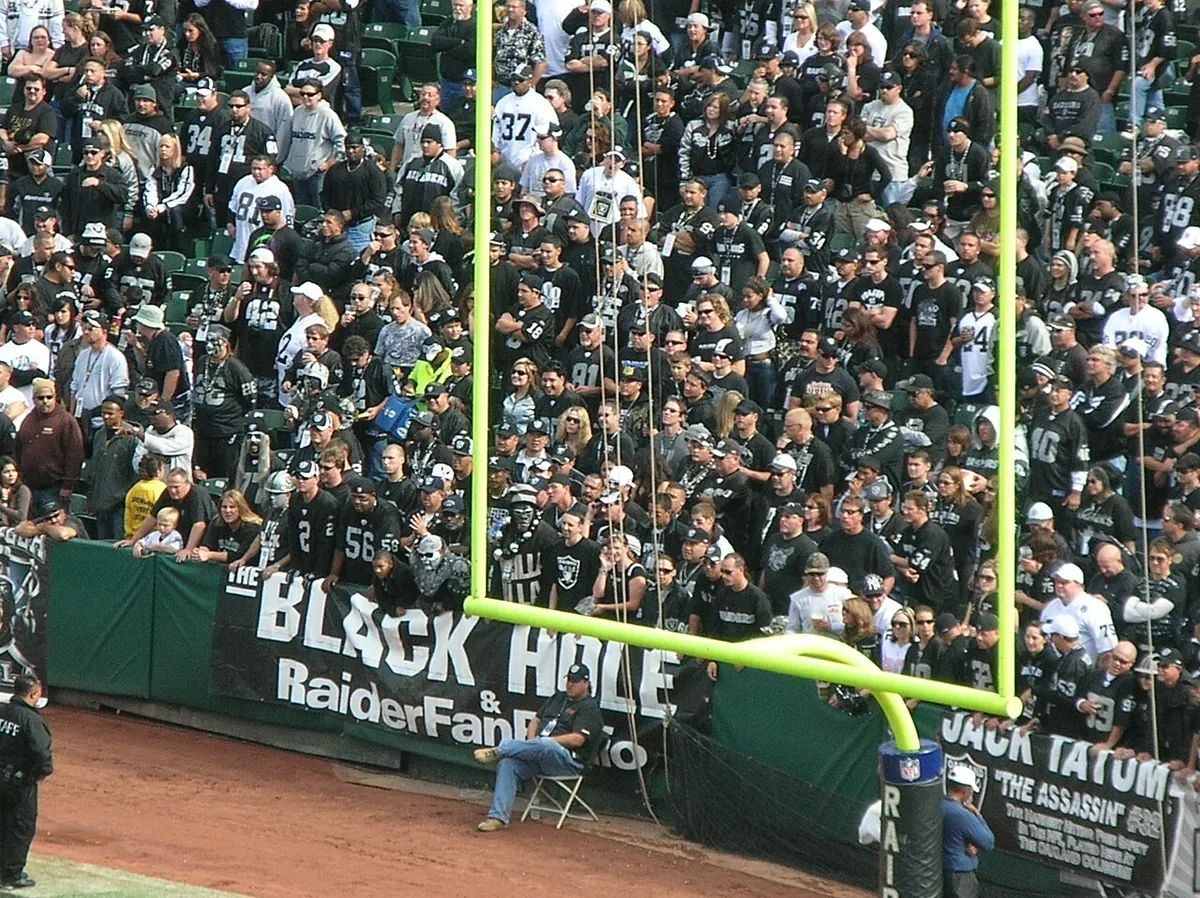
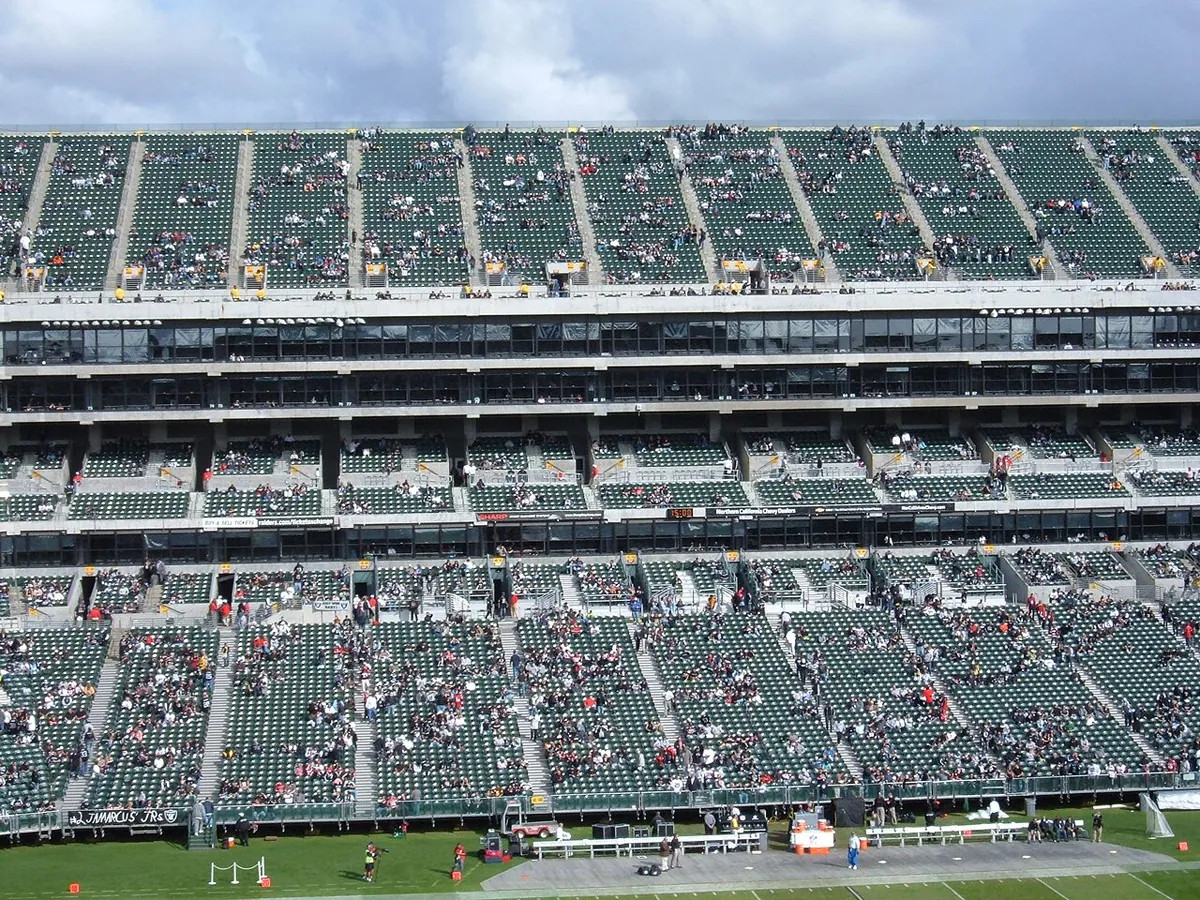
The most dramatic change came with the 1996 renovation that added a massive four-tier grandstand, nicknamed "Mount Davis," which increased capacity to over 63,000. In 2013, the Raiders placed tarps over all seats in the upper deck on the east side because of a decrease in attendance, which reduced the seating capacity. The stadium's record football attendance of 62,784 was set on January 14, 2001, for a playoff game between the Raiders and the Baltimore Ravens. The 1996 renovation made the Coliseum one of the largest NFL venues by capacity for over a decade.
Oakland Raiders Tenancy and Team History
The Oakland Raiders were the stadium's founding and most significant football tenant. During this initial period, the team achieved considerable success, winning a Super Bowl. Key players from that era included quarterback Kenny Stabler, the NFL MVP in 1974. Following a dispute with the city over stadium renovations and luxury seating, owner Al Davis moved the team to the Los Angeles Coliseum after the 1981 season. A deal was struck in June 1995, contingent on a $200 million expansion of the Coliseum. Construction began in November 1995, adding 22,000 seats and 125 luxury suites. The Raiders returned for the 1996 NFL season and remained through the 2019 season. The second tenure saw another period of success. Quarterback Rich Gannon passed for 4,689 yards and threw 26 touchdown passes in the 2002 season. The Raiders' final season at the Coliseum was 2019 before their relocation to Las Vegas and Allegiant Stadium in 2020. The Raiders won 12 division titles and three Super Bowls as a franchise.
Notable Football Events and Renovations
The stadium also hosted preseason games for other NFL teams and was a site for international soccer matches, including games during the 2009 CONCACAF Gold Cup. The major renovation from 1995 to 1996 fundamentally altered the stadium's character and capacity. The project removed the original outfield bleachers and replaced them with the massive "Mount Davis" structure, enclosing the stadium and increasing football capacity. This renovation was part of the agreement to bring the Raiders back from Los Angeles. Later updates included the installation of new high-definition video scoreboards before the 2015 season. Each board measured 36 feet high by 145 feet wide and cost $10 million to replace the older dot-matrix boards. The renovation timeline includes several key projects.
- 1966: Stadium opens with an original construction cost of $25.5 million.
- 1995 to 1996: $200 million renovation adds "Mount Davis" and luxury suites.
- 2015: Two new HD video scoreboards installed at a cost of $10 million.
- 2017: Playing field dedicated as Rickey Henderson Field.
- 2019: Final season of Oakland Raiders football.
Naming Rights History and Corporate Sponsors
The stadium has undergone numerous name changes due to corporate sponsorship agreements. For its first 32 years, it was known as the Oakland, Alameda County Coliseum, though a deal with UMAX Technologies was agreed to in 1997 before a dispute. A naming rights deal was signed with Network Associates in 1998 for $5.8 million over five years, creating the Network Associates Coliseum. When that company renamed itself McAfee in 2004, the stadium became McAfee Coliseum. McAfee declined to renew the deal in 2008, and the name reverted to Oakland, Alameda County Coliseum on September 19, 2008. In April 2011, Overstock.com secured a six-year, $7.2 million deal, leading to the name Overstock.com Coliseum. It was renamed O.co Coliseum in June 2011. During the Overstock.com/O.co period, the Oakland Athletics continued to refer to it by its original name in official communications. Overstock ended the deal early in 2016. In May 2019, RingCentral purchased naming rights for $1 million per year, creating RingCentral Coliseum. RingCentral's sponsorship ended in April 2023, and the stadium reverted to Oakland, Alameda County Coliseum. In 2017, the playing field itself was dedicated as Rickey Henderson Field in honor of the Baseball Hall of Famer. The chronology of naming rights reflects the stadium's commercial history.
- 1966 to 1998: Oakland, Alameda County Coliseum
- 1998 to 2004: Network Associates Coliseum
- 2004 to 2008: McAfee Coliseum
- 2008 to 2011: Oakland, Alameda County Coliseum
- 2016 to May 2019: Oakland, Alameda County Coliseum
- 2023 to present: Oakland, Alameda County Coliseum
Stadium Design, Features, and Shared Tenancy
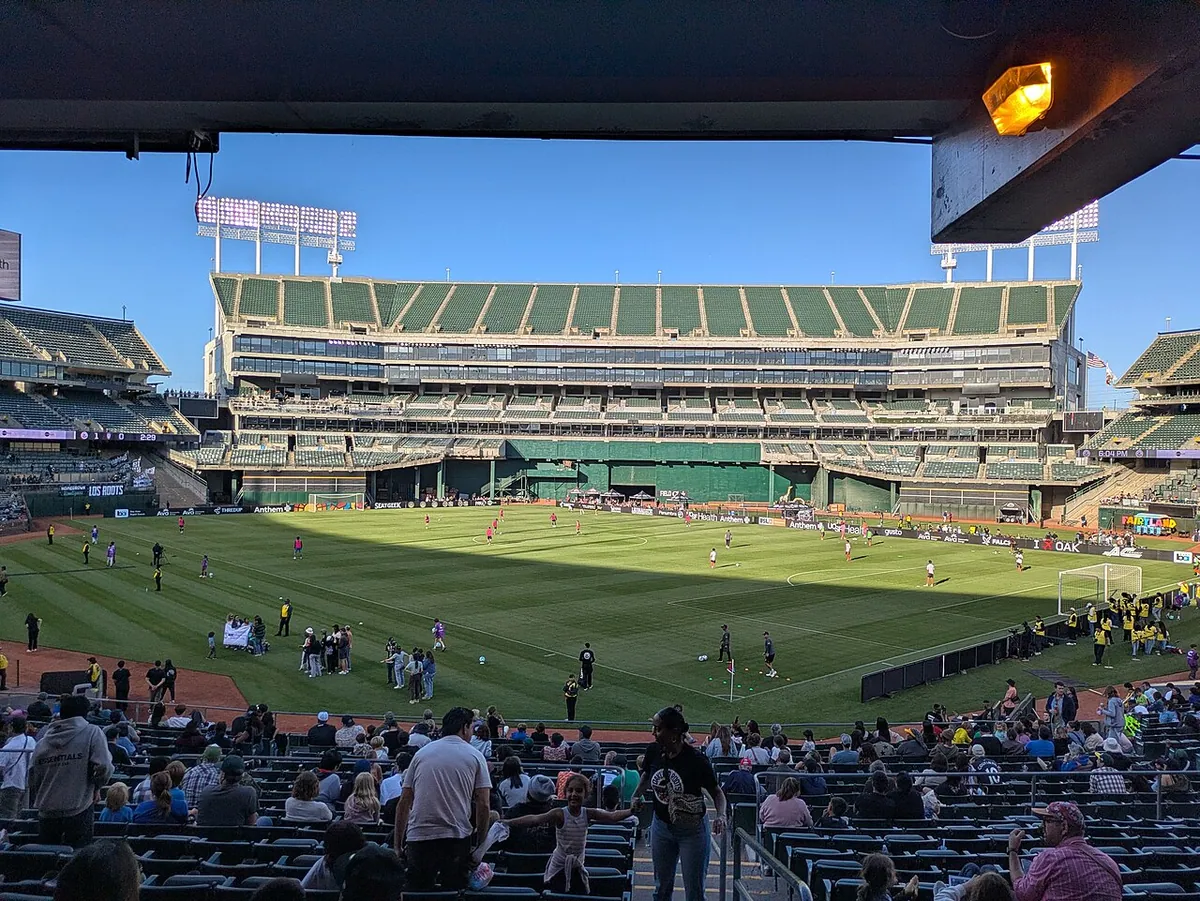
The Oakland Coliseum's design was unique among major sports venues. Its most distinctive feature was the sunken bowl, with the field 21 feet below sea level and the lower seating tiers built into the ground. From the exterior, only the third deck was visible above the landscaped berm that surrounded the structure. The original circular design had an open east end until the 1996 renovation enclosed it. For baseball, it was known for having the most foul territory in Major League Baseball, turning potential hits into outs. The stadium was the last in the United States to be shared full-time by an MLB and an NFL team, a relic of the multi-purpose stadium era of the 1960s and 1970s. Its state and lack of modern amenities were widely criticized in later years, often cited as one of the worst ballparks in the league. The shared tenancy created constant configuration changes and limited opportunities for sport-specific upgrades. Following the departures of the Raiders in 2019 and the Athletics in 2024, the stadium's future as a top-tier sports venue ended. It remains in use for other events, including soccer for the USL Championship's Oakland Roots SC and as the home of the San Francisco Unicorns of Major League Cricket.
Attempts at New Stadiums and Future of the Site
The long-term future of the Oakland Coliseum site has been a subject of planning and speculation for decades, driven by both the Athletics' and Raiders' desires for new, modern facilities. The Athletics, during their search for a new ballpark, announced in November 2018 their intent to purchase the Coliseum site from the city and county. Their vision was to redevelop the land into a technology and housing hub, while preserving the adjacent Oakland Arena and reducing the Coliseum itself to a low-rise sports park similar to Kezar Stadium in San Francisco. This plan was concurrent with their effort to build a new 34,000-seat stadium at the Howard Terminal waterfront site. The Athletics later moved their focus to Las Vegas, where a new stadium is expected to be completed by 2028. The Raiders' stadium search also followed a long path. Oakland authorities hired a consultant in 2015 to build a financial model for a new stadium, with the goal of finding $900 million without using taxpayer money. This effort failed, leading to the NFL approving the move to Las Vegas. The stadium continues to host minor league and second-division sports, concerts, and community events, but its era as a home for major professional football is firmly part of sports history.
Key Figures in Coliseum History
The development and operation of the Oakland Coliseum involved several influential individuals from the worlds of business, sports, and politics. Their decisions shaped the stadium's construction, tenancy, and eventual fate. Robert T. Nahas, a local real estate developer and former chamber of commerce president, led the non-profit corporation that financed and built the Coliseum, serving as its board president for 20 years. Al Davis, the owner of the Oakland Raiders, was a central figure whose demands for renovations led to the team's move to Los Angeles in 1982 and whose negotiations brought them back in 1995. Charles O. Finley, the owner of the Kansas City Athletics, was personally convinced by Nahas to move his baseball team to Oakland, making the Coliseum a dual-sport venue in 1968. Edgar F. Kaiser and former U.S. Senator William Knowland were among the other prominent East Bay business leaders on the original Coliseum development board. Dave Kaval, who became Athletics team president in 2016, led the later stadium hunt that focused on the Howard Terminal site. Scott McKibben, the head of the Coliseum Authority in 2019, resigned amid scandal related to the RingCentral naming rights deal. These individuals played critical roles across six decades of the stadium's story.
- Robert T. Nahas: Developer who led financing and construction.
- Al Davis: Raiders owner who moved the team twice.
- Charles O. Finley: Athletics owner who moved the team to Oakland in 1968.
- Edgar F. Kaiser: Business leader on the original Coliseum board.
- William Knowland: Former U.S. Senator on the original Coliseum board.
- Dave Kaval: Athletics president who led the Howard Terminal plan.
- Scott McKibben: Coliseum Authority head involved in naming rights scandal.
Recent games
| Date | Game | Week |
|---|---|---|
| Dec 15, 2019 | Jacksonville Jaguars 20 at Oakland Raiders 16 | Week 15 |
| Dec 8, 2019 | Tennessee Titans 42 at Oakland Raiders 21 | Week 14 |
| Nov 17, 2019 | Cincinnati Bengals 10 at Oakland Raiders 17 | Week 11 |
| Nov 7, 2019 | Los Angeles Chargers 24 at Oakland Raiders 26 | Week 10 |
| Nov 3, 2019 | Detroit Lions 24 at Oakland Raiders 31 | Week 9 |
| Sep 15, 2019 | Kansas City Chiefs 28 at Oakland Raiders 10 | Week 2 |
| Sep 9, 2019 | Denver Broncos 16 at Oakland Raiders 24 | Week 1 |
| Dec 24, 2018 | Denver Broncos 14 at Oakland Raiders 27 | Week 16 |
| Dec 9, 2018 | Pittsburgh Steelers 21 at Oakland Raiders 24 | Week 14 |
| Dec 2, 2018 | Kansas City Chiefs 40 at Oakland Raiders 33 | Week 13 |
| Nov 11, 2018 | Los Angeles Chargers 20 at Oakland Raiders 6 | Week 10 |
| Oct 28, 2018 | Indianapolis Colts 42 at Oakland Raiders 28 | Week 8 |
Video
FAQ
What was the O.co Coliseum?
The O.co Coliseum was a corporate naming rights name for the Oakland Coliseum. The online retailer Overstock.com, which uses O.co as a marketing name, purchased the naming rights in April 2011 for a six-year, $7.2 million deal. The stadium was officially renamed O.co Coliseum in June 2011. This name was used until Overstock.com ended the agreement early in 2016, after which the stadium reverted to its original name, Oakland, Alameda County Coliseum.
How many people did the Oakland Coliseum hold for football games?
The Oakland Coliseum's football capacity changed multiple times. Its original capacity in 1966 was 54,587. After a major renovation in 1996, the capacity increased, reaching a peak of 63,132 seats from 1999 to 2012. In later years, due to tarping off sections of the upper deck, the capacity was lowered. For the final Raiders seasons from 2018 to 2019, the listed football capacity was 55,997. The all-time record football attendance was 62,784, set for a playoff game on January 14, 2001.
Why did the Raiders leave the Oakland Coliseum?
The Oakland Raiders left the Coliseum after the 2019 season and relocated to Las Vegas. The primary reasons were the stadium's age and lack of modern revenue-generating amenities. The Raiders had sought a new stadium for years, sharing the venue with the MLB's Athletics made scheduling and design compromises difficult. Efforts to build a new stadium in Oakland failed to secure sufficient funding, leading the NFL to approve the team's move to Las Vegas, where they now play in Allegiant Stadium.
What other teams played at the Oakland Coliseum?
The primary football tenant was the NFL's Oakland Raiders from 1966 to 1981 and again from 1995 to 2019. The stadium was also the home of MLB's Oakland Athletics from 1968 to 2024. In later years, it hosted the USL Championship soccer team Oakland Roots SC and the San Francisco Unicorns of Major League Cricket. It also occasionally hosted international soccer matches, including games for the 2009 CONCACAF Gold Cup and select San Jose Earthquakes MLS matches in 2008 and 2009.
When was the Oakland Coliseum renovated?
The most significant renovation occurred from 1995 to 1996 at a cost of $200 million. This project was undertaken as part of the deal to bring the Oakland Raiders back from Los Angeles. It involved demolishing the outfield bleachers and constructing a massive new upper deck, nicknamed "Mount Davis," which added 22,000 seats and 125 luxury suites. In 2015, the stadium installed two new high-definition video scoreboards, each 36 feet by 145 feet, at a cost of $10 million. In 2017, the Athletics reopened parts of the third deck for baseball games.
Is the Oakland Coliseum going to be torn down?
Following the departure of the Athletics in 2024, the stadium no longer hosts major league sports. The Athletics had expressed intent to purchase the site for redevelopment. The venue remains owned by the Oakland, Alameda County Coliseum Authority and continues to host soccer, cricket, concerts, and other events. Its long-term fate has not been officially determined.
Sources
- Oakland Coliseum (Wikipedia) Wikipedia
- RingCentral Coliseum, Oakland Raiders football stadium Stadiums of Pro Football
- Oakland Coliseum, Oakland A's ballpark ballparksofbaseball.com
- Oakland, Alameda County Coliseum (Oakland Coliseum) stadiumdb.com