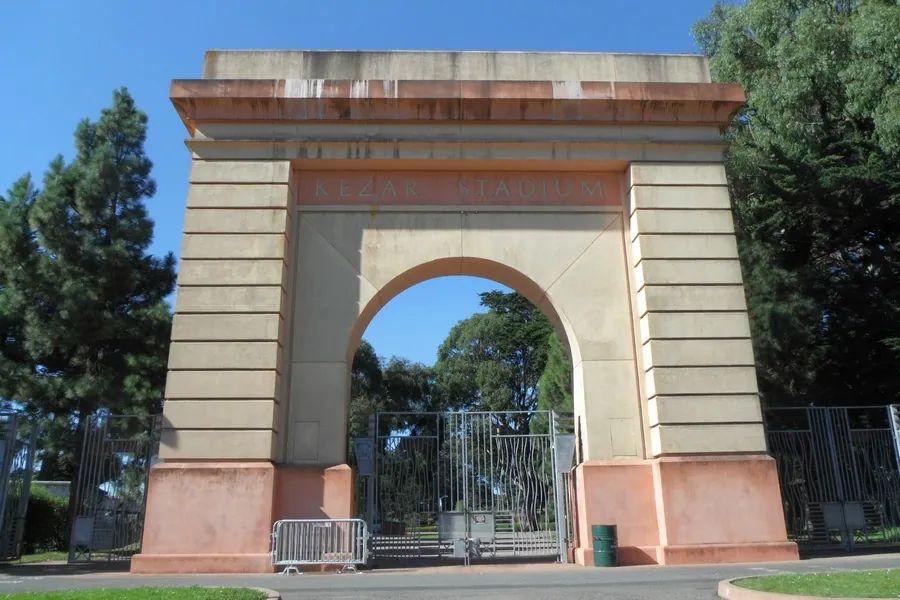
Kezar Stadium is an outdoor athletics stadium located at 670 Stanyan Street in San Francisco, adjacent to Kezar Pavilion in the southeastern corner of Golden Gate Park. It originally opened on May 2, 1925, with a capacity of 59,942 and served as the first home of the San Francisco 49ers from 1946 through 1970. The stadium was demolished in 1989 and rebuilt as a 10,000-seat venue, reopening in 1990 with a natural grass surface and an all-weather track. Today, Kezar Stadium hosts high school football, soccer, lacrosse, and community sports, maintaining its legacy as a historic San Francisco landmark. The stadium is owned by the City and County of San Francisco and operated by the San Francisco Recreation & Parks Department, and it continues to be a hub for public recreation and sporting events.
Construction and Opening
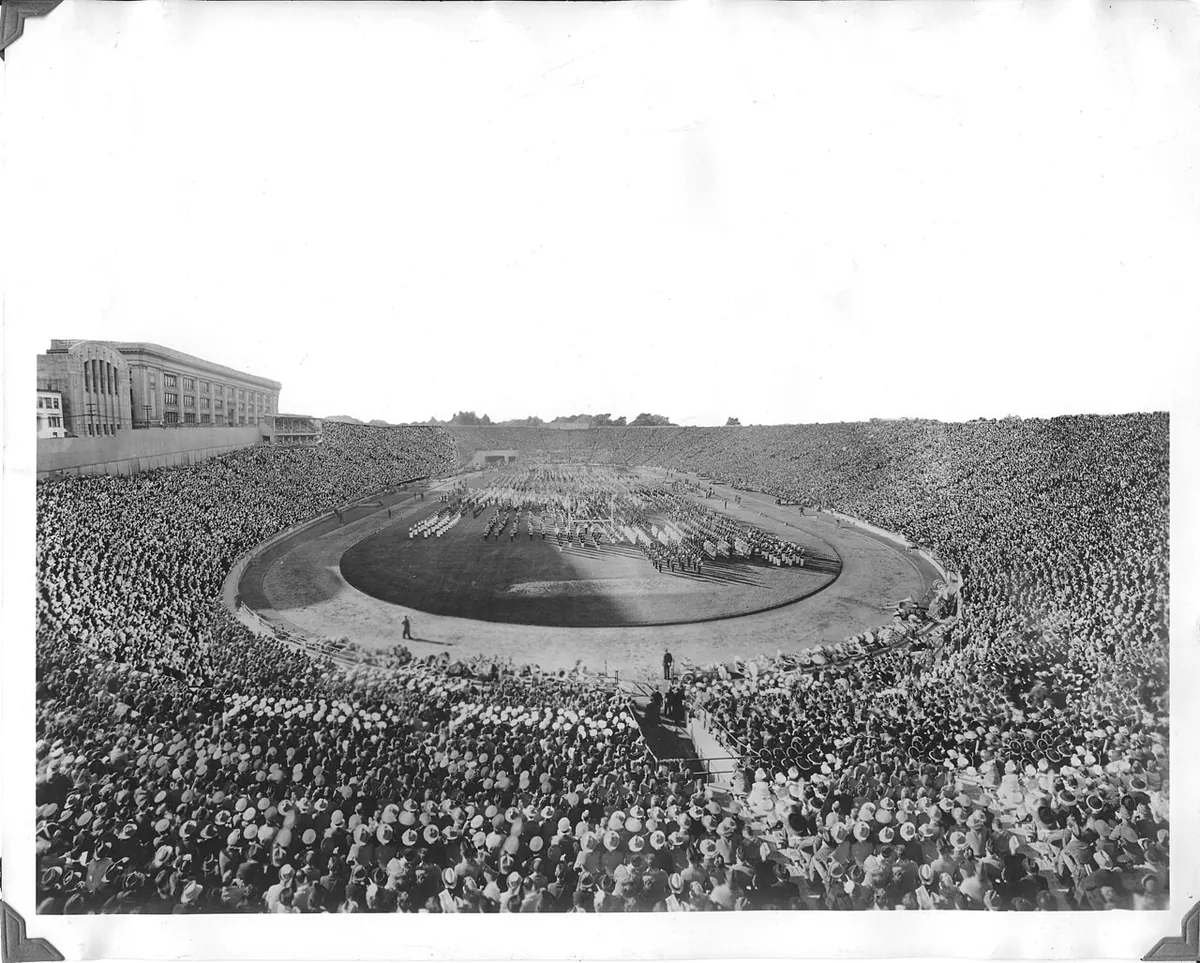
The proposal for a large athletics stadium in San Francisco came from Jack Spaulding in 1920, who envisioned a 50,000-seat venue to keep the city competitive with others. The city appropriated an additional $200,000, bringing the total original cost to $300,000. Ground was broken on June 27, 1924, and construction was completed in just one year under the design of architect Willis Polk. The dedication ceremony on May 2, 1925, featured a two-mile footrace between Finnish runners Ville Ritola and Paavo Nurmi. A little over a month later, the stadium hosted the USA Outdoor Track and Field Championships, establishing its multi-sport purpose from the outset. The stadium was built in the southeastern corner of Golden Gate Park adjacent to the Kezar Pavilion.
NFL Football Tenants and Era
Kezar Stadium's primary football tenant was the San Francisco 49ers, who played there from their inaugural 1946 season in the All-American Football Conference through their final NFL season at the venue in 1970. The 49ers compiled a record of 95 wins, 61 losses, and 1 tie during their tenure at Kezar. The stadium also hosted the Oakland Raiders for their first four home games in the 1960 AFL season before the team moved to Candlestick Park and then to a temporary facility in Oakland. Kezar was the site of numerous historic NFL moments, including defensive end Jim Marshall's famous wrong-way run for the Minnesota Vikings against the 49ers on October 25, 1964. The final NFL game at the original Kezar was the 1970 NFC Championship Game on January 3, 1971, where the 49ers lost to the Dallas Cowboys 17-10.
The stadium had a poor reputation among NFL players due to its inadequate facilities. Hall of Fame defensive tackle Art Donovan recalled the look of dread on visiting teams due to the poor dressing rooms, long dusty tunnel, shredded turf, and seagulls that would arrive in the fourth quarter. Fans were notoriously rowdy, and after the 1970 NFC Championship Game, 22 people were arrested for fighting or throwing objects. Many Pro Football Hall of Famers played their home games at Kezar for the 49ers. The Alley-Oop pass, popularized by 49ers receiver R.C. Owens, was first seen at Kezar Stadium.
College and High School Football
College football was a major feature at Kezar from its opening. The annual East-West Shrine Game, a postseason matchup of college all-stars, was held at Kezar from 1925 to 1941, 1943 to 1968, and 1971 to 1973. Stanford University played four home games at Kezar: one in 1928 and three in 1942. The first-ever major college football double header occurred on September 28, 1940, featuring Stanford vs. USF and Santa Clara vs. Utah. The Little Big Game rivalry between St. Mary's and Santa Clara drew crowds of 50,000 to watch these two powerhouses battle in its heyday. Stanford University also held its spring football game at Kezar in 2010, 2011, and 2012.
High school football also set records at the venue. In 1928, the city championship game between San Francisco Polytechnic and Lowell High School drew over 50,000 fans, which remains the record for a high school football game in Northern California. The annual Bruce-Mahoney rivalry game between St. Ignatius College Preparatory and Sacred Heart Cathedral Preparatory is held at the rebuilt stadium. Sacred Heart Cathedral Preparatory and Mission High School both use the field for their home football games. The stadium has hosted several Northern California Semi-pro football championship games. The city high school championship is known popularly as the Turkey Bowl. Other high school and amateur events at Kezar include the Turkey Bowl city championship, the Bruce-Mahoney game, home games for Sacred Heart Cathedral Preparatory, home games for Mission High School, and Northern California Semi-pro football championship games.
Demolition and 1990 Reconstruction
The original Kezar Stadium was demolished in 1989. A farewell party was held in April 1989 where fans paid $30 to wander through the stadium and bleacher planks were sold off. The stadium was demolished in June 1989. The stadium was rebuilt between 1989 and 1990 into a much smaller venue. St. Clair played his entire football career at Kezar, including high school at Polytechnic, college at USF, and 11 professional seasons with the 49ers from 1953 to 1963. The playing surface was officially named Bob St. Clair Field in January 2001 by the City of San Francisco. The new stadium on this site, often called 'Little Kezar,' has a much smaller seating capacity.
Renovations and Modern Improvements
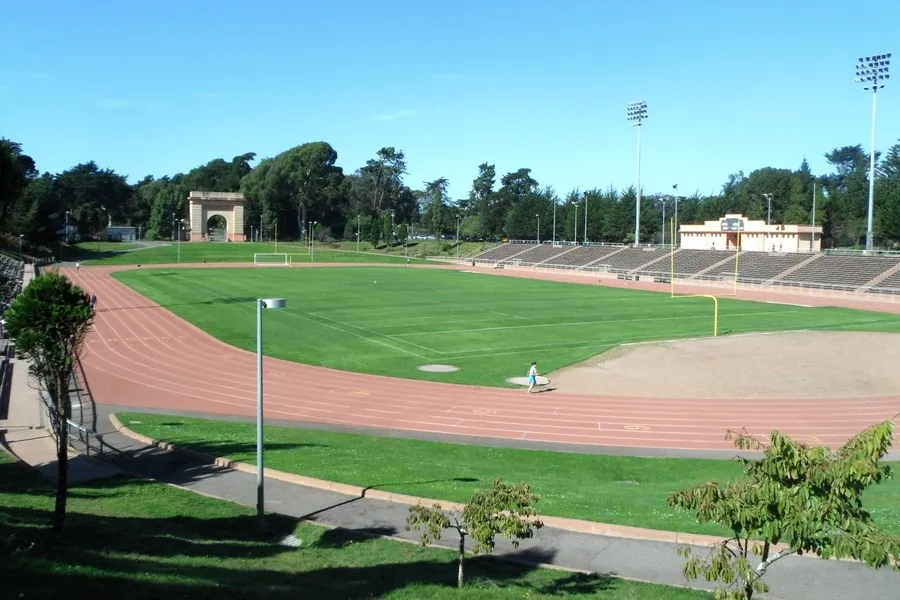
Kezar Stadium underwent a significant renovation from September 2014 to March 2015 at a cost of $3.2 million, funded by the city's Capital Planning General Fund. The project included new entry walk paving, an upgraded sound system, new perimeter walkways and curbs, and the installation of a new Mondo running track surface striped for nine 42-inch lanes. As part of this renovation, 1,000 historic seats from Candlestick Park were installed for public use. Mayor Edwin M. Lee helped re-open the stadium with a warm-up run in March 2015. In December 2016, an additional 4,000 Candlestick Park seats were acquired and installed, paid for by the San Francisco Deltas soccer team as part of a $1 million improvement agreement. The stadium continues to be managed by the San Francisco Recreation & Parks Department and is used for a wide variety of community and sporting events.
Capacity and Physical Features
The capacity of Kezar Stadium has changed dramatically over its history. From its opening in 1925 until its demolition in 1989, the original bowl-shaped stadium could hold 59,942 spectators on bench seating that circled the entire field. After the 1989 to 1990 reconstruction, the capacity was reduced to 10,000 seats. The current venue is an open-air stadium with a natural grass playing surface named Bob St. Clair Field. It features an all-weather track that circumscribes the field. The stadium's intimate atmosphere is noted for events, with its official capacity listed as 10,000. Public transit access is available via the Carl and Stanyan stop.
Soccer and Lacrosse History
Kezar Stadium has hosted professional soccer since 1967 when it served as home for the San Francisco Golden Gate Gales of the United Soccer Association. In October 2006, it was announced that the new pro soccer team California Victory would play their 2007 home games at Kezar in the USL First Division, though the team later folded. The stadium has been the home field for San Francisco City FC of USL League Two since 2001, a supporter-owned club that returned to Kezar for the 2018 season. In 2017, Kezar became the home field for the San Francisco Deltas of the North American Soccer League, who contributed over $1 million in renovations before the team folded. The stadium also hosts women's soccer with the San Francisco Nighthawks of the WPSL and formerly the Bay Area Breeze of the W-League.
In lacrosse, Kezar hosted the San Francisco Dragons of Major League Lacrosse in 2006 and 2007 following the league's West Coast expansion. The stadium is the site of the annual San Francisco Fall Lacrosse Classic, an NCAA Division I event started in 2009 to benefit the Bay Area Youth Sports Foundation. The first event in 2009 featured Brown and North Carolina, with North Carolina winning 13-5 in front of a crowd of more than 4,500. Subsequent events included Johns Hopkins vs. Notre Dame in 2010, Denver vs. Harvard in 2011, and Lehigh vs. Ohio State in 2012. The foundation has made over $225,000 in grants to local youth sports programs as a result of these events. Teams that have played in the San Francisco Fall Lacrosse Classic include Brown University, the University of North Carolina, Johns Hopkins University, the University of Notre Dame, the University of Denver, Harvard University, Lehigh University, and Ohio State University.
Other Events and Pop Culture
Beyond traditional sports, Kezar Stadium has hosted a diverse array of events throughout its history. The SNACK Benefit Concert in 1975 was a notable music event held at the stadium. The stadium had a memorable role in popular culture, serving as a filming location for the 1971 movie Dirty Harry, where the antagonist Scorpio lived and worked under the grandstand. Months after the 49ers' departure, several scenes from the film were shot at and above the stadium.
The stadium has also hosted other sports including rugby, baseball, boxing, cricket, auto racing, and motorcycle racing in the 1930s. In September 1932, the Australian Cricket Team played a North California all-star team at Kezar during their 56-game tour of the U.S. and Canada. In 2004, it served as the home of the San Francisco Freedom Pro Cricket team. The stadium was home to the San Francisco Dogfish of Major League Ultimate (MLU) in 2013 and has hosted Gaelic football through the San Francisco GAA football league.
Future Plans and Ongoing Legacy
San Francisco has approved a public-private deal that would bring a new soccer club, Golden City FC, to Kezar Stadium. The legacy of Kezar is firmly rooted in its 25-year tenure as the home of the San Francisco 49ers, where Hall of Famers like Joe Perry, Y.A. Tittle, and Hugh McElhenny played. The 49ers have returned for open practices during training camp in years such as 2003 and 2016. The stadium remains a vital public resource, hosting high school championships including the city championship Turkey Bowl, amateur leagues, and serving as a daily destination for runners and sports enthusiasts in Golden Gate Park. It continues to host the San Francisco Fall Lacrosse Classic and serves as home for San Francisco City FC. The stadium opened in 1925 and continues to be a hub for public recreation and sporting events.
Video
FAQ
When did the San Francisco 49ers play at Kezar Stadium?
The San Francisco 49ers played at Kezar Stadium from their first season in 1946 through the 1970 NFL season. The team played their home games at the venue during their 25-year tenure, achieving a record of 95 wins, 61 losses, and 1 tie. Their final game at Kezar was the 1970 NFC Championship Game on January 3, 1971, which they lost to the Dallas Cowboys by a score of 17-10. The 49ers then moved to Candlestick Park for the 1971 season and played there through 2013.
What is the seating capacity of Kezar Stadium?
Kezar Stadium has had two distinct capacity figures throughout its history. The original stadium, which opened in 1925 and stood until 1989, had a capacity of 59,942 spectators on bench seating that completely encircled the field. After being demolished and rebuilt between 1989 and 1990, the current stadium has a much smaller capacity of 10,000 seats. The current venue is an open-air stadium with a natural grass playing surface and an all-weather track. Public transit access is available via the Carl and Stanyan stop.
What sports and events does Kezar Stadium host today?
Today, Kezar Stadium serves as a multi-use public venue hosting numerous sports and community events. It is the home field for San Francisco City FC of USL League Two soccer and hosts high school football games including the city championship Turkey Bowl and the Bruce-Mahoney rivalry between St. Ignatius and Sacred Heart Cathedral. The stadium hosts the annual San Francisco Fall Lacrosse Classic NCAA event, recreation sports leagues, and high school championships. Community members regularly use the all-weather track for exercise, and the venue continues to host concerts and special events while being managed by the San Francisco Recreation & Parks Department.
Did any other NFL teams play at Kezar Stadium besides the 49ers?
Yes, the Oakland Raiders also played at Kezar Stadium during their inaugural 1960 season in the American Football League. The Raiders played their first four home games at Kezar before moving to Candlestick Park for the remainder of their first two seasons. The stadium also hosted numerous NFL exhibition games and was the site of Jim Marshall's famous wrong-way run in 1964 when his Minnesota Vikings visited to play the 49ers. Kezar Stadium was the first home of both the San Francisco 49ers and the Oakland Raiders.
What future upgrades are planned for Kezar Stadium?
San Francisco has approved a public-private deal that would bring a new soccer club called Golden City FC to Kezar Stadium. The planned upgrades include a new grass playing field, improved seating arrangements, a modern sound system, and a high-definition LED scoreboard. The project also aims to enhance accessibility throughout the stadium while maintaining its availability for community use and school sports. These improvements represent another chapter in the stadium's ongoing evolution.
When was Kezar Stadium originally opened and when was it rebuilt?
Kezar Stadium originally opened on May 2, 1925, after groundbreaking on June 27, 1924. The original structure was demolished in 1989 and then reconstructed from 1989 to 1990. The rebuilt stadium was inaugurated in 1991 with a much smaller seating capacity. The original construction cost was $300,000, which equates to approximately $5.51 million in 2025 dollars.
Sources
- Kezar Stadium (Wikipedia) Wikipedia
- Kezar Stadium: The Original Home of Professional Football in the Bay Area broughttolight.ucsf.edu
- Kezar Stadium stadiumsportus.com
- On This Day in The Bay: Goodbye Old Kezar 49ers.com