Candlestick Park was an outdoor stadium in the Hunters Point area of San Francisco, California. It opened on April 12, 1960, and was originally built for the San Francisco Giants baseball team. The stadium became the home of the San Francisco 49ers football team from 1971 until 2013. It was the site of eight NFC Championship Games. The venue was demolished in 2015 after the 49ers moved to a new stadium.
Location and Construction History
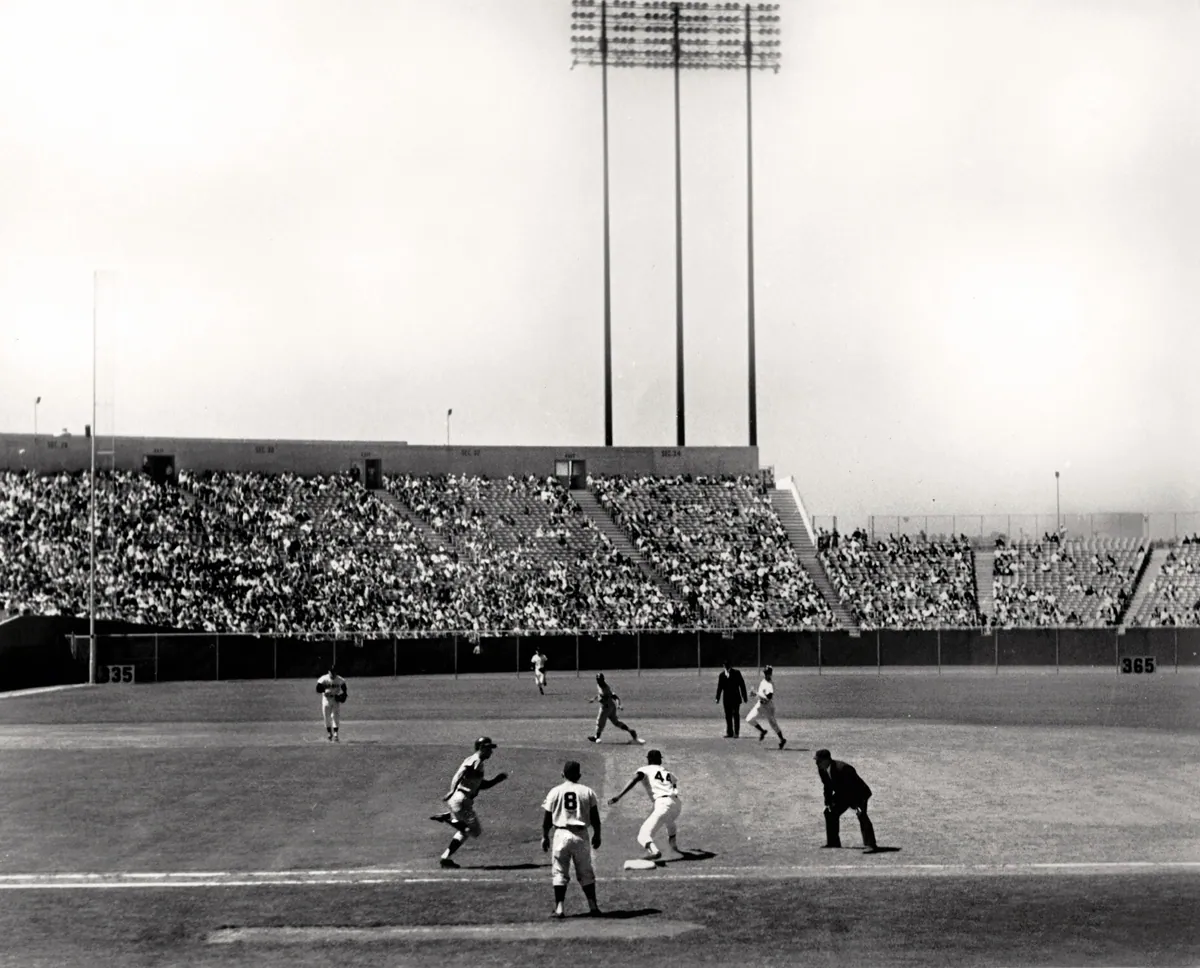
Candlestick Park was built on Candlestick Point along the western shore of San Francisco Bay. The area was named for the long-billed curlews, locally called candlestick birds, that lived there. City planning for a stadium began in 1954 when Mayor George Christopher promised to build one if a Major League Baseball team came to San Francisco. A $5 million bond was approved that year to fund the project. After the New York Giants moved to San Francisco in 1958, the city chose the Candlestick Point site over a downtown location because it was cheaper and had room for 10,000 parking spaces. The land was bought from contractor Charles Harney, who also won the construction contract without a bidding process, a deal investigated by a grand jury in 1958. Workers broke ground on August 12, 1958, and the stadium was ready for its opening on April 12, 1960. The total construction cost was $15 million, and it was the first ballpark built completely from reinforced concrete. The stadium was originally shown on maps as Bay View Stadium before being named Candlestick Park after a public contest on March 3, 1959.
Design, Capacity, and Playing Conditions
The stadium's original baseball configuration seated 43,765 fans when it opened in 1960. A major renovation in 1971 enclosed the outfield with new grandstands to accommodate the San Francisco 49ers, increasing football capacity to about 61,000. The final listed football capacity was 69,732. The venue was infamous for its harsh weather, with strong, cold winds and fog blowing in from the bay. Architect John Bolles included a boomerang-shaped concrete baffle in the upper deck to block wind, but the design failed to work properly. For most of its operational life, the field surface was natural bluegrass. An artificial AstroTurf surface was installed in 1970 and used for nine seasons before grass was restored in 1979. The stadium's unique oblong shape resulted from its conversion from a baseball-only park to a dual-purpose facility, which left some lower-deck seats with obstructed views for football games. The stadium's reputation for cold led to promotions like the 'Croix de Candlestick' pin awarded to fans who stayed through extra-inning night games.
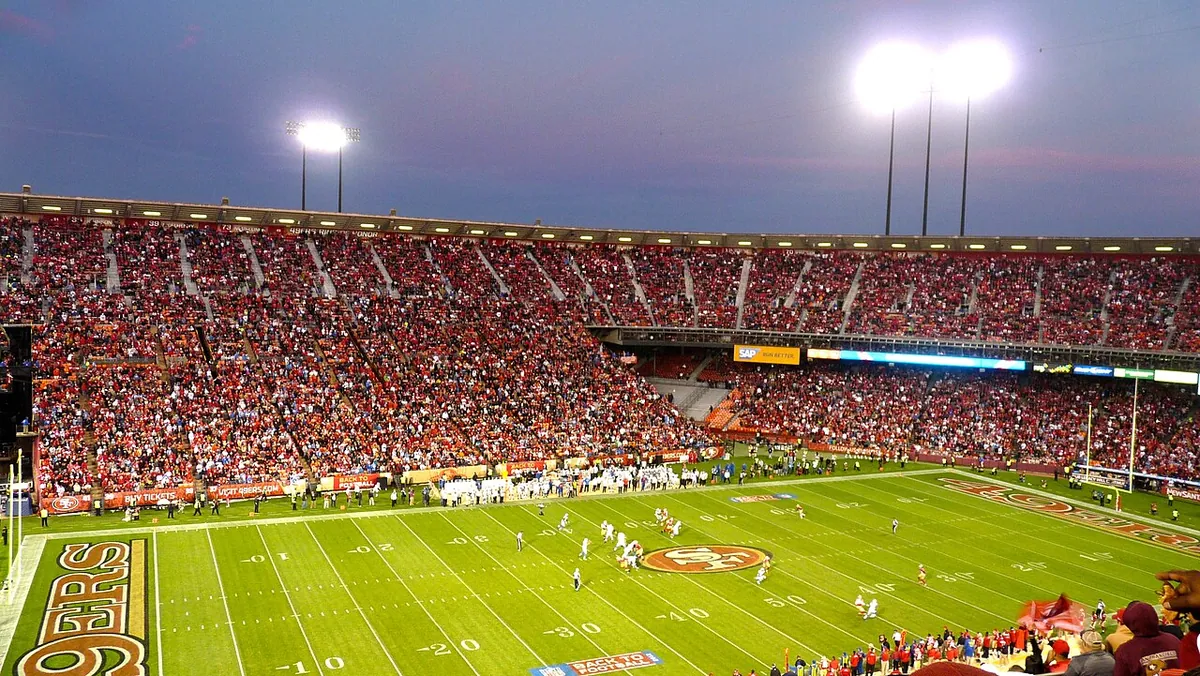
Football Tenants and Regular Season History
The San Francisco 49ers were the primary football tenant, playing at the stadium from 1971 through the 2013 season. Before the 49ers' arrival, the Oakland Raiders of the American Football League used the stadium for the final three games of their 1960 season and all of their 1961 season. These games were held under the stadium's various corporate names: Candlestick Park, 3Com Park, and Monster Park. The 49ers' first game at the stadium was on October 10, 1971. Their final regular season game there was on December 23, 2013, a 34-24 win over the Atlanta Falcons. That Monday Night Football contest was the 36th such broadcast from the stadium, the most for any venue in NFL history. The 49ers moved from their previous home, Kezar Stadium, where they had played since 1946.
NFL Playoffs and Championship Games
Candlestick Park hosted eight NFC Championship Games during the 49ers' tenure. The 49ers won four of those eight championship games played at home. Their victories came against the Dallas Cowboys in the 1981 and 1994 seasons, the Chicago Bears in the 1984 season, and the Los Angeles Rams in the 1989 season. Their four losses at home in the NFC Championship came against the Cowboys in 1992, the New York Giants in 1990 and 2011, and the Green Bay Packers in 1997. The final NFC Championship Game at the site was on January 22, 2012, where the Giants defeated the 49ers 20-17 in overtime. From the 1999 season through 2013, the stadium hosted four playoff games, including the 2012 NFC Divisional Playoff where the 49ers beat the Green Bay Packers 45-31. The highest-scoring NFL game at the stadium from 1999 to 2013 was a 77-point affair on January 5, 2003, when the 49ers beat the New York Giants 39-38.
- NFC Championship Game record: 4 wins, 4 losses.
- Last NFC Championship: January 22, 2012 (Giants 20, 49ers 17).
- Total playoff games (1999 to 2013): 4.
- Notable play: The Catch II (1998 NFC Wild Card, 49ers vs. Packers).
- Notable play: The Catch III (2011 NFC Divisional, 49ers vs. Saints).
Other Football Events and Notable Incidents
The stadium hosted only one college football game on September 3, 2011. The California Golden Bears, designated as the home team, defeated the Fresno State Bulldogs 36-21. This game was moved to San Francisco because California Memorial Stadium was under renovation. Candlestick Park was awarded Super Bowl XXXIII by the NFL on November 2, 1994, but the game was moved to Miami on October 31, 1996, after required renovations were not completed. The league later promised Super Bowl XXXVII if a new football stadium was built, but the plan was abandoned. A significant power outage occurred on December 19, 2011, before a Monday Night Football game between the 49ers and Pittsburgh Steelers. A transformer sparked, causing a 17-minute delay at the start and another 30-minute delay in the second quarter. The stadium also withstood the Loma Prieta earthquake on October 17, 1989, which struck just before a World Series game, causing minor structural damage but no injuries. The 49ers moved their October 22 game against the New England Patriots to Stanford Stadium as a result.
Renovations and Stadium Upgrades
The first major renovation project started after the 1970 season to prepare for the 49ers. The city approved $16.1 million to enclose the stadium, add outfield grandstands, and install retractable seating in right field. This work also involved replacing the natural grass with AstroTurf. In 1979, the artificial surface was removed and natural grass was reinstalled. After the San Francisco Giants moved to Pacific Bell Park after the 1999 season, the retractable seating in right field was locked in its football position. The stadium's name changed several times due to corporate sponsorships. It was renamed 3Com Park at Candlestick Point in 1995. From 2004 to 2008, it was called Monster Park. The original Candlestick Park name was restored from 2008 until the venue closed. The 1971 enclosure was intended to reduce wind but instead caused it to swirl irregularly throughout the stadium.
Baseball History and Multi-Use Challenges
Candlestick Park was originally built for the San Francisco Giants, who played there from 1960 through 1999. The Giants played six postseason series at the stadium, hosting the NLCS in 1971, 1987, and 1989, the World Series in 1962 and 1989, and the NLDS in 1997. The stadium hosted the MLB All-Star Game in 1961 and again in 1984. The final baseball game was played on September 30, 1999, a 9-4 loss to the Los Angeles Dodgers. For its final years, Candlestick Park was the only NFL stadium that had started as a baseball-only facility and was later redesigned for football. This led to its irregular shape, where a large section of lower-deck seating in the old right-field corner was obstructed by the eastern grandstand added for football. Those seats were left empty for football games and were eventually removed after the Giants departed.
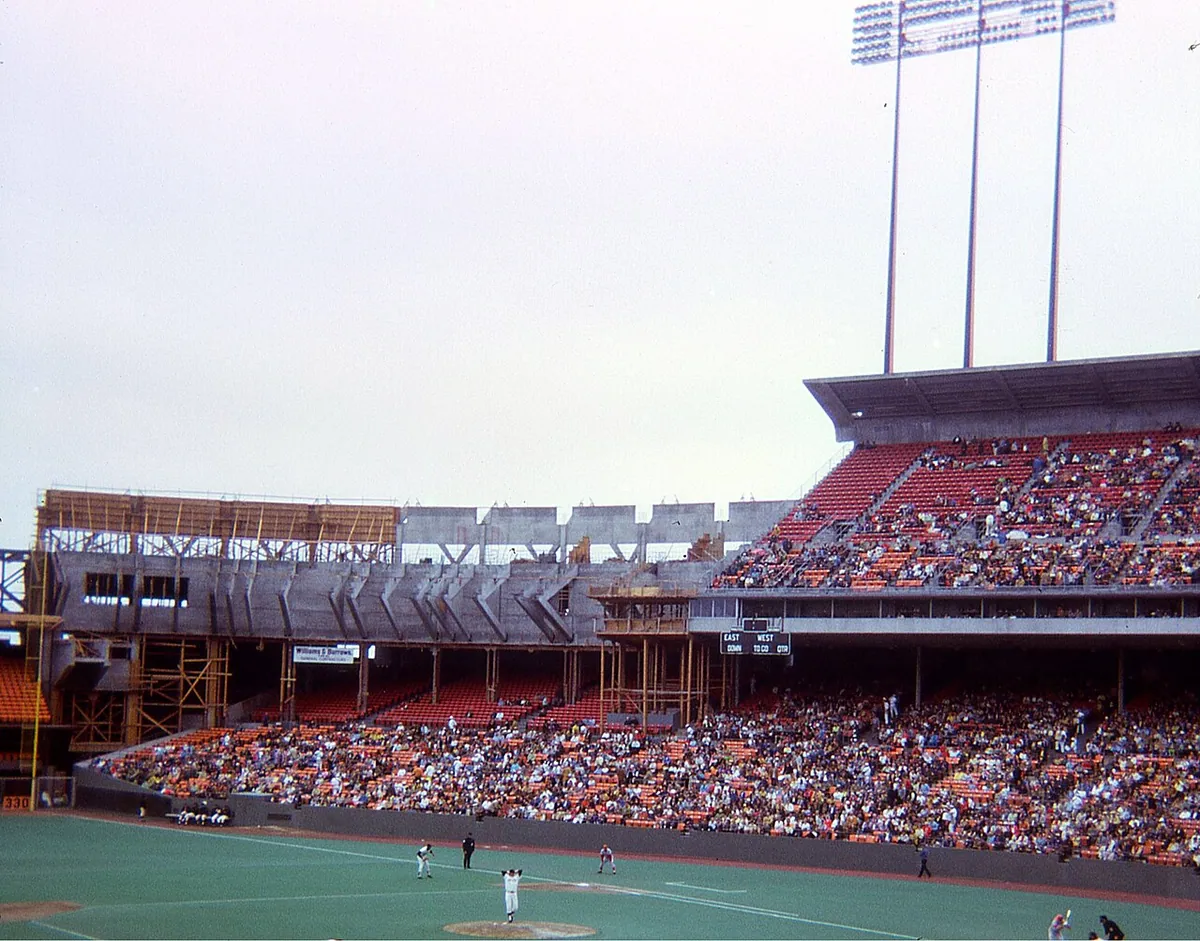
Closure, Demolition, and Site Legacy
The San Francisco 49ers played their last game at the stadium on December 23, 2013, and moved to Levi's Stadium in Santa Clara for the 2014 season. The final public event was a Paul McCartney concert in August 2014, and the stadium officially closed on August 14, 2014. Demolition crews began tearing down the structure on February 4, 2015, and finished on September 24, 2015. As of 2019, plans called for the site to be redeveloped into office space, but it has remained vacant. Its challenging weather conditions and multipurpose design made it a distinctive part of the city's sports landscape for over five decades.
Stadium Records and Operational Data
This figure includes 119 regular season contests and 4 playoff games. The San Francisco 49ers were the home team for all these matches. The venue was consistently classified as an outdoor stadium with a grass playing surface during this period. The 2011 NFC Championship Game was the last conference title game held there. The stadium's reputation for difficult wind conditions was well-earned, with studies showing gusts were particularly strong due to its location next to a hill that first intercepted Pacific winds. The stadium was home to a 49ers franchise that won five Super Bowl championships. The stadium hosted 368 professional football games over its entire history from 1960 to 2013.
| Category | Detail | Time Frame / Date |
|---|---|---|
| NFL Games Played | 123 games | 1999 season through 2013 season |
| Stadium Names Used | Candlestick Park (50 games), 3Com Park (49 games), Monster Park (24 games) | 1999 to 2013 |
| Home Team | San Francisco 49ers | 1999 to 2013 |
| Final Event | Paul McCartney Concert | August 2014 |
| Surface Type (1999 to 2013) | Grass | Roof listed as outdoors |
| Total Pro Football Games | 368 games | 1960 to 2013 |
Weather and Cultural Impact
The windy and cold conditions at Candlestick Park were noted in both baseball and football. Giants Hall of Fame player Willie Mays stated the wind cost him over 100 home runs during his time playing there. A famous apocryphal story from the 1961 All-Star Game claimed pitcher Stu Miller was blown off the mound by a gust and called for a balk, though Miller later denied it. In 1963, wind reportedly lifted a batting cage and dropped it 70 feet away. The stadium's radiant heating system, consisting of hot water pipes under the lower seats, was ineffective because the pipes were not embedded in the concrete. Attorney Melvin Belli successfully sued the Giants in 1960 because his expensive seat was unbearably cold. Fan nicknames for the park included 'The Dump', 'North Pole', 'Cave of the Winds', and 'The Ashtray By The Bay'.
Recent games
| Date | Game | Week |
|---|---|---|
| Dec 23, 2013 | Atlanta Falcons 24 at San Francisco 49ers 34 | Week 16 |
| Dec 8, 2013 | Seattle Seahawks 17 at San Francisco 49ers 19 | Week 14 |
| Dec 1, 2013 | St. Louis Rams 13 at San Francisco 49ers 23 | Week 13 |
| Nov 10, 2013 | Carolina Panthers 10 at San Francisco 49ers 9 | Week 10 |
| Oct 13, 2013 | Arizona Cardinals 20 at San Francisco 49ers 32 | Week 6 |
| Oct 6, 2013 | Houston Texans 3 at San Francisco 49ers 34 | Week 5 |
| Sep 22, 2013 | Indianapolis Colts 27 at San Francisco 49ers 7 | Week 3 |
| Sep 8, 2013 | Green Bay Packers 28 at San Francisco 49ers 34 | Week 1 |
| Jan 12, 2013 | Green Bay Packers 31 at San Francisco 49ers 45 | Divisional |
| Dec 30, 2012 | Arizona Cardinals 13 at San Francisco 49ers 27 | Week 17 |
| Dec 9, 2012 | Miami Dolphins 13 at San Francisco 49ers 27 | Week 14 |
| Nov 19, 2012 | Chicago Bears 7 at San Francisco 49ers 32 | Week 11 |
Video
FAQ
What was the seating capacity for football at Candlestick Park?
The football capacity at Candlestick Park changed after renovations. Initially a baseball park, its first major redesign in 1971 increased capacity to approximately 61,000 for football. By the end of its operational life, the official listed football capacity was 69,732. The original baseball configuration from 1960 seated 43,765 fans. The expansion involved enclosing the outfield with new grandstands to create a bowl suitable for football viewing.
Why was Candlestick Park so famous for being windy and cold?
Candlestick Park was built directly on the shore of San Francisco Bay, where it was exposed to strong winds coming off the Pacific Ocean. A hill adjacent to the stadium caused these winds to swirl and create unpredictable gusts inside the bowl. The stadium's radiant heating system, installed under the lower seats, was ineffective. These conditions led to its nicknames like 'Windlestick' and 'The Quagmire,' and players like Willie Mays claimed the wind cost him home runs.
Did Candlestick Park host any college football games?
Yes, Candlestick Park hosted one college football game in its history. On September 3, 2011, the California Golden Bears faced the Fresno State Bulldogs in a neutral-site game where Cal was designated the home team. California won the game by a score of 36-21. The contest was held in San Francisco because California Memorial Stadium in Berkeley was undergoing a major renovation and seismic retrofit at the time.
What happened during the 1989 earthquake at Candlestick Park?
The Loma Prieta earthquake, measuring 6.9 in magnitude, struck the San Francisco area on October 17, 1989, just minutes before Game 3 of the World Series was scheduled to start at Candlestick Park. The stadium sustained only minor structural damage, and no one inside was injured. Engineers credited recent seismic retrofitting work for preventing a potential collapse. The World Series was delayed for 10 days so engineers could inspect the stadium's safety.
What is on the site of Candlestick Park today?
The Candlestick Park stadium was completely demolished by September 24, 2015. The site at 602 Jamestown Avenue in San Francisco's Hunters Point neighborhood has remained vacant since then. As of 2019, plans were in place to redevelop the land into office space, but no construction had begun. The area was originally a quiet cove before the stadium was built and is part of the larger Candlestick Point area.
What were the different names used for Candlestick Park over the years?
Candlestick Park had several official names throughout its history. It was originally named Candlestick Park from 1960 to 1995. From 1995 to 2002, it was called 3Com Park at Candlestick Point, followed by San Francisco Stadium at Candlestick Point from 2002 to 2004. It was known as Monster Park from 2004 to 2008 before reverting to Candlestick Park from 2008 until its closure in 2013. Game records from the 1999 to 2013 seasons reflect these changes, listing games under Candlestick Park, 3Com Park, and Monster Park.
Sources
- Candlestick Park (Wikipedia) Wikipedia
- Candlestick Park, History, Photos & More of the San Francisco 49ers.. Stadiums of Pro Football
- nflverse game, roster and draft data nflverse (CC BY 4.0)