Ohio Stadium is a historic American football stadium located on the campus of Ohio State University in Columbus, Ohio. Primarily the home venue for the Ohio State Buckeyes football team, the stadium opened on October 7, 1922, with an original capacity of 66,210. Commonly nicknamed "The Horseshoe" or "The Shoe," the stadium is renowned for its distinctive horseshoe shape and Roman-inspired architectural details. Ohio Stadium is the third largest on-campus football stadium in the United States and was added to the National Register of Historic Places in 1974.
Location, Construction and Financing
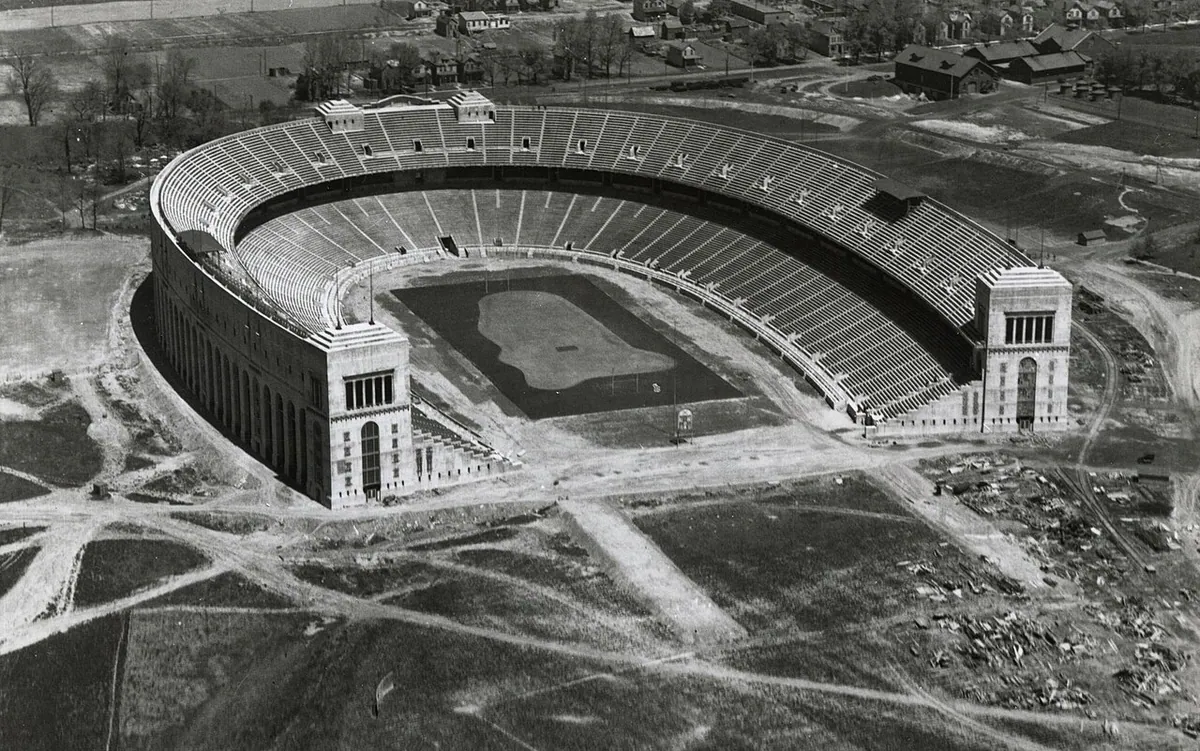
Ohio Stadium is located at 411 Woody Hayes Drive in Columbus, Ohio, on the campus of Ohio State University, situated on the flood plain of the Olentangy River. The need for a new stadium arose as early as 1913 when the previous venue, Ohio Field, could no longer contain the growing crowds drawn to Buckeye football games, a trend accelerated by the popularity of player Charles Chic Harley. University architect and 1907 graduate Howard Dwight Smith conceptualized and designed the horseshoe-shaped stadium in 1918, employing revolutionary architectural techniques. A public subscription campaign to fund the project began in October 1920 and secured over $1.1 million in pledges by January 1921, with $975,001 of those pledges ultimately being fulfilled. Groundbreaking occurred on August 3, 1921, and the E. H. Latham Company of Columbus constructed the stadium using materials from the Marble Cliff Quarry Co. The total construction cost was $1.34 million, with a complete project cost of $1.49 million.
Architectural Design and Features
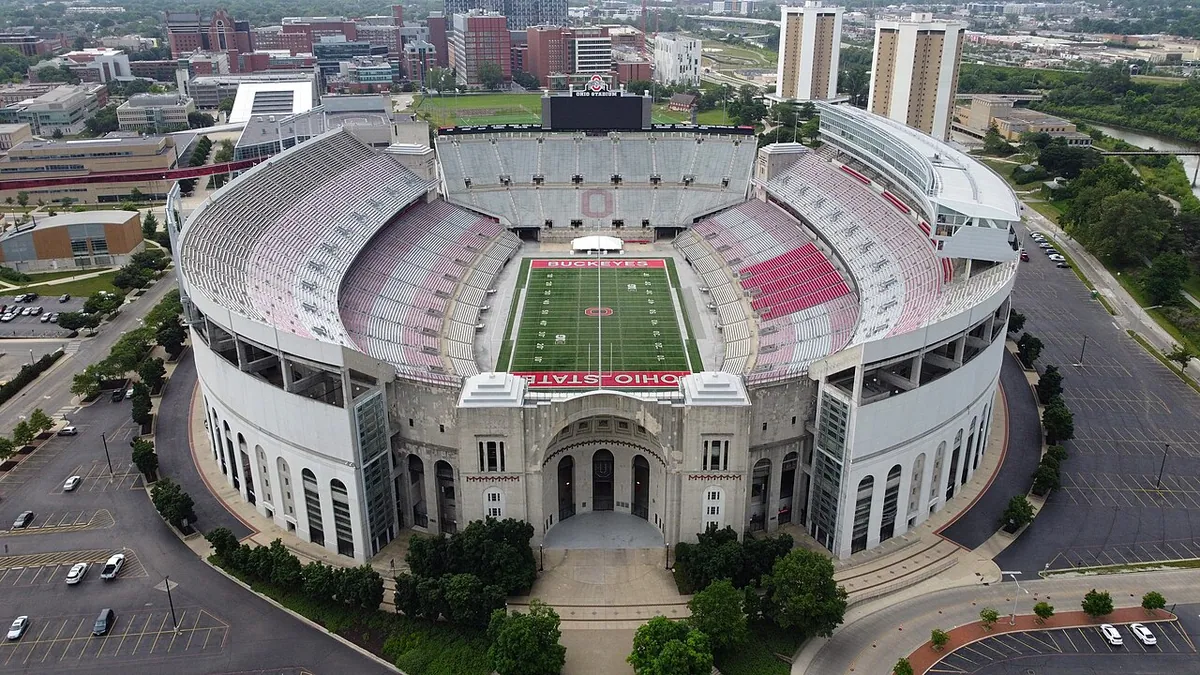
Architect Howard Dwight Smith designed Ohio Stadium with numerous innovative features that distinguished it from other stadiums of its era. Instead of building a large bowl like the Yale Bowl, Smith designed a double-decked structure with an upper deck that hangs over part of the lower deck, creating the stadium's distinctive A, B, and C decks. To improve sightlines, he used double columns instead of the numerous single columns seen at Harvard Stadium, allowing for more space between supports. A critical engineering element is the slurry wall built at the base of the stadium to keep out waters from the nearby Olentangy River. The north end of the stadium features a rotunda designed to resemble the dome of the Pantheon in Rome, which is now adorned with stained glass murals of Buckeye football squads. The original plans explicitly noted the Horseshoe shape, which directly led to the stadium's enduring nickname. These design choices, inspired by Smith's visits to Roman structures like the Colosseum, have made Ohio Stadium one of the most instantly recognizable venues in sports.
Capacity and Seating History Timeline
The seating capacity of Ohio Stadium has increased significantly through a series of expansions and renovations over its century of operation. The original capacity in 1922 was 66,210, which many university officials feared would never be filled. Minor adjustments over the years gradually increased capacity, with a notable jump to 91,470 possible spectators after the 1991 expansion. The most dramatic change came with the 2000 to 2001 renovation, which removed the track, lowered the field, and added permanent seating in the south end zone, raising capacity to 101,568. A renovation beginning in 2017 to add more luxury suites led to a planned decrease of 2,600 seats, resulting in the current capacity of 102,780 as of 2019. The stadium has consistently ranked among the nation's top five for average home attendance since 1949 and led the nation in average attendance for the 2014 season with 106,296 fans per game.
| Capacity | Years |
|---|---|
| 66,210 | 1922 to 1943 |
| 78,677 | 1948 to 1957 |
| 83,112 | 1975 to 1981 |
| 91,470 | 1991 to 1994 |
| 101,568 | 2001 to 2006 |
| 102,329 | 2007 to 2014 |
| 102,780 | 2019 to present |
Playing Surface Evolution and Field Name
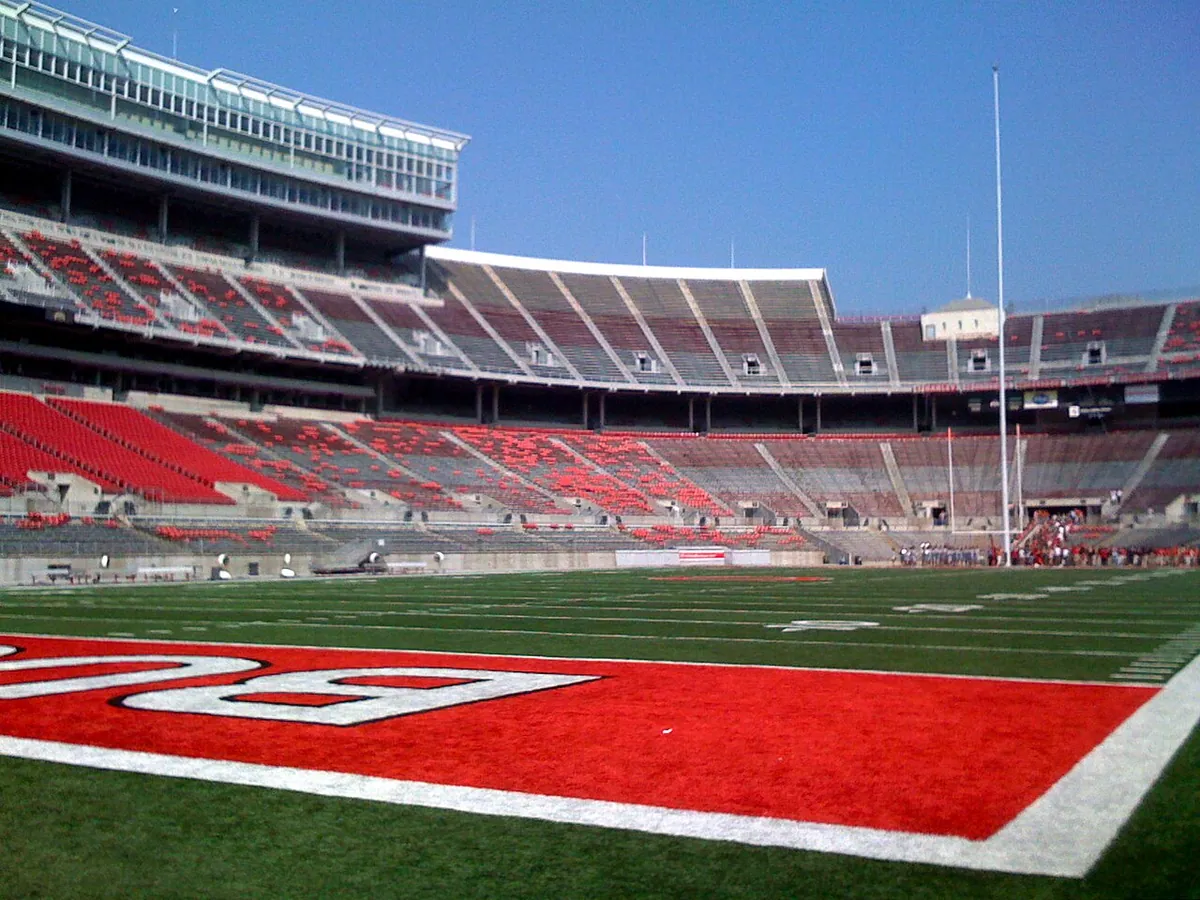
The playing surface at Ohio Stadium has undergone several significant changes driven by maintenance needs and technological advancements. From its opening in 1922 through the 1970 season, the field featured a natural grass surface. In 1971, AstroTurf was installed thanks to a donation by Lou Fisher, dedicated to fellow football player Joseph Campanella, with a commemorative plaque placed in the southeast corner. This surface was replaced with SuperTurf in 1979. Natural grass made a return in 1990 in the form of a specialized system called Prescription Athletic Turf, which was used through the 2006 season. Persistent problems with the natural grass in 2006, requiring two costly re-soddings, led the university to install FieldTurf for the 2007 season. The playing field itself is named Safelite Field, following a naming rights deal announced on August 26, 2022, with the Columbus-based glass repair company Safelite. This agreement allows for Safelite logos to be displayed on the field, though the name of the stadium facility itself remains Ohio Stadium.
Football Tenants and Historic Games
The primary and historic tenant of Ohio Stadium is the Ohio State Buckeyes football team, which has played its home games there since the stadium opened in 1922. The stadium has also hosted professional soccer, serving as the home for the Columbus Crew of Major League Soccer from 1996 through 1998 before they moved to a soccer-specific stadium. The Crew's home opener on April 13, 1996, drew 25,266 fans for a 4-0 win over D.C. United. The most notable football events at the venue are the annual rivalry games against the University of Michigan. The largest crowd in stadium history, 110,045, attended the Ohio State-Michigan game on November 26, 2016, a double-overtime victory for the Buckeyes. Other record-setting attendances have often occurred during high-profile conference matchups, with all of the ten largest crowds occurring since 2014. Memorable Ohio State wins over Michigan in the stadium include the 2002 game that propelled the Buckeyes to a national title, the 2006 top-ranked showdown, and the 1974 victory sealed by Tom Klaban's four field goals.
- The first game was October 7, 1922: Ohio State 5, Ohio Wesleyan 0.
- The formal dedication game was October 21, 1922: Michigan 19, Ohio State 0.
- The 1935 game against Notre Dame was the first sellout, with over 81,000.
- The stadium hosted the Columbus Crew MLS team from 1996 to 1998, finishing with a 30-18 record there.
- The record attendance of 110,045 was set November 26, 2016: Ohio State 30, Michigan 27.
Major Renovations and Modernization
Ohio Stadium has undergone several major renovation projects to modernize facilities, improve the fan experience, and increase capacity. The most comprehensive renovation took place from 1998 to 2001 at a total cost of $194 million. This project removed the track, lowered the field by 14.5 feet, and built a 45-foot slurry wall underneath to place it below the water table. It replaced the press box, added 81 luxury suites and 2,500 club seats, and installed a 90-by-30-foot video board in the south end zone. The financing for this renovation was unique, with 80 percent coming from the sale of leases on the new suites and club seats. The remaining 20 percent was funded by donations and the sale of naming rights for parts of the stadium, and no public funds or university money was used. The 2014 renovation added 2,500 permanent seats in the south stands, installed permanent stadium lighting in the northeast and southeast corners and atop the press box, and replaced the playing surface. The ongoing renovation that began in 2017 focuses on adding more luxury suites, which will reduce overall seating by 2,600.
Night Games and Attendance Records
Before the installation of permanent lights in 2014, night games at Ohio Stadium were a rare occurrence. The first night game was played on September 14, 1985, when the 9th-ranked Buckeyes defeated Pittsburgh 10-7. Ohio State did not play another night game at the stadium until September 11, 1993, a 21-12 win over 12th-ranked Washington. The Buckeyes have faced Penn State three times in night games at Ohio Stadium, holding a 2-1 record in those matchups. They are 2-0 in night games against Nebraska, Washington, and Wisconsin. The stadium holds the national record for a spring football game, drawing 100,189 fans on April 16, 2016, breaking their own previous record of 99,391 set in 2015. Since the opening game in 1922, nearly 40 million fans have passed through the stadium's gates.
Other Events and Multi-Purpose Use
Beyond football, Ohio Stadium serves as a major multi-purpose venue for large-scale events. It is the site of the university's Spring Commencement ceremonies each May. The first concert listed was by Loverboy on April 24, 1982. Notable concerts include Pink Floyd in 1988 and 1994, the latter drawing 75,250 fans, and The Rolling Stones in 1997 and 2015. Taylor Swift's performance on July 7, 2018, made her the first woman to headline a concert at the stadium. More recent performers include Billy Joel and Stevie Nicks in 2023, Morgan Wallen for two nights in 2023 drawing 139,000 total fans, and scheduled shows by Luke Combs, Bruno Mars, and AC/DC in 2026. The stadium also hosted the Buckeye Country Superfest music festival in 2015 and 2016, with the 2015 event drawing approximately 90,000 attendees over two days. From 1923 to 2001, the stadium was home to the Ohio State track and field teams, featuring a cinder track later named for Jesse Owens. A significant future sporting event is scheduled for March 1, 2025, when the stadium will host the NHL Stadium Series outdoor hockey game between the Columbus Blue Jackets and Detroit Red Wings.
Stadium Atmosphere, Traditions, and Records
The crowd at Ohio Stadium is renowned for creating a loud and difficult environment for opposing teams, a fact famously noted by University of Iowa coach Hayden Fry after a 1985 loss. Fry complained that the noise prevented his quarterback Chuck Long from calling plays and suggested the use of sound meters to penalize home teams for excessive noise. One of the most famous and sustained fan traditions is the O-H-I-O chant, which typically starts with students in the south stands and travels around the stadium with each section yelling one letter in sequence, sometimes lasting for 5 to 10 minutes. Before kickoffs, the entire stadium screams O continuously until the ball is kicked, followed immediately by the unified O-H-I-O chant. The stadium's impact is quantified by its consistent top-five national attendance ranking since 1949 and its all-time record crowd of 110,045.
Video
FAQ
What is the capacity of Ohio Stadium?
The current official seating capacity of Ohio Stadium is 102,780 as of the 2019 season. This figure has fluctuated with renovations, having previously been as high as 104,944 in 2014 before the addition of more luxury suites reduced the number of seats. The stadium's original capacity when it opened in 1922 was 66,210. Through expansions in 1948, 1991, 2001, and 2014, the capacity grew to accommodate the massive fan base of Ohio State football.
When did Ohio Stadium open and what was the first game?
Ohio Stadium opened on October 7, 1922. The first game was a 5-0 Ohio State victory over Ohio Wesleyan University, which drew a crowd of around 25,000. The stadium's formal dedication ceremony was held two weeks later on October 21, 1922, during a game against the University of Michigan, which attracted an announced crowd of 72,000 spectators. The Wolverines won that dedication game by a score of 19-0.
Why is Ohio Stadium called The Horseshoe?
Ohio Stadium is nicknamed The Horseshoe because of its distinctive architectural shape. Designed by Howard Dwight Smith, the stadium features a double-decked, horseshoe-shaped design with one end closed and the south end partially open. The original construction plans from 1921 explicitly noted the Horseshoe shape in the specifications. This unique configuration, reminiscent of a horseshoe, has been a defining characteristic since its construction and is the source of its popular nicknames The Horseshoe and The Shoe.
What kind of playing surface does Ohio Stadium have?
The current playing surface at Ohio Stadium is Shaw Sports Momentum Pro artificial turf, installed in 2022. This replaced the FieldTurf surface that had been in use since the 2007 season. Historically, the stadium had natural grass from 1922 to 1970 and again from 1990 to 2006. The field itself is named Safelite Field due to a 2022 naming rights agreement with the Safelite glass company.
Who was the architect of Ohio Stadium?
Ohio Stadium was designed by architect Howard Dwight Smith, a member of the Ohio State University Class of 1907. He conceptualized the horseshoe-shaped stadium in 1918 and employed numerous revolutionary architectural techniques during its construction. For instance, Smith designed double columns to allow for more space and included a rotunda at the north end inspired by the Pantheon in Rome. His work resulted in the largest poured concrete structure in the world upon its completion in 1922.
What is the record attendance for an event at Ohio Stadium?
The record attendance at Ohio Stadium is 110,045, set on November 26, 2016, during a football game against the University of Michigan. Ohio State won that game 30-27 in double overtime. This broke the previous record of 108,975 set the prior year against Michigan State. The stadium's largest crowds are consistently for major football games, with many of the top ten attendance figures occurring in recent seasons.